
You’re both finally home. It’s 8:45 p.m. Clinic notes are (mostly) done, someone inhaled a protein bar for dinner, and you’ve got a rare 30 minutes together on the couch.
You open the investment account. She opens hers.
You’re 80% stocks. She’s 40% stocks. You like broad index funds. She likes the advisor her co‑resident’s spouse recommended. You bring up Roth vs traditional. She brings up “my dad says we should buy a rental.”
You can feel it coming. Money argument number 57.
If you’re a dual‑physician couple trying to coordinate investments without turning every conversation into a low‑grade fight, this is for you.
Let’s get specific and tactical.
Step 1: Agree on One Thing First – The “Money Team” Rule
Before you pick funds or argue about advisors, you need one decision:
Are you operating as two solo investors who happen to be married, or as one household “money team”?
If you do not answer this clearly, you will keep having the same fight every 6–12 months in a slightly different outfit.
As a dual‑physician couple, you are almost always better off acting as one money team. Why?
- Your taxes are joint.
- Your retirement target is joint.
- Your lifestyle spending is joint (even if you “split” categories).
- Your risk of burnout/job change/parental leave hits the household, not just one of you.
So the rule is:
“We’re one financial unit. We can have separate accounts, but we make big‑picture investment and savings decisions as a team.”
If one of you is thinking “I just want to do my own thing,” that’s a relationship issue disguised as an investment issue. Don’t paper over that with more spreadsheets.
Say this out loud together:
- “We are building one combined plan.”
- “Our accounts can be separate, but our strategy is joint.”
- “We will not blindside each other with major money moves.”
Once that’s clear, you can move.
Step 2: Make It Objective – Numbers First, Opinions Second
Most couples start wrong. They argue preferences (“I hate debt,” “I don’t trust the stock market”) without even knowing their actual numbers.
You need a single snapshot of your combined situation. One page. Not a 42‑tab Excel monstrosity.
Here’s what you capture, together:
- Combined annual after‑tax income
- Required fixed expenses (mortgage/rent, loans, insurance, childcare)
- Current savings rate (what % of income goes to investing / saving)
- Current net worth (assets – debts, ballpark is fine)
- Each retirement account and its current investment mix
Do this once, sitting together. Not you “doing the numbers” and presenting them like a grand speech.
Use something simple like:
| Category | Example Number |
|---|---|
| After-tax income | $420,000 |
| Fixed expenses | $180,000 |
| Savings rate | 25% |
| Total investments | $350,000 |
| Total student loans | $280,000 |
Then, at the account level:

| Category | Value |
|---|---|
| Her 401k | 75 |
| His 403b | 60 |
| Her Roth | 90 |
| His Roth | 80 |
| Taxable | 50 |
(Imagine those values roughly representing % in stocks. You want to actually pull the real numbers from your accounts.)
The point isn’t accuracy to the last dollar. The point is both of you seeing the same picture at the same time.
Once you both see: “We have $X saved, Y% in stocks, Z% in bonds/cash, and are saving about __% per year,” the tone changes. You’re no longer fighting about “I think” vs “you think.” You’re working off the same base.
Step 3: Decide the Only Three Things That Actually Matter
Couples get lost in the weeds on things that barely move the needle. Which exact fund. Which platform. Whether to overweight healthcare stocks because “we understand them.”
For a dual‑physician couple, investment success comes down to three decisions:
- How much you save (savings rate)
- How aggressive you are (stock/bond mix)
- How simple you keep it (fees, complexity, and emotional noise)
That’s it.
1. Savings Rate: Your First Non‑Negotiable
Target a savings rate that actually fits your goals. General guideline for dual physicians starting in early‑mid 30s:
- 20% of gross income = you’ll probably be fine at 65
- 25–30% of gross income = solid for late 50s–early 60s retirement
- 30%+ of gross, especially early = you’re buying options: sabbaticals, part‑time work, earlier retirement
You want one agreed‑upon number.
Example: “We will invest 25% of our gross combined income toward long‑term goals every year.”
That includes:
- Retirement accounts (401k/403b/457/IRAs)
- HSA if used as investment, not just spending
- Taxable brokerage earmarked for long‑term
Not: emergency fund, down payment savings, or short‑term “savings.”
Once you both commit to this savings rate, the fights about “should we contribute to this account or that account” calm down. You’ve already decided the big number.
2. Risk Level (Stock/Bond Mix): One Household Decision
Next, you decide one risk profile for your household, not two competing ones.
Rough age‑based starting points for dual physicians in their:
- Early 30s: 80–90% stocks / 10–20% bonds
- Late 30s: 70–80% stocks / 20–30% bonds
- 40s: 60–75% stocks / 25–40% bonds
Then adjust based on:
- How secure your jobs feel
- How much you hate seeing account balances drop
- Whether early retirement is a real goal or just “would be nice”
If she wants 90% stocks and you want 60%, don’t try to win that argument in one night.
Try this:
- “We’ll set the household target at 75% stocks / 25% bonds.”
- “We’ll review how we felt after the next real market drop.”
Compromise on a middle lane that neither of you loves, but both can live with. The portfolio that survives the marriage is better than the one that wins the argument.
3. Complexity: The Fewer Moving Parts, The Fewer Fights
Dual‑physician couples are busy. If your investment setup requires spreadsheets and a weekend every month, it will not survive.
I push couples toward this structure:
- Each retirement account: 1–3 broad funds
- Most of your money: in total stock market + total international + total bond (or a target‑date fund if you’re really allergic to tinkering)
- Avoid: random stock picks, sector funds, shiny “alternative” products from advisors
You are not hedge fund managers. You are two highly paid professionals who need a system that can survive kids, call, burnout, relocations, and job changes without imploding.
Step 4: Divide “Money Roles” So You Don’t Step on Each Other
Here’s where a lot of couples blow up: both of you are used to being the one in control. You’re both trained decision‑makers. You’re both used to being right.
You need a clear division of roles, or you’ll fight over control instead of collaborating.
Some frameworks that work well:
The “CFO / COO” Model
Financial “CFO”:
- Runs the numbers
- Manages accounts, automations, logins
- Proposes changes or improvements
Household “COO”:
- Has veto power on anything big
- Doesn’t have to like the details but must understand the big picture
- Calls time‑out if plan creates stress or feels too tight
This lets the more financially interested partner do the heavy lifting without turning the other into a passenger.
But you must agree:
- Nothing major (new advisor, big shift in allocation, buying rental property, moving large sums to crypto, etc.) happens without a clear yes from both.
The “Domains” Split
If you each already have separate workflows, do this:
- One owns retirement accounts and long‑term investing (401k/403b/457/IRAs, taxable brokerage)
- One owns cash flow and insurance (budget, emergency fund, disability/life coverage, big purchases)
You meet quarterly and update each other with short summaries. No one is allowed to say, “Don’t worry about it, I’ve got it.” That phrase is how resentment and blind spots grow.
Step 5: Build a “Default Portfolio” and Route Everything Into It
To avoid constant arguments, you need a shared default. A standing order.
It looks like this:
- Household target: 75% stocks / 25% bonds
- Our default portfolio:
- 50% US total stock market index
- 25% international stock index
- 25% US total bond index
You can actually write it down:
“Our default investment strategy is:
- Max all available pre‑tax or Roth retirement accounts.
- Use the same simple index funds in each account where possible.
- Keep the overall household at ~75/25 stocks/bonds via rebalancing once a year.”
Then plug accounts into that.
Example for dual‑physician couple in their mid‑30s:
Her 403(b):
- 60% total US stock index
- 20% total international stock index
- 20% total bond index
His 401(k):
- 70% total US stock index
- 30% total international stock index
Both Roth IRAs:
- 100% total US stock index (to tilt Roth toward growth)
Taxable brokerage:
- 70% total US stock
- 30% international stock
When you put it all together you land near the 75/25 target.
You don’t need each account to be perfectly balanced. You need the sum to hit your target. That’s where couples waste hours: fussing over each individual account instead of the household.
Use a once‑a‑year “rebalancing month” to check:
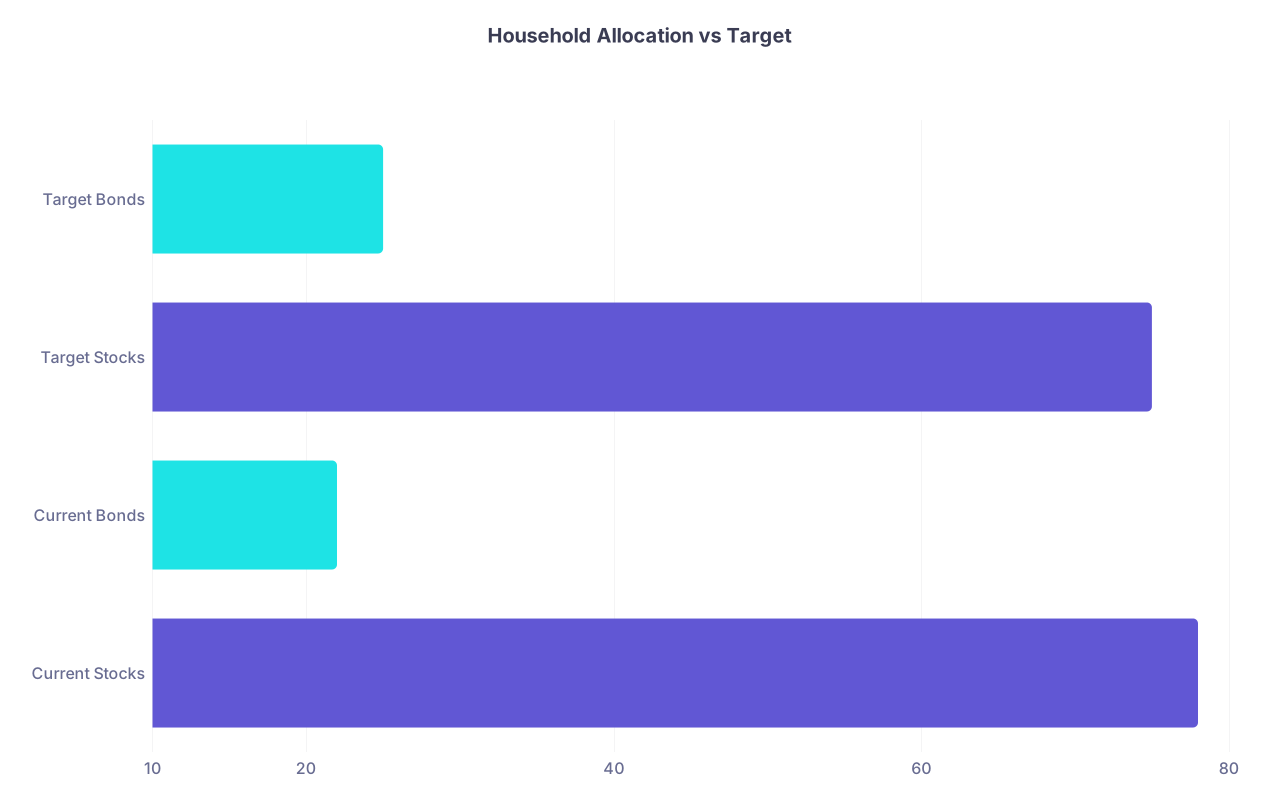
| Category | Value |
|---|---|
| Current Stocks | 78 |
| Current Bonds | 22 |
| Target Stocks | 75 |
| Target Bonds | 25 |
If it’s close, leave it. If it’s way off (say 85/15 vs 75/25), adjust new contributions or make a small trade. Done.
Step 6: Handle the Emotional Landmines Directly
A lot of physician couples are not actually arguing about investments. They’re arguing about:
- Scarcity mindset from training years
- Family‑of‑origin money scripts
- Fear of losing what they’ve finally built
- Guilt over debt or spending
If one of you:
- Freaks out every time the market drops
- Clings to cash
- Or chases risky stuff trying to “make up for lost time”
…you need to call that out as an emotional pattern, not an investment strategy.
Set ground rules like:
- “We will not make investment changes during a panic day. We’ll wait 48 hours and talk again.”
- “We will not move more than 10% of our total portfolio based on a single idea or tip.”
- “If either of us feels talked over or dismissed in a money conversation, we pause.”
I’ve watched couples torch years of progress because one person panicked in March 2020 and the other was too checked‑out or conflict‑avoidant to stop them. You have to protect each other from your worst money selves.
Step 7: If You Use an Advisor, Use One You Both Actually Chose
Common dual‑physician disaster:
- One partner has “a guy” from residency
- Other partner hates paying 1% AUM and sees expensive funds
- Advisor meetings turn into three‑way tension
If you’re going to pay someone, this is non‑negotiable:
- Both of you attend the initial meeting
- Both can ask blunt questions
- Both understand how the advisor is paid
And you should both agree on clear rules:
- We will not use proprietary products we don’t understand
- We will not pay >0.3–0.5% annually on all our assets unless there’s a very good reason
- We will not turn off our brains and outsource every decision
If one of you loves an advisor and the other deeply distrusts them, that advisor is a problem even if they’re technically competent. Distrust around money is corrosive.
You can also take a hybrid approach:
- Flat‑fee financial planner for setup and occasional check‑ins
- You implement the simple index strategy yourselves
That often fits dual‑physician couples well: expert input, but no one skimming off your growing account balances forever.
Step 8: Set a Standing Money Meeting and Script It
You will not “just talk about it when needed.” Too busy, too tired, too many fires.
Pick one recurring time:
- Monthly for 30–45 minutes, or
- Quarterly for 60–90 minutes
Treat it like a standing case conference for your financial life.
Here’s a simple script:
Quick emotional check:
- “Anything stressing you out financially right now?”
- 5 minutes max, each.
Status update:
- Savings rate this month/quarter
- Any big changes (job, income, benefits)
Portfolio check:
- Are contributions happening as planned?
- Any major deviations from target allocation?
Decisions:
- Is there anything we need to decide now (refi, new account, Roth vs traditional this year)?
Parking lot:
- Fun/complex topics (rental property ideas, side investments) get written down, not decided in the same meeting if they start a fight.
To keep it from feeling like torture, combine it with something you both like:
- Takeout and wine
- Saturday morning coffee
- Post‑call brunch
You want a routine that feels like, “We’re running our life like grownups,” not “We’re being punished for making money.”
A basic timeline helps:
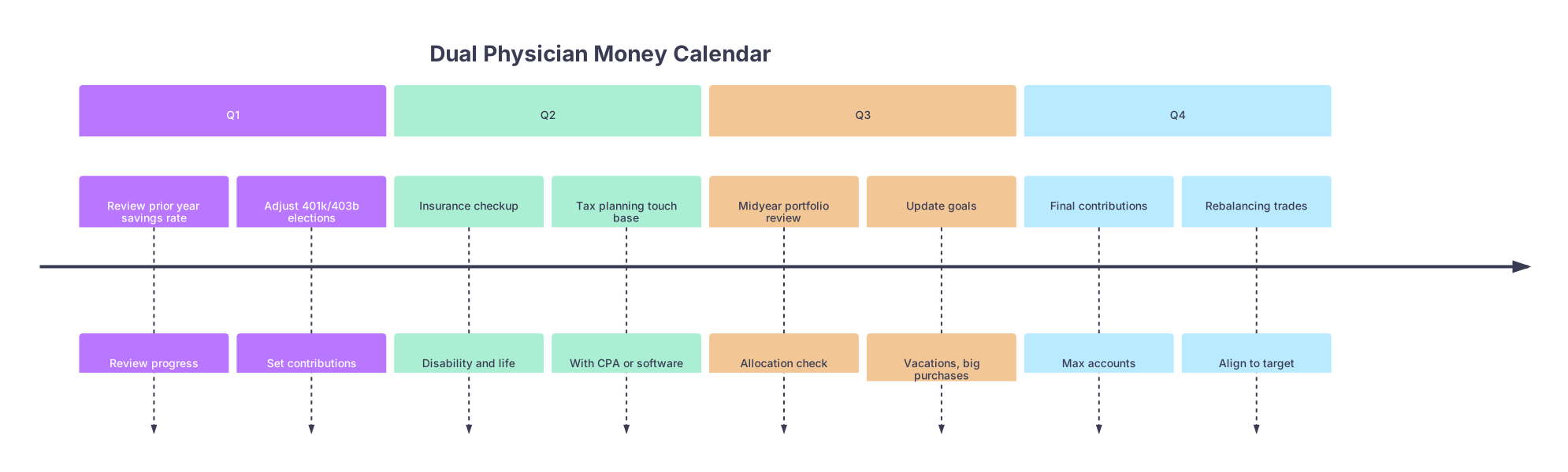
| Period | Event |
|---|---|
| Q1 - Review prior year savings rate | Review progress |
| Q1 - Adjust 401k/403b elections | Set contributions |
| Q2 - Insurance checkup | Disability and life |
| Q2 - Tax planning touch base | With CPA or software |
| Q3 - Midyear portfolio review | Allocation check |
| Q3 - Update goals | Vacations, big purchases |
| Q4 - Final contributions | Max accounts |
| Q4 - Rebalancing trades | Align to target |
Step 9: Decide How to Handle “Fun Money” and Side Bets
One more thing that keeps couples sane: an agreed‑upon sandbox.
Even if your main portfolio is boring index funds, one or both of you may want to:
- Buy individual stocks
- Play with crypto
- Invest in a friend’s startup
- Do a tiny real‑estate syndication deal
Instead of banning it outright (which just pushes it underground, financially and emotionally), cap it:
- “Up to 5% of our total invested assets can be in ‘experimental’ stuff, split however we agree.”
- “No single speculative investment >2% of our total net worth.”
- “We both have to understand the risk is 100% loss.”
You want rules that protect the core plan. The core plan is what sends future you to a beach or a mountain trail instead of more night shifts at 62.
Step 10: When You Still Disagree – Use the “Pilot Program” Rule
There will be issues where you just do not see eye‑to‑eye.
Common ones:
- How aggressively to pay off debt vs invest
- Whether to buy a rental property
- How much house to buy
- Whether to go all‑in on Roth or use pre‑tax
Instead of endless debate, run a time‑limited pilot.
Examples:
- “For the next 12 months, we’ll put an extra $5k/month toward loans. At the end, we’ll see how it feels and whether to keep that pace.”
- “We’ll seriously evaluate one rental property this year. If we don’t find a deal that meets clear written criteria, we drop the topic for at least 12 months.”
- “We’ll do 50% Roth, 50% pre‑tax this year, then revisit with our CPA.”
Pilot programs turn theoretical arguments into actual data and lived experience. They also give you both an exit ramp: you’re not agreeing “forever,” just “for a defined period.”
A Quick Sanity Check: Are You on Track?
Most dual‑physician couples underestimate how strong their position can be if they get coordinated early. A simple high‑savings, boring‑portfolio plan snowballs fast.
Example:
- Combined gross income: $500k
- Savings rate: 25% ($125k/year invested)
- Average annual return: 6–7% after inflation
- Timeline: 20 years
Ballpark projection:

| Category | Value |
|---|---|
| Year 1 | 125000 |
| Year 5 | 700000 |
| Year 10 | 1600000 |
| Year 15 | 2800000 |
| Year 20 | 4300000 |
You’re looking at multiple millions in real (inflation‑adjusted) dollars if you just don’t blow yourselves up with drama, complexity, or panic selling.
The enemy is not usually the market. It’s you two being out of sync.
Your Next Step Today
Do not try to build the perfect plan tonight. Just get on the same page.
Here’s the one concrete action to take:
Tonight or this weekend, schedule a 45‑minute “money team” meeting with just two agenda items:
- Agree that you’re operating as one financial unit (even with separate accounts).
- Decide on a household target savings rate (as % of gross income) and a rough stock/bond mix.
Write both down. In actual text. On paper or in a shared note.
Once those two are set, every other investment decision becomes easier. Open your calendar right now and put that meeting in. Without that conversation, you’re just two smart people with great incomes and a recurring fight.