
It’s 6:45 a.m. in the physician lounge. You just wrapped another brutal week of nights. One of the older partners walks in, still in scrubs, but lighter somehow. He pours coffee, chats for a few minutes, then drops it casually:
“Couple more months and I’m done. Calling it at 55.”
You do the mental math. That’s… soon. He doesn’t have a side business, he’s not married to a hedge fund manager, and you’ve never heard his name on a startup cap table. Yet he’s walking away while you’re still wondering if you can afford to drop a moonlighting shift.
Here’s the part people do not say in the lounge: the physicians who quietly retire by 55 are not financial wizards. They’re disciplined. They know how to weaponize one of the most boring tools in medicine: the 401(k) and its cousins.
Let me walk you through how it actually works behind the scenes, how attendings and senior partners structure this, and what they start doing in their late 30s/early 40s to make “55 and out” realistic instead of fantasy.
The Real Reason Some Docs Can Walk at 55 (And Others Can’t)
Most younger physicians think early retirement comes from:
- Owning the group or ASC
- Real estate syndications
- Some magical side hustle
That’s not what I see when we’re in closed-door partnership meetings.
The common denominator among the 55-year-olds who tap out and never come back? They have relentlessly maxed and optimized every tax-advantaged retirement bucket available, especially the 401(k)/403(b)/profit-sharing stack. For 15–20 years. Without blinking.
They don’t brag about it. They just do it, year after year.
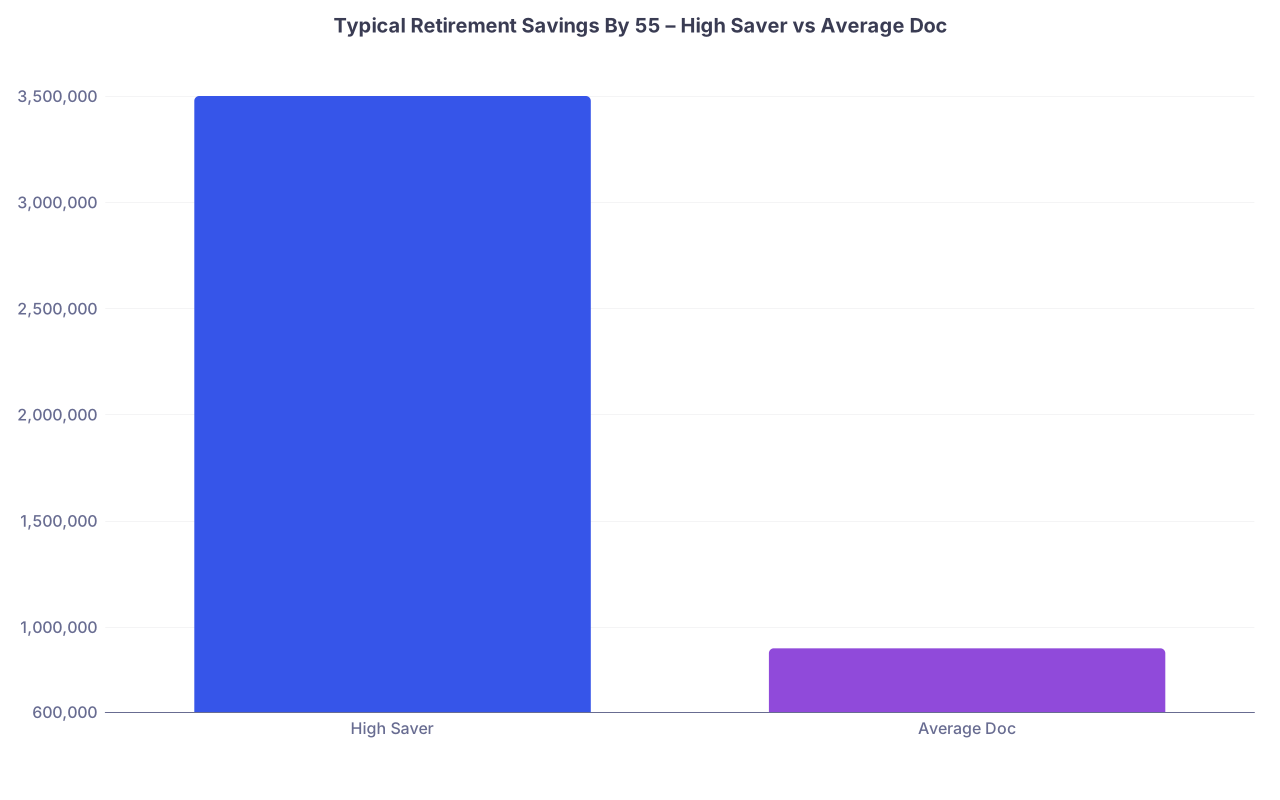
| Category | Value |
|---|---|
| High Saver | 3500000 |
| Average Doc | 900000 |
Here’s the quiet formula:
- Use the 401(k)/403(b)/solo-k as the spine of the plan
- Stack profit-sharing and cash balance when possible
- Keep investment choices boring but correctly aggressive
- Control spending enough that a 10–20 year compounding window can do its job
Everybody wants the complicated answer. The truth is more brutal: most physicians simply underfund their available retirement plans for too long and then discover in their late 40s that compounding doesn’t care about your income.
How the 401(k) Really Works for a High-Earning Physician
Forget the HR slide deck. Let’s talk about how attendings actually use these things.
There are three broad flavors you’ll run into:
- Big hospital W-2: 401(k) or 403(b), sometimes 457(b)
- Private group with a plan: 401(k) + profit-sharing, sometimes cash balance
- Independent / 1099: Solo 401(k) (and often a defined benefit plan)
The IRS doesn’t care that you’re a physician. The rules are the rules. But physicians sit in a sweet spot: high, stable income and a long runway. Which means you can pound those limits harder than most.
The Core: Employee + Employer Buckets
Every year, there are two numbers you need to know cold:
- Employee deferral limit (under 50 vs 50+ “catch-up”)
- Total plan limit (employee + employer contributions combined)
For 2025 (you can look up exact current year numbers, but the structure is what matters):
- Employee deferral: mid-$20k range if under 50, plus ~$7k catch-up at 50+
- Total 401(k) limit: around $69k if under 50, ~$76k if 50+
Here’s how senior physicians squeeze this.
| Situation | Employee Deferral | Employer/Profit-Sharing | Typical Total |
|---|---|---|---|
| Hospital W-2 only | Max deferral | 3–6% match | $30–40k |
| Private group partner | Max deferral | Aggressive profit-share | $60–76k |
| Solo 401(k) (1099) | Max deferral | Up to plan max via PS | $60–76k |
That partner retiring at 55? If they’ve been maxing $60–75k per year for 15–20 years with decent returns, you’re looking at low seven figures in just that bucket.
Roth vs Traditional: What the Richer Docs Actually Do
A lot of younger attendings fixate on Roth everything.
Here’s what senior physicians quietly do once their income is firmly high six figures:
- 401(k) deferrals: Usually pre-tax (Traditional), not Roth, in peak earning years
- Backdoor Roth IRA: Yes, regularly
- Mega backdoor Roth (if available): They use it aggressively
The logic is simple. When you’re in the top brackets, the immediate tax deduction on pre-tax 401(k) contributions is extremely valuable. That deduction accelerates how much you can put to work elsewhere (backdoor Roth, taxable brokerage). And if you’re planning to retire at 55, your effective tax rate in retirement is often lower than your peak attending rate anyway.
The Roth 401(k) obsession is mostly a resident/early attending phenomenon. The folks close to the exit are laser-focused on tax arbitrage: deduct at 37% now, maybe pay 15–24% in retirement withdrawals.
The Real Play: Stacking Plans and Reading Between the Lines
Here’s where most physicians miss the boat: they think “401(k)” and stop there.
The smart 55-and-out crowd is using multiple coordinated plans.
Hospital Doc Version: 401(k)/403(b) + 457(b) + Taxable
At big hospital systems, I’ve watched cardiologists walk away at 55 with this stack:
- Maxed 403(b)/401(k) for 20+ years
- Maxed governmental 457(b) (or carefully used non-governmental 457 with eyes open)
- Backdoor Roths for a decade or two
- Decent taxable brokerage account investing in broad index funds
The key move? They didn’t treat the 457(b) as optional. When they realized they could double their tax-advantaged savings, they did it every single year.
And no, they didn’t day-trade. They bought boring index funds and went back to work.
Private Group Version: 401(k) + Profit-Sharing + Cash Balance
This is where the real “silent wealth” sits.
You join a private anesthesia, ortho, GI, EM, derm, or radiology group. For the first few years, you’re focused on base pay and RVUs. What you don’t see yet is the older partners quietly designing the retirement plan to shovel huge pre-tax dollars out of the practice and into their future.
If the group is run intelligently, by your mid-career you’ll see:
- 401(k) with maximum employee deferral
- Profit-sharing contribution from the practice (often 10–20% of comp, up to the legal max)
- A cash balance / defined benefit plan on top for partners
These guys and women are not smarter than you. They’re just playing a different game.
Over time, this stacks like crazy:
- 401(k) + profit-sharing: Up to ~$69–76k/year
- Cash balance: Another $30–100k+/year, age-dependent
Now multiply. 15–20 years. Normal market returns. You end up with retirement plan values that surprise even them when they get their year-end statement at 52 and realize, “I actually don’t need to be here much longer.”
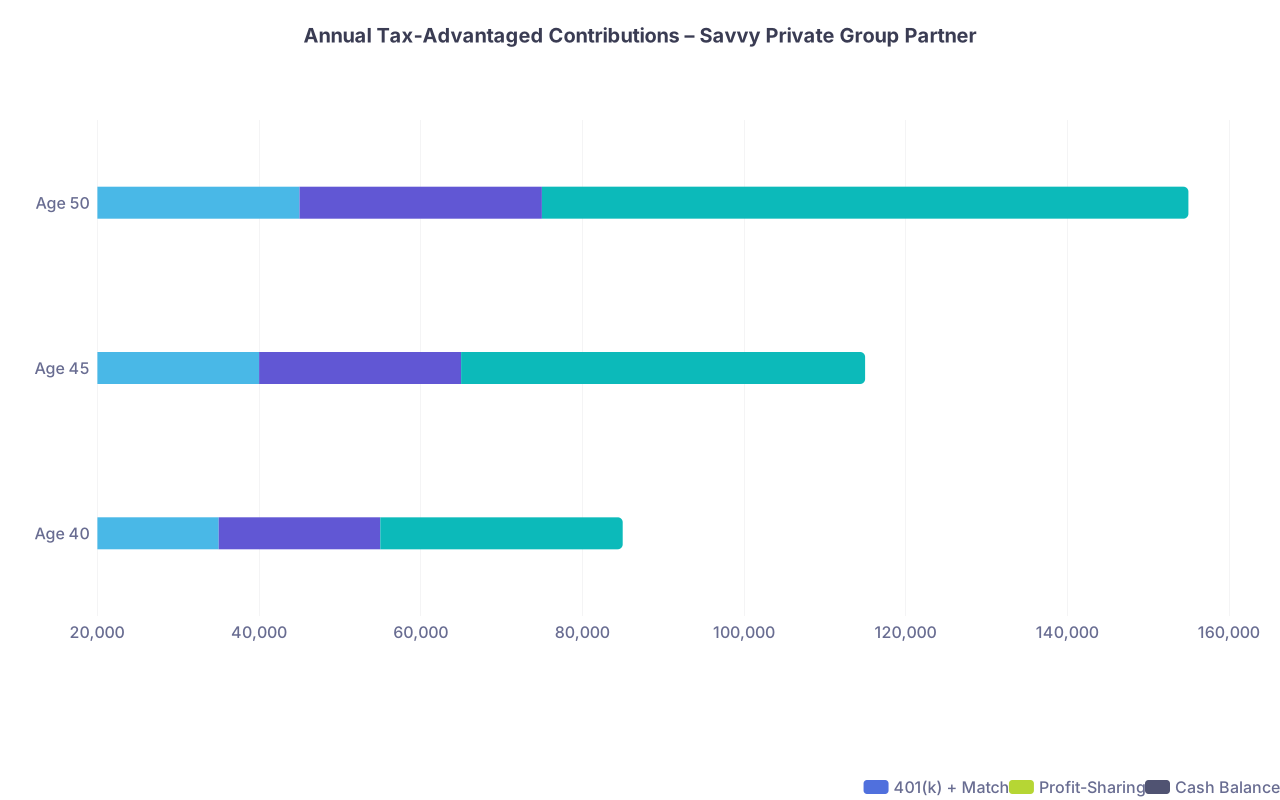
| Category | 401(k) + Match | Profit-Sharing | Cash Balance |
|---|---|---|---|
| Age 40 | 35000 | 20000 | 30000 |
| Age 45 | 40000 | 25000 | 50000 |
| Age 50 | 45000 | 30000 | 80000 |
If you’re not in these conversations, you don’t even realize this exists. But the senior folks do. They’ve been voting on plan design in those “partners only” meetings for years.
The 55 Problem: How They Actually Access the Money
Let’s address the technical elephant in the room: “But you can’t touch your 401(k) until 59½ without penalty!”
Wrong. And this is one of the biggest “quiet” tricks that savvy older physicians know, but almost no resident or early attending understands.
There are three main ways I see docs retiring at 55 use these accounts without getting smashed by penalties.
1. The Rule of 55 (W-2 / Group Plan)
If you separate from your employer in or after the year you turn 55, you can take distributions from that employer’s 401(k)/403(b) without the 10% early withdrawal penalty. Ordinary income tax still applies, but no penalty.
A few important realities from the field:
- You must keep the money in that employer’s plan to use this rule. If you roll the 401(k) to an IRA, you lose the Rule of 55 flexibility.
- This only applies to the plan of the employer you separated from at/after 55. Old plans from previous employers don’t get this treatment.
Senior physicians who know this often do a very calculated move: they leave a surgical chunk of money in their most recent employer plan specifically to bridge the 55–59½ window, while rolling older plans and IRAs elsewhere.
2. 72(t) Substantially Equal Periodic Payments (IRAs)
This is more of a “back-pocket” option, usually set up with a good planner or CPA.
You can set up a schedule of “substantially equal periodic payments” from an IRA before 59½, avoid the 10% penalty, but you’re locked into a rigid schedule for the longer of 5 years or until 59½. Miss it or change it, and the IRS hits you with retroactive penalties.
I’ve seen a few 53–55-year-old physicians do this when they’re burned out and done, but did not set up their employer plan situation cleanly. It’s a rescue option, not my favorite.
3. Don’t Need to Touch It Yet (Because of the “Bridge”)
This is the big one: the physicians truly set to walk away at 55 are not planning to live solely off their 401(k) from day one.
They’ve built a bridge:
- Taxable brokerage account that they’ve been funding for 10–15 years
- Backdoor Roths with 5-year-old contributions that can be withdrawn tax and penalty-free (contributions only, not earnings)
- Maybe rental income or some practice sale payout
So the 401(k) is the heavy artillery, but they delay firing it. They tap:
- Taxable and Roth contributions from 55–60
- Then start blending in 401(k)/IRA withdrawals later to manage their tax brackets
I’ve seen more than one 55-year-old doc with $3–5M in retirement accounts and $800k–$1.5M in taxable funds, and they’re barely touching the qualified money early on.
How Much They Actually Need To Walk at 55
Let’s strip away the online noise and talk about what I actually see in the exit interviews and retirement parties.
Most of the physicians bowing out at 55 are not living like social media influencers. They’re upper-middle-class comfortable:
- Solid house, usually paid off or close
- No med school debt, no car loans
- 2–3 trips a year, nice but not Four Seasons every time
- Some help for kids’ college, but not writing checks to cover everything for three kids at Ivy League sticker price
They tend to aim for:
- Retirement spending: $160–250k/year after tax (some more, some less)
Rough math using a 3.5–4% withdrawal rate:
- $200k/year x 25 = $5M total portfolio target
- Many hit $3–4M and decide, “I can work part-time 2–3 more years and be fine,” or cut lifestyle modestly
Now, where does the 401(k) fit?
For the conservative 55-and-out group, I typically see:
- 60–80% of that $3–5M sitting in 401(k)/403(b)/IRA/cash balance
- 20–40% in taxable + Roth
That’s the real picture behind the smiling photos on their “last shift” Instagram post. It’s not one magical investment. It’s relentless stacking and compounding of boring, tax-advantaged accounts.
The Behind-the-Scenes Behavioral Stuff No One Talks About
You want the truth? The math is easy. The behavior is where most docs fail.
Here’s what the 55-year-olds who successfully walk away actually did differently:
They kept lifestyle creep on a leash.
The classic pattern: Income jumps from $65k as a PGY-3 to $350–600k as an attending. The ones who retire at 55 didn’t immediately act like they made $600k. They lived like they made $250–300k and banked the spread.
They treated maxing retirement plans as mandatory, not optional.
The high savers didn’t “see what they could do” at the end of the year. They told payroll and the practice administrator, “Max my 401(k) and any profit-sharing/cash balance I’m eligible for. I’ll adapt.” That single decision compounds into millions.
They didn’t try to outsmart the market.
This is the quiet one. The docs who get burned are the ones day-trading options between cases or doing concentrated bets in biotech. The 55-and-out folks mostly held broad index funds, maybe a tilt here or there, and they didn’t bail every time there was a correction.
They actually read the plan documents.
I’ve sat in rooms where the benefits person explains a mega backdoor Roth option, and most of the room checks their phone. The couple of people paying attention? They’re the ones later quietly dropping $20–30k/year more into Roth space while everyone else never bothers.

A Concrete Example: The 40-Year-Old Hospitalist Who Actually Retires at 55
Let me sketch this out like I’ve seen it.
- Age 40: Hospitalist making $320k W-2, no ownership. Net worth around $300k.
- Retirement options: 403(b) with 4% match, governmental 457(b), backdoor Roth available.
She decides she wants the option to be done at 55. Not a guarantee, but the option.
From 40 to 55 she does:
- Max 403(b) deferral every year (pre-tax)
- Capture full match (automatic)
- Max governmental 457(b) every year (pre-tax)
- Max backdoor Roth IRA each year
- Invests additional $20–30k/year into a taxable brokerage in index funds
She doesn’t buy a $2M house. She buys $900k. She keeps one car slightly longer than she wants to.
Fast forward 15 years with average market returns. Rough back-of-the-envelope numbers (assuming 6–7% real returns, no exotic math):
- 403(b) + match: easily >$1.2–1.5M
- 457(b): ~$800k–1.1M
- Roth IRA: ~$200–300k
- Taxable: ~$700k–1M
Total: $2.9–3.9M
Plus whatever she had already amassed before 40.
Now imagine she works to 57 instead of 55, or she cuts spending expectations by $20k/year. She’s there.
Did she need a private equity deal? No. She needed boring, consistent 401(k)/403(b)/457 funding with time.
If You’re 30–45: How to Set This Up Now
Here’s the part that actually matters for you.
Forget trying to copy the 55-year-old’s end state. You need to copy the habits they started 10–20 years earlier.
Step 1: Get Totally Clear on Your Plan Options
Not “skim HR’s brochure.” Actually know:
- What type of retirement plan do you have? 401(k), 403(b), both, plus 457(b)?
- What’s the employer match and vesting schedule?
- Is there a profit-sharing or cash balance plan you’ll qualify for as partner? When?
- Is mega backdoor Roth allowed in your 401(k)?
If you’re in private practice, get ahold of the plan documents. If you’re in a hospital, schedule time with the benefits person and go in with questions.

Step 2: Decide That Maxing Is Default
If you want the 55 option, partial contributions are a fantasy. The high savers treat the IRS limits as targets, not suggestions.
- Max your 401(k)/403(b) employee deferral
- If you have a governmental 457(b), strongly consider maxing that too once your emergency fund and minimum debts are under control
- Backdoor Roth every year unless there’s a clear reason not to
You’re going to feel it the first 1–2 years. Then you adapt, just like everyone else.
Step 3: Align Your Risk With Your Time Horizon
This part is usually messed up.
I’ve seen 42-year-old physicians with 30% of their 401(k) in a money market or stable value fund “because the market feels high.” Those same people then wonder, at 55, why they don’t have enough.
A 40-year-old aiming to retire at 55 still has a 40+ year investing horizon. In practice, the 55-and-out types sit:
- Heavy in equity index funds in their 40s
- Gradually glide to more bonds in their late 50s and 60s
They don’t dump everything into bonds the minute they decide they “might retire early.” That’s how you strangle compounding.
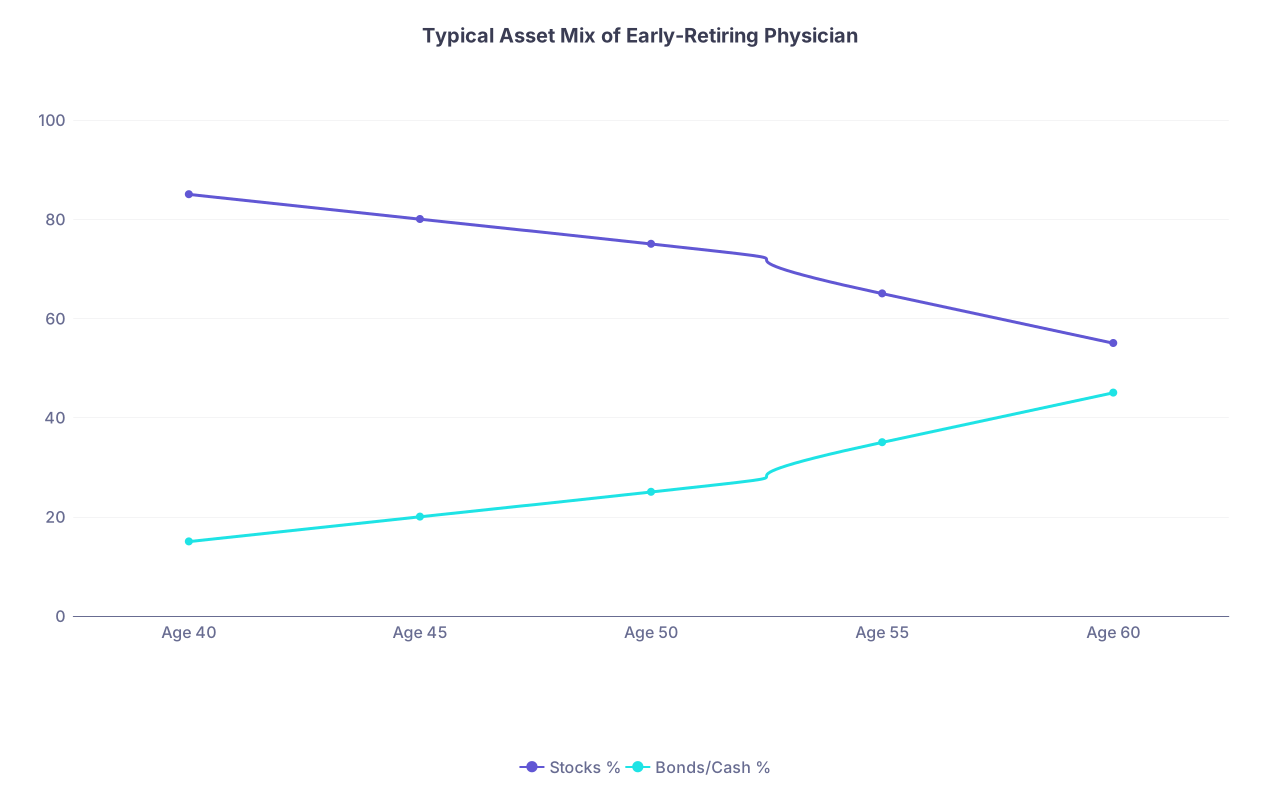
| Category | Stocks % | Bonds/Cash % |
|---|---|---|
| Age 40 | 85 | 15 |
| Age 45 | 80 | 20 |
| Age 50 | 75 | 25 |
| Age 55 | 65 | 35 |
| Age 60 | 55 | 45 |
Step 4: Build the Non-401(k) Bridge
If you really want to be able to walk at 55, you can’t just have a fat 401(k). You need money that’s easy to tap in your 50s.
That means:
- Taxable brokerage: automatic monthly investments just like your 401(k)
- Backdoor Roths: stacking contributions that will be your tax-free “release valve” later
The folks who end up trapped at 62 are the ones with huge pre-tax 401(k)s and no money outside of retirement accounts. Everything they touch triggers big taxable events, so they delay leaving.
The folks who walk at 55 without flinching? They’ve got multiple buckets.

The Legal/Technical Landmines That Actually Matter
Since you asked for financial and legal aspects, here are the things that actually get discussed in real physician planning meetings, not in Instagram reels.
- Non-governmental 457(b) plans: These are technically assets of the employer, not you. In a hospital bankruptcy, you’re a creditor. Some physicians still use them when the institution is rock-solid; others refuse. The senior folks know this and choose consciously.
- ERISA protection: Employer 401(k)/403(b) plans are generally very well protected from creditors and lawsuits. IRAs have variable protection by state. Malpractice attorneys don’t fantasize about your 401(k); they fantasize about your house and taxable accounts.
- Early retirement health insurance: This is a big one. If you retire at 55, how are you covering the 10 years until Medicare? COBRA, ACA marketplace, or a working spouse’s plan are usual paths. The 55-and-out physicians factored that cost in. They didn’t pretend it would work itself out.
- Required minimum distributions (RMDs): Starting in your early/mid-70s now. That’s future-you’s problem, but the really thoughtful 55-year-olds already think about slowly converting pre-tax money to Roth during low-income years in their 50s/60s to manage later tax bombs.
What Happens the Year They Actually Leave
Let me give you a snapshot of what I’ve seen with multiple 55-ish physicians.
The last year:
- They crank contributions to the max one more time
- They often drop to 0.8 or 0.5 FTE for 6–12 months as a test runway
- They meet with a financial planner and CPA, not to start planning, but to confirm what they already know: “Yes, the numbers work”
Then they give their group or hospital 3–6 months’ notice, tie up loose ends, and walk.
And the rest of the group is shocked. Because from the outside they didn’t look richer, or smarter, or more “into finance” than anyone else. They just quietly used the tools correctly for long enough.