
It is 9:30 p.m. You just got home from a call shift. You are still in your white coat, microwaving leftover takeout, staring at a loan servicer email that says your balance is higher than last year even though you have been paying.
Retirement account? You are thinking more about “rent account” and “can I afford daycare” than about investing.
Here is the hard question that keeps circling:
How do you invest for your future when your student loans already feel like a mortgage strapped to your back?
You are a doctor. Or about to be one. You do not get to opt out of dealing with this. The good news: the strategy is fixable and repeatable. You do not have to choose between “I only pay loans” and “I only invest.” You can and should do both—if you sequence it correctly.
I am going to give you a step‑by‑step investing plan specifically for doctors in repayment, with the loan piece built in. You will know:
- Exactly what to do first, second, third
- How much to invest at each stage
- When it actually makes sense to prioritize investing over extra loan payments
- How PSLF and private refinancing change the plan
No vague “pay yourself first” nonsense. Concrete numbers and thresholds.
Step 1 – Get Clear On Your Loan Reality (No More Hand‑Waving)
Before you talk about investing, you need to know what game you are playing with your loans. There are only a few basic loan “profiles” for physicians.
First, classify yourself.
| Profile | Typical Situation | Best Default Strategy |
|---|---|---|
| PSLF-bound | Academic/VA/nonprofit, ≥10 years ahead | Maximize forgiveness, invest early |
| IDR long-term (no PSLF) | Mixed employers, unsure PSLF-eligibility | Damage control + invest |
| Private refinanced | Attending income, stable job | Aggressive payoff + targeted investing |
| High-rate federal, no plan | Not yet refinanced/IDR optimized | Fix this first, then invest |
You need to know four things:
Loan type
- Federal Direct (Subsidized, Unsubsidized, Grad PLUS, Consolidated)
- Perkins (older but still out there)
- Private loans (originated or refinanced through SoFi, Laurel Road, etc.)
Interest rate for each loan
- Write it down, loan by loan.
- If it is federal and you are in Income‑Driven Repayment (IDR), remember: the “headline” rate is not always your effective rate because of unpaid interest subsidies under SAVE or REPAYE.
Your repayment path
- Public Service Loan Forgiveness (PSLF) – 10 years, 120 qualifying payments at a nonprofit/VA/government employer
- IDR forgiveness after 20–25 years (SAVE, PAYE, IBR)
- Private refinance with payoff in 5–10 years
- Or “no plan, just paying what they tell me” – which is not acceptable after you read this
Your timeline to attending income
- In training for 1–7 more years?
- Or already an attending with a stable contract?
Once you have that, you can choose which investing track you belong in:
- Track A – PSLF doctors (nonprofit/academic/VA, planning ≥10 years): Goal is to minimize loan cost and maximize investments early.
- Track B – Non‑PSLF federal (IDR long game): You will likely carry loans for 15–25 years. The answer is balanced investing plus tax‑bomb planning.
- Track C – Private/refinance payoff: Your loans are a high‑interest bond you already bought. Your investing plan must respect that.
Hold that track in your mind. Everything else hangs on it.
Step 2 – Lock In a Repayment Strategy Before You Talk About Investing
You are not allowed to think about mutual funds until you have a deliberate loan repayment choice.
A. If you are PSLF‑eligible (and likely to stay in nonprofit)
You want:
- Consolidate to Direct loans (if not already) to get them all PSLF‑eligible.
- Enroll in SAVE (or another IDR if strategically better) with the lowest monthly payment that still counts.
- Certify employment annually.
- Absolutely no extra principal payments. Extra payments just burn money that would otherwise be forgiven.
PSLF plus IDR lowers your effective interest rate dramatically because a huge chunk of that “interest” gets forgiven at year 10. So for a PSLF doctor, loans behave like a low‑yield, slowly disappearing obligation. That is why investing early makes sense.
B. If you are federal but not sure about PSLF
You still:
- Put loans on SAVE or another IDR to keep cash flow flexible.
- Avoid consolidation that might wipe out credit for past qualifying payments unless you understand the temporary IDR adjustment rules.
- Keep the PSLF door open if your career shifts toward nonprofit.
Your plan is optionality first, optimization later. While you are unsure, you do not throw huge extra payments at the loans.
C. If you have or should have refinanced privately
This is usually you if:
- You are an attending with a stable job in private practice or a for‑profit group.
- No realistic PSLF path.
- Federal rates are 6–8% and private refinance offers you 3–5%.
Refinance in chunks if you are nervous, but once refinanced your loan is a guaranteed after‑tax “negative bond” at 3–5%. Extra payments that remove a 5% guaranteed cost are a strong competitor to investing.
We will handle this in the priority list.
Step 3 – Build the “Emergency + Minimum Investing” Backbone
You do not skip investing until your loans are gone. That is how you end up 42 with no retirement savings and a different kind of panic.
You start with a backbone that every doctor in repayment should build:
1. Mini emergency fund
Residents / fellows:
- Aim for $3,000–$5,000 in a high‑yield savings account.
- Yes, that is less than the usual “3–6 months of expenses.” You do not have the margin yet. This is triage.
Attendings:
- Get to 1–3 months of bare‑bones expenses.
- More than that is optional and often suboptimal if you have high‑interest loans.
This is not a flex fund. It is “car repair, flight for family emergency, deductible on an ER visit” money.
2. Capture the highest‑ROI free money first
Before you even think about extra loan payments:
401(k)/403(b) match
- If your employer matches, for example, 3% of salary, you contribute at least that 3%.
- Match is a 100% instant return. No loan payoff beats that.
HSA (if you have a High Deductible Health Plan)
- HSA = triple tax advantage. Pre‑tax in, tax‑free growth, tax‑free out for qualified medical costs.
- If you can afford it, aim for at least a partial HSA contribution, then let it ride as a “stealth IRA.”
Backdoor Roth IRA (usually as an attending)
- Once your income crosses the Roth IRA limit, you can still do backdoor Roth.
- This may be lower priority than loan payoff depending on your rate, but it is a key long‑term wealth lever.
At this stage, on a resident salary, your whole investing plan might be:
- $150/month into a 403(b) to get the match
- $50/month into an IRA
- Everything else to bills, minimum loan payment, and small emergency fund
Not exciting. But it is a foundation.
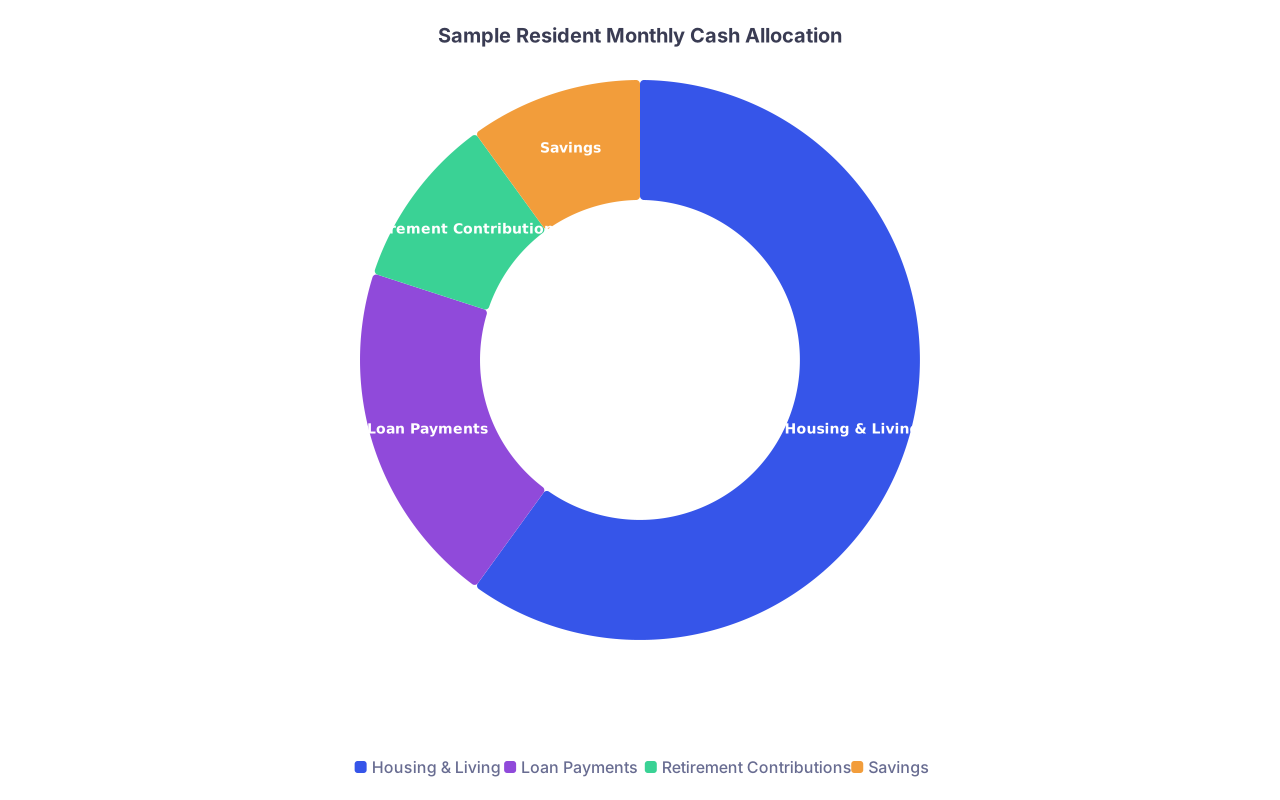
| Category | Value |
|---|---|
| Housing & Living | 60 |
| Loan Payments | 20 |
| Retirement Contributions | 10 |
| Savings | 10 |
Step 4 – Use a Clear Priority Order: When to Invest vs Pay Loans
This is the heart of it. Once your basics are set, how do you allocate extra dollars—above required payments and matches—between loans and investing?
Here is the priority stack I use with physicians.
Priority 1 – Required loan payments + minimum lifestyle
Non‑negotiable. You pay:
- Required IDR or refinanced payment
- Rent/mortgage, food, transportation, insurance, childcare, minimum utilities
If you are not cash‑flow positive after this, you do not have an investing problem. You have an income/expense mismatch problem. Different article.
Priority 2 – Employer retirement match
Already covered. You contribute to capture the full match. This is true even if your loan rate is high.
Priority 3 – High‑interest “toxic” debt (not usually your student loans)
If you have credit cards at 15–25%, these jump the line.
- Attack them aggressively before plowing money into extra student loan payments or additional investing.
- Use a simple avalanche: highest interest rate first.
Priority 4 – Emergency fund to minimum target
Top this to your target ($3–5k for trainees, 1–3 months for attendings).
After that, extra safe cash is usually less attractive than loan paydown or investing.
Priority 5 – Decide your line between investing and loan payoff
This is where it gets nuanced. You compare:
- Guaranteed after‑tax “return” from loan payoff vs.
- Expected long‑term after‑tax return from investing
Broad rules of thumb that I stand by for physicians:
If effective loan rate > 7–8%
- Extra payments take priority over most additional investing. That is a high guaranteed drag.
- Once you secure the employer match and basic emergency fund, throw serious money at these loans.
If effective loan rate 4–7%
- This is the gray zone. You likely split extra dollars between:
- Extra payments (especially as you get closer to payoff)
- More aggressive investing (Roth IRA, more 401(k)/403(b), taxable brokerage)
- This is the gray zone. You likely split extra dollars between:
If effective loan rate < 4%
- Strong tilt toward investing, especially if you are young (20s/30s).
- Reason: long‑term stock market returns, even adjusted for risk, beat 3–4% with a wide margin over 30 years.
Here is the key nuance:
- PSLF doctors: Your “effective rate” is much lower than the stated federal rate because a large part will be forgiven. You usually behave like you have loans at ~0–3%. That means heavier investing, minimal extra payments.
- Refinanced attendings at 3–4%: Very reasonable to prioritize maxing tax‑advantaged accounts and only making scheduled payments.
| Situation | Effective Loan Rate | Default Extra $ Use |
|---|---|---|
| PSLF path in IDR | Very low | Invest, no extra payments |
| Federal, no PSLF, 7–8% cost | High | Extra loan payoff |
| Refinanced at 4–5% | Moderate | Split investing vs payoff |
| Refinanced at 3% | Low | Mostly invest, normal payments |
Step 5 – Concrete Investing Plan By Stage (Resident vs Attending)
Let us translate this into actual steps and numbers.
A. Resident / Fellow Investing Plan While in Repayment
Assumptions:
- $65k resident salary
- $250k federal loans at 6–7%
- Plan: PSLF at a nonprofit hospital using SAVE
- Minimal other debt
Step 1: IDR + PSLF
- Enroll in SAVE, certify employment.
- Payment is low, maybe $200/month depending on AGI and marital status.
- Your principal may not move much. That is fine. The goal is payment count, not principal reduction.
Step 2: Starter emergency fund
- $100/month into high‑yield savings until you hit $3,000–$5,000.
Step 3: Retirement match
If your hospital offers a match (many do not for trainees):
- Contribute enough to get the full match.
- Even 2–4% of income makes a difference.
Step 4: Roth IRA (if possible)
Most residents are under the direct Roth income limit:
- Auto‑transfer $100–$250/month into a Roth IRA.
- Invest in a low‑cost stock index fund (e.g., Vanguard Total Stock Market Index, Fidelity Zero Total Market).
If your budget screams when you see these numbers, cut them back. But do not cut them to zero.
Step 5: No extra student loan payments
You are PSLF‑bound. Extra payments are lighting dollars on fire that you will never get back. Use that money for:
- Roth IRA
- Small taxable brokerage account if you can swing it
- HSA if available
That is your resident playbook. Boring. Effective.
B. Attending Physician Investing Plan With PSLF
Assumptions:
- $260k attending salary at a nonprofit hospital
- Same $250k federal loans in SAVE, 4 years of PSLF credit already from residency/fellowship
- Plan to stay in nonprofit for at least 6 more years
Step 1: Keep IDR payments low and legit
- File taxes in a way that optimizes your IDR payment (for many, married filing separately is worth modeling if your spouse has income).
- Re‑certify IDR annually and employment annually.
- Pay only what is required.
Step 2: Maximize tax‑advantaged investing
Your savings engine as an attending must move:
401(k)/403(b)
- Target: Max the employee contribution (for 2025, check current limits; as of 2023 it was $22,500, expect similar or slightly higher).
- Use low‑cost index funds (e.g., U.S. total market, international index, bond index).
Backdoor Roth IRA (for you, and spouse if eligible)
- Put in the annual limit each year through the backdoor process.
- Invest aggressively in stocks if you are comfortable with volatility.
HSA (if eligible)
- Max it. Treat it as a long-term investment, not a checking account.
Only after you are on track with these do you even consider sending extra dollars to loans. You are going to have massive forgiveness at year 10. Feed the accounts that you get to keep.
C. Attending Physician Investing Plan Without PSLF (Refinanced)
Assumptions:
- $300k salary in private practice
- $300k loans refinanced at 4.25% over 10 years
- No PSLF
This is the classic “I make good money but I feel broke” profile.
Step 1: Set a realistic payoff horizon
You have two options:
- Normal 10‑year payoff with 4.25% payments and balanced investing
- Aggressive 5–7 year payoff with higher monthly payments
Let us say the standard 10‑year payment is ~$3,075/month (ballpark). An aggressive 7‑year payoff might be closer to $4,100–4,500/month.
Step 2: Minimum backbone
You still do:
- 3 months expenses in emergency fund
- 401(k)/403(b) match
- At least some HSA or Roth IRA if you can
Step 3: Decide your split
My typical recommendation for this profile:
Max tax‑advantaged accounts first, unless your rate is quite high
- 401(k)/403(b) up to the limit
- Backdoor Roth
- HSA
Then aim to be debt free in 10 years or less from graduation
- If you can handle a 7–8 year payoff while still maxing retirement, do it.
- If that chokes your lifestyle, commit to the 10‑year payoff and invest aggressively alongside.
In practice, you might:
- Put $2,000–$3,000/month into investments (retirement + maybe taxable)
- Put $3,000–$4,000/month into loans
If you keep lifestyle inflation moderate, those numbers are entirely achievable on a $300k salary.
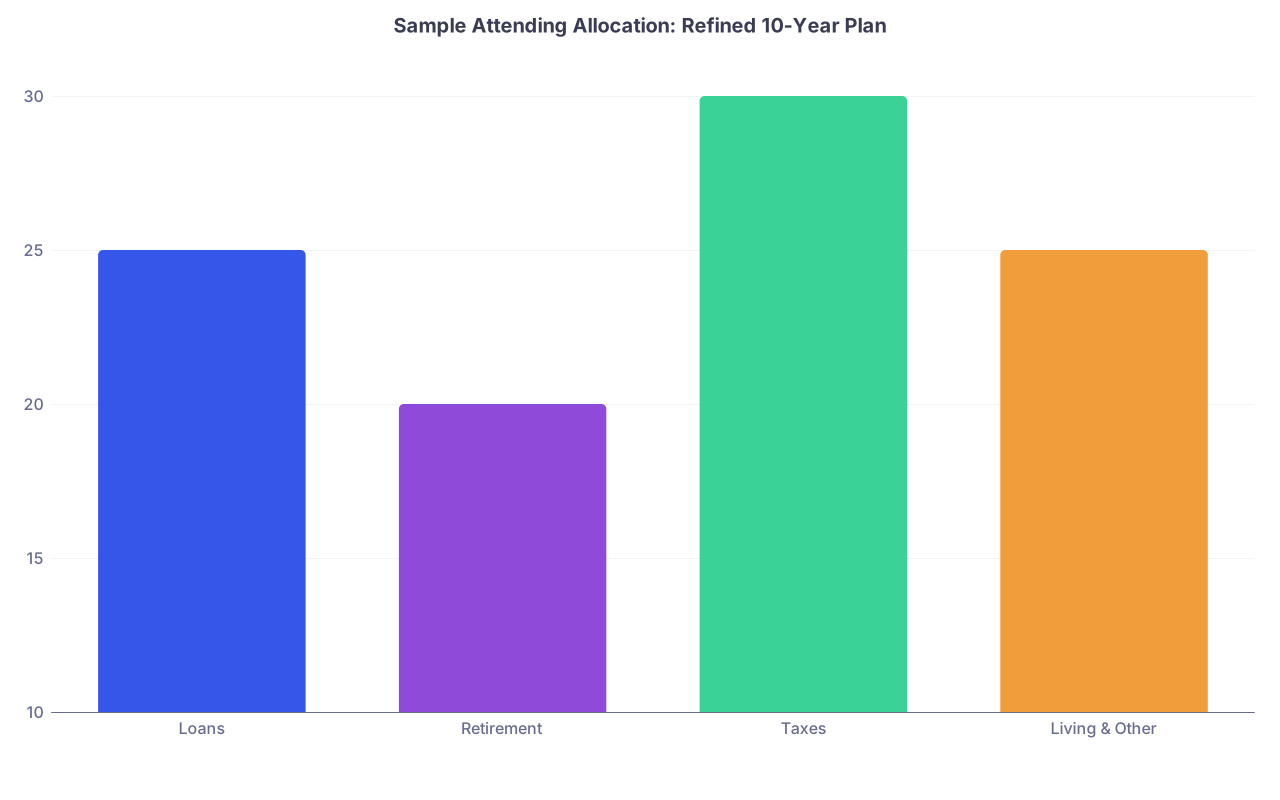
| Category | Value |
|---|---|
| Loans | 25 |
| Retirement | 20 |
| Taxes | 30 |
| Living & Other | 25 |
Step 6 – Simple, Low‑Maintenance Investment Choices
You do not have time for fancy. You need “set it and ignore it while you work nights.”
1. Use broad, low‑cost index funds
In each account (401k/403b, Roth IRA, taxable), a simple allocation:
- 80–100% stocks if you are in training or early attending years and can tolerate volatility
- 60–80% U.S. total stock market
- 20–40% international stock index
- Add bonds (10–30%) as you approach your 40s or if you sleep badly during downturns
Or even simpler:
- A single target‑date index fund in each account that roughly matches your expected retirement age (e.g., “Target Retirement 2060”).
2. Automate contributions
- Set up auto‑deduct from payroll to retirement accounts.
- Monthly automatic transfer to Roth IRA or taxable brokerage.
You should spend more time reading consult notes than logging into your brokerage.
3. Keep taxable investing flexible
Once retirement accounts are getting solid contributions, open a taxable brokerage account for:
- Extra investing
- Future house down payment
- Early financial independence
Invest the same way: broad index funds, automated buys.
Step 7 – Common Mistakes That Wreck This Plan
I have seen the same errors repeatedly.
Waiting to invest “until the loans are gone”
- If you finish at 35 and your plan is “I will start investing at 45 when the loans are paid,” you have lost a decade of compounding.
Massive lifestyle inflation on attending income
- New Tesla, new house, private school immediately. Then “I cannot afford to max my 401(k).” That is not a math problem. That is a choice.
Being PSLF‑eligible and still throwing extra thousands at principal
- Academic physician, 7 years into PSLF, paying $2,000 extra per month “because the balance makes me anxious.” I have literally seen people burn six figures this way.
Ignoring tax planning with IDR
- Filing status, spousal loans, and side‑gig income all affect your IDR and PSLF math. Have a CPA who actually understands this.
Chasing hot investments before paying double‑digit debt
- Crypto and options trading while holding 7–8% graduate PLUS loans is financial malpractice.
Step 8 – A Simple Checklist You Can Implement This Month
Here is your “do this now” list you can walk through over the next 30 days.
Inventory your loans
- Types, balances, interest rates, repayment plan, PSLF status.
Decide your track
- PSLF | non‑PSLF IDR | refinance/payoff.
Fix repayment
- If PSLF-eligible: consolidate if needed, enroll in SAVE/IDR, submit PSLF form.
- If not PSLF: ensure best IDR or refi at best available rate.
Set emergency fund target and start auto‑savings
- $100–$300/month until you hit your number.
Enroll/adjust retirement contributions to capture full employer match
Open and fund a Roth IRA (or set up backdoor Roth as attending)
- Even $100/month beats zero.
Choose default investments
- Target‑date fund or three‑fund portfolio in each account.
Run your “extra dollar” decision
- Calculate effective loan rate.
- If >7–8%: prioritize extra loan paydown after match/emergency.
- If 4–7%: split.
- If <4% or PSLF: tilt heavily toward investing.
Automate everything
- Payroll deduction for retirement
- Auto‑drafts for loans
- Auto‑transfer for Roth/taxable investing
Put a 1‑hour calendar block every 6 months to review
- You do not need to babysit this monthly. Twice a year is fine.
FAQ (Exactly 4 Questions)
1. Should I ever pause investing completely to pay off loans faster?
Yes, but only in specific conditions. If you are:
- Not PSLF‑bound
- Carrying loans effectively above ~7–8%
- Already have a small emergency fund and no match you are leaving on the table
Then a 1–3 year sprint with near‑total focus on loan payoff can be justified. Especially if the psychological relief will help you stay disciplined with investing afterward. But you still want at least minimal retirement contributions if your employer is offering free match money.
2. How do I factor in a spouse’s loans and income?
Spousal income and loans change two big things:
- Your IDR payment (if you file jointly, your spouse’s income is included)
- Your household savings potential
You need to:
- Run side‑by‑side tax projections for married filing jointly vs separately, including the impact on IDR payments and PSLF.
- Look at combined debt‑to‑income when deciding whether to refinance or pursue IDR/forgiveness. Sometimes one spouse is PSLF‑bound and the other is not; you handle them separately.
This is complex enough that I recommend at least one session with a CPA or planner who actually knows physician loan strategy.
3. I am a new attending and feel behind. How much should I aim to save and invest?
If you are less than 5 years out of training, a solid target is:
- 20% of gross income going to wealth building (retirement accounts + taxable investments + extra principal on high‑interest debt).
- If you are starting from zero savings and big loans, you might start at 10–15% and ramp to 20–25% over 2–3 years as you control lifestyle creep.
If you hit a true 20%+ for most of your career, you will be fine, even with six‑figure loans.
4. What if markets crash right after I start investing while I still have loans?
Then you are doing it right. Seriously.
When markets drop early in your investing life:
- You are buying more shares at lower prices with each contribution.
- Your loan payoff “return” is still the same fixed number.
- Over decades, starting to invest during a bear market often improves long‑term results.
The only mistake is letting a downturn scare you into stopping contributions. Keep buying on schedule. Your loans still get their scheduled payment. Time and discipline do the rest.
Key Takeaways
- Get your loan strategy locked in first (PSLF vs IDR vs refinance), then layer your investing plan on top.
- Always grab free money and basic safety: employer match + small emergency fund come before extra payments.
- Use your effective loan rate to decide when to invest heavily versus pay down aggressively, and stick to a simple, automated investment plan you can ignore on call nights.