
Most physicians are using their HSA completely wrong.
They treat it like a glorified checking account for copays. That is a mistake. For a high‑income doctor, a properly managed Health Savings Account is one of the most powerful investment vehicles you have—often better than your 401(k), and arguably the best “stealth IRA” in the entire tax code.
Let me break this down specifically, with a focus on how physicians can exploit the triple‑tax advantage, structure investments, avoid the usual traps, and coordinate all this with malpractice, estate, and practice‑owner issues.
1. The Triple‑Tax‑Free Structure: Why HSAs Are Unfairly Good
An HSA is not just a savings account. It is a tax shell.
You get three separate tax benefits:
- Contributions are tax‑deductible (or pre‑tax via payroll)
- Growth is tax‑deferred
- Withdrawals are tax‑free if used for qualified medical expenses
That combination—deductible in, tax‑free out—is better than a traditional IRA (taxable out) and better than a Roth IRA (after‑tax in). It is both.
For a physician in a high bracket, this is not a rounding error. It is a material arbitrage.
Let’s put some real numbers on this.
Assume:
- Combined marginal tax rate: 37% federal + 6% state ≈ 43%
- Annual family HSA contribution limit (2025 ballpark, adjust when IRS updates): about $8,300
- Investment return: 7% per year, long term
- Time horizon: 25 years
If you invest the full HSA limit every year and never spend a dollar from it:
- Pre‑tax dollars going in: $8,300 per year
- Tax savings each year at 43%: ~$3,569
- After 25 years at 7%, the account grows to roughly $540,000 (order of magnitude)
All of that $540,000 is tax‑free if ultimately used for qualified medical expenses. For a physician household, hitting several hundred thousand dollars of lifetime medical costs is not remotely far‑fetched: premiums, dental, vision, long‑term care, Medicare premiums, etc.
Compare that to a plain taxable brokerage account:
- Same $8,300/year after tax is only $4,731 (because you lose 43% to taxes first)
- Invested at 7% for 25 years → about $308,000
- Then you still owe taxes on dividends and capital gains along the way
That is the spread you are giving up by not using an HSA as an investment vehicle.
To make this really clear:
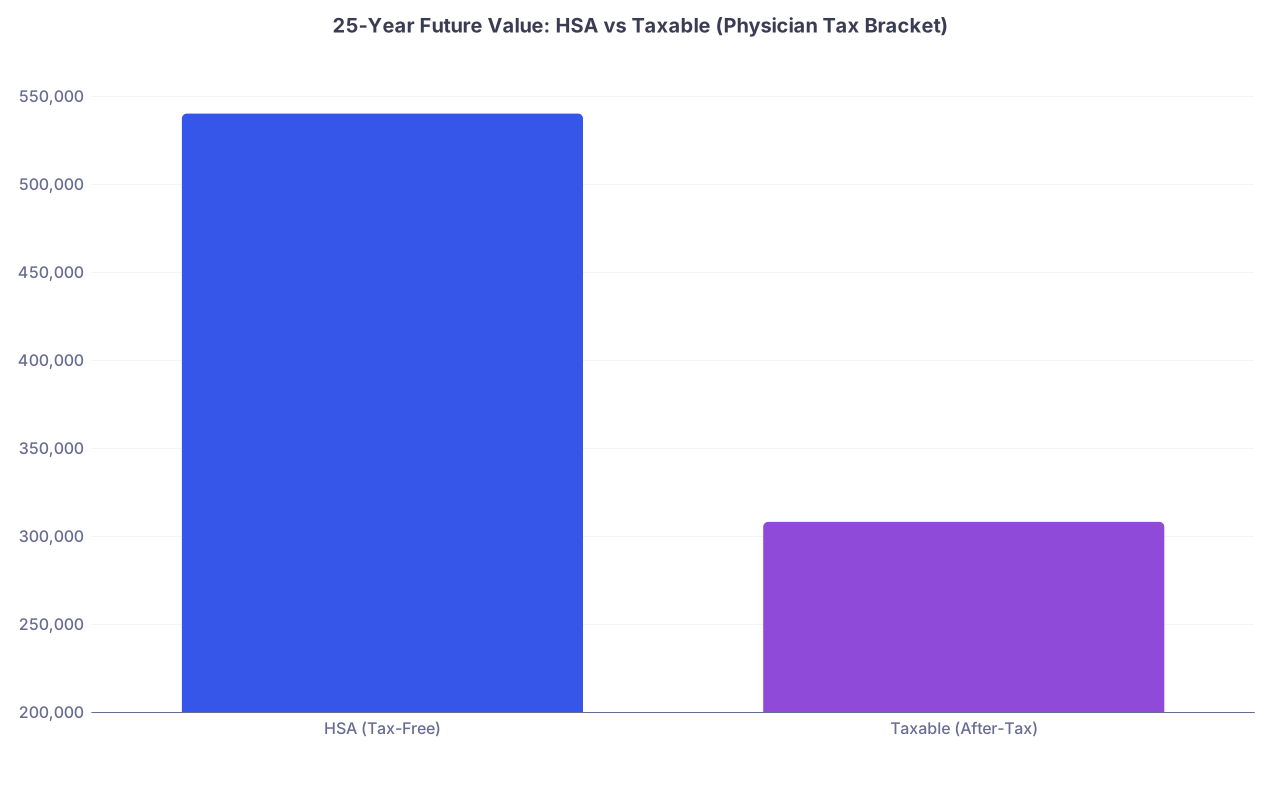
| Category | Value |
|---|---|
| HSA (Tax-Free) | 540000 |
| Taxable (After-Tax) | 308000 |
This is why I tell doctors: if you qualify for an HSA, it often belongs at the top of your investment account priority list, right after getting any employer 401(k) match.
2. Eligibility Reality Check: Many Physicians Disqualify Themselves
You cannot just decide you want an HSA. You must be enrolled in a High Deductible Health Plan (HDHP) that meets IRS criteria:
- Minimum deductible
- Maximum out‑of‑pocket limit
- No disqualifying other coverage (like a full FSA)
Where physicians mess this up:
- You pick the “richest” PPO plan because it feels safer.
- Your spouse has you on their non‑HDHP plan.
- You sign up for a general‑purpose FSA instead of a limited‑purpose dental/vision FSA.
For attendings with high income and reasonable emergency funds, the high‑deductible plan is often financially superior when you include the HSA tax arbitrage, even if you pay more cash out of pocket in a given year.
If you are a W‑2 employee:
- Ask HR: “Which of our plans is HSA‑eligible?”
- Confirm there is no general FSA attached (unless it is HSA‑compatible / limited‑purpose).
If you are an independent contractor or practice owner:
- You control this. Coordinate with your benefits broker to pick an HSA‑eligible plan.
- Do not let them lazily renew a rich PPO just because “doctors like low deductibles.”
Once HDHP coverage is active on January 1 (or when you start), you can contribute up to that calendar year limit, prorated if you are not covered the full year under the standard rule (there is also a “last‑month rule” with a two‑year testing period; if you do not understand it, stick with prorated to avoid complications).
3. HSA vs 401(k) vs Roth: Priority for Physicians
You have limited cash and multiple buckets. Here is the physician‑specific order I tend to recommend, assuming typical high earner in a developed practice:
- Employer 401(k)/403(b) match → always take free money
- HSA to the max
- Backdoor Roth IRA (if eligible and no pro‑rata mess)
- Rest of 401(k)/403(b) as needed
- Taxable brokerage
For practice owners, layering in a defined benefit / cash balance plan can shuffle the order, but the HSA remains extremely high priority.
Why HSA before Roth?
Because Roth gives you:
- Tax‑free growth
- Tax‑free withdrawals
But you pay taxes up front.
HSA gives you:
- Deduction up front (saves at 37–43%+ marginal)
- Tax‑free growth
- Tax‑free withdrawals for medical expenses
So for the subset of your future spending that will be health care (which in retirement will be substantial), HSA beats Roth on sheer math.
4. The “Stealth IRA” Strategy: Do Not Spend Your HSA Today
Here is where most physicians screw this up: they use the HSA like a health spending account, not an investment account.
If you want to truly master this vehicle, adopt this mindset:
- Pay current medical expenses out of pocket from your checking account.
- Keep every HSA dollar invested and untouched.
- Save all your receipts in a meticulous, durable way.
- Decades later, pull money out of the HSA tax‑free reimbursing old expenses.
Yes, that is legal. The IRS does not care when you reimburse a qualifying expense, as long as:
- The expense occurred after the HSA was established.
- You were HSA‑eligible at the time.
- You have documentation.
- You have not already been reimbursed by insurance or another account.
So your HSA turns into a retroactive Roth for as many years of medical receipts as you can document.
Let us illustrate.
Resident year 1: You open an HSA on your new HDHP. You pay a $1,200 MRI bill out of your checking account. You keep the itemized statement and proof of payment.
Fast forward 20 years: HSA has grown. You want $1,200 tax‑free cash. You submit your preserved documentation to your HSA administrator (or self‑document, depending on custodian) and reimburse that old MRI. Tax‑free. The account invested and compounded in the meantime.
Multiply by a few decades of copays, prescriptions, orthodontics for the kids, dental crowns, LASIK, etc. The number becomes large.
This is why record‑keeping is absolutely non‑negotiable. A simple approach:
- Scan or download every Explanation of Benefits (EOB), invoice, and receipt.
- Save in cloud storage with redundant backup.
- Organize by year and patient.
- Track total unreimbursed qualified expenses in a spreadsheet (one line per expense).
You will thank yourself at 65 when you can pull out $150,000 tax‑free to remodel the kitchen by “reimbursing” 30 years of accumulated health expenses.
5. Investment Strategy: How Physicians Should Invest Their HSA
Most default HSA providers run on a bank chassis. They:
- Pay almost no interest on cash.
- Hide the investment menu behind a balance threshold (e.g., must keep $1,000–$2,000 in cash).
- Offer expensive, mediocre funds.
That is unacceptable for a high‑income physician who wants to use this as a long‑term investment account.
You want:
- Low‑fee, broad index funds (total US stock, total international, maybe bond later in life).
- Minimal account and trading fees.
- Ability to invest nearly the entire balance.
If your employer’s HSA provider is terrible, you have two main options:
- Use it, then periodically roll over to a better HSA custodian you choose (like Fidelity, Lively, HSA Bank + brokerage, etc.).
- If you buy your own HDHP (self‑employed), skip the crappy custodian and open directly at a good one.
Asset allocation:
- If you are early‑career and treating the HSA as a retirement vehicle with long horizon: invest it like your Roth IRA. Usually heavily equity.
- If you plan to spend HSA dollars in the next 5–10 years: carve out that portion in cash or short‑term bonds, but keep the long‑range bucket stock‑heavy.
I have seen too many physicians park six figures in an HSA “cash” balance earning 0.3%. That is dead money.
Example HSA Portfolio for a 40‑Year‑Old Attending
Let’s say:
- Age: 40
- Planning to work to 60–65
- No intention to spend HSA for current expenses
A sample simplified investment mix:
- 70–80% Total US Stock Market index
- 20–30% Total International Stock index
Rebalance yearly. No need for bonds in the HSA if your overall portfolio’s risk level is already appropriate. Just treat HSA as one slice of your broader asset allocation.
6. Withdrawal Rules and Timing: How to Avoid Painful Mistakes
The IRS is not forgiving if you botch distributions.
Basic rules:
- Withdrawals for qualified medical expenses (for you, spouse, dependents) → tax‑free.
- Non‑medical withdrawals before age 65 → taxed as ordinary income plus 20% penalty.
- Non‑medical withdrawals after age 65 → taxed as ordinary income only, no penalty.
So after 65, the HSA starts to look like a traditional IRA for non‑medical spending. This is your “worst‑case scenario”: you still got tax‑deferred growth and front‑end deduction, but no tax‑free pass on the back end if you do not use it for medical.
Given that reality, aiming to overfund your HSA is not a real risk. You will almost certainly have ways to use it:
- Medicare Part B & D premiums
- Medicare Advantage premiums
- Out‑of‑pocket deductibles
- Dental and vision expenses
- Certain long‑term care expenses and premiums (within IRS limits)
Where doctors get themselves in trouble:
- Double dipping: claiming an HSA distribution for an expense that insurance, FSA, or employer plan already reimbursed.
- Poor records: no clear receipt or EOB with dates, amounts, and proof of payment.
- Ineligible period: reimbursing expenses that occurred before the HSA was established or while you were not HSA‑eligible.
- Co‑mingling: using HSA debit card casually for non‑qualified things and trying to “fix it later.”
Be boring. Use the HSA as if it were a retirement account. When needed, submit carefully documented reimbursement requests. Otherwise leave it alone.
7. Special Physician Situations: Locums, Owners, and Multi‑State Tax
Physicians do not have simple W‑2, one‑employer lives. Let us hit a few edge cases I see repeatedly.
Locums / 1099 Physicians
If you are 1099:
- You usually buy your own HDHP on the exchange or through a private broker.
- You open the HSA yourself at whichever custodian you like.
- HSA contributions are taken as an above‑the‑line deduction on your 1040, not via payroll.
Key point: even if you do not have a formal “employer plan,” you can still do this and still get the same tax benefits.
Multi‑Employer Scenarios
You work for Hospital A (offers non‑HDHP) and pick up shifts at Hospital B (offers HDHP). Or your spouse has a family HDHP and your employer offers something else.
Rules get messy quickly, but the core idea:
- If you are covered by any non‑HDHP major medical plan, you are not HSA‑eligible.
- If only your spouse has an HDHP for self‑only, and you have non‑HDHP through your employer, you personally are not HSA‑eligible.
- If your spouse has a family HDHP that covers you, and you have no disqualifying plan, then you may both be treated as eligible, but the family HSA limit is shared between you.
So you cannot play double‑dipping games by pretending each of you gets a full family limit. IRS will absolutely disallow it if audited.
Practice Owners and Group Plans
If you own a practice:
- You control whether the group plan is an HDHP.
- You decide contribution structures for partners vs staff (within ERISA and discrimination rules).
A common approach for small physician groups:
- Offer a competitive HDHP with an HSA.
- Contribute a fixed employer amount to staff HSAs (e.g., $500 single / $1,000 family).
- Physicians top up to the limit personally.
You get:
- Deductible employer contributions
- Attractive benefit to recruit/retain staff
- Additional tax shelter for physician‑owners
Work closely with a benefits consultant and ERISA attorney if you are designing this. Do not guess.
8. Legal, Asset Protection, and Estate Issues
You are a physician. Malpractice and asset protection are never far from your mind. HSAs have some wrinkles here.
Asset Protection
Federal law does not provide a uniform, strong shield for HSAs the way it does for certain retirement accounts. Protection is state‑dependent.
- Some states treat HSAs like IRAs for creditor protection purposes.
- Others offer very limited protection.
You need to ask your asset protection attorney: “In [YOUR STATE], are HSAs protected to any degree from creditors and malpractice judgments?” Do not assume.
Regardless, HSAs should still be part of your planning, but you might not treat them as your last‑line bunker asset the way you might with a fully protected qualified plan.
Estate Planning and Beneficiaries
HSA beneficiary designation matters more than most realize.
If your spouse is the beneficiary:
- The HSA becomes their HSA. It retains its tax status. Very clean.
If a non‑spouse is the beneficiary (children, trust, etc.):
- The HSA is deemed distributed at death.
- The entire balance becomes taxable income to the beneficiary in that year.
This is harsh. Which is why, for married physicians, I typically want spouse as primary HSA beneficiary, then others as contingent.
If you are single, child beneficiaries may still be fine, but your estate plan should anticipate the income tax hit. Might be worth intentionally spending down the HSA in later life on medical expenses, rather than leaving a tax bomb for heirs.
9. Common HSA Misconceptions I See with Physicians
Let me just rapid‑fire the greatest hits. I have heard all of these in physician lounges.
“HSAs are just for people who cannot afford good insurance.”
Wrong. HSAs are for people who understand math. For high earners with liquidity, a high‑deductible plan plus an HSA can be superior both now and later.
“If I don’t use it this year, I lose it, right?”
You are thinking of FSAs. HSAs roll over indefinitely. They are not use‑it‑or‑lose‑it.
“I cannot have an HSA because I have an FSA.”
Partially true. You cannot have a general‑purpose FSA and be HSA‑eligible. But you can have a limited‑purpose FSA (dental/vision only) that is HSA‑compatible.
“HSAs are only for my expenses, not my family.”
Incorrect. You can use HSA funds for qualified medical expenses of:
- Yourself
- Your spouse
- Any dependents you claim on your tax return
Even if they are not on your HDHP, in some situations. The governing factor is tax dependency, not plan membership.
“If I keep receipts for 30 years, that will look suspicious.”
IRS does not care how long you wait. The code is clear: no time limit, as long as expenses were incurred after the HSA was established and you were HSA‑eligible.
10. Implementation Plan for a Busy Physician
You do not need a 40‑page financial plan to get this right. You do need a clear, boring process you can stick with.
Here is a simple sequence:

| Step | Description |
|---|---|
| Step 1 | Check HDHP Eligibility |
| Step 2 | Enroll in HSA-Eligible Plan |
| Step 3 | Open Quality HSA Custodian |
| Step 4 | Set Automatic Contributions to Max |
| Step 5 | Invest in Low-Cost Index Funds |
| Step 6 | Pay Medical from Checking |
| Step 7 | Save and Track Receipts |
| Step 8 | Periodic Reimbursements or Wait for Retirement |
Couple of concrete habits:
- At the start of each year: update HSA contribution amount to hit the new IRS limit.
- Quarterly: move any idle HSA cash above your required buffer into your chosen investments.
- Monthly: upload new medical receipts and update your unreimbursed‑expenses spreadsheet.
- Every 5–10 years: consider reimbursing a chunk of old expenses if you need tax‑free cash for a big purpose (home down payment, tuition, etc.).
11. How HSAs Fit into a Full Physician Financial Plan
Zoom out for a second. Your HSA is not a standalone toy. It interacts with:
- Your retirement asset location (what goes in pre‑tax vs Roth vs taxable)
- Your insurance choices (HDHP vs PPO)
- Your family planning (kids, orthodontics, fertility treatment)
- Your estate planning and beneficiary structure
- Your practice or employment benefits design
You want coordination, not one‑off decisions.
A typical smart structure for a mid‑career attending might look like:
| Account Type | Primary Role | Tax Treatment |
|---|---|---|
| 401(k)/403(b) | Core retirement savings | Pre-tax or Roth, tax-deferred |
| Backdoor Roth IRA | Long-term tax-free growth | After-tax in, tax-free out |
| HSA | Medical stealth IRA | Deductible in, tax-free out |
| Taxable Brokerage | Flexibility, early retirement | Taxable, capital gains rate |
| Cash/Cash-Like | Emergency fund, short-term | Taxable, principal stable |
Notice the HSA is not a minor line item. It is a core, privileged account that should be fully funded every year you are eligible.
12. Numbers Perspective: Long-Term HSA Growth for a Physician Couple
Let’s take a physician couple, both attendings, married, on a family HDHP, starting at age 35, planning to work to 65.
- They max the family HSA every year: say $8,300 adjusted upward over time with inflation.
- Average 7% return.
- They never touch the account; they pay medical costs out of pocket.
Approximate outcomes:
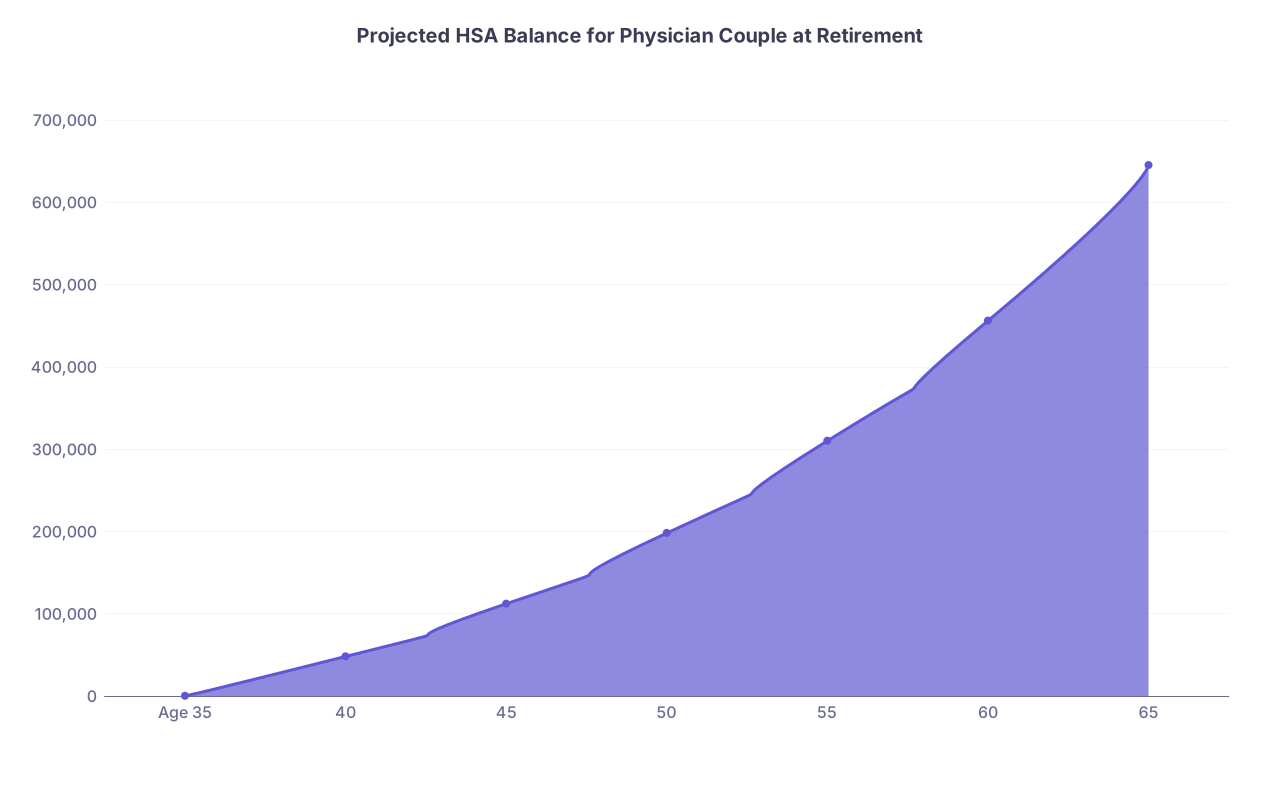
| Category | Value |
|---|---|
| Age 35 | 0 |
| 40 | 48000 |
| 45 | 112000 |
| 50 | 198000 |
| 55 | 310000 |
| 60 | 456000 |
| 65 | 645000 |
End result: something like $600k–$700k in tax‑free medical funding available in retirement, depending on return sequence and contribution increases.
That is enough to cover:
- Decades of Medicare premiums for both
- Routine medical care
- Dental, vision, hearing aids
- A large chunk of long‑term care costs
Without touching their other retirement accounts. Which means more flexibility for lifestyle, giving, or leaving a legacy.
13. Final Physician‑Specific Pitfalls to Avoid
I will end the technical section with a short list of “do not do this” mistakes I actually see in physician tax returns and financial setups:
- Choosing a rich non‑HDHP plan every year, leaving HSA eligibility on the table despite high income and healthy family.
- Signing up for a general FSA that kills HSA eligibility by accident.
- Leaving HSA money sitting in cash for years out of ignorance or inertia.
- Treating HSA as a petty‑cash slush fund for pharmacy purchases instead of a long‑term asset.
- Failing to name a spouse as beneficiary, causing an unnecessary tax hit at death.
- Assuming HSAs are fully protected from lawsuits and bankruptcy without checking state law.
- Not coordinating multiple HSAs from old employers; forgetting one exists entirely.
- Poor documentation. Trying to “recreate” years of receipts later. That rarely ends well.
The fix in most cases is not complicated. It is just deliberate.
FAQs (Exactly 6)
1. As a physician, should I prioritize maxing my HSA over maxing my 401(k)?
Usually, yes—after taking your full employer match. The HSA’s triple‑tax‑free treatment makes it more powerful than a standard pre‑tax 401(k) for dollars that will eventually be spent on health care. A sensible order for many doctors: 401(k) match → HSA max → backdoor Roth → additional 401(k) → taxable.
2. What if I have unpredictable, very high annual medical expenses—should I still use an HDHP and HSA?
Maybe. You have to run the numbers. For families with ongoing, very high costs (e.g., complex chronic illness), a rich PPO can still be better even after accounting for HSA benefits. Use your actual claims data from prior years, compare total premiums + expected out‑of‑pocket + value of HSA tax savings. For many healthy or moderately utilized physician families, the HDHP + HSA wins. For heavy‑utilizer families, not always.
3. How do I handle my HSA if I switch from an HDHP to a non‑HDHP later?
You simply stop contributing. The HSA itself remains yours, can stay invested, and can still be used tax‑free for qualified expenses. You just cannot add new contributions for months you are not HSA‑eligible. Think of it like “freezing” a retirement account: no new money in, but full use of the existing balance under the usual rules.
4. Can I reimburse myself from the HSA decades later for old expenses if I retire abroad?
Yes, as long as those expenses were qualified, incurred after the HSA was established, and properly documented. The tax treatment of the HSA distribution is under U.S. law. Living abroad can introduce local tax issues depending on the country, but from the IRS perspective, the timing rule is unchanged. Many U.S. citizen physicians abroad still maintain HSAs as part of their U.S. tax footprint.
5. Is it ever smart to use HSA money now instead of paying out of pocket?
Yes. If you are in a temporary low tax bracket (e.g., early residency, fellowship, sabbatical year with very low income) and genuinely need cash flow relief, using the HSA currently is reasonable. The stealth IRA strategy is most powerful once your marginal bracket is high and stable. I am more forgiving of current use for residents than for a neurosurgeon making $900k.
6. How do HSAs interact with Medicare when I retire?
Once you enroll in any part of Medicare (A, B, or D), you become ineligible to contribute to an HSA. Contributions must stop, and you must be very careful about the 6‑month retroactive Part A coverage window when you enroll. However, you can still use your existing HSA balance tax‑free to pay Medicare premiums (except Medigap), deductibles, copays, and other qualified expenses. Many physicians essentially “earmark” their HSA to cover Medicare costs in retirement.
With these mechanics and strategies under your belt, your HSA stops being a sleepy side account and becomes what it should be for a physician: a central, tax‑optimized engine inside your long‑term plan.
You are now ready to align it with your broader investment, practice ownership, and estate strategy—so the next step is integrating this with your retirement projections and legal structures. But that is a deeper planning conversation for another day.