
Only 18% of high-income U.S. professionals hold any dedicated international equity fund, despite earning most of their money in a single country and single currency.
You read that right. Most physicians in the U.S. are 90–100% exposed to one economy, one healthcare system, one political structure, and one currency. Then they call that “diversified.”
Let me break this down properly.
You are a U.S. physician. Your job, your income, your house, your mortgage, your malpractice premiums, your student loans, and your future Social Security are all denominated in U.S. dollars and tied directly or indirectly to the U.S. economy. So when you think about international index funds, you are not chasing “fancy global plays.” You are deciding how much of your financial life you are willing to keep chained to a single country.
This article is about that decision—specifically through the lenses that matter most for you:
- Currency exposure
- Tax consequences
- Risk (real, not imagined)
1. What “International Index Funds” Actually Are (For a U.S. Physician)
Forget the jargon. At your level, there are only a few categories you really need to care about.
Most common flavors you will see in a 401(k), 403(b), or taxable brokerage:
- Total international ex‑US (developed + emerging; no U.S. stocks)
- Developed markets ex‑US (Europe, Japan, etc.; excludes emerging)
- Emerging markets only (China, India, Brazil, etc.)
- International small cap
- International real estate (REITs)
Examples you will actually encounter:
| Ticker | Type | Includes EM? | Typical Expense Ratio |
|---|---|---|---|
| VXUS | Total International ex-US ETF | Yes | ~0.07% |
| VTIAX | Total International Admiral | Yes | ~0.11% |
| IXUS | Total International ex-US ETF | Yes | ~0.07% |
| VEA | Developed Markets ex-US | No | ~0.05% |
| VWO | Emerging Markets | Only EM | ~0.08% |
“Index” here just means the fund buys a broad basket of non‑U.S. stocks, weighted roughly by market size, and tries to match a benchmark index (FTSE Global All Cap ex‑US, MSCI ACWI ex‑US, etc.) with minimal tracking error.
Why you care as a physician:
- These funds are often the only easy way you’ll ever own more than a handful of foreign companies.
- They introduce currency exposure whether you realize it or not.
- Their tax treatment is slightly different from your U.S. total market fund in a taxable account.
Let’s deal with the scary part first.
2. Currency Exposure: What You Are Actually Betting On
Most physicians misunderstand currency risk. I hear this constantly:
“I avoid international because I do not want currency risk. I will retire and spend dollars.”
I get the instinct. But the logic is backwards.
If you own a Japanese company in yen through an international fund, you are exposed to two things:
- The business performance of that company in its local economy.
- The exchange rate between that currency (yen) and the dollar, when your fund reports returns in USD.
Here is the part most people miss: your life is already 100% exposed to the U.S. dollar and U.S. economy. So your “currency decision” is not:
- “Dollar vs foreign currency”
It is:
- “Only dollar… or mostly dollar plus some exposure to other developed currencies.”
How currency exposure shows up in your returns
Say you buy a broad ex‑US fund that holds Nestlé (Swiss franc), Toyota (yen), and LVMH (euro).
If Nestlé goes up 5% in local currency but the Swiss franc falls 5% against the dollar, your U.S.-dollar return from Nestlé is roughly 0%. The currency move has eaten the local gain.
This is why international funds often look “disappointing” to U.S. investors in multi‑year periods when the dollar is strong. It is not that all foreign companies did terribly. It is that the foreign currencies weakened.
Now flip the situation. Dollar weakens for a decade. Same Nestlé 5% local gain, but now the franc is +3% vs the dollar. Your U.S. return is roughly 8%. The currency move helped.
Over 30–40 year horizons, currency effects tend to be noise compared with the underlying earnings growth and valuation changes. Over 3–10 year periods, they can dramatically amplify or mute your returns.
Should you hedge currency as a U.S. physician?
Most broad international index funds commonly used by physicians are unhedged. That means you own the foreign currency exposure by default.
Hedged options exist (e.g., some iShares “Hedged” ETFs), but here is my position:
- For long‑term retirement investing (20+ years), most U.S. physicians do not need currency hedging.
- For shorter horizon or liability‑matched goals (paying for a child’s UK university in 5 years), you might consider hedged exposure or simply holding that currency separately.
Hedging adds cost and complexity, and historically has given mixed benefits over long horizons. You do not need another variable to obsess over between cases and call nights.
Practical currency translation for your life
The question you actually should ask:
“How much of my net worth do I want directly tied to just the U.S. dollar?”
Concrete example:
- Your future Social Security benefit: fully USD.
- Any military pension: fully USD.
- Your real estate: USD currency and U.S. local economy.
- Your practice buy‑in / equity: USD, and directly tied to the U.S. health‑care system.
If 80–90% of your lifetime economic exposure is already USD, holding 20–40% of your equities in unhedged international actually diversifies your currency exposure. That is a feature, not a bug.
3. Taxes: Where International Funds Help You, Hurt You, Or Do Nothing
Most physicians wake up to tax drag late. Usually after a year where they owe an extra five-figure tax bill because their “simple” index funds threw off large capital gain distributions.
International index funds add two extra layers you must understand:
- Foreign taxes withheld on dividends
- Foreign tax credit on your U.S. return (or lack of it)
How foreign taxes work in practice
When a French company pays a dividend to your U.S.-domiciled fund, the French government may withhold, say, 15% as a tax. So if the gross dividend was $100, only $85 actually hits the fund.
Then the fund distributes a dividend to you as a U.S. taxpayer. You see the after-foreign-tax amount and pay U.S. tax on that, too. This is why it feels like double taxation.
The IRS knows this is a problem, so there is a foreign tax credit mechanism.
But here is the catch: where you hold the fund matters.
Asset location: where to put international index funds
Here is the simple, physician‑appropriate rule:
- Best place: Taxable brokerage account (because you can usually claim the foreign tax credit).
- Next best: 401(k)/403(b)/IRA if the only international you have access to is there and you want some exposure.
- HSA: fine, but you are throwing away the foreign tax credit.
In a taxable account, your annual 1099‑DIV from a broad international fund (like VXUS or VTIAX) will typically show “foreign tax paid.” You can often claim this as a credit on Form 1116, which directly offsets U.S. income tax dollar-for-dollar (within limits).
Rough effect: International funds often have slightly higher dividend yields than U.S. total market funds and lose 0.10–0.30% of yield to foreign withholding. The foreign tax credit can reclaim a chunk of that, but not always all.
If you stuff that same fund in a 401(k), the income is tax-deferred, but you permanently lose the foreign tax credit. For a heavy international tilt, that drag can add up over multiple decades.
Mutual fund vs ETF for international
For most busy physicians, use a low‑cost ETF if you are investing in a taxable account. Reasons:
- Often slightly more tax efficient (lower capital gain distributions).
- Easier to move between brokerages.
- Lower minimums and easier to automate.
In a retirement account (401(k), 403(b), 457, IRA), it does not matter much; pick the lowest cost, broadest fund available.
4. Risk: Diversification Reality vs Narrative
The single worst argument I hear:
“International has underperformed the U.S. for a decade. Why should I own it?”
That is performance-chasing dressed up as logic.
Here is the truth: most U.S. physicians are massively overexposed to U.S. specific risk. Not theoretical. Real.
You depend on:
- U.S. health‑care reimbursement
- U.S. malpractice environment
- U.S. tax policy on high earners
- U.S. political stability
If the U.S. does great for 30 years, an all‑U.S. portfolio wins. If the U.S. has a structurally weaker few decades relative to the rest of the world, your “home country plus international” mix will look very smart.
The point of diversification is not to always win. It is to avoid getting annihilated when your home market is the one that lags.
Historical context physicians forget
Long stretches of relative underperformance are normal. Example patterns:
- 1980s–1990s: Periods when non‑U.S. markets, especially Japan and parts of Europe, had massive booms and the U.S. was not the star.
- 2000–2009: U.S. “lost decade” when the S&P 500 went basically nowhere while emerging markets crushed it.
- 2010–2021: U.S. mega‑cap tech dominance, international lagging.
The reality: nobody can reliably predict the next 10–20 year relative winner. If you think you can, you are in the wrong profession. Go run a hedge fund.
A rational stance: Own both, in a predetermined ratio, and ignore the relative performance noise.
Volatility and drawdowns
International stocks tend to:
- Be at least as volatile as U.S. stocks.
- Sometimes draw down more in global crises.
- Sometimes fall less when the U.S. specific issue is at play (dot‑com bust, U.S. financial crisis).
If you are used to a 70/30 U.S. stock/bond mix, shifting to 50% U.S. / 30% international / 20% bonds will feel slightly more volatile in USD terms during periods of dollar strength. During periods of dollar weakness, it will feel like an engine strapped to your returns.
Risk here is not just volatility. It is concentration. Being all‑U.S. is a concentrated bet on one system. That is not automatically wrong. It is just a larger bet than most people realize.
5. How Much International Does A U.S. Physician Actually Need?
Let’s be concrete. Global stock market weight (roughly):
- U.S.: about 60% of global market cap
- Rest of world: about 40%
A market-weight global portfolio would have ~60% U.S. total market, ~40% total international.
Most Bogleheads and evidence-based advisors who work with U.S. physicians recommend:
- 20–50% of your equity allocation in international stocks.
Anything in that window is defensible. Below 10% and above 60% starts to look more like personal ideology than evidence.
Here is a simple framework tailored to physicians:
You plan to live and retire in the U.S., have no non‑U.S. income or liabilities, and you hate watching international underperform:
20–25% of equities in international is fine.You are comfortable with tracking error and want more diversification closer to global market weight:
30–40% of equities in international.You have some real non‑U.S. exposure (dual citizenship, strong likelihood of living abroad, spouse with foreign income, etc.):
40–50% of equities in international can make sense.
Example portfolios for a U.S. attending
Assume equity-heavy doc in peak earning years, 80/20 stocks/bonds.
Conservative international tilt:
- 60% U.S. total market
- 20% total international
- 20% bonds
Closer to global market cap:
- 48% U.S. total market
- 32% total international
- 20% bonds
Higher international tilt for someone with non‑U.S. ties:
- 40% U.S. total market
- 40% total international
- 20% bonds
The key: pick a target, write it down, and stop tinkering every time the Wall Street Journal runs a “U.S. vs International” piece.
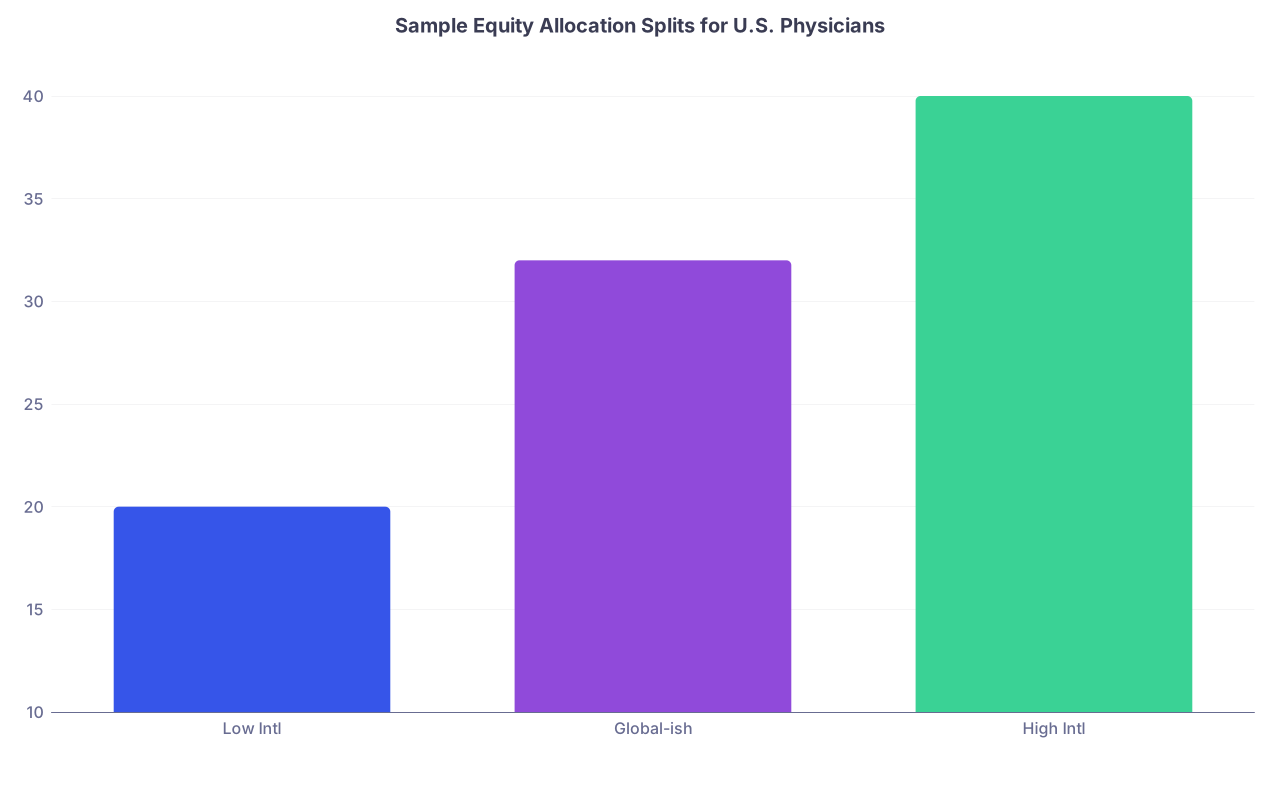
| Category | Value |
|---|---|
| Low Intl | 20 |
| Global-ish | 32 |
| High Intl | 40 |
(Values above represent the international equity percentage in each sample approach.)
6. Implementation Details That Actually Matter
This is where physicians either overcomplicate things or get lazy and accept whatever random “International Equity” fund is shoved into their 403(b).
Let’s tighten it up.
Step 1: Decide your international equity percentage
Use the framework above. Write it down: “Target 30% of stocks in international.”
Step 2: Check what your employer plan offers
Look for:
- Words like “International Index,” “Developed Markets Index,” “Total International”
- Prefer passive index funds with expense ratios under 0.20%
- Avoid high‑fee, actively managed international funds as your core holding unless you literally have no other option
If the plan only has a decent broad developed markets index (no emerging), that is still acceptable. You can optionally add a small slice of emerging via taxable if you care enough.
Step 3: Decide where to place what
General rule of thumb:
- Put U.S. stocks and bonds across tax‑advantaged and taxable depending on options.
- Put broad international index funds primarily in taxable to capture foreign tax credit, if you have enough taxable assets.
For a high‑earning physician with a growing taxable account, a very clean setup:
- 401(k)/403(b)/457/IRA: U.S. total stock, U.S. bond funds.
- Taxable brokerage: Total international equity fund(s) + U.S. total market.
This keeps rebalancing straightforward and uses the taxable account for the “slightly more tax‑complex but credit-eligible” international holdings.
Step 4: Do not slice international into oblivion
Common mistake of over‑enthusiastic “portfolio architects”:
- 10% Developed ex‑US
- 10% Emerging
- 5% International small cap
- 5% International REITs
Looks smart on paper. In reality, it:
- Adds complexity
- Makes rebalancing annoying
- Does not dramatically change risk/return vs a single broad total international fund, for most people
If you are reading this after a 26‑hour call, you do not have time to micromanage six international sub‑slices. Use a single broad index for 90–100% of your international exposure. If you must tinker, add at most one small satellite (like 5–10% emerging markets or international small cap).
7. Legal and Structural Risks: Domicile, Fund Choice, and What Not To Touch
You will, at some point, see a “too clever” suggestion:
“Open an account in [foreign country] and buy their local ETFs; you’ll get more options and maybe better tax treatment.”
No. For a U.S. physician, this is almost always a disaster in the making.
You want U.S.-domiciled funds
Reasons:
- Clear and familiar tax reporting (1099s).
- Covered by U.S. regulations and investor protections.
- Avoids the dreaded PFIC regime (Passive Foreign Investment Company) that punishes U.S. persons who own foreign mutual funds/ETFs.
U.S.-domiciled international index funds and ETFs are designed for you. Use them.
Watch for these structural red flags
I have seen physicians burned by:
- Non‑U.S. brokers pitching exotic foreign ETFs.
- Insurance‑wrapped “international investment” products with opaque fees.
- Bankers selling “structured notes” tied to international indices with hidden complexity.
If you cannot explain the product in one or two sentences to a co‑resident, pass.
Stick with:
- Broad, low‑cost U.S.-domiciled index mutual funds or ETFs from reputable families (Vanguard, Fidelity, Schwab, iShares, etc.).
Regulatory risk in foreign markets
Yes, foreign countries can have more political instability, less transparent accounting, greater corporate governance risk. That is exactly why you own a broad index instead of 3 carefully picked foreign stocks you read about in Barron’s.
A total international index fund diversifies this across thousands of companies in dozens of countries. You are not betting your retirement on the honesty of a single foreign CEO.
8. Putting It All Together: A Practical Physician Blueprint
Let me give you a realistic, boring, effective blueprint for a mid‑career U.S. physician couple in their 40s.
Facts:
- Combined income: $550k
- Maxing 401(k)s / 403(b)s / 457s / Backdoor Roth IRAs
- Growing taxable brokerage balance
- Plan to retire in the U.S. at 60–65
Objective: Reasonable global diversification without needing a spreadsheet every Sunday.
Target allocation: 70% stocks, 30% bonds
Within stocks: 70% U.S., 30% international
Implementation:
Tax‑advantaged accounts (401(k)/403(b)/457/IRA):
- 45% U.S. total stock market index
- 30% U.S. total bond market index
Taxable brokerage:
- 25% Total international index ETF (VXUS, IXUS, or equivalent)
You rebalance annually or when your international drifts outside 25–35% of the stock portion.
The effect:
- You still have the majority of your equity in U.S. companies.
- You have meaningful exposure to foreign markets and currencies.
- You use the foreign tax credit in taxable.
- You avoid overcomplicating your financial life.
Over a 25–30 year window, this will almost certainly:
- Track fairly close to global market behavior.
- Smooth out U.S.-specific underperformance periods.
- Provide enough exposure to foreign growth without putting your retirement at the mercy of a single bet.

| Step | Description |
|---|---|
| Step 1 | Decide Intl % of Stocks |
| Step 2 | Check Employer Plan Options |
| Step 3 | Use in Tax Advantaged |
| Step 4 | Use Intl ETF in Taxable |
| Step 5 | Hold Majority Intl in One Broad Fund |
| Step 6 | Rebalance Annually to Target |
| Step 7 | Low Cost Intl Index Available |
FAQ (Exactly 4 Questions)
1. Should I reduce my international allocation now because U.S. stocks have been outperforming?
No. That is exactly backward. You set your international percentage based on long‑term diversification goals, not on which region has outperformed recently. If the U.S. has had a strong run, your U.S. allocation may be overweight; that is a reason to rebalance back to your target, not a reason to abandon international.
2. Is it safer to only invest in developed markets (no emerging) for my international exposure?
“Safer” is debatable. Developed‑only funds have somewhat lower geopolitical and governance risk, but you also give up exposure to faster-growing economies. For most physicians, a single total international fund (developed + emerging) is simpler and perfectly reasonable. If your only plan option is developed‑only, it is still superior to having zero international exposure.
3. How much does the foreign tax credit really matter in practice?
For a high‑earning physician with a six‑figure taxable portfolio, the foreign tax credit is not trivial, but it is not life-changing either. You might recover 0.10–0.20% per year of return that would otherwise be lost to foreign tax drag. Over decades that compounds, so yes, it is worth optimizing asset location to the extent it is easy. But you do not ever skip retirement accounts just to chase the foreign tax credit.
4. What if I plan to move abroad after retirement—should I load up on international funds now?
Not necessarily “load up,” but your situation is different. If you have a high probability of retiring or spending extensively in another currency area (e.g., EU), having a higher international equity allocation (40–50% of stocks) is reasonable. You might also eventually hold local currency cash or bonds closer to retirement. The key is to match your asset mix gradually to the currency and country risk of your future spending, not to reverse your portfolio overnight.
Key points, stripped down:
- International index funds are not exotic moves. They are how you reduce a massive, usually unrecognized, bet on the U.S. alone.
- For U.S. physicians, 20–40% of equities in broad, low‑cost international index funds—held primarily in taxable for the foreign tax credit—is a rational, evidence-based range.
- Decide your allocation once, implement it simply with 1–2 funds, and then stop letting short‑term U.S. vs. international headlines dictate your long-term strategy.