
You are three weeks into a busy locums stretch. Hospitalist nights. You have just been paid $18,400 for a block of shifts, another $7,200 from a different group “on the 15th or so,” and you are still waiting on a straggler check from a December gig.
Your checking account looks inflated. Your brain thinks, “I’m doing great.” Then next month you work less, a contract delays payment, and suddenly your credit card autopay plus quarterly taxes eat half your balance in one shot.
Investing? Feels like a luxury you will get to “once things stabilize.” Except with locums, they do not stabilize. The irregular paychecks are the point.
Here is the fix: you need a system that:
- Works with completely uneven income
- Pays your taxes without surprises
- Pays you a predictable “salary”
- Auto‑invests every single month, regardless of chaos
And it has to run with as little ongoing effort as possible. You are a doctor, not a full‑time bookkeeper.
I will walk you through a concrete, step‑by‑step structure you can set up in a weekend and then mostly ignore.
Step 1: Separate your worlds — business vs personal
If you are doing locums and all the money is just landing in one personal checking account, you are making life harder and more expensive than it needs to be.
You need:
- A business account (LLC or S‑corp, depending on your setup)
- A personal “household” account
Money flows one way:
Locums pay → Business account → Fixed transfer to personal “salary” → Bills and investing.
The minimum structure
Set up:
- Business checking – all locums income lands here.
- Business savings (Tax/Buffer) – for taxes and business reserves.
- Personal checking – your pseudo‑salary arrives here.
- Personal savings (Emergency) – 3–6 months of fixed expenses.
- Investment accounts – taxable brokerage + retirement.
Visually:

| Step | Description |
|---|---|
| Step 1 | Locums income Business Checking |
| Step 2 | Business Tax/Buffer Savings |
| Step 3 | Monthly Owner Pay Personal Checking |
| Step 4 | Quarterly tax payments |
| Step 5 | Fixed bills |
| Step 6 | Automatic Investing Brokerage & Retirement |
| Step 7 | Personal Emergency Fund |
Once this is set up, you never again “spend” from your business account. That account is for:
- Income in
- Tax set‑aside out
- Owner pay (your salary) out
- Maybe small business expenses
Your personal life never directly depends on whether a specific week of shifts got paid on time. That alone will reduce your stress by half.
Step 2: Define your personal “salary” based on real numbers
Auto‑investing with irregular paychecks is impossible if your spending expands and contracts with every deposit. You need a fixed draw: the same transfer from business to personal every month, like an employed doc paycheck.
Start with your real, current lifestyle.
- Pull your last 3–6 months of personal spending (from Mint, Monarch, bank statements, or a basic spreadsheet).
- Strip out business items and taxes (those belong to the business side).
- Average the monthly total, then add 10–15% as a buffer.
Say you discover you are consistently spending around $11,000/month (mortgage, rent, childcare, food, etc.). Add a buffer and call it $12,000/month.
That $12,000 is:
- What your personal checking account needs each month
- What your “salary” transfer from business should be
- The number you build all automation around
If that number makes you physically ill, good. That is useful information. You either:
- Cut expenses, or
- Work more / improve hourly rate, or
- Accept slower investing goals
But you cannot skip this step. Fuzzy spending = fuzzy investing.
Step 3: Build a tax and buffer system inside the business
Locums chaos destroys investing mostly because of taxes. You finally have money in the account, then a $42,000 federal + state quarterly payment nukes your balance. You panic and stop investing “until things calm down.”
So you build a tax system that makes quarterly payments boring.
Decide on your tax percentage
Ask your accountant (if you do not have one, get one) or use a conservative starting estimate:
- Federal + state + self‑employment (if sole prop/LLC): often 30–40% of net income
- If you contribute heavily to pre‑tax retirement or have high deductions, that can drop. But estimate on the high side.
Example: You pick 35% of gross collections as a working number.
For every single payment that lands in your business checking:
- Instantly move 35% to Business Tax/Buffer Savings.
If $20,000 comes in:
- $7,000 goes to Tax/Buffer
- $13,000 stays in business checking
Do not get cute and try to outguess it on the fly. Automate if possible:
- Some banks allow “rules” that automatically move a percentage of each incoming deposit.
- If not, set a weekly calendar reminder to sweep the correct percentage across.
This way when quarterly taxes hit, you just pay from the Tax/Buffer account. Your investing never gets touched.
Add a business buffer
On top of tax set‑aside, keep a business operating buffer, usually:
- 1–2 months of owner pay + typical business expenses
Example: Your owner pay is $12,000/month, malpractice is $2,000/month equivalent, plus $1,000 random. Round to $15,000/month. You keep $30,000 as a minimum business cushion.
Every dollar above:
- Tax set‑asides
- Business buffer
- Planned owner pay
is available for extra investing or short‑term goals.
Step 4: Convert irregular income into a smooth personal cash‑flow
Now we smooth the chaos.
Your business checking will be lumpy. That is fine. But your personal checking should look like this:
- On the 1st of each month: $12,000 transfer from business
- On predictable days: mortgage, insurance, utilities, credit card autopays, etc.
- On the 5th or 10th: auto‑transfers to investments.
So while your business account sees $0 one week and $32,000 the next, your personal life sees a boring, reliable number.
Mechanics:
- Set a recurring transfer from Business Checking → Personal Checking for your chosen “salary” (e.g., $12,000 on the 1st of each month).
- Monitor for 2–3 months to ensure your business buffer is stable and you are not draining it. Adjust salary if needed.
- Once stable, you can forget about matching each monthly salary transfer to that month’s exact collections. The buffer does the smoothing.
Step 5: Now automate the investing itself
You have two sources of investing fuel:
- Baseline investing – funded by your personal “salary,” every month.
- Surge investing – funded intermittently from surplus in the business after tax and buffer.
You want both.
5.1 Baseline investing: the non‑negotiables
From your personal checking each month, set up automatic transfers to:
- Retirement accounts (401(k)/solo 401(k)/403(b)/457b/IRA/HSA, depending on your setup)
- Taxable brokerage account
For each, pick:
- Date (usually right after your salary transfer lands)
- Amount
- Destination fund(s)
Example setup:
- On the 2nd: $3,000 auto‑transfer from Personal Checking to brokerage, invested into a 3‑fund portfolio or simple target risk fund.
- On the 3rd: $1,000 ACH to Roth IRA (or backdoor Roth, slightly more steps).
- HSA and solo 401(k) often get funded via the business, but you can treat them as line items in your plan.
You anchor everything to your personal salary, not to the chaos in your business account.
If your salary is $12,000/month and your fixed bills are $8,000/month:
- You have $4,000 left.
- Decide that $3,000 is auto‑invested, and $1,000 stays as flexible spending / extra savings.
You are now investing $36,000/year automatically, even if you have a mediocre year with locums.
5.2 Surge investing: use the “good months” without getting fancy
Locums has seasons. One quarter you work 18 shifts a month, another you take a travel month and barely work.
You do not want your baseline investing swinging all over the place. But you absolutely should capitalize on heavy earning periods.
Here is how:
- Once a month (or once a quarter), look at your Business Tax/Buffer Savings and Business Checking.
- If both are above your target minimums (tax estimate funded + 1–2 months business buffer), move the excess to your taxable brokerage in a lump.
- Invest it immediately according to your pre‑chosen allocation.
This keeps the action simple:
- Baseline investing flows every month no matter what.
- Surplus investing happens in lumpy chunks when the business is clearly ahead.
You are not guessing. You are applying a rule:
“When business cash above tax plus buffers > X, invest the rest.”
You can even define X in writing with your spouse or solo, so you do not renegotiate each time.
Step 6: Choose investments that do not need your attention
An auto‑system dies fast if every time money lands you agonize over ETF choices.
You need a boring, broad, low‑maintenance allocation. For most physicians, especially high‑earning locums, a simple scheme is fine.
Example for taxable + retirement combined:
- 60–80% US total market (VTI, ITOT, FSKAX, etc.)
- 20–40% international total market (VXUS, IXUS, FTIHX, etc.)
- Optional: 10–20% bonds if you are more conservative or near retirement.
In practice you can use:
- A single target risk or target date fund in retirement accounts, and
- A 2‑fund or 3‑fund portfolio in taxable.
The key: set it once, automate purchases, and rebalance no more than once or twice a year.
You are not a hedge fund. You are trying to shovel as much money as possible into broadly diversified low‑cost funds for 20+ years. The volume matters more than your cleverness.
Step 7: Guardrails for lifestyle creep and “big month” delusions
The biggest behavioral risk with locums is the illusion of wealth.
You get a $25,000 month and start structurally raising your lifestyle: nicer car lease, bigger house, premium everything. Then you hit a $10,000 month and you are scrambling.
The system above already fights that by:
- Fixing your personal “salary”
- Routing surplus to investing rather than automatic lifestyle
But you need explicit rules. For example:
- Any one‑time reward purchase > $2,000 must wait 7 days and be decided on with your partner.
- Any recurring expense increase (rent, car payment, tuition) must be supported by a 6‑month trailing average income, not a single crazy month.
- If your business buffer falls below 1 month of salary, you temporarily pause surge investing (but not baseline, if at all possible) and/or pick up extra shifts instead of cutting investments.
For some people, drawing this as a decision flow helps.

| Step | Description |
|---|---|
| Step 1 | Business cash above tax estimate |
| Step 2 | Rebuild buffer Do not increase spending |
| Step 3 | Send surplus to investments |
| Step 4 | Allow limited lifestyle upgrades or discretionary goals |
| Step 5 | Buffer >= 2 months owner pay? |
| Step 6 | Personal goals funded? |
You are creating a default: excess cash goes to investments unless a clear, pre‑decided rule says otherwise.
Step 8: Coordinate retirement accounts with irregular income
Locums complicates retirement contributions because:
- Income varies
- You might be using a solo 401(k), SEP, or multiple employer plans
- You might max some accounts early, then pull back
The goal is still the same: make contributions automatic wherever possible.
Common setup for an independent locums doc
- Solo 401(k) (or group 401(k) if working through an agency that offers one)
- Backdoor Roth IRA
- HSA if you have a high‑deductible plan
- Taxable brokerage
A simple protocol:
- Estimate your annual locums income conservatively, say $280,000.
- Work with your accountant to determine the maximum solo 401(k) contribution (employee + employer). For an income like that, you are often near the overall limit (check current year rules).
- Divide that by 12 or 24 and set monthly or twice‑monthly contributions from your business account to the solo 401(k).
- If your income ends up higher, you do a catch‑up contribution near year end. If lower, you dial back in Q4.
Same with Roth IRA:
- On the 15th of each month, auto‑transfer 1/12 of the annual limit to your “Roth staging” account (often taxable brokerage in cash or money market).
- Once a month or once a quarter, do the backdoor Roth steps as a batch (non‑deductible traditional IRA contribution, then convert).
For HSA:
- Set the HSA contribution as a line item, either via direct deposit from business or from personal checking monthly.
Point is: irregular income does not mean irregular contributions. You treat contributions as an expense of doing business, just like malpractice or EMR.
Step 9: Put numbers to this — a worked example
Let me run a straightforward sample so you can see this working.
Scenario
- Locums hospitalist, 1.0 FTE equivalent but irregular blocks
- Average gross locums income: $300,000/year
- Filing solo, high state tax, rough combined tax rate estimate: 35%
- Personal spending: $9,500/month after initial review
- You choose personal salary: $11,000/month
- Goal: Save/invest at least $60,000/year
Step 1: Monthly structure
From business side (average over year):
- Monthly gross into business: $25,000 (lumpy but this is average)
- Tax set‑aside: $8,750 (35% of 25k) → Business Tax/Buffer Savings
- Remaining: $16,250 in Business Checking
You set:
- Business buffer target: $22,000 (2 months of owner pay at $11,000)
From business to personal:
- On 1st: $11,000 transfer Business → Personal
Step 2: Personal side automation
Personal fixed expenses: $9,500
Target baseline monthly investing: $3,000
That is $12,500 total. You only have $11,000 salary. So you must adjust:
- You either cut expenses, work more, or lower baseline investing.
Say you reduce some subscriptions, refinance something, and get to:
- Fixed expenses: $8,500/month
- Baseline investing: $2,500/month
Now:
- Salary: $11,000
- Expenses: $8,500
- Baseline investing: $2,500
- Leftover cushion: $0 (tight but workable if you are disciplined)
You decide:
- 2nd of month: $1,500 automatic to taxable brokerage
- 3rd of month: $1,000 automatic to Roth IRA/IRA staging
- Retirement from business: separate (solo 401(k) from business account)
Step 3: Retirement contributions from business
You and your accountant decide:
- Goal solo 401(k) total: $40,000/year (for example)
You set:
- On 5th and 20th of each month: $1,666.67 transfer from Business Checking to solo 401(k) (twice monthly → about $40k annually)
Between solo 401(k) and baseline personal investing:
- Solo 401(k): $40k/year
- Taxable + Roth: $2,500 * 12 = $30k/year
You are investing around $70,000/year if everything fires.
Step 4: Handle the actual randomness
Some months you earn:
- $40k gross → $14k tax set‑aside → $26k remaining in business
- After $11k salary and $3,333 to solo 401(k), business buffer grows fast.
Other months you earn:
- $15k gross → $5,250 tax set‑aside → $9,750 remaining
- You still send $11k salary and $3,333 to solo 401(k), so the business buffer shrinks.
You watch your Business Tax/Buffer + Checking combo:
- If above tax liabilities and your $22k minimum buffer, you periodically sweep the excess to brokerage as surge investing.
- If you dip close to your buffer minimum, you:
- Avoid increasing lifestyle, and
- Possibly cut back on optional spending or pick up extra shifts
The entire system functions without you thinking about each dollar.
Step 10: Track just a few metrics that actually matter
You do not need a 20‑tab spreadsheet. You need to monitor:
- Business buffer size
- Tax set‑aside vs actual tax owed
- Annual amount invested
- Savings rate (invested + debt payoff / gross income)
A simple view might look like this:
| Metric | Target / Rule |
|---|---|
| Business buffer | ≥ 2 months owner pay |
| Tax set-aside | 30–40% of gross collections |
| Baseline monthly investing | Fixed dollar amount, never zero |
| Annual investing total | ≥ 20–30% of gross income |
| Lifestyle inflation check | Track salary vs trailing 12m income |
Spend 20 minutes once a month looking at these. Adjust if you see problems early, rather than in April when your accountant shows you a surprise tax bill.
Common traps and how to avoid them
I have seen the same mistakes over and over with locums docs:
Trap 1: “Catch‑up investing”
You tell yourself:
“This quarter is crazy; I will invest a big chunk later when it slows down.”
Then the “slow” quarter shows up and you work less and earn less and you never catch up. Years disappear this way.
Fix:
Baseline monthly investing must run even in bad months. Surge investing is optional. Baseline is not.
Trap 2: Single‑account chaos
All money in one checking account, mixing:
- Business income
- Taxes
- Personal spending
- Emergency fund
You have no idea what is actually safe to invest. So you under‑invest out of fear.
Fix:
Separate accounts and give each a job. Income → business. Taxes → tax account. Salary → personal. Investing → brokerage/retirement.
Trap 3: Overestimating safe spending
You see a $45k balance and think you are fine, then:
- $15k quarterly tax
- $8k credit card autopay
- $3k malpractice
- $2k estimated state
- Suddenly you are stressed.
Fix:
Never look at the gross balance and guess. Only consider:
- What is above tax set‑asides
- What is above your buffers
The rest is already “spoken for.”
Optional: Visualize your year so you do not panic
Sometimes just seeing the pattern calms people down. Use a simple projection of income and investing over time, even if lumpy.
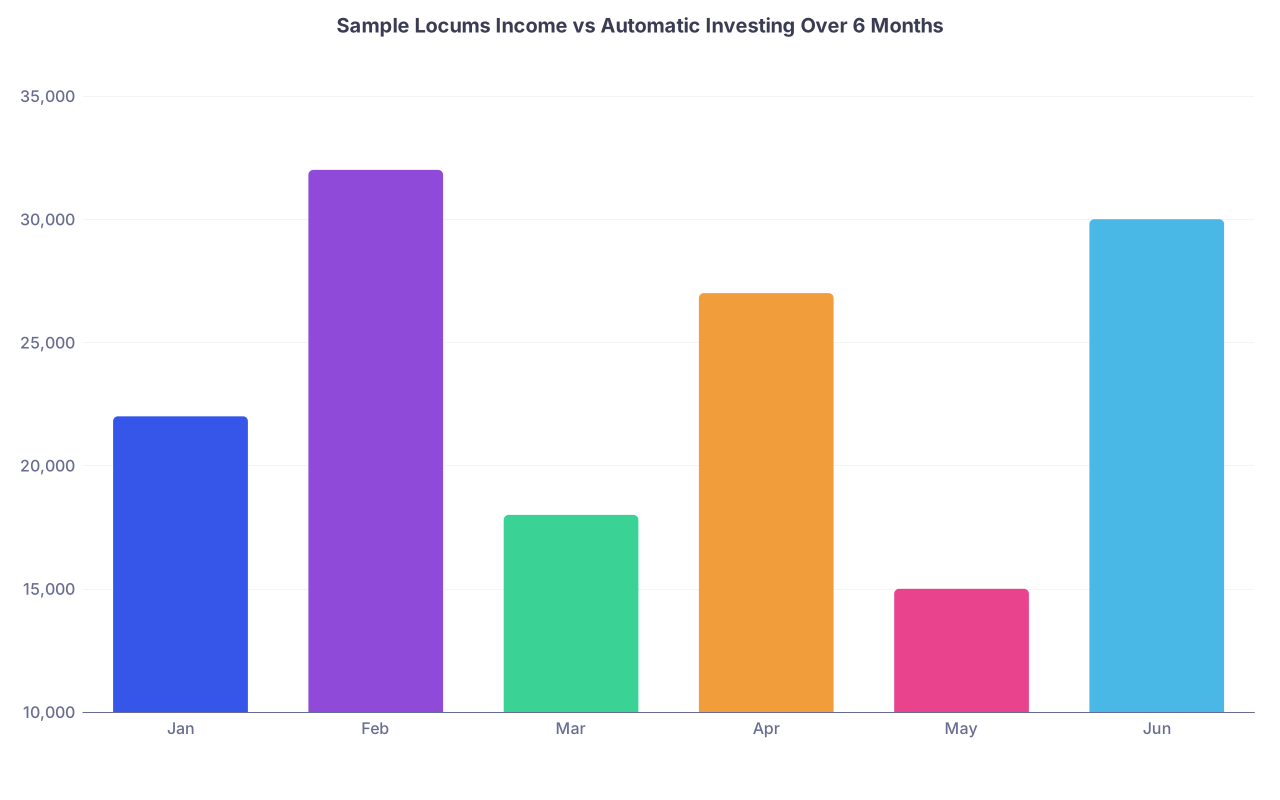
| Category | Value |
|---|---|
| Jan | 22000 |
| Feb | 32000 |
| Mar | 18000 |
| Apr | 27000 |
| May | 15000 |
| Jun | 30000 |
Over that same period, your baseline investing might be a flat:
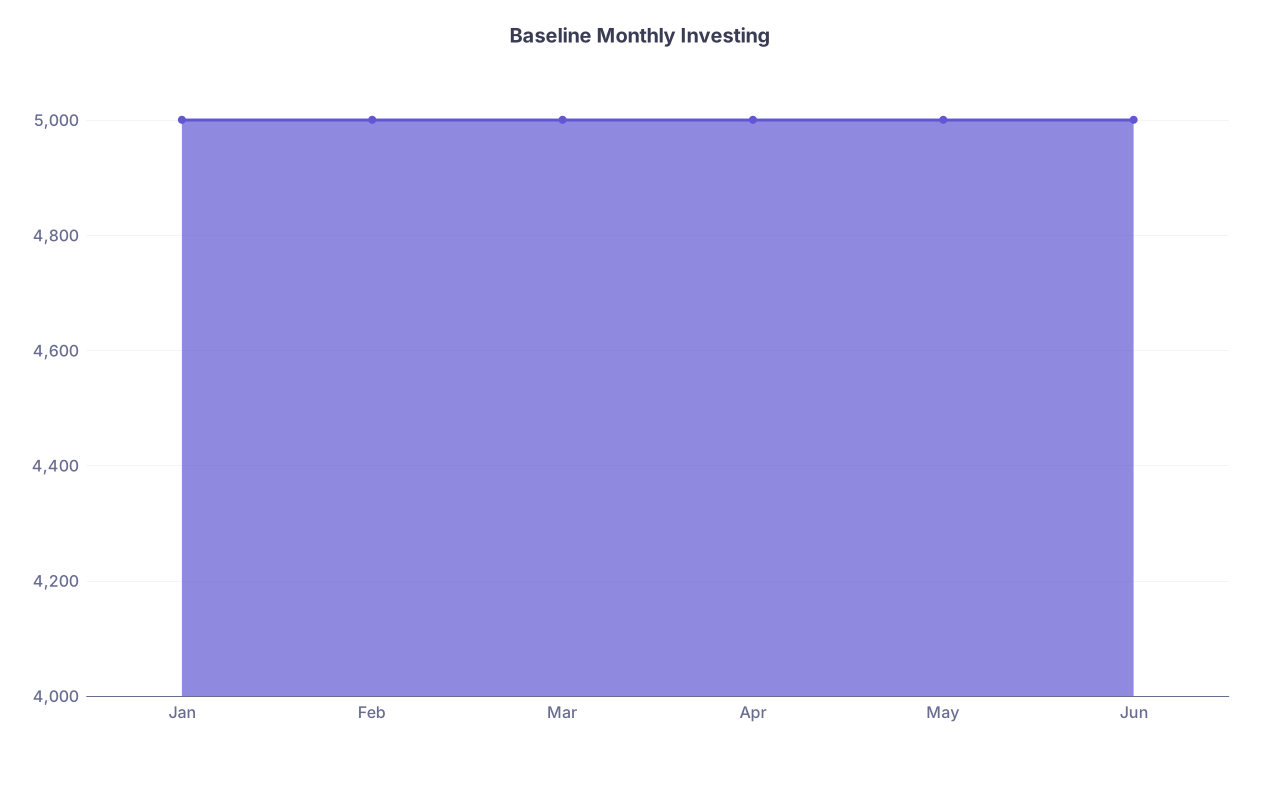
| Category | Value |
|---|---|
| Jan | 5000 |
| Feb | 5000 |
| Mar | 5000 |
| Apr | 5000 |
| May | 5000 |
| Jun | 5000 |
Irregular income. Regular investing. That is the point.
Implementation checklist (do this over 1–2 weekends)
You can read all this and feel “motivated,” or you can actually fix your system. Here is the short, blunt checklist.
Weekend 1:
- Open:
- Business checking
- Business tax/buffer savings
- Personal checking (if needed)
- Route all locums contracts to deposit into business checking only.
- Pull 3–6 months of spending and set your personal salary.
- Define your tax percentage and set a recurring weekly or per‑deposit sweep to Business Tax/Buffer.
Weekend 2:
- Create an automatic monthly transfer of your fixed salary from business to personal.
- In personal checking, schedule automatic contributions to:
- Taxable brokerage
- Roth/backdoor Roth funding (or Roth staging)
- In business checking, set up automatic contributions to solo 401(k) or other retirement plans.
- Choose a simple investment allocation and set automatic buys for incoming contributions.
- Write down your surge investing rule: When business cash above tax + buffers > X, invest the rest.
- Put a 20‑minute recurring calendar event once a month to check:
- Buffers
- Tax account vs expected tax
- Monthly investing total
Last piece: decide ahead of time what you will not do:
- You will not pause baseline investing unless there is a true emergency.
- You will not increase structural lifestyle costs because of one big month.
- You will not rely on “I’ll save whatever is left at the end of the month.”
Final thoughts
Three core points and you are done:
- Turn lumpy income into a smooth, predictable salary using a business account, tax set‑aside, and a fixed monthly transfer.
- Lock in automatic investing from that salary, every month, independent of how good or bad your latest locums block was.
- Use clear rules for surplus cash so big months boost your net worth, not just your lifestyle.
You do this once, correctly, and the “locums income chaos” turns into exactly what you wanted from locums in the first place: flexible work with serious wealth‑building power in the background.