
The idea that every doctor should own real estate is wrong. Not “in some cases,” not “for certain personalities.” As a blanket rule, it is bad advice. And a lot of physicians quietly know it—but feel too guilty (or “unprofessional”) to say so.
You’ve heard the script: “You’re throwing money away on rent.” “You need to build equity.” “Why would a high-income professional not own?” That chorus usually comes from three groups: older attendings who bought a $300k house in 1995 that’s now “worth” $1.2M, real estate salespeople whose income depends on your FOMO, and colleagues who confuse being leveraged to the eyeballs with being “savvy.”
Let me be specific: there are plenty of situations where renting not only makes sense for doctors, it is mathematically superior, psychologically healthier, and legally safer. The data back this up.
The ownership fairy tale vs the numbers
The ownership myth lives on one simplistic line: “Rent is 100% gone, mortgage payments build equity.” That line ignores:
- Interest
- Property taxes
- Insurance
- Maintenance
- Transaction costs
- Opportunity cost of your down payment
- Risk of needing to move earlier than you planned
The “building equity” argument is only true after all of those are paid and only if the property actually appreciates enough.
Let’s put numbers to it.
Say you’re a new attending in a high-cost coastal city.
- Buy: $1,200,000 condo
- 10% down = $120,000
- Physician loan, 6.5% interest, no PMI
- Property tax: 1.2% of value = ~$14,400/year
- Insurance + HOA: say $900/month
- Rent: similar unit for $5,000/month
Your mortgage (principal + interest) on $1.08M at 6.5% over 30 years is about $6,830/month. Add:
- Property tax: $1,200/month
- Insurance/HOA: $900/month
- Maintenance reserve: be honest—at least 1% of property value per year over time; call that $1,000/month averaged out
Total monthly housing cost as owner: roughly $9,930.
Versus rent: $5,000.
Yes, some of that $6,830 mortgage is principal. In year one, though, most of it is interest. You can check an amortization table; around 70–75% of early payments are interest.
Assume roughly:
- Interest portion year one: ~$4,800/month
- Principal: ~$2,000/month (I’m rounding to keep this readable)
So effectively you’re:
- Paying $4,800 interest
- Plus $1,200 taxes
- Plus $900 insurance/HOA
- Plus $1,000 maintenance = ~$7,900/month burned, plus $2,000 going to equity.
Versus renting at $5,000/month, where 100% is “burned.”
But here’s the part most white-coat real estate evangelists skip:
- You also had to lock $120,000 into the down payment plus closing costs (say $25k more). Call it $145,000 tied up.
- And you’re paying almost $3,000/month more in ongoing cost compared with renting ($7,900 vs $5,000 net of principal).
If you instead:
- Rented at $5,000
- Invested the $145,000 down payment into a boring total-market index fund
- Invested the ~$3,000/month difference into that same fund
…you’ve got a very different wealth trajectory.
Let’s do a clean, conservative comparison over 5 years.
Five-year scenario: rent vs buy
Assumptions:
- Market returns: 7%/year on investments (historical US stock market long-run average adjusted modestly for volatility)
- Property appreciation: 3%/year (which is generous for many real markets after inflation)
- You stay only 5 years (which is actually common for early-career physicians)
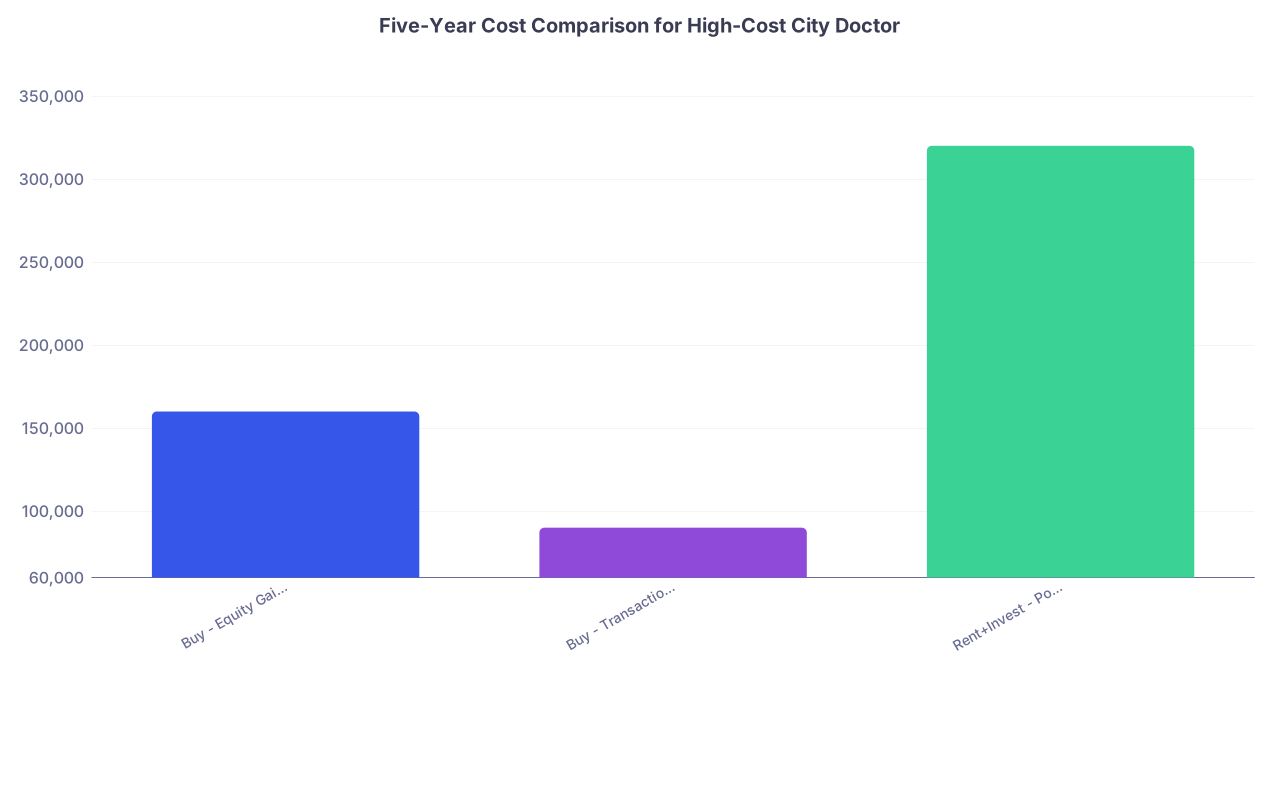
| Category | Value |
|---|---|
| Buy - Equity Gained | 160000 |
| Buy - Transaction Costs | 90000 |
| Rent+Invest - Portfolio Value | 320000 |
Very rough math:
Buy:
- Value after 5 years:
- $1.2M * (1.03^5) ≈ $1.39M
- Mortgage balance after 5 years on $1.08M @ 6.5%:
- Around $1.0M (exact number depends on amortization, but order of magnitude is right)
- Equity:
- ~$390k (value) - ~$1.0M (balance) = ~$390k
- Plus your original $120k down was part of that
- So net new equity built ≈ $270k
Now subtract:
- Transaction costs to sell: 5–6% of sale price
- 5.5% of $1.39M ≈ $76k
- You almost certainly put in capital improvements over 5 years (that full kitchen remodel you “had” to do)—say $30k
So effective equity gain:
- ~$270k – ~$76k – ~$30k ≈ ~$164k
Rent + invest:
- Initial $145k invested at 7% for 5 years:
- ≈ $203k
- Monthly surplus of $3,000 invested for 60 months at 7%:
- Future value ≈ $213k
Total ≈ $416k.
Even if I’m off by 10–15% either way, renting + investing is very competitive or outright better in this realistic, not-cherry-picked scenario.
Yet you’ll never hear this breakdown from the “own don’t rent” crowd. They talk about “paying your landlord’s mortgage” and conveniently ignore the part where you’re paying the bank, the county, the HOA, and the plumber instead.
Doctor-specific realities that make renting smarter
If you were a tenured schoolteacher staying in a small town for 25 years, buying early might be a no-brainer. But you are not that person.
Physicians have three structural issues that make the “always own” mantra especially dumb.
1. Your timeline is unstable
You don’t have a normal 9–5 stability path. You’ve got:
- Med school in one city
- Residency somewhere else
- Fellowship maybe in a third place
- First job in a system that may merge, implode, or change comp structures
- Spouse careers, kids, visas, aging parents layered on top
I’ve watched plenty of new attendings buy in year one, then:
- Their group gets sold to private equity, call explodes, they leave in 2–3 years
- Their partner matches fellowship across the country
- They realize they hate cold winters, or they want to be closer to family
The general rule: if you aren’t pretty sure you’ll be in that geography for at least 5–7 years, buying is speculation, not “responsible adulthood.”
2. Your specialty risk matters more than your ego
Different specialties have different job market volatility and compensation risk.
| Specialty | Typical Job Stability | Geographic Mobility Need | Good Case for Buying? |
|---|---|---|---|
| Primary Care | Moderate | Moderate | Sometimes |
| Hospitalist | Low–Moderate | High | Often weak |
| EM | Low | High | Usually weak |
| Radiology | Moderate | Moderate–High | Case by case |
| Derm/Optho | High | Low–Moderate | Stronger |
If you’re in EM in 2026 and still thinking “I should definitely own,” you’re ignoring the restructuring, contract churn, and outright closures in that field. Same for certain subspecialties of hospital-based work.
Buying a house is a leveraged bet on staying geographically stuck. Sometimes that’s fine. But for a lot of doctors, your career risk profile says: keep your asset flexibility high, not low.
3. Your time is expensive
Attendings love to pretend they’ll manage the contractors, fight the tax assessment, and DIY half the repairs. Then reality hits:
- You’re post-call on a Tuesday and the “small leak” has turned into ceiling damage
- Your HOA has a 3-hour evening meeting about assessments
- The garage door dies the same week you’re preparing for board recert
You don’t just pay in dollars. You pay in attention. And physician attention is scarce.
Renting outsources an entire category of mental overhead. You can put an hourly value on that. If you’re making $250–$400/hour clinically, burning five hours/month dealing with housing nonsense is not “free.”
The tax myth: “But I get the mortgage deduction!”
This one refuses to die, so let’s kill it cleanly.
After the 2017 Tax Cuts and Jobs Act, the standard deduction jumped, and state and local tax (SALT) deductions got capped at $10,000. For many physicians, especially in high-tax states, this means:
- Property taxes + state income tax alone already hit the $10k SALT cap
- Only mortgage interest above that, combined with charitable deductions, will push you past the standard deduction
Plenty of attendings who say “I need the mortgage deduction” are not actually itemizing at all.
Even if you do itemize, you’re not “saving” all your interest. You’re only saving your marginal tax rate on the interest amount above what the standard deduction would have given you anyway.
Example:
- Married filing jointly
- Standard deduction: ~$29k (check current year, but that’s ballpark)
- You pay:
- $16k property tax
- $20k mortgage interest
- $5k charity
Total potential itemized: $41k. Incremental deduction over standard: $12k.
At a 32% marginal rate, that’s:
- 0.32 * $12k = $3,840 of actual tax savings
You spent $20k on interest and got $3,840 back. That’s not a “deal.” That’s a partial coupon on a huge bill.
If you rent and instead invest aggressively in retirement accounts, HSA, and taxable index funds, you can still have a very tax-efficient life without writing checks to a bank and a county assessor to “save on taxes.”
Legal and asset protection: ownership cuts both ways
This is where a lot of physicians get bad information from other physicians.
There’s a meme that “owning your home protects you from lawsuits” because of homestead exemptions. The reality is more nuanced.
Homestead protections vary wildly by state:
- Florida and Texas: extremely strong homestead protection on primary residence
- Many states: modest or capped protections
- Some: pretty weak
If you practice in Florida, yes, converting excess cash into a paid-off home can be powerful asset protection late in your career.
But that is not the same as “you should buy as a PGY-3 with negative net worth.”
Owning an expensive home early actually increases your concentration risk:
- Massive portion of your net worth tied up in one illiquid asset
- That asset is in the same jurisdiction where you practice (and could be sued)
- The value can swing with local economics, hospital closures, tax policy
If you want real asset protection, the competent sequence looks like this:
- Max retirement accounts (401k/403b, 457, backdoor Roths) — often strongly protected in lawsuits
- Consider umbrella insurance
- Understand your state’s homestead rules
- Only then start playing “I’ll park millions in my house” games if it actually fits your plan
I’ve seen young attendings in non-homestead-friendly states buy $1.5M homes on fellowship-level assets and call it “protection.” It’s not. It’s leverage wrapped in denial.
When renting very clearly wins
Let’s get concrete. These are situations where, if you insist on buying, you’re not being “smart”—you’re ignoring evidence.
1. You’re finishing training and might move in 3–5 years
If your honest answer to “Will I be here in 7–10 years?” is “No idea,” you rent.
The buy-then-sell cycle is brutally expensive: realtor fees, transfer taxes, closing costs, and market risk. You’re not a flipper, you’re a physician. You don’t need two additional part-time jobs (landlord + amateur speculator).
2. You have student loans at non-trivial interest rates
If you still have six-figure loans at 5–7% and minimal investment portfolio, prioritizing a big down payment is bad math.
Redirect that capital to:
- Maxing tax-advantaged investments
- Aggressively paying down high-interest debt
Holding 6.8% student loan debt while taking out a 6.5% mortgage and calling it “wealth building” is the kind of thing that makes bankers very happy. They see both sides of that trade. You see stress.
3. You’re in a brutally competitive housing market
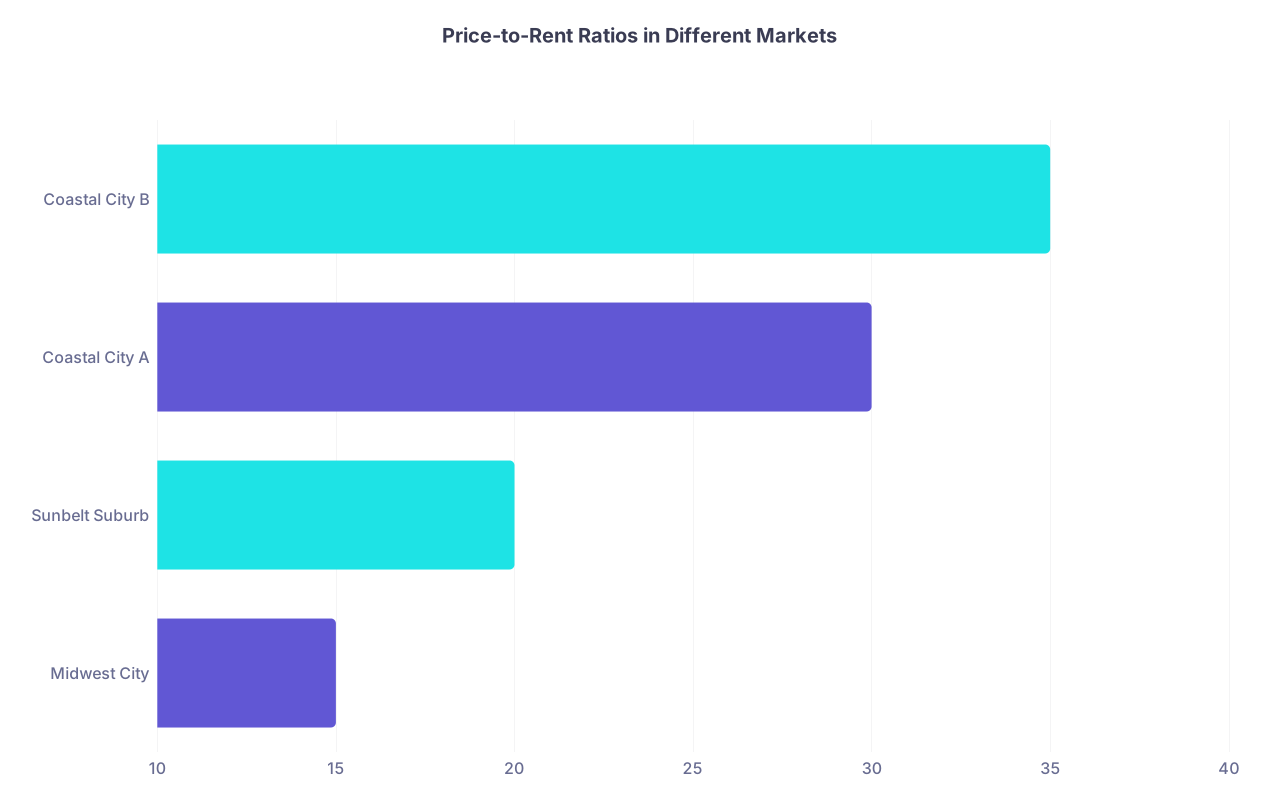
| Category | Value |
|---|---|
| Midwest City | 15 |
| Sunbelt Suburb | 20 |
| Coastal City A | 30 |
| Coastal City B | 35 |
When price-to-rent ratios are this skewed (30–35x annual rent for purchase price), renting is often financially superior. In plain language: if buying the house costs more than ~20–22 times what it would cost to rent it for a year, you’re usually better off renting and investing the difference.
Coastal doctors, I’m looking at you. When your $2M house rents for $6,000/month, something is off. That’s a cap rate under 4% before maintenance and taxes. Investors would laugh at that. Yet physicians call it “a great school district.”
What actually makes sense for most doctors
I’m not anti-ownership. I’m anti-dogma.
Ownership makes sense when:
- You have a stable job you like, in a region you’ll likely stay in for 7–10+ years
- You’ve cleaned up high-interest debt and are on track for retirement
- The price-to-rent ratio is reasonable (say under low-20s)
- You’re funding investment accounts and can still comfortably afford housing without stretching
Renting makes sense when:
- You’re early in your career and mobility is likely
- The market is insane and rent is relatively reasonable
- You value mental bandwidth more than Instagram-worthy kitchen renovations
- You’re still building your financial foundation
If you want a simple decision flow:

| Step | Description |
|---|---|
| Step 1 | Need housing |
| Step 2 | Rent |
| Step 3 | Consider buying |
| Step 4 | Plan to stay 7 years or more |
| Step 5 | Price to rent under 22x |
| Step 6 | High interest debt or weak savings |
| Step 7 | Comfortable payment with investing |
The emotional pressure you need to ignore
A lot of this is not finance. It is identity.
“I’m a doctor, I should own by now.” “My parents will freak if I say I’m renting.” “My colleagues will think I’m behind.”
I’ve heard attendings on $500k+ incomes say this while sitting on $400k of loans and a $3k/month car habit. Then they buy a $1.3M house and call it “cheaper than renting” because their mortgage is $7k vs rent of $6k on a worse property. They don’t count everything else.
Housing is not a moral achievement. It’s a consumption choice with financial side effects. Owning a house does not mean you are good with money. It just means you own a house.
If renting a clean, quiet, well-located place allows you to:
- Max out all your investment accounts
- Pay off loans faster
- Sleep without worrying about the AC compressor dying
…then that is not “throwing money away.” That is buying flexibility.
Doctors, stop playing the wrong game
Here’s the uncomfortable truth. Real estate is a game where:
- The bank gets paid
- The realtor gets paid
- The contractor gets paid
- The county gets paid
- You take the leverage and the risk
Sometimes, that trade is worth it. Long-term, in sane markets, ownership can absolutely build wealth.
But physicians already play a highly leveraged, highly specialized main game: your career. You’ve got human capital that throws off big cashflow when you protect it—through good schedules, better jobs, sane call, and not chaining yourself to the wrong zip code just to feel “grown up.”
Own when it truly fits your life and numbers. Rent proudly when it doesn’t.
Boiled down
- “Doctors should own real estate” is not a universal truth; it’s a story that collapses as soon as you run honest numbers on total costs, timelines, and opportunity cost.
- Renting can beat buying—often by a wide margin—when you factor in instability early in your career, insane price-to-rent ratios, and the value of your time and flexibility.
- Your status as a physician doesn’t require a mortgage. Your job is to build net worth and freedom, not just square footage.