
The way hospital executives expect you to “invest” is designed to keep their balance sheet healthy, not yours.
Once you see the game board, their advice stops sounding like mentorship and starts looking like what it is: a retention strategy dressed up as “opportunity.”
Let me walk you through how this really works behind closed doors.
The Hidden Agenda Behind “Opportunities” for Physicians
I’ve sat in those admin meetings where they talk about you. Not by name, usually. By type.
“High producer. Young family. Just bought a house. Should be open to equity-type incentives.”
“Burned out. Talking about cutting FTE. We should get them into the comp committee early.”
They do not say, “How can we help Dr. Smith build independent wealth?”
They say, “How do we keep Dr. Smith here for 10 years?”
That difference is everything when you’re talking about money, contracts, and “investment opportunities.”
Here’s the uncomfortable truth: hospital executives generally expect physicians to invest in three main ways:
- Invest your time (extra clinics, admin roles, committees).
- Invest your career risk (join new service lines, “help us build this program”).
- Invest your actual money (ASC ownership, practice buy-ins, capital calls, hospital-linked projects).
They sell each of those as a way for you to “benefit from the upside.”
Most of the time, they’re dead wrong. Or they’re right only for the top 10% of producers and absolutely wrong for everyone else.
Let’s unpack each category the way they talk about it in the C‑suite.
How Admins Expect You to Invest Your Time (and Why It’s Almost Never a Good Deal)
There is no cheaper asset in a hospital than physician goodwill. Executives are trained to monetize it.
You think you’re “being a team player.”
They think you’re “accepting uncompensated work with high marginal ROI for the system.”
Common time “investments” they push:
- “Growth opportunities” (new clinic sessions, expanded coverage)
- “Leadership development” (medical directorships, committee work)
- “Strategic initiatives” (EMR optimization, quality projects, ‘value-based care’ pilots)
Let me tell you how those look from the admin side.
Extra clinical time: the productivity trap
You’ll hear:
“If you just add one more half-day, you’ll hit the next comp tier.”
“We really need coverage for evenings and Saturdays. Huge growth potential.”
Behind the scenes, the CFO pulls up a spreadsheet:
“What’s the margin on another 4 sessions a month from this doc? How much do we need to adjust comp to keep them happy but still net more?”
They expect you to think like this:
- More RVUs = more income = I’m investing in my earning power.
Here’s what they ignore, and what most doctors never calculate:
- Marginal tax rate on that extra income (often 37–50% effective when you add federal, state, payroll).
- Burnout cost. You’re turning your one non-renewable asset—your own energy—into a little more cash that you’re usually too exhausted to deploy intelligently.
- Opportunity cost of using that time to build scalable, non-wRVU income: real estate, index fund portfolio, a simple side LLC, or frankly, rest and recovery so you can sustain your career.
I’ve watched too many internists go from 0.9 FTE to 1.1 FTE for maybe 15–20% more gross pay and absolutely wreck their health, marriage, and life, while the system’s EBITDA looks great.
Executives are not wrong that more clinical work creates “value.”
They’re just wrong about for whom.
“Leadership roles”: the prestige illusion
The other big one is leadership.
You’ve heard this pitch:
“We’d love for you to be Medical Director of the service line. It’s a strategic role.”
Real translation:
“We need a doctor face to sell decisions we’ve already made. Ideally one who won’t fight too hard.”
Typical structure:
- 4–12 hours a week of “admin time”
- A small stipend or a slight bump in base
- No real authority over budget, staffing, or capital spending
- Responsibility for metrics you do not control (throughput, LOS, readmissions)
From the executive narrative:
- This is an “investment in physician leadership pipeline.”
- It “aligns the doctors with the strategic plan.”
- It “builds engagement.”
From the financial reality:
- They’re buying your credibility cheaply.
- They offload physician discontent onto you: “Talk to your Medical Director.”
- They expect you to absorb political blows when unpopular changes roll out.
Is there ever a scenario where this is worth it for you? Yes, but it’s specific:
- You actually want to move into admin long term (CMO, VPMA, etc.).
- You negotiate clear authority and clear metrics tied to meaningful pay.
- You treat the stipend as seed capital to build outside assets, not an excuse to inflate lifestyle.
Where doctors go wrong is thinking prestige equals wealth.
Executives know better. They’re paid on hard metrics—operating margin, growth, payer mix. You should be too.
The Riskiest Ask: When They Want Your Actual Money
Here’s where things get really interesting—and often really ugly.
The minute a hospital system or affiliated group starts offering you a chance to write a check—to “buy in,” “participate in equity,” “co-invest”—you need to pause.
Because someone in a suit already did the math. If it were such an obviously great deal, they would not need you.
Common examples:
- ASC (ambulatory surgery center) ownership
- Imaging center, lab, or ancillary equity
- Group practice buy-ins (especially PE-backed deals)
- “Physician-hospital organization” or CIN “participation units”
- Real estate tied to the hospital campus
Let’s break down the ones I see most abused.
ASC and ancillary equity: where admin thinks you should pile in
Every admin loves to talk about physician “alignment.”
Equity in an ASC, they say, is the perfect alignment.
Their pitch usually sounds like this:
“You’ll benefit from both professional fees and facility fees.”
“We want you to share in the upside as we grow this center.”
“This is how partners build generational wealth.”
Behind the scenes, in the boardroom, the tone is different:
“We need physician capital so we do not strain system debt ratios.”
“We have to keep them tied to our ecosystem so they don’t take cases across town.”
“We’ll structure the waterfall so the system gets paid first.”
Typical structure they won’t explain to you clearly:
- They control the management company, or at least the key contracts.
- They determine how much of the revenue is skimmed off as “management fees.”
- They control the payer contracts that determine rates.
- They often hold call coverage, block time, or referral levers.
Sometimes the deal is strong, especially for high-volume proceduralists in markets with good commercial payers.
But here’s where they’re often wrong:
- They expect every surgeon or proceduralist to jump in regardless of personal financial position (high-interest debt, no emergency fund, zero diversification).
- They assume you won’t compare the risk-adjusted return to a dead-simple index fund or a boring rental property.
- They count on your fear of missing out, not your ability to read an operating agreement.
I’ve seen surgeons pour six figures into a center that looked hot on paper and then watched reimbursement erode, management fees creep up, and distributions dry to a trickle. Meanwhile, their net worth would have doubled if they’d just maxed retirement accounts and bought VTI for five straight years.
Private equity buy-ins and “a second bite at the apple”
This has exploded in the last decade.
Story usually goes like this:
- You join a large specialty group.
- PE comes in and buys 60–80%.
- Senior partners cash out nicely.
- Junior partners and new hires get told they’re “buying in” to something that will have a “second exit” down the road.
On the physician side, the story is, “You’re now an owner.”
On the investor side, the story is, “We just acquired labor at a discount with baked-in non-competes.”
I’ve watched anesthesiologists, ophthalmologists, dermatologists sink $150–250k into these buy-ins, while the PE fund extracts their return through:
- Management fees
- Debt load put on the practice
- Squeezing comp and benefits
By the time “second exit” rolls around, valuations are lower, growth is slower, and the “multiple” is already harvested. You get table scraps.
Can it work out? Sometimes. But the asymmetry is glaring:
- They’re diversified across multiple deals.
- You’re concentrated in one illiquid stake plus your own W‑2 job in the same entity.
Executives and investors expect you to ignore that concentration risk because “you’re already here.”
That’s not strategy. That’s inertia.
The Investment Strategy Hospital Leaders Never Want You to Have
Let me flip the frame.
If you strip away the hospital’s agenda, what should a rational physician actually invest in?
Not theory. Actual sequencing.
I’ll give you the skeleton I’ve watched work over and over again for attendings who do end up wealthy and free, not just highly paid and trapped.
Step 1: Buy your own freedom first
Before you buy an ounce of hospital-tied equity, do this:
- Build 3–6 months of bare bones expenses in cash.
- Destroy any non-mortgage debt over 6–7% interest.
- Max out tax-advantaged accounts you control: 401(k)/403(b) up to match at least, then backdoor Roth IRA, then HSA if you have one.
Why executives hate this: none of this keeps you tied to their institution.
You can take that retirement account anywhere. Your emergency fund works just as well if you quit.
But this is your foundation. Without it, every “investment opportunity” they offer is built on quicksand.
Step 2: Build diversified, boring, portable wealth
Once the basics are locked in, you prioritize investments that are:
- Liquid or at least diversifiable.
- Not tied to one employer, one payer mix, one regional network.
- Simple enough that you can understand the risk without a 40‑page PPM.
That usually means:
- Broad index funds in taxable accounts (total US + total international).
- Maybe a straightforward real estate approach (REITs, or if you want direct ownership, a cautious entry with one small property in a stable market).
- Very minimal “alternative” investments until your net worth can absorb volatility.
Hospital execs almost never bring up low-cost index funds in their “investment” conversations with you. Because your Vanguard account does not add a line to their balance sheet.
What they want is your human capital and your financial capital pointed in the same direction: toward their system.
Your job is to aim them in different directions on purpose.
Step 3: Only then consider hospital-tied investments—and treat them like spices, not the main dish
Once your core portfolio is large enough that losing 50–100k would sting but not ruin you, then you can consider things like:
- ASC equity (with ruthless due diligence and real legal review).
- Practice ownership shares where you actually have governance power.
- A very selective PE-recap buy-in where the risk-return equation makes sense for you.
But you size them as 5–15% of your total net worth, not your entire plan.
The exec mindset is the inverse. They want the majority of your economic life anchored to your employment and their ecosystem.
They’re not evil for that. They’re doing their job.
You just can’t outsource your financial life to someone whose success is measured by how stuck you are.
What They Get Wrong About “Risk”
Behind closed doors, I’ve listened to CFOs and strategy VPs justify doctor-facing deals like this:
“From the physician perspective, this is low risk—they’re already doing the cases here. This is just monetizing existing volume.”
Their blind spots are huge:
- Career risk: If this blows up (reimbursement cuts, regulatory changes), you cannot just “pivot to another vertical.” They can. You’re tied to licenses, call schedules, credentialing.
- Regulatory risk: Stark, anti-kickback, changing interpretations. These things shift. When they do, guess who gets named personally in investigations? Hint: it’s not the VP of Strategy.
- Concentration risk: They run a portfolio of service lines, hospitals, regions. You have one credentialed specialty and one physical body.
They see your investment in their ventures as “skin in the game.”
In reality, it’s usually all your skin in one game.
The smarter physicians I know think like institutional investors:
- Cap total exposure to any one employer or entity.
- Demand a risk premium for illiquidity and concentration.
- Nail down the downside first, then look at upside.
If the execs pitching you can’t speak coherently about downside scenarios, distributions, capital calls, and exit mechanisms, assume they don’t care about your risk. Only their own.
The Quiet Investments That Really Change Your Life
There are three underrated investments almost no hospital leader will ever mention, but they’re the ones that actually move the needle on your long-term freedom.
1. Contract literacy
I’ve seen more money lost in bad contracts than in bad stocks. And I’ve watched highly paid physicians sign:
- 2‑year non-competes covering entire metro areas
- RVU targets that require 60–70 hours/week to hit “median pay”
- Call requirements that effectively cap their outside earning and investment capacity
You should treat contract review as an investment class of its own.
Pay the attorney. Ask the annoying questions. Walk away if you need to.
Admin expects you to negotiate softly, if at all.
The physicians who end up wealthy behave like they’re the only person in the room protecting their future. Because most of the time, they are.
2. Financial education
Executives speak fluent P&L, EBITDA, NPV.
Most doctors do not.
They expect you to glaze over when they throw around phrases like “normalized earnings,” “platform multiple,” “top-line growth vs margin compression.”
Every hour you spend making yourself literate in:
- Basic corporate finance
- Tax strategy for high earners
- Physician contract and healthcare law basics
…is an hour that breaks their information advantage.
You don’t need an MBA. You need enough fluency to spot a bad deal in the first 10 minutes of a pitch.
3. Optionality
Probably the most valuable asset you can buy as a physician is the ability to say, “No, that doesn’t work for me,” and actually mean it.
You build that through:
- Low fixed expenses
- High savings rate (especially early attending years)
- Portable investments
- Minimal golden handcuffs
Admin expects you to get trapped:
- Big house
- Private school
- Car leases
- Lifestyle that exactly consumes your W‑2
Then, when they offer you a “chance” to buy into their projects, you’re too scared to say no.
The doctor who has already built a 7‑figure portfolio outside the hospital network is a different animal. That doctor looks at every hospital-tied investment as optional seasoning, not food.
Executives feel that in negotiations. And they behave very differently when they can sense you’re free to walk.
| Area | What Execs Push | What Actually Helps You |
|---|---|---|
| Time | Extra clinics, more FTE | Protected time, sustainable load |
| Money | ASC/PE buy-ins, practice equity | Broad index funds, simple real estate |
| Career Risk | New service lines, leadership | Contract flexibility, low overhead |
| Education | “Leadership academies” | Independent finance and legal literacy |
| Alignment | Tied to system ventures | Diversified, portable net worth |
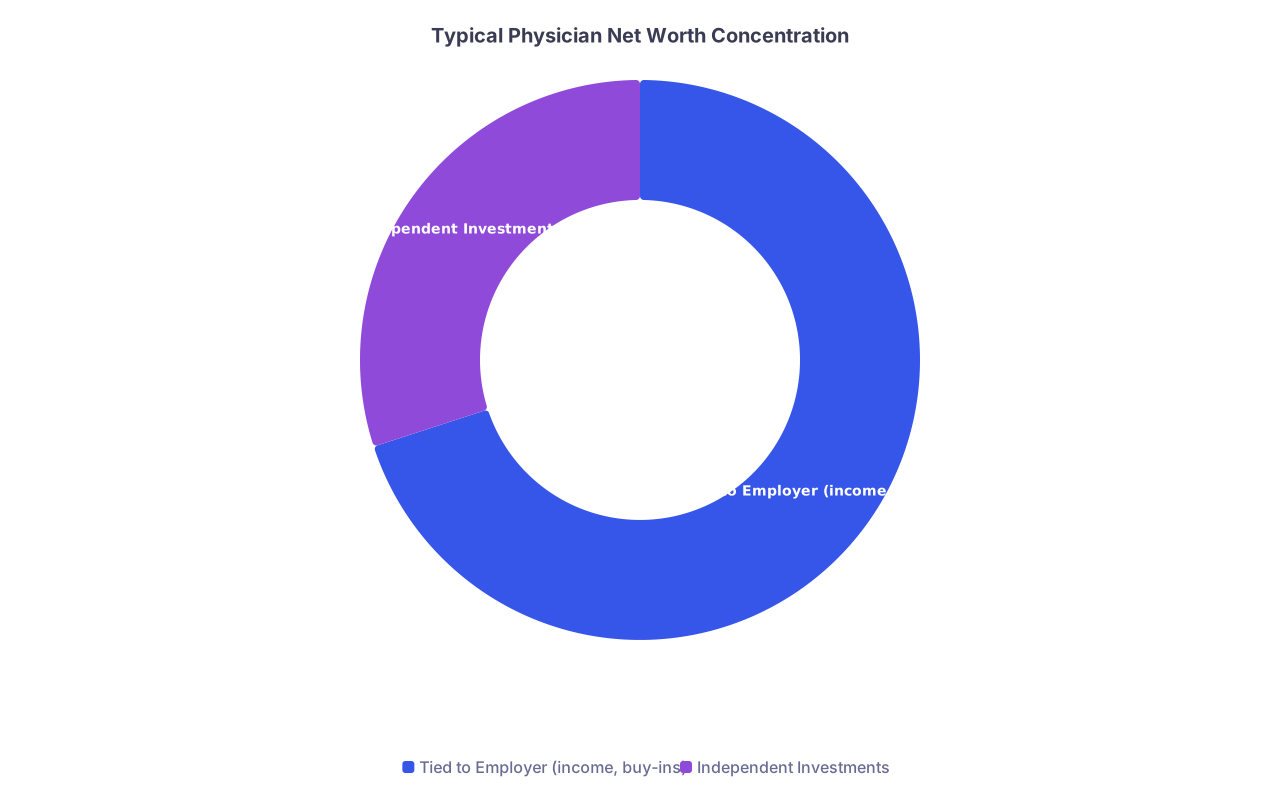
| Category | Value |
|---|---|
| Tied to Employer (income, buy-ins) | 70 |
| Independent Investments | 30 |

| Step | Description |
|---|---|
| Step 1 | Offered Hospital Investment |
| Step 2 | Build Emergency Fund and Pay High Interest Debt |
| Step 3 | Max Retirement Accounts and Index Funds |
| Step 4 | Reduce Existing Employer Exposure |
| Step 5 | Due Diligence and Legal Review |
| Step 6 | Pass on Deal |
| Step 7 | Invest Small Slice of Net Worth |
| Step 8 | Foundation Built? |
| Step 9 | Concentration Under 20 percent? |
| Step 10 | Risk Reward Makes Sense? |

How to Respond When Admin Comes With “Opportunities”
Let’s get tactical. When an executive comes to you with an “investment” idea, here’s the internal script the savvy physicians I’ve worked with use.
Assume it’s structured in their favor until proven otherwise.
That sounds cynical. It’s just accurate.Separate the decision to work there from the decision to invest there.
You can be a loyal, hardworking doc and still say no to their equity pitch. Those are different relationships.Ask for everything in writing—then have your people read it.
Operating agreement, cap table, distribution waterfall, call provisions, redemption terms. If they flinch when you ask for this, you have your answer.Calculate what percentage of your net worth this would be.
If the number makes you sweat, it’s too big.Run the boring comparison.
“If I put this same amount into a global index fund or a simple property and never touch it for 15–20 years, what does that look like?”
A shocking number of hospital deals look terrible next to that.Be willing to say: “I’m going to pass for now.”
No elaborate excuse. Just a calm, “This doesn’t fit my risk tolerance and current plan.”
The doctors who do that consistently end up in a far better spot than the ones who chase every “inside” deal attached to their hospital badge.

FAQs
1. Are all hospital or ASC investment opportunities bad for physicians?
No. Some are genuinely lucrative—especially high-quality ASCs in strong commercial markets where physicians have real governance power and reasonable buy-in terms. But they’re the exception, not the rule. The key is: they should be a modest slice of a diversified plan, after you’ve built a strong independent base.
2. How much of my net worth is “safe” to tie to my employer’s ventures?
As a rough ceiling, I do not like seeing more than 10–20% of your total net worth tied to any single employer’s equity, buy-ins, or real-estate-adjacent deals. If your job, your income, and a big chunk of your capital are all pointed at the same entity, your risk is far higher than you think.
3. I’m already deep into an ASC/practice buy-in. Did I ruin my financial future?
Probably not. But you do need to rebalance. That means pushing new savings into diversified, portable assets—retirement accounts, broad index funds, maybe conservative real estate—rather than doubling down on more employer-linked deals. You treat your existing buy-in as a fixed, illiquid position and build around it.
4. What kind of lawyer should review these deals for me?
You want someone who does this weekly, not a generic real estate or family attorney. Look for an attorney who specializes in physician contracts and healthcare transactions. Ideally, they’ve actually read and negotiated ASC operating agreements, PE recap docs, and hospital joint ventures before. Ask them bluntly, “Would you invest in this if you were me at my age and net worth?”
5. If I say no to a hospital investment, will I hurt my career there?
You might bruise an ego or two, but I’ve rarely seen real retaliation if you stay professional. Executives respect quiet, firm boundaries more than you think. A simple, “Given my current financial plan and risk tolerance, I’m going to pass, but I appreciate you thinking of me,” is enough. If a system treats you differently because you didn’t write them a check, that’s not a place you should be tying your career to anyway.
Key points:
Hospital executives expect you to invest your time, risk, and money in ways that secure their institution, not your independence. Your primary investments should be portable, diversified assets and your own legal and financial literacy. Only after that foundation is solid should you even consider employer-tied deals—and even then, they’re seasoning, never the main course.