
The riskiest thing most doctors do with money is nothing.
Not crypto. Not meme stocks. Not options trading. Just…sitting in cash because the stock market feels like a casino where everyone else somehow knows the rules and you’re the idiot walking in with a white coat and zero clue.
If your gut reaction to investing is, “I’m going to lose everything,” you’re not crazy. You’re just a doctor who has seen way too many worst‑case scenarios in real life, and your brain is now running the same disaster simulator on your finances.
Let’s talk about safer, boring, “I can sleep at night” ways to get started without feeling like you’re gambling away your future kids’ college funds.
Why Doctors Are So Scared of the Market (You’re Not Broken)
You’re not bad with money. You’re traumatized by risk.
You spent your 20s in libraries and call rooms while your non‑medical friends learned about 401(k)s and “the market.” Meanwhile, your financial education was:
“Sign this loan document. Don’t worry, you’ll be an attending someday.”
Now you’re:
- Late to the game
- Carrying multiple six figures in debt
- Terrified of making a big mistake
And you’ve heard every horror story:
- “My uncle lost half his retirement in 2008.”
- “My colleague tried day trading and blew through 50k.”
- “That one doctor who invested in a surgery center that never opened.”
So your brain does what it always does: catastrophizes.
“If I invest in the stock market, I’ll pick the wrong thing, buy at the top, the market will crash, I’ll lose it all, I’ll never retire, I’ll work until I’m 80, and I’ll die in clinic.”
Sound familiar?
Let me be blunt: avoiding investing because you’re scared is not safer. It just trades one kind of risk (volatility) for another, much more silent one (time and inflation).
The Real Risk You’re Missing: Doing Nothing
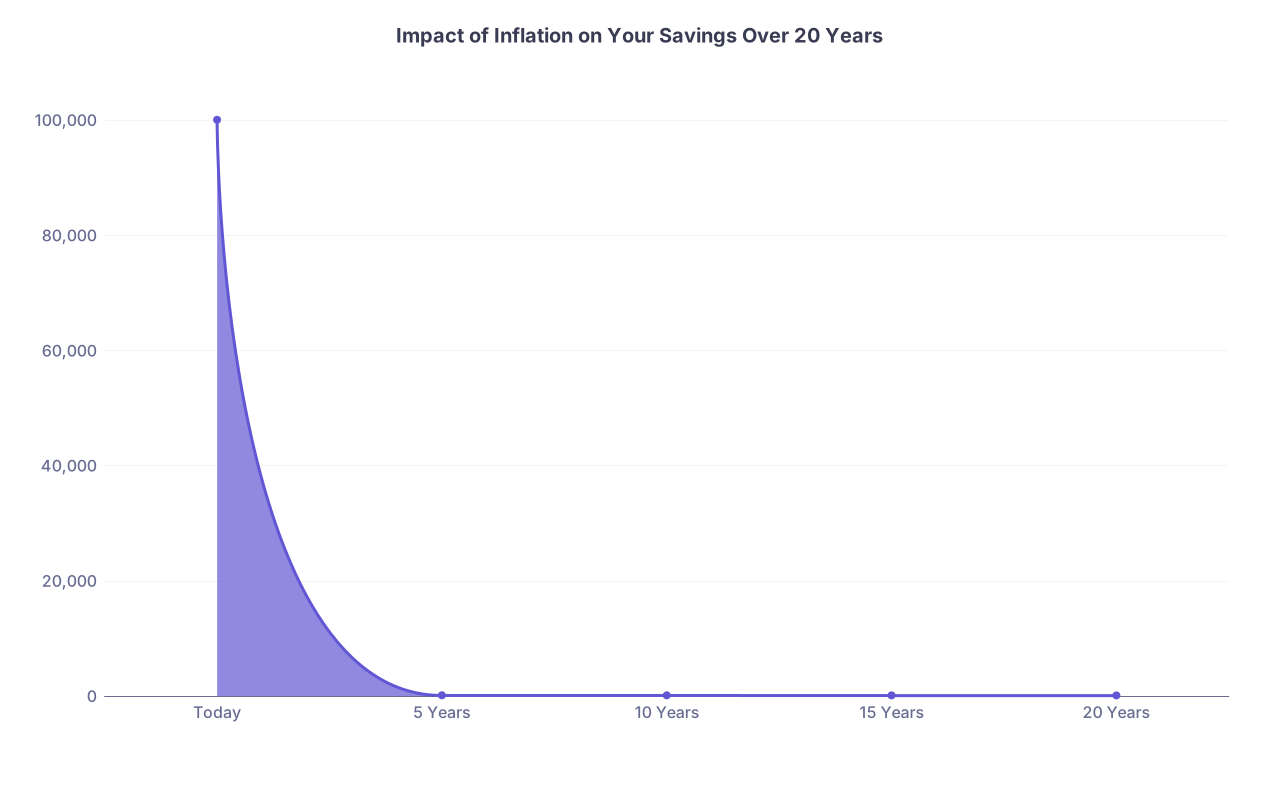
You probably trust numbers more than motivational quotes, so let’s look at actual math.
| Category | Value |
|---|---|
| Today | 100000 |
| 5 Years | 90 |
| 10 Years | 82 |
| 15 Years | 74 |
| 20 Years | 67 |
If inflation averages just 3% a year (which is conservative long‑term), $100,000 in cash today has the buying power of about $67,000 in 20 years.
So the “safe” choice of leaving everything in a savings account is quietly killing your future purchasing power. No drama. No flashing red line on CNBC. Just erosion.
Meanwhile, a boring, diversified stock/bond portfolio has historically grown way faster than inflation over long stretches of time, even though it looks terrifying if you zoom in too close.
Here’s the uncomfortable truth:
- Cash feels safe.
- Investing feels scary.
- Long‑term reality is usually the opposite.
You don’t need to become a fearless risk‑taker. You just need to stop confusing “no movement” with “no risk.”
Ground Rules: What “Safer” Actually Means for You
Let’s define “safer,” because this is where anxious brains get messed up.
“Safer” does not mean:
- No red days
- No temporary losses
- Never seeing your account drop
“Safer” for a doctor just starting out means:
- You can be wrong without being ruined
- You don’t need to check your portfolio every day to function
- You don’t put money at risk that you might need in 1–3 years
- You don’t bet your entire future on a single stock, property, or business
Think of your financial life the way you think of a patient:
- Critical needs first (emergency fund, insurance)
- Then stabilization (debt, basic retirement savings)
- Then long‑term rehab (growing wealth, optional risks later)
If that foundation isn’t set, any investment will feel like playing with fire.
Step Zero Before You Invest a Dollar: Don’t Skip This
You want “safe”? This is where it actually starts.
Emergency fund
3–6 months of expenses in a high‑yield savings account.
Attending making $300k with fixed costs of $8k/month? You want $24–$48k in cash.
Resident with $2.5k/month expenses? Aim for ~$8–15k.Insurance that keeps disaster from wiping you out
- Own-occupation disability insurance (non‑negotiable)
- Term life insurance if anyone depends on your income
This is the “don’t lose everything if something awful happens” layer.
No high‑interest debt beyond 7–8%
If you’ve got 19% credit cards or 11% personal loans, those are a guaranteed negative “investment.” Paying those off is safer and mathematically smarter than almost anything in the market.
Once those three are in place, now we can talk about investing without that chronic pit in your stomach.
The Safest On‑Ramp: Use the Retirement Accounts You Already Have
Here’s the part they did not explain at orientation when HR dumped a 70‑page benefits packet on you.
Most doctors already have access to the simplest, cleanest investing structure and are just…not using it.
- 401(k) or 403(b) through your hospital
- 457(b) in some systems
- Roth IRA or backdoor Roth IRA on your own, depending on income
These accounts are just containers. What makes them safe or dangerous is what you put inside.
The “scary” part (picking investments) doesn’t have to be complicated. Many plans literally have an autopilot option called a “target date fund.”
Option 1: Target Date Funds (Training Wheels, But Fine)
You pick a fund labeled with a year around when you might retire. For example:
- You’re 32, maybe want to retire around 65 → pick 2055 or 2060 fund
- You’re 40 → maybe 2045 or 2050 fund
That fund automatically adjusts the mix of stocks and bonds as you age. More aggressive now, more conservative later.
Could you do better customizing your mix? Sure.
Do you need to as a terrified beginner? No.
This is the “just put something in and stop overthinking” option.
A Very Boring, Very Doctor‑Friendly Starter Portfolio
If target date funds feel too opaque (“what’s actually inside this thing?”), here’s the kind of ultra‑simple setup I’ve seen calm down a lot of anxious physicians:
| Asset Type | Percentage |
|---|---|
| Total US Stock Index | 40% |
| Total International Stock Index | 20% |
| Total Bond Market Index | 40% |
This isn’t magic. It’s just:
- Broad stock exposure (US + international) for growth
- A heavy dose of bonds to smooth out the violent swings
Could this lose money in a bad year? Absolutely.
Could it go down 10–20% in a nasty bear market? Yep.
But could it plausibly go to zero and ruin you? Basically no, unless capitalism itself melts down, in which case your portfolio won’t be your main problem.
“But What If I Invest Right Before a Crash?”
This is the nightmare loop most anxious beginners run.
“I finally gather the courage, I put money in, and then the market immediately tanks 30%. That would literally prove I’m cursed.”
Let’s address this like adults, not like Instagram influencers.
Yes, that could happen.
You are never guaranteed to invest at the “right” time. No one is.This is why you don’t dump everything in at once if you’re terrified.
You can use dollar‑cost averaging: spread your investing over 6–12 months.Example: You’ve built $60k in cash beyond your emergency fund and want to invest it. Instead of tossing all $60k in one day and then doom‑scrolling:
- Invest $5k each month for 12 months
- Or $2.5k every paycheck if you’re paid biweekly
This way, if the market drops, you’re buying at lower prices along the way. If it goes up, you still benefited.
The real protection is time, not clever timing.
Historically, broad stock markets have recovered from crashes and gone on to new highs. The worst 1–3 years feel brutal; the 10–20 year chart usually looks like a rough patch on a rising staircase.
If you’re in your 30s or 40s, your time horizon is not 6 months. It’s decades. Your nervous system doesn’t like that. But your math brain knows it’s true.
Non‑Stock Options if You’re Truly Shaking
There are a few things you can do if you’re just not emotionally ready to stomach a typical stock portfolio yet.
High‑Yield Savings + CDs
This is the “baby pool”:
- Online savings accounts with ~4–5% interest (varies with rates)
- CDs (Certificates of Deposit) with locked terms: 6, 12, 24 months, etc.
Pros:
- FDIC insured up to limits
- No market swings
- You can see the interest accruing slowly
Cons:
- Long‑term, they won’t keep up with inflation as well as stocks+ bonds
- You won’t build real wealth here, just protect cash
Good for:
- Emergency fund
- Short‑term goals (house down payment in 1–3 years)
Not good as your only “retirement plan.”
I Bonds and Treasuries
If inflation scares you (and it probably should more than day‑to‑day volatility), US I Bonds and Treasury securities are another relatively safe space.
- I Bonds: Backed by the US government, interest tied to inflation
- Treasuries: Short‑ or long‑term government bonds with low default risk
These are not exciting. Which is exactly why anxious investors like them.
The “Doctor Trap” to Avoid: Overcomplicated “Safe” Deals
There’s a special category of financial horror stories that only physicians seem to collect: “safe” sounding private deals that go sideways.
Things like:
- A “can’t lose” surgery center investment
- A “conservative” real estate syndication pitched at a steak dinner
- A private note for a colleague’s startup or clinic expansion
- Whole life insurance sold as an “investment” and “forced savings”
These all get advertised as safer, more stable, more “sophisticated” than the public markets.
I’ve watched people lose hundreds of thousands in:
- Urgent care ventures that died
- Real estate projects that never hit projected returns
- Illiquid private deals where the money is stuck for years
Are all of these bad? No. But they are absolutely not where you start if you already feel like you’re one misstep away from financial disaster.
If you can’t clearly explain:
- How the money is made
- Where your risk actually is
- How you get your money back and on what timeline
- Why this is better than just owning a boring index fund
…then you’re not ready for it. And that’s not a moral failing. That’s just self‑preservation.
Emotional Safety Protocols for Anxious New Investors
You can have the perfect portfolio on paper and still feel sick whenever you open your account. So design your system to protect your nervous system, not just your net worth.
A few things that actually help:
Automate everything
Set a percentage of each paycheck to go straight into your 401(k)/403(b) and maybe an IRA. You should not be manually deciding every month “do I invest or not?” That decision fatigue alone will wreck you.Change how often you check
In residency, you weren’t evaluating patients every 30 seconds “just in case.” Same with investments. Once a month is plenty. Once a quarter is honestly better for your sanity.Pre‑decide what you’ll do in a crash
Write it down. Literally. Something like:
“If my portfolio drops 20%, I will:- Not sell anything for at least 3 months
- Continue my automatic contributions
- Revisit my allocation only if I’m losing sleep for weeks”
Use a separate login for your investments
Keep your day‑to‑day checking/savings account separate from your investment accounts. Don’t have them in your face every time you pay a bill.
Very Rough Starter Blueprint for a Scared Doctor
Here’s an anxiety‑friendly progression, not a rigid plan:
- Build 3–6 months of expenses in high‑yield savings
- Get disability and term life in place
- Pay off any credit card / high‑interest debt
- Start contributing to 401(k)/403(b) up to employer match (if any)
- Use a single target date fund or simple 2–3 fund portfolio inside that account
- Consider Roth IRA/backdoor Roth IRA once you’re steady
- Resist FOMO on fancy private deals until your boring base is strong
If you want a sense of how this might look over time:

| Step | Description |
|---|---|
| Step 1 | Start - All Cash |
| Step 2 | Emergency Fund |
| Step 3 | Insurance In Place |
| Step 4 | High Interest Debt Paid |
| Step 5 | 401k Contributions Start |
| Step 6 | Simple Boring Portfolio |
| Step 7 | Roth IRA or Backdoor |
| Step 8 | Optional Complex Investments |
You don’t have to do all of this this year. You just have to not be in exactly the same fearful spot 5 years from now.
FAQ (Exactly the Stuff You’re Afraid to Say Out Loud)
1. What if I literally know nothing and I’m scared I’ll click the wrong thing and lose money?
Then start with your workplace retirement plan and pick a single target date fund that matches your rough retirement year. That’s it. One choice. You’re not going to “accidentally” buy options or crypto inside a basic 401(k) unless you go hunting for it. When in doubt, call HR or the plan’s helpline and tell them, “I want a target date retirement fund appropriate for someone age X.” This is normal. They hear it all the time.
2. Is it stupid to keep a lot in cash because it helps me sleep?
It’s not stupid. It’s just expensive in slow motion. Holding more cash than strictly necessary is a psychological crutch that many anxious investors use early on. I’d rather see you keep 9–12 months in cash and actually start investing something, than insist you be “optimized” and then you stay paralyzed. Over time, as you see that the world doesn’t end when your balance goes up and down, you can gradually shift more into investments.
3. What if I invest and then need the money for a house or an emergency?
That’s why money you’ll need in the next 1–3 years should not be in the stock market. House down payment money? Keep it in high‑yield savings, CDs, maybe short‑term Treasuries. The money you invest in stocks/bonds should be money you don’t expect to touch for 5+ years. If you’re mixing short‑term and long‑term money in the same pot, everything will feel terrifying because any drop feels like it’s delaying your life plans.
4. Aren’t bonds safe enough to just put everything there?
Bonds are generally safer than stocks in terms of volatility, but they still move, and long‑term they don’t grow as fast. If you’re 35 and put everything in bonds, you’re basically accepting slower growth and a higher chance of not hitting your retirement goals without working longer or saving way more. A mix of stocks and bonds is usually a better compromise. If you’re terrified, tilt heavier to bonds (like 40/60 stocks/bonds) at first and adjust later.
5. Do I need a financial advisor, or can I actually do this myself?
You can absolutely do this yourself with a simple setup. But if your anxiety is so high that you know you’ll freeze or freak out, a good fee‑only fiduciary advisor can be training wheels, not handcuffs. Red flags: anyone trying to sell you whole life insurance as an “investment,” or anyone paid by commissions on products. Green flag: someone who charges a flat or hourly fee, talks you out of fancy stuff, and recommends simple index funds.
6. What if I start now and realize 5 years later I “did it wrong”?
Doing it “wrong” (like using a slightly more expensive fund or being too conservative early on) is still dramatically better than not investing at all. The people who regret things most are rarely the ones who bought a decent index fund instead of the perfect one; they’re the ones who stayed in cash for a decade because they were scared. You can always adjust your allocation as you learn. The only truly catastrophic mistake is never starting.
Bottom line?
You don’t need to become a fearless investor. You just need a boring, protective foundation, a simple plan you actually follow, and guardrails so your anxiety doesn’t shove you into either paralysis or panic‑selling.
Start small. Make it automatic. Don’t chase “smart.” Chase “repeatable and calm.”