
Real estate is not “passive income” for doctors. The data shows three very different businesses hiding under that label: direct ownership, REITs, and syndications. Treat them as interchangeable, and you are asking for disappointment.
You are a physician. Your scarcest resource is time, not income. So the only rational way to choose between these three is to quantify: returns, risk, taxes, and time drag. Let’s do exactly that.
1. The Real Return Drivers: What Actually Makes You Money
Strip away the sales pitches. All three structures pay you from the same economic engines:
- Rental income (cash yield)
- Loan paydown (if leveraged)
- Property value growth
- Tax benefits (depreciation, 1031 exchanges, etc.)
The differences are not “what” you earn from, but “how” that income is sliced, packaged, and taxed.
Here is the high-level comparison pulled into one table.
| Factor | Direct Ownership | Public REITs | Private Syndications |
|---|---|---|---|
| Typical Target Return | 7–12% annualized | 7–10% long-run total return | 12–18% projected IRR |
| Cash Yield (current) | 4–7% | 3–5% dividend yield | 6–10% distributions (variable) |
| Liquidity | Low (months) | High (daily) | Very low (5–10+ years) |
| Control | High | None | None / very limited |
| Time Commitment | High | Minimal | Low–Moderate (front-loaded) |
| Leverage Control | You decide | Manager decides (usually modest) | Sponsor decides (often higher) |
| Tax Shelter (Depreciation) | Strong – direct use | Built-in at REIT level | Very strong – often accelerated |
Those ranges are based on broad historical and market data, not “my friend’s deal.” Outliers exist. You should not build a financial plan around outliers.
2. Direct Ownership: The “Doctor Landlord” Business
Direct ownership is exactly what it sounds like. You buy the property. You own the debt. You are the asset manager (even with a property manager you hired).
What the numbers generally look like
Let’s quantify a very typical doctor move: a $1,000,000 small medical office / mixed-use building.
- Purchase price: $1,000,000
- Down payment: 25% ($250,000)
- Loan: 75% at 6.0%, 25-year amortization
- Gross rent: 7.5% of value = $75,000/year
- Operating expenses (taxes, insurance, repairs, management): 35% of gross = $26,250
- Net operating income (NOI): $48,750
- Annual debt service: about $77,600
On those numbers, year 1 cash flow before tax is actually negative: about -$28,850.
That shocks a lot of physicians. The first years of leveraged direct ownership often do not feel like “cash flow freedom.” They feel like “why did I sign up for this.”
So where is the return?
- Principal paydown (loan amortization): roughly $16,000 in year 1
- Economic depreciation: not a real loss, but a tax shield
- Potential rent growth and value appreciation
Assume 3% appreciation on property value:
- Property value after year 1: $1,030,000
- Equity after 1 year:
- Original equity: $250,000
- Plus principal paydown: +$16,000
- Plus appreciation on full property: +$30,000
- Minus negative cashflow: -$28,850
Net equity change ≈ +$17,150 on $250,000 invested = about 6.9% economic return in year 1, before tax, mainly from appreciation and loan paydown, not spendable cash.
Over 10+ years, the math gets better as rent grows faster than fixed-rate debt costs and you refinance or raise rents. Historically, small commercial and residential properties have produced:
- Nominal total returns: 8–12% per year over long horizons (often front-loaded on appreciation, with cashflow improving later).
But those are business returns. You worked for them.
Time, stress, and concentration risk
The data everyone forgets to factor: hours and risk concentration.
A realistic experience curve for a physician with 1–3 properties:
- Time: 3–10 hours/month/property (tenant issues, renewals, CapEx decisions, bookkeeping, lender updates) even with a manager.
- Risk concentration: One bad lease, one structural issue, or one major local employer closure can slam your returns.
You own a lumpy, idiosyncratic asset. That cuts both ways. You can crush it if you buy dramatically below market or reposition the property. You can also bleed slowly from vacancies and unexpected capital expenses.
Taxes
Tax-wise, direct ownership is powerful:
- Depreciation on the building (27.5 years for residential, 39 years for commercial)
- Bonus depreciation / cost segregation can front-load deductions
- 1031 exchanges allow you to defer capital gains if you trade up
For higher-income W–2 physicians, passive loss limitations can restrict your ability to use paper losses to offset your clinical income, unless you qualify as a real estate professional (few practicing physicians do). Still, cashflow is often partially or fully sheltered.
Bottom line: Direct ownership can deliver high, tax-efficient returns over decades, but the variance is large and the “hidden labor” is real. If you already work 50–60 hours a week in medicine, you are signing up for a second, smaller job.
3. REITs: Real Estate Wrapped Like a Stock
REITs are real estate operating companies traded on public markets. Legally they must:
- Hold mostly real estate assets
- Distribute at least 90% of taxable income to shareholders as dividends
They convert rent into a ticker symbol.
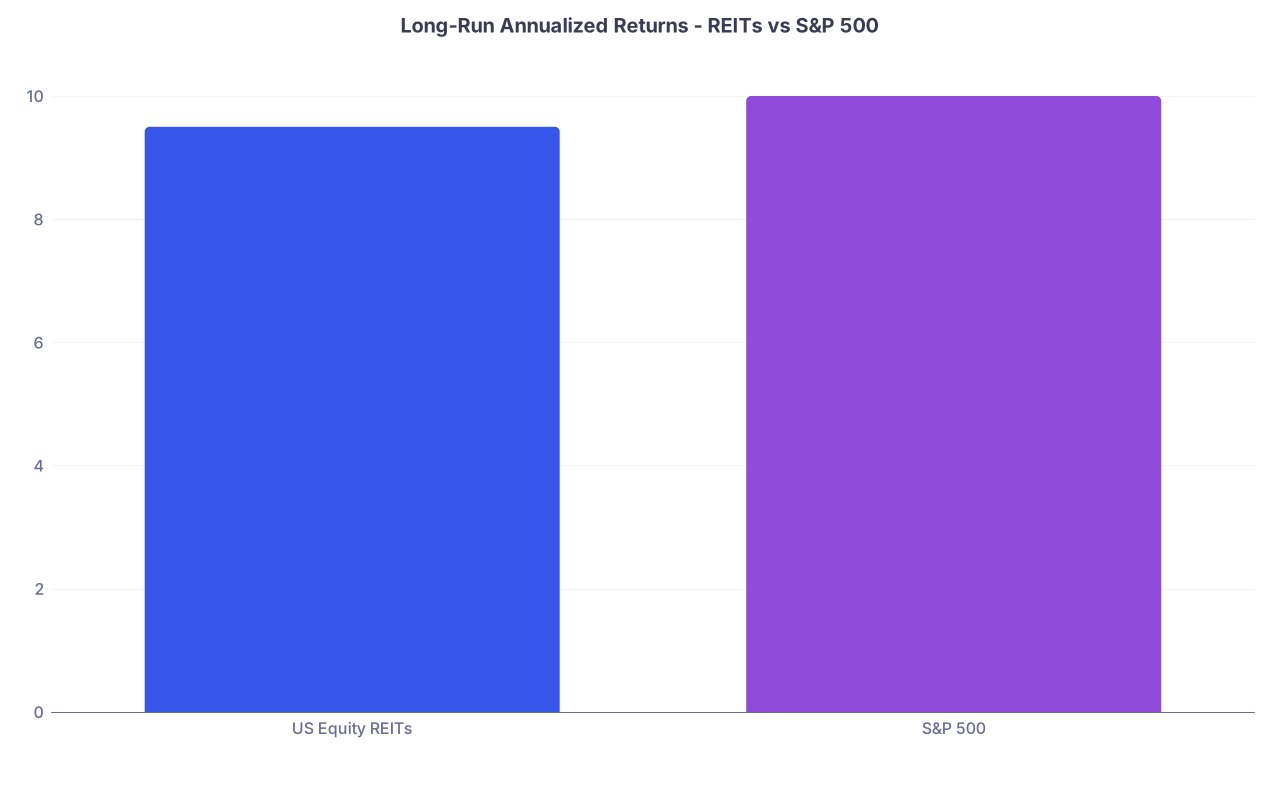
| Category | Value |
|---|---|
| US Equity REITs | 9.5 |
| S&P 500 | 10 |
From the mid-1970s through recent decades, US equity REITs have delivered around 9–10% annualized total returns, roughly comparable to the S&P 500, with higher income and different sector behavior.
What you get as a physician investor
Mechanically:
- You buy a REIT ETF or individual REIT shares through a brokerage account.
- You receive quarterly dividends (3–5% yields are common) plus price appreciation (or loss).
- You can sell any day the market is open.
This is the polar opposite of a syndication lockup. Liquidity is near-perfect.
Sector choices are broad: medical office, senior housing, data centers, industrial, apartments, self-storage, etc. You can build a diversified real estate portfolio with a few tickers.
Volatility vs underlying stability
Here is where physicians often misread the risk. Real estate itself is not marked to market every second. REIT shares are. That creates stock-like volatility on top of property-level fundamentals.
POV from the data:
- In 2008–2009, public REITs dropped 60–70% peak-to-trough.
- Underlying real estate values did not fall 70%. The price reflected panic, forced selling, and leverage.
- Long-run, investors who held or averaged in during those drawdowns did very well.
If you are the type who constantly checks your brokerage account, you will feel that volatility more than the true risk justifies.
Taxes for REITs
REIT dividends are generally:
- Taxed as ordinary income, though a portion can be treated as return of capital or qualified dividends depending on structure
- Eligible for the 20% QBI deduction in many cases (United States)
- No depreciation passed through directly to you like in K-1 real estate
You still get decent after-tax yield, but you give up the most aggressive depreciation benefits you see in direct ownership or private deals.
Bottom line: REITs are the cleanest solution if your goals are: reasonable long-run returns, high liquidity, zero phone calls from tenants, and no K-1 surprises.
4. Syndications: Higher Returns… On Paper
Syndications are where I see the most unrealistic expectations among physicians. The slide deck always says 15–18% IRR. The distributions always start “next quarter.” And the risk is often underappreciated.
Structure in plain language:
- You (limited partner) put in $50k–$250k+
- Sponsor (general partner) finds the deal, operates it, takes fees and a performance split (“promote”)
- Hold period: typically 5–7 years
- You receive quarterly or monthly distributions (if the deal performs), plus a chunk on sale or refinance

Typical projected numbers vs reality
Example pro forma you will see constantly:
- Equity raise: $5,000,000
- Loan: 70% LTV, interest-only for 3 years
- Purchase price: $16,700,000
- Target IRR: 15–17% to LPs
- Preferred return: 7–8% (non-guaranteed)
- Hold: 5 years
How do they “get” to 15–17%?
- Assume rent growth of 3–5% annually
- Assume cap rate compression or at least no expansion
- Assume value-add improvements increase NOI substantially
- Assume smooth exit at desired price in year 5
Those are often reasonable assumptions. They are not guaranteed. The sensitivity analyses (when they are shown at all) usually reveal how thin the margin for error really is.
I have seen plenty of post-mortems:
- Deals that paid 5–7% cash yields then exited flat, producing closer to 7–9% IRRs.
- Deals that suspended distributions for 1–2 years when interest rates jumped or occupancy dipped.
- A smaller subset that genuinely delivered 18–20%+ IRRs by buying at a discount and selling in a hot market.
The key: private deals widen your outcome distribution. Average can be slightly better than REITs. The tails (very good or very bad) are much fatter.
Fee drag and alignment
You must quantify fees. Do not wave your hand at them.
Common structures:
- Acquisition fee: 1–3% of purchase
- Asset management fee: 1–2% of equity or revenue annually
- Disposition / refinance fees
- Promote: 20–30% of profits above a preferred return
Quick math: Suppose a deal genuinely produces a 15% return at the property level before fees. After sponsor promote and fees, LPs might see closer to 11–13%. That is your actual return.
That is still solid. Better than most broad REIT ETFs over many periods if achieved consistently. But it is not “free” money.
Liquidity and control: you have neither
Once you wire funds:
- Lockup: 5–10+ years common
- No secondary market in most cases
- You rely heavily on sponsor reporting and integrity
You can sometimes sell your interest privately with sponsor approval, usually at a discount. That is not a reliable liquidity plan.
Taxes: this is where syndications shine
Syndications often use cost segregation and bonus depreciation aggressively. That means:
- Year 1 K-1 showing a large paper loss (often 30–80% of your initial investment), even if you receive cash distributions
- Those passive losses can offset passive income from other rentals and future passive gains
- Unused losses carry forward indefinitely
For high-income doctors, these paper losses are attractive. But remember:
- They do not shelter W–2 clinical income unless you meet real estate professional status rules
- When the asset is sold, you face depreciation recapture and capital gains – you are deferring, not erasing tax, unless you plan a lifetime of rollovers and careful estate planning
Bottom line: Syndications can be efficient if you pick capable sponsors, accept illiquidity, and understand that 15–18% pro forma IRR is a modeled scenario, not a baseline entitlement.
5. Time, Risk, and Return Compared Head-to-Head
Let’s put the three side by side in a way that speaks to your real constraints as a physician.
| Dimension | Direct Ownership | REITs | Syndications |
|---|---|---|---|
| Target Long-Run Return | 7–12% (wide range) | 7–10% | 12–18% projected, realized lower |
| Volatility Seen | Low in statements, real risk hidden | High market volatility | Low mark-to-market, real risk in illiquidity |
| Time Required | High (ongoing) | Near zero | Low–Moderate (front-loaded DD) |
| Liquidity | Months to sell/refi | Daily trading | None until exit |
| Tax Efficiency | High if structured well | Moderate | Very high (early years) |
| Minimum Capital | ~$50–250k+ per property | ~$100+ via brokerage | Typically $50–100k per deal |
A few patterns I see with physicians who actually build wealth rather than just chase glossy deals:
- They treat their clinical career as their primary high-ROI engine and refuse to let real estate turn into an unplanned second job.
- They respect liquidity. Something bad eventually happens: divorce, disability, practice change, burnout. Liquidity is a shock absorber.
- They do not chase yield. They target risk-adjusted, after-tax, time-adjusted returns.
If we reframe the question that way, the math gets clearer.
6. A Data-Driven Allocation Approach for Physicians
There is no single “right” mix. But there are patterns that make sense once you factor in age, risk tolerance, and time.
Early career (resident to ~5 years attending)
Constraints:
- Lower net worth
- High human capital, low financial capital
- Often limited time and limited emergency reserves
Data-driven recommendation:
- Emphasize REITs or low-cost REIT ETFs for real estate exposure.
- If you want direct ownership, keep it extremely simple: maybe house-hack or a single small property close to home with conservative leverage.
- Avoid big syndication bets early unless:
- You fully understand the risk,
- The capital is genuinely surplus, and
- You are comfortable with a 7–10 year lockup.
Behaviorally, you cannot afford an illiquid mistake yet.
Mid-career (10–20 years out of training)
Now the picture shifts. You likely have:
- Higher income stability
- More savings
- Some tax pressure you would like to soften
Reasonable structure I see working:
- Baseline: broad market index funds + REIT ETF as core.
- Plus: 1–3 carefully chosen private deals or syndications, 5–10% of investable assets each, with sponsors you have vetted.
- Optional: 1–2 direct properties if you enjoy the business side and have local knowledge.
This keeps your net worth from being hostage to any single GP, single property, or single local market.
Late-career / pre-retirement
At this stage, sequence of returns risk and liquidity matter more than aggressive growth.
Data supports:
- More diversified REIT exposure and broad equity/fixed income mix.
- If you hold syndications or direct properties, consider:
- Debt paydown to lower risk.
- Planning exit timing so you do not depend on a single sale event to fund retirement.
- Evaluating estate planning implications (stepped-up basis, etc.)
You want enough stable income and liquidity to retire on your schedule, not on the real estate cycle’s schedule.
7. Practical Selection Criteria: Picking Your Vehicles
You asked about returns, but the variance in returns is more about your selection process than the structure itself.
For direct ownership
The data that matters:
- Cap rate vs local comparables
- Rent growth history and vacancy rates in that micro-market
- Debt terms (fixed vs variable, amortization length)
- Stress testing: What if rents drop 10%? What if vacancy doubles for 12 months?
If you cannot model those in a spreadsheet, you are not investing. You are guessing.
For REITs
Key metrics:
- FFO (funds from operations) and AFFO growth
- P/FFO multiple vs peers
- Sector fundamentals (e.g., data centers vs malls)
- Balance sheet leverage (debt to EBITDA)
Most physicians are not going to manually underwrite 20 REITs. Frankly, a low-cost diversified REIT ETF is usually the most rational default.
For syndications
Focus hard on:
- Sponsor track record through at least one tough cycle (e.g., 2008, 2020, or recent rate spikes)
- Skin in the game: How much of their own capital is in the deal?
- Fee structure and waterfall, quantified in dollar terms, not just percentages
- Sensitivity tables: IRR if cap rates rise 0.5–1.0%, if rent growth is 1–2% lower than pro forma, etc.
Ask for realized deal summaries, not just pretty decks. If the sponsor cannot or will not provide concrete, deal-by-deal performance history (including misses), that is a data point by itself. A bad one.
8. Pulling It Together: What the Data Actually Supports
Let me be blunt.
- Relying on just direct ownership: high upside if you treat it like a business and have time. For many full-time physicians, it quietly becomes a stress amplifier.
- Relying only on syndications: you are paying for leveraged, concentrated bets run by someone else. Some will work. A few will disappoint badly. It is not prudent as your only real estate exposure.
- Relying only on REITs: you leave some tax advantages on the table, but you gain liquidity, simplicity, and adequate long-run returns that historically rival private real estate without the hassle.
From a data analyst’s standpoint, the most rational pattern for most doctors looks like this:
- Use low-cost index funds and REIT ETFs as your default engine for compounding.
- Add a limited number of carefully underwritten syndications when your net worth and liquidity allow. Treat them as satellites, not the core.
- Only pursue direct ownership if you want to operate a small real estate business and can quantify your time cost. Not because someone told you “rentals are passive.”
The question is not “Which of these three has the highest advertised return?” The question is “Which mix delivers the best risk-adjusted, tax-adjusted, and time-adjusted return for a high-income, time-poor professional?”
Answer that honestly, and the decision becomes much clearer.