
The data shows that most doctors are leaving six to seven figures of lifetime wealth on the table by spending their side‑gig income instead of investing it. Not hypothetically. Mathematically.
You can argue psychology, burnout, “I deserve it” all day. The compounding tables do not care.
Let me walk you through what actually happens to your net worth when you route that extra 2–5k per month into investments versus lifestyle. With numbers, not vibes.
1. Ground Rules: What Side‑Gig Money Are We Talking About?
Think of realistic, not fantasy, side‑gig income for physicians. I am not modeling “build a SaaS and exit for $20M.” I am modeling what I see on real tax returns:
- Telemedicine shifts
- Locums 1–4 weekends a month
- Expert witness work
- Chart review / utilization management
- Consulting or small niche coaching
Common pattern: baseline W‑2 or partnership income covers “normal life,” and side‑gig is 1–5k per month.
Typical ranges I see:
- Early attending: 1–2k/month
- Mid‑career with consistent locums: 3–5k/month
- Highly entrepreneurial: 5–10k/month+ (less common, more volatile)
For this analysis, I will use three anchor points for after‑tax side‑gig cash flow:
- Scenario A: $1,000 per month
- Scenario B: $3,000 per month
- Scenario C: $5,000 per month
Assume you are already maxing standard retirement accounts from your main job (401(k), 403(b), etc.). Side‑gig income is what you decide to either:
- Invest in taxable / extra tax‑advantaged vehicles, or
- Spend on lifestyle creep, upgrades, and “treat yourself” expenses.
We will model 20‑year and 30‑year outcomes. Because medicine is a long game.
2. Core Assumptions: Return, Taxes, and Inflation
You can argue about every assumption below. That is fine. Adjust the numbers if you want. The directional conclusion will not change.
Investment return
Long‑run, globally diversified stock‑heavy portfolios have returned in the 6–8% real range historically, depending on the period and allocation. To be conservative but not pessimistic:
- Nominal annual return: 7%
- Inflation: 2.5%
- Real return: ≈ 4.5%
I will mostly quote nominal values for simplicity. Adjust down by ~30% mentally for real purchasing power, or run your own real‑return model.
Investment vehicle and tax drag
Assume:
- You invest in a tax‑efficient stock index ETF in taxable or solo‑401(k) / SEP‑IRA when side‑gig income allows.
- Long‑term capital gains and qualified dividends taxed at 15% federal + some state. Net drag on the 7% nominal might push it closer to 6–6.5% in taxable.
- To avoid pretending we know your exact jurisdiction, I will stick with 7% nominal before personal taxes and then comment on tax effects where relevant.
Key point: whether it is 6%, 7%, or 8%, the gap between invest‑vs‑spend dwarfs the fine‑tuning.
Time horizons
We will model:
- 20 years (e.g., age 35 to 55, or 40 to 60)
- 30 years (35 to 65, typical pre‑retirement span)
And we assume regular monthly investing of side‑gig net income, versus $0 invested and 100% spent.
3. Modeled Outcomes: Invest vs Spend, in Cold Numbers
Here is the standard future value of an annuity formula for monthly contributions:
FV = P × [((1 + r/12)^(12n) − 1) / (r/12)]
Where:
P = monthly contribution
r = annual return (0.07)
n = years invested
I will spare you the algebra and give you the computed results for the scenarios that actually matter to you.
3.1 20‑Year and 30‑Year Outcomes at 7% Nominal
| After-Tax Side-Gig Invested Monthly | 20-Year Future Value | 30-Year Future Value |
|---|---|---|
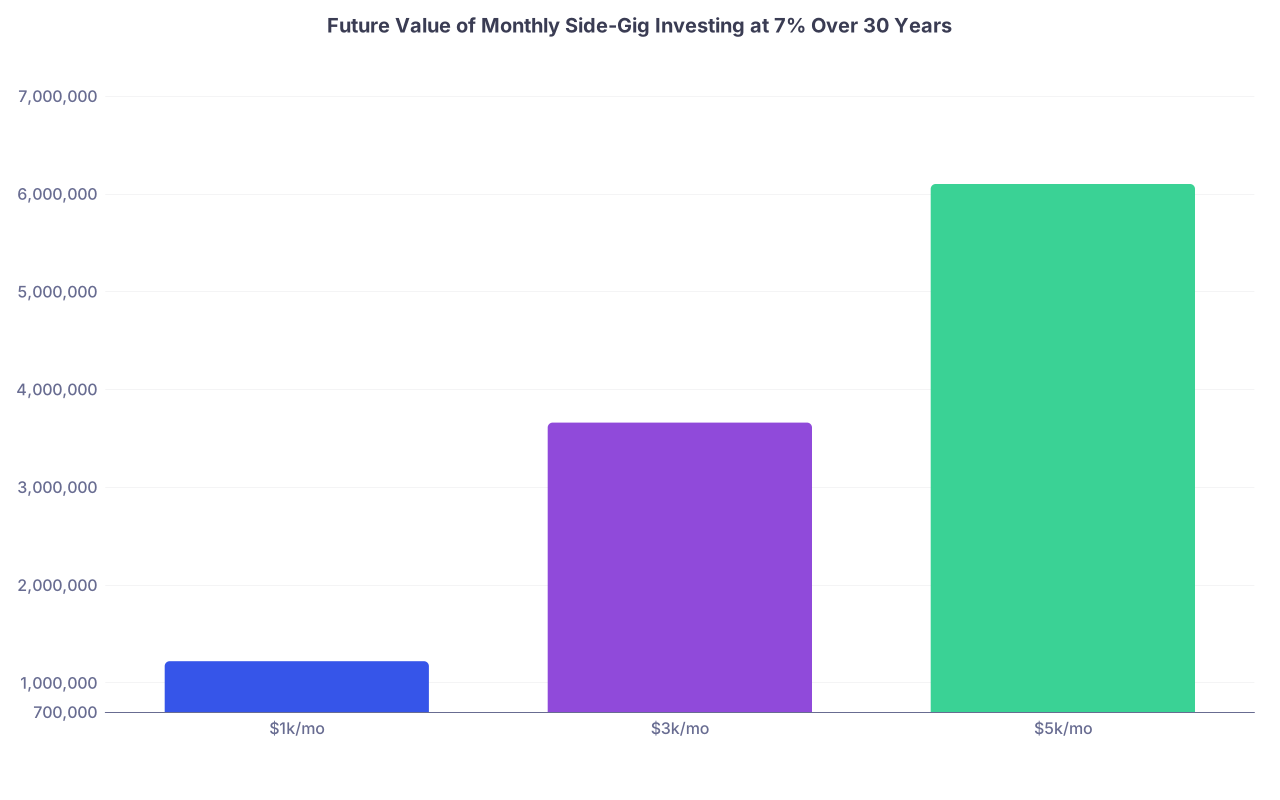
| $1,000 | ≈ $523,000 | ≈ $1,220,000 |
| $3,000 | ≈ $1,570,000 | ≈ $3,660,000 |
| $5,000 | ≈ $2,610,000 | ≈ $6,100,000 |
These are nominal values, ignoring future tax on gains. Knock them down by ~30% for purchasing power and tax realities, and you still end up with:
- $1k/month for 30 years → ~ $800k real, after tax
- $3k/month for 30 years → roughly $2.4M real
- $5k/month for 30 years → ~ $4M real
This is the opportunity cost when you decide the extra weekend call is “for vacations” instead of for investments.
To visualize the growth difference between monthly side‑gig investment levels, look at this:
| Category | Value |
|---|---|
| $1k/mo | 1220000 |
| $3k/mo | 3660000 |
| $5k/mo | 6100000 |
Every bar here is the “shadow portfolio” most doctors never build because the side‑gig money disappears into lifestyle.
4. Scenario Modeling: Three Typical Doctors
Let’s make this less abstract and more real. Three anonymous composites I have seen versions of over and over.
4.1 Dr. A: Early Attending with Modest Side Gig
- Age 32
- Base salary: $260k
- Side‑gig telehealth: $1,000/month after tax
- Already maxing 401(k) and Roth IRA via backdoor
Two paths for the next 25 years:
- Spend path: The $1,000/month goes to nicer rent, frequent travel, and car upgrades every 5–6 years. Savings rate basically unchanged.
- Invest path: The $1,000/month goes into a taxable brokerage with 80/20 global stock/bond index ETFs, rebalanced annually.
Using the same formula at 7% for 25 years:
FV ≈ $1,000 × [((1 + 0.07/12)^(12×25) − 1) / (0.07/12)]
This computes to ≈ $816,000 nominal.
That is $816k extra by age 57 solely from investing the side gig, not counting growth on their main 401(k).
Practically, that $800k+ does one of three things:
- Covers 100% of their early retirement gap from 57 to when Social Security / pensions kick in
- Funds private school + college for multiple children
- Or it simply increases safe withdrawal in retirement by roughly $32k/year (4% rule) in today’s dollars, after some adjustment for inflation
The “spend everything” version has none of that. Same career, same side gig, radically different exit options.
4.2 Dr. B: Mid‑Career, Steady Locums
- Age 40
- Base income: $350k
- Locums weekends: ~$3,000/month after tax
- Existing net worth: $900k across home equity, retirement, and some taxable
Two paths for 20 years (40 to 60):
- Spend it: The extra $3k/month sustains a $36k/year higher lifestyle floor. Nicer home, more travel, some private schooling, more “we worked hard; we deserve it.”
- Invest it: $3,000/month invested for 20 years at 7%.
From the earlier table: 20 years at 7% for $3k/month → ≈ $1.57 million.
Now compare that to working longer versus stopping earlier.
If Dr. B wants to retire at 60, that $1.57M side‑gig portfolio supports:
- ~ $60k/year at a 3.8% withdrawal
- ~ $47k/year at a more conservative 3% withdrawal
In other words, by investing side‑gig income from 40 to 60, Dr. B can replace 13–17% of their pre‑tax main income with passive withdrawals from just that stream, separate from primary 401(k) and practice equity.
That is why some doctors at 60 look trapped and others quietly phase out clinical work. Same clinical income. Different treatment of side‑gig dollars.
4.3 Dr. C: High Earner, Aggressive Side Gigs, Late Realization
Here is the uglier one.
- Age 45
- Base income: $500k
- Side‑gig mix (consulting + expert witness + telehealth): $5,000/month after tax
- Spent virtually all side‑gig for the last 10 years (ages 35–45)
Then at 45, Dr. C burns out, looks up, and asks for a plan.
Let’s model what happened and what is still possible:
- Past 10 years (spent): If that $5k/month from 35–45 had been invested for 10 years at 7%, it would be:
FV after 10 years ≈ $5,000 × [((1 + 0.07/12)^(12×10) − 1) / (0.07/12)]
This is ≈ $861,000.
So they “burned” almost $900k in potential portfolio value.
- Next 15 years (45–60, invest): If they now invest $5,000/month from 45 to 60:
FV 15 years ≈ $5,000 × [((1 + 0.07/12)^(12×15) − 1) / (0.07/12)]
≈ $1.56 million.
Total potential from 25 years of side‑gig at $5k/month? About $2.4M. Instead, Dr. C ends up with $1.56M — still great, but they permanently forfeited almost a million of portfolio value by using side‑gig for lifestyle in the 35–45 decade.
Notice something: starting at 45 is not hopeless. The remaining 15 years still generate more than $1.5M of capital. But the earlier missed decade has a measurable cost you can quantify.
5. The Hidden Tax Angle of Investing Side‑Gig Income
You do not just get growth. You also get optionality on tax strategy.
If your side gig is structured as a 1099 sole proprietorship, S‑corp, or single‑member LLC, you can often layer in:
- Solo 401(k)
- SEP‑IRA
- Defined benefit / cash balance plan (for very high side‑gig earnings)
Investing side‑gig income through these structures achieves two effects:
- Immediate tax deduction on contributions, lowering your current tax bill.
- Tax‑deferred growth on the invested assets.
Let’s keep the math simple with a solo 401(k) example.
Example: $3k/month side gig, solo 401(k) route
Assume:
- You have $3,000/month net after business expenses, before retirement contributions.
- You contribute $2,000/month into a solo 401(k) (24k/year) and keep $1,000/month as taxable take‑home.
Over 20 years, that $2,000/month at 7% nominal in a tax‑deferred account becomes:
FV ≈ $2,000 × [((1 + 0.07/12)^(12×20) − 1) / (0.07/12)] ≈ $1.05 million.
If you are in a 35% combined marginal tax bracket now and expect 25% effective tax rate in retirement:
- You defer 35% of $24k each year → ~$8,400/year of tax not paid now.
- That deferred tax grows alongside the account.
Even if you eventually pay 25% tax on distributions, the time value of tax deferral plus compounding usually beats taking the income, paying full tax, and then spending it.
The contrast with just spending the side‑gig is obvious: no deduction, no deferred growth, and no retirement reservoir.
6. The Lifestyle Penalty: What Spending Actually Buys You
I am not going to pretend spending buys you nothing. It buys exactly what you decide to trade for multi‑million‑dollar compounding.
In physician households I see, side‑gig spending tends to go to:
- Bigger home and faster upgrades
- Luxury car cycles instead of durable, mid‑priced vehicles
- Private school when the public option was acceptable
- Frequent international travel at business class or 5‑star level
- Eating out multiple times a week at high‑end spots
- “Convenience” spending that quietly layers on: housekeeper, lawn, subscriptions, etc.
Here is the funny part: most of those expenses get normalized in under 12–18 months.
What felt like a huge lifestyle upgrade becomes the new baseline. Yet the opportunity cost continues: 1–5k/month that could have been invested keeps getting consumed, year after year.
Let’s attach numbers to one decision: buying “up” on a car every 5 years, funded by side‑gig.
- Incremental cost vs a reliable midrange car: +$700/month (lease or payment)
- Two cars in the household, staggered: effectively $1,000–$1,200/month persistent extra outflow
That single choice consumes the equivalent of:
- $1,000/month invested for 20 years → ≈ $523,000
- Or for 30 years → ≈ $1.22 million
From “nicer cars” alone.
When you stack multiple such decisions (cars + home + travel + school), it is not hard to see where the missing millions went.
7. Risk, Volatility, and “What If Returns Are Lower?”
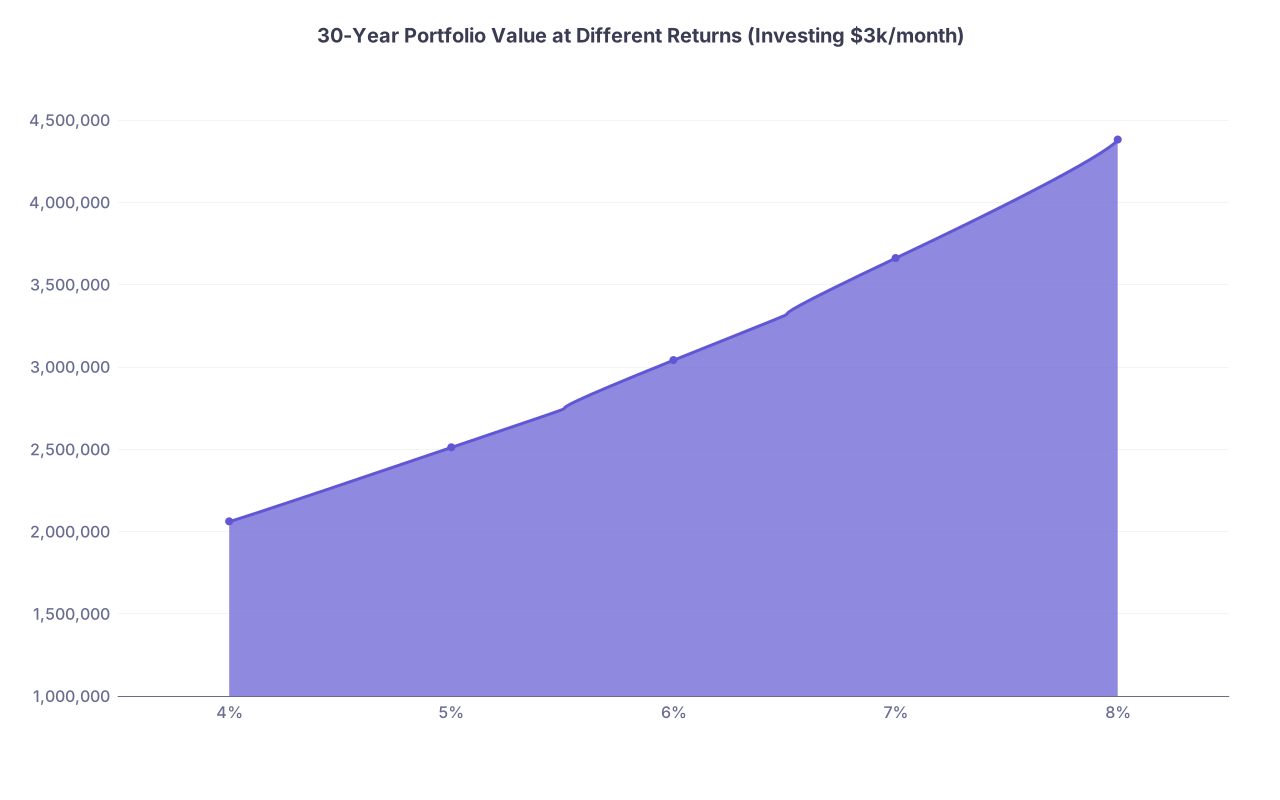
Reasonable objection: “What if 7% is too optimistic?” Fine. Let’s stress‑test at 5% nominal.
At 5%, the monthly FV factor over 30 years is roughly 0.05/12 = 0.004167 per month. The future value formula yields:
- $1,000/month for 30 years at 5% → ≈ $836,000
- $3,000/month → ≈ $2.51 million
- $5,000/month → ≈ $4.18 million
So even with much lower returns, investing:
- $1k/month still yields close to $1M
- $5k/month still crosses $4M
The shape of the outcome stays the same: investing side‑gig income accumulates seven‑figure capital; spending it creates no asset.
To visualize the sensitivity to return assumptions:
| Category | Value |
|---|---|
| 4% | 2060000 |
| 5% | 2510000 |
| 6% | 3040000 |
| 7% | 3660000 |
| 8% | 4380000 |
Even at 4%, you are over $2M. So the idea that you “might not get 7%” is not an argument for spending; it is an argument for risk‑appropriate investing.
8. Decision Framework: When It Actually Makes Sense To Spend
I am not going to tell you to invest 100% of every extra dollar forever. That is not how humans work, and frankly, joy matters.
But the data supports one very explicit rule: default to investing the majority of recurring side‑gig income, and be extremely deliberate about exceptions.
A reasonable, evidence‑aligned framework for a physician:
Recurring side‑gig (telehealth, locums, UM)
- Invest at least 70–80% by default.
- Use 20–30% for guilt‑free lifestyle upgrades or fun.
One‑time windfalls (large expert witness case, one‑off consulting)
- Consider 50/50: half to wealth‑building, half to spending or debt paydown, depending on your situation.
Before increasing fixed lifestyle costs (bigger mortgage, private school)
- Run the numbers: what is the 20‑year and 30‑year cost of permanently allocating your side‑gig dollars to that payment?
If that sounds too rigid, look at the outcomes.
Compare 80/20 investing vs 0/100 spending: $3k/month for 30 years
- 100% invested ($3k/mo) → ≈ $3.66M
- 80% invested ($2.4k/mo) → ≈ $2.93M
- 0% invested → $0 portfolio from side‑gig
You can still direct ~$600/month to “fun” and end up with nearly $3M versus zero.
That is the lever. Use it.
9. Practical Implementation: Where to Actually Put the Money
Let us get concrete. A typical allocation pipeline for a doctor with side‑gig income:
Side‑gig entity and accounts
- Use a separate checking account for the side‑gig.
- Route all 1099 income there. This keeps it visually and mentally distinct from your main salary.
Retirement vehicles from side‑gig (if eligible)
- Solo 401(k) first, up to the elective deferral plus employer profit‑sharing limits, respecting combined 401(k) caps.
- If side‑gig is large and stable, consider adding a cash balance plan with a specialized actuary and CPA.
Taxable investing
- Once tax‑advantaged space is full, auto‑transfer a set percentage (say 75–80%) of monthly side‑gig net income into a taxable brokerage.
- Invest in broad, low‑cost index funds or ETFs with a target asset allocation coherent with your overall plan.
Automation
- The worst thing you can do is “decide each month” whether to invest. You will not.
- Automate transfers the day after your usual side‑gig payouts land.
To illustrate the flow:

| Step | Description |
|---|---|
| Step 1 | Side gig income hits account |
| Step 2 | Contribute to solo 401k |
| Step 3 | Transfer to taxable brokerage |
| Step 4 | Invest per IPS |
| Step 5 | Set lifestyle spend percent |
| Step 6 | Automated transfer to checking for spending |
| Step 7 | Retirement space available |
The point is to remove willpower from the system. The math only works if the investing is consistent.
10. Psychological Reality: Why Doctors Sabotage This
The numbers are clear. The behavior is not.
Common rationalizations I hear (and have literally heard in hospital lounges and call rooms):
- “This locums money is my fun money.”
- “I worked too hard to live like a resident forever.”
- “I will start investing once my loans are gone / kids are older / we move / COVID is over.”
Then 5–10 years vanish. The compounding window shrinks. The side‑gig dollars vanish into lifestyle fog.
Here’s what the data actually supports:
- You do not need to live like a resident.
- You do need to live clearly below your combined main + side‑gig income and route the difference into assets.
- Starting in year 1 of attending‑hood is massively more powerful than starting in year 10, even with the same contribution amount.
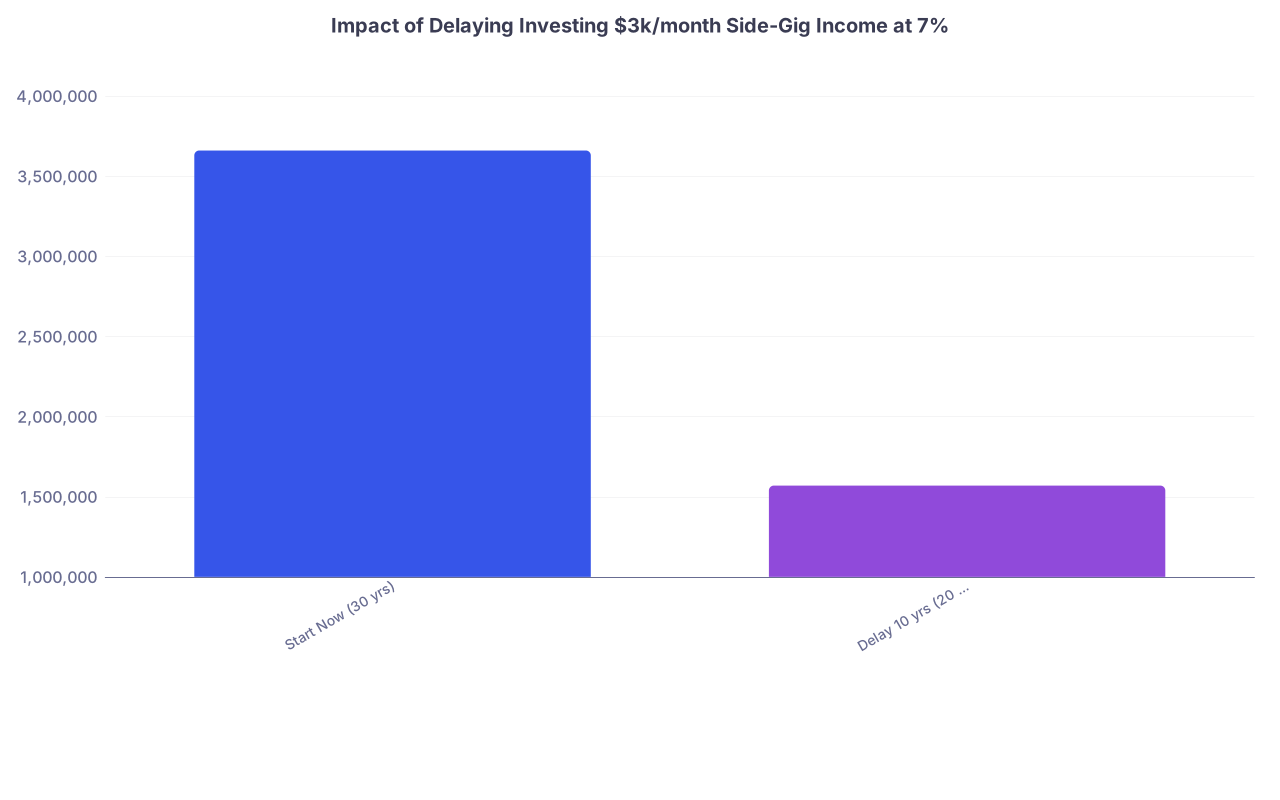
The math of delayed investing is brutal. If you invest $3k/month for 30 years versus waiting 10 years and then investing $3k/month for 20 years:
- 30 years at 7%: ≈ $3.66M
- 20 years at 7%: ≈ $1.57M
The “cost of waiting 10 years” is about $2.1M in future value.
Put differently: that decade of side‑gig money you blew on lifestyle costs you more than the entire amount you will eventually invest later.
To make this visceral:
| Category | Value |
|---|---|
| Start Now (30 yrs) | 3660000 |
| Delay 10 yrs (20 yrs) | 1570000 |
The difference between those bars is what procrastination looks like in dollar terms.
11. The Core Takeaways, Without the Sugarcoating
You became a doctor. You can handle blunt math.
- Investing even $1–3k/month of side‑gig income over 20–30 years almost always builds seven‑figure additional net worth. Spending it builds nothing.
- The timing matters: the first 5–10 years of attending life and side‑gig work generate a disproportionate chunk of lifetime compounding. Delay is expensive.
- You do not have to be perfect. Investing 70–80% of recurring side‑gig cash while allowing 20–30% for lifestyle still yields multi‑million‑dollar portfolios over a career.
That is the modeled reality. The data shows the side gig is not just “extra fun money.” It is, in practice, the difference between a standard physician retirement and true financial independence with options.