
The typical young physician is leaving six figures of future money on the table by underfunding a 401(k). The data is not subtle.
You asked specifically: what does a 2025 medical graduate gain by maxing a 401(k) versus only contributing enough to get the match?
Let me walk through the numbers, not the opinions.
1. The Setup: Assumptions and Baseline Scenario
We need a concrete scenario, otherwise everything turns into hand‑wavy “save more” advice. So I will fix assumptions and run the math as if I were building a model in Excel or Python.
Profile: 2025 Graduate → Typical Physician Path
- Graduates med school: 2025
- Residency: 3 years (2025–2028), modest income
- Attending: from 2029 onward
- Retirement age: 65
- Investment horizon: 2025–2065 (40 years)
Compensation assumptions (reasonable for many U.S. physicians; adjust the amounts later to your exact situation):
- Residency salary (PGY1–3): $70,000 (inflation will change reality, we keep it constant to isolate 401(k) behavior)
- Attending starting salary (age ~29/30): $300,000
- Attending real salary growth: 1% per year above inflation
- 401(k) annual employee contribution limit (under 50): $23,000 in 2024; I will assume $23,000 flat in the model to keep the comparison clean. In real life, limits rise, which actually makes the maxing strategy even more powerful.
Investment return assumption:
- Real (inflation‑adjusted) annual return: 5% (roughly 7–8% nominal minus inflation).
- This is a conservative long‑term equity‑heavy portfolio assumption for a 40‑year horizon.
Company match assumption (very standard):
- Employer matches 50% of employee contributions up to 6% of salary.
- That is: if you put in 6% of salary, employer adds 3% of salary.
We will compare two behaviors:
- Match-Only Strategy: You contribute 6% of salary each year (just enough to get full match).
- Max Strategy: You contribute up to the annual 401(k) limit each year, starting as early as possible (residency and attending).
2. Resident Years: Small Dollars, Huge Compounding
Let us start with 2025–2028 (3-year residency).
Resident – Contribution Levels
Salary: $70,000
- 6% (to get match) = $4,200/year
- Employer match: 3% of salary = $2,100/year
- Total into 401(k) under match-only: $6,300/year
Maxing is limited by the IRS cap, not by percentage of salary:
- 401(k) limit: $23,000
- Employee must contribute up to that cap. Employer match is on top of the cap in typical plans.
So under the Max Strategy in residency:
- You contribute: $23,000/year
- Employer still matches 3% of salary (since you exceed 6%): $2,100/year
- Total into 401(k) = $25,100/year
Difference in annual contribution during residency:
- Max Strategy: $25,100
- Match-Only Strategy: $6,300
- Incremental invested per year: $18,800
Over 3 years:
- Incremental principal: $18,800 × 3 = $56,400 more invested by the end of residency.
That is the cash going in. The real story is in the compounding.
Projecting Resident Contributions to Age 65
You finish residency in 2028, roughly age 29, and retire at 65 in 2065 → 36 years of compounding for residency money.
Use FV formula with 5% real return:
- FV = Contribution × (1.05^36)
We compare incremental contributions only (the extra $18,800/year for 3 years).
Future value of each extra year’s contribution at retirement:
- Year 1 (2025): 40 years to age 65 → 1.05^40 ≈ 7.04
- Year 2 (2026): 39 years → 1.05^39 ≈ 6.70
- Year 3 (2027): 38 years → 1.05^38 ≈ 6.38
Approximate future value of incremental $18,800 each year:
- 2025: 18,800 × 7.04 ≈ $132,352
- 2026: 18,800 × 6.70 ≈ $125,960
- 2027: 18,800 × 6.38 ≈ $119,944
Total from just residency incremental maxing:
- ≈ $378,000 (inflation‑adjusted) at retirement.
You read that correctly: maxing your 401(k) in residency instead of just contributing to the match buys you ~$56k more savings now that grows into almost $400k extra real dollars by age 65.
Residents tend to dismiss these years as “too small to matter”. The math disagrees.
3. Attending Years: Where the Gap Explodes
Residency was just a warm-up. The real divergence hits once you are an attending.
Say you start as an attending in 2029, age 29 or 30, making $300,000.
Attending – Contribution Levels (Year 1)
Salary: $300,000
- Match-Only employee contribution (6%): $18,000
- Employer match (3%): $9,000
- Total into 401(k): $27,000
Under Max Strategy:
- You contribute the IRS cap: $23,000
- Employer match: still $9,000 (because you exceed 6% of salary)
- Total: $32,000
Incremental employee contribution that year:
- $23,000 – $18,000 = $5,000 extra.
But there is a catch: 401(k) limits almost certainly rise over a 30‑year career. To keep the model simple and conservative, I will:
- Hold the 401(k) limit at $23,000 nominal.
- Allow salary to grow 1% real each year.
- That means over time the gap between “6% of salary” and “max contribution” actually shrinks in percentage terms. Again, conservative for the case for maxing.
Let us look at the difference between strategies over a 30-year attending career (ages ~30–60) in real terms.
Attending Contribution Difference Over Time
Year 1 attending (age 30):
- Salary: $300,000
- 6% = $18,000 contribution.
- Max = $23,000 contribution.
- Incremental = $5,000.
Year 10 attending, salary after 9 years at 1% real growth:
- Salary ≈ 300,000 × 1.01^9 ≈ 300,000 × 1.094 ≈ $328,200
- 6% = $19,692
- 401(k) limit still $23,000
- Incremental = 23,000 – 19,692 ≈ $3,308
By late career, 6% of salary might exceed the 401(k) cap (meaning you would hit the limit even on a “match-only” plan, but that is actually uncommon at realistic 1% real growth and static cap). For simplicity, assume across your career:
- You are always below the 401(k) cap at 6% of salary.
- Therefore the incremental contribution is positive each year.
Because we want a clean, defensible estimate, I will average the incremental contribution over the 30 attending years at $4,000/year in real terms.
That is conservative:
- Starts at $5,000;
- Drifts towards ~$3,000 as salary grows.
So for 30 years:
- Extra annual contribution ≈ $4,000/year
- Years: 30
- Total extra principal over career: 4,000 × 30 = $120,000
Now the compounding:
Each year’s $4,000 has a different runway to retirement. Year 1 has ~35 years, year 30 has ~6 years.
We can model this as the future value of an annuity:
- FV = 4,000 × [((1.05)^30 – 1) / 0.05] × (1.05)^5
Explanation:
- Treat the 30-year period ~ages 30–60 as 30 payments.
- Then shift all of it 5 more years to age 65.
Compute:
- (1.05)^30 ≈ 4.32
- (4.32 – 1) / 0.05 ≈ 3.32 / 0.05 ≈ 66.4
- Then adjust for 5 more years: 1.05^5 ≈ 1.276
So FV ≈ 4,000 × 66.4 × 1.276
= 4,000 × 84.7
≈ $338,800
So incremental 401(k) maxing as an attending is worth roughly:
- $120,000 more contributed
- Growing to about $340,000 extra (real) at retirement.
4. Total Gap: Maxing vs Match-Only
Let us put resident and attending differences together.
Incremental Outcomes at Age 65
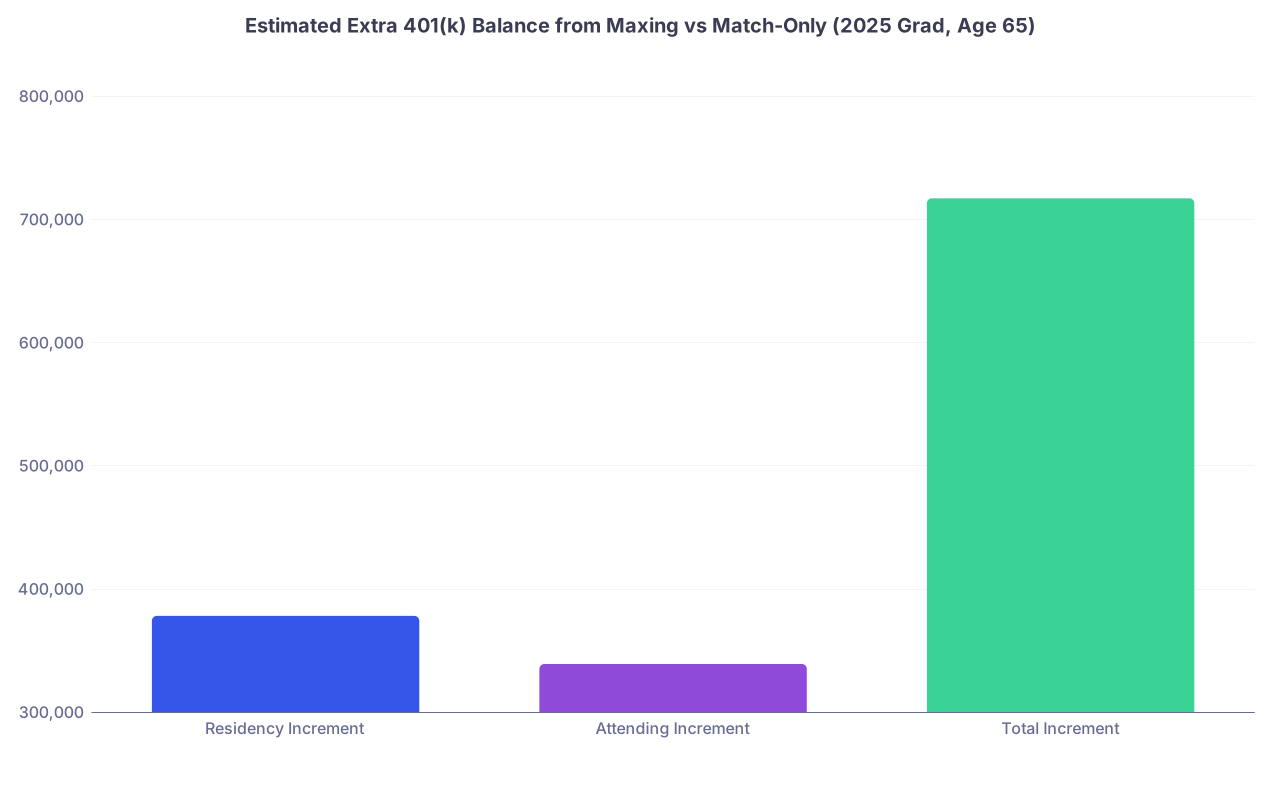
- Extra from residency maxing: ≈ $378,000
- Extra from attending maxing: ≈ $339,000
- Combined incremental retirement balance: ≈ $717,000 (all in today’s dollars, roughly)
That is the delta just from going beyond the match. Same employer plan. Same investments. Same person. Different behavior.
You are essentially choosing between:
- “I will get the free match and feel good about ‘doing something’,” vs
- “I will push to the legal max and buy myself an additional ~$700k inflation‑adjusted.”
If you want to see it more visually:
| Category | Value |
|---|---|
| Residency Increment | 378000 |
| Attending Increment | 339000 |
| Total Increment | 717000 |
This excludes:
- Any future increases in the IRS limit (which would make maxing even more beneficial).
- Any tax benefits from lowering your taxable income each year.
- Any employer matching structure richer than 3% (many hospital systems use 4% or more when you include base contributions).
The actual advantage is likely higher than the model.
5. Tax Impact: Real-Time Benefit vs Future Flexibility
I have focused so far on ending balances. But physicians care a lot about cash flow now and taxes.
During Residency
Marginal tax rate as a single resident (roughly):
- Federal: 12–22% range depending on deductions and state
- State: 0–6% typical
Call it 20–25% combined marginal.
Every $1 contributed pre-tax to your 401(k) might only “cost” you $0.75–0.80 in take-home pay.
So that extra $18,800 per year you put in as a resident:
- Reduces your tax bill by maybe $4,000–5,000 per year.
- Your actual take-home hit might be closer to $14,000–15,000, not the full 18,800.
Yet that “pain” becomes ~$120k+ real dollars per year of residency at retirement. The trade is heavily skewed in your favor.
As an Attending
Now your marginal tax rates get ugly:
- Federal: 32–37%
- State: 0–10%
Many hospital-employed physicians in high-tax states are facing 40–45% combined marginal.
Every extra dollar into the traditional 401(k) can save you close to $0.40–0.45 in current tax.
So that extra $4,000/year of contributions:
- Saves you perhaps $1,600–1,800/year in taxes.
- Net “pain” in take-home ≈ $2,200–2,400/year.
Total over 30 years in today’s dollars:
- You redirect about $2–2.5k/year of take-home pay.
- For that, you buy yourself ≈ $340,000 extra real wealth at retirement.
The ratio is almost comically lopsided.
Of course, withdrawals in retirement may be taxed. But you will have much more control:
- Ability to manage your tax bracket.
- Opportunity years between partial retirement and full RMD age.
- Possibly lower state tax if you relocate.
Even with future taxes, the after‑tax retirement gap between maxing and match‑only is typically still hundreds of thousands of dollars.
6. Behavioral Objections: “Can I Afford to Max?”
Let us address the common pushbacks I hear from residents and new attendings.
“As a Resident, I Cannot Afford Maxing”
Sometimes true. Often exaggerated.
Let us quantify.
Extra resident contribution to max vs match-only:
- Extra = $18,800/year
- After tax savings, real take-home reduction ≈ $14–15k/year → about $1,200/month.
For a single resident paying high rent in a coastal city, $1,200/month is real pain. You might not want, or be able, to take the full hit.
But this is not binary. You can:
- Increase from 6% to, say, 12–15%.
- Maybe contribute $10–12k/year instead of 4.2k.
- That still picks up a big chunk of the compounding benefit.
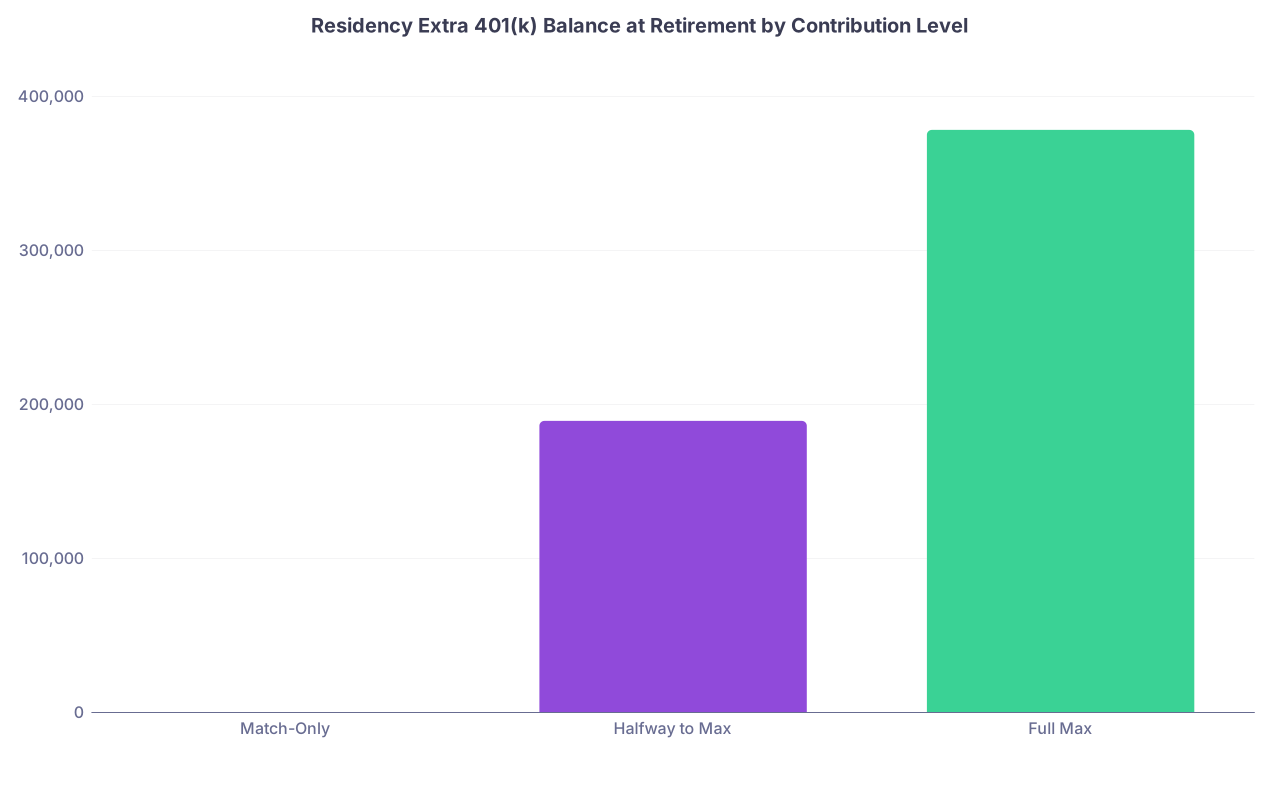
Let us do a partial max example:
- Instead of $18,800 extra, you go for half that: $9,400/year extra for 3 years.
- Total extra = $28,200
- Using the same 40/39/38-year compounding factors:
- Year 1: 9,400 × 7.04 ≈ $66,176
- Year 2: 9,400 × 6.70 ≈ $62,980
- Year 3: 9,400 × 6.38 ≈ $59,972
- Total ≈ $189,100 extra at retirement.
So even a 50% partial max during residency is a six-figure move in today’s dollars. That is not trivial.
| Category | Value |
|---|---|
| Match-Only | 0 |
| Halfway to Max | 189000 |
| Full Max | 378000 |
“I Have Loans, So 401(k) Can Wait”
Common phrase: “My 7% loan is guaranteed; market returns are not.”
Fine. Let us compare expected values.
- Student loans: often 5–7% interest.
- Expected long-term stock return (real): 5%; nominal 7–8%.
On pure spread, it can make sense to be aggressive on higher-interest loans. But a physician’s situation is messier:
- Forgiveness programs (PSLF), refinance options, practice-owner income jumps.
- Tax deduction on 401(k) contributions in a 40%+ bracket is an instant, risk-free 40% “return” on that portion. That matters.
If you put $23,000 into a pre-tax 401(k) at a 40% marginal rate:
- You save $9,200 in tax that year.
- Net cost to you is $13,800.
- You now own $23,000 of retirement assets instead of making an extra $13,800 payment on loans.
From a data perspective, physicians who skip 401(k) contributions to hyper-focus on loans often end up:
- Debt-free a bit earlier.
- But with dramatically smaller retirement balances later, forced to play “catch-up” in their 40s and 50s.
Catch-up rarely fully compensates for missed early compounding.
7. Scenario Table: Side-by-Side for a 2025 Grad
Here is a compact comparison across the two strategies.
| Metric | Match-Only Strategy | Max 401(k) Strategy | Increment (Max - Match) |
|---|---|---|---|
| Resident years (3) annual contrib (you + match) | ~$6,300 | ~$25,100 | +$18,800/year |
| Extra resident principal total | — | — | ~$56,400 |
| Extra resident balance at 65 | — | — | ≈ $378,000 |
| Extra attending principal over 30 yrs | — | — | ≈ $120,000 |
| Extra attending balance at 65 | — | — | ≈ $339,000 |
| **Total extra 401(k) at 65** | Baseline | Higher | **≈ $717,000** |
Interpret that last line as the whole point of this article.
8. What This Means for a 2025 Graduate in Plain Terms
Strip away the modeling details and you get a very blunt conclusion:
If you are a 2025 med school graduate and you:
- Always contribute only enough to get the match, versus
- Stretch to max your 401(k) from residency onward,
you are highly likely leaving around $700,000 of real retirement wealth on the table. Possibly more if:
- 401(k) limits rise faster than inflation.
- Market returns are above the 5% real assumption.
- You have an employer with a richer match or profit-sharing.
Even if you cannot fully max:
- Pushing toward the cap, especially in your first 10–15 years, buys you massive optionality later: financial independence in your 50s, reduced call, part-time work, academic pivots.
This decision is not about “being responsible” or “doing the right thing”. It is a numeric trade:
Forego a few hundred to a couple thousand dollars a month in early disposable income for mid-six-figure additional wealth later.
The data is crystal clear on which side wins financially. The real question is whether you are willing to feel that short-term pressure in residency and early attending life.
You are still early in your trajectory. The leverage on your behavior right now is enormous. A few payroll form checkboxes in 2025–2029 will echo in 2065.
You have the numbers. The next move is yours.