
Most doctor‑only real estate deals are sold, not selected—and that’s your first red flag.
Let me be blunt: being a physician does not make a real estate deal safer, smarter, or more profitable. It just makes the investor pool richer and busier—exactly the kind of group marketers love to target with shiny “exclusive” offerings.
Doctor‑only real estate investments can work. Some are solid, run by competent operators, and appropriately structured. But many rely on three things: your high income, your lack of time, and your trust in colleagues. That combination can quietly vaporize six figures if you do not ask the right questions.
This is your filter: not “Is this a doctor‑only deal?” but “Does this stand on its own as a good, well‑structured, properly aligned real estate investment?”
Let’s walk through what to look for, what to avoid, and the questions you should ask before wiring a single dollar.
1. Are Doctor‑Only Real Estate Deals Inherently Better?
No. The “doctor‑only” label is a marketing hook, not a quality guarantee.
Real estate returns are driven by:
- The underlying asset (location, property type, purchase price)
- The operator’s skill and integrity
- The deal structure (fees, splits, debt terms, reserves)
- The macro environment (rates, rents, supply/demand)
None of that changes because the investors are cardiologists instead of software engineers.
What “doctor‑only” often signals:
- The sponsors know physicians are:
- High earning
- Time poor
- Often financially under‑educated
- Influenced by peer recommendations and status
- They can charge higher fees or sell riskier deals because:
- “My colleague is in it” feels like due diligence
- Social proof replaces real analysis
- Many doctors are late to investing and eager to “catch up”
So, are doctor‑only deals ever worth it?
Yes—if:
- You’d still invest even if zero physicians were involved
- The numbers, structure, and operator check out under independent scrutiny
- The illiquidity and risk fit comfortably into your overall plan
If the main pitch is “Lots of physicians are in this” or “It’s built for doctors,” assume they’re selling the network, not the deal.
2. Core Financial Questions You Must Ask
You do not need to be a real estate pro to spot most bad deals. You just need to ask direct questions and insist on clear, quantified answers.
1. “Exactly how do you make money on this deal?”
You want a line‑item answer:
- Acquisition fee (commonly 1–3% of purchase price)
- Asset management fee (usually % of revenue or equity)
- Disposition fee/sale fee
- Construction/development fees (if applicable)
- Promote/carried interest (their share of profits above a hurdle)
If they cannot explain their compensation in simple terms, walk.
2. “What are the projected returns—and what has your ACTUAL track record been?”
Demand a written pro forma and specific track record:
- Target cash‑on‑cash returns per year
- Target IRR (internal rate of return)
- Equity multiple (e.g., 1.8x over 5–7 years)
- Distribution schedule (monthly, quarterly?)
- Their last 5–10 realized deals: projected vs actual IRR and hold period
If all you hear are “We’ve never lost money” stories without a full deal list and actual realized numbers, that’s not data—that’s marketing.
3. “What debt is on this property?”
Right now, debt structure is where many ‘safe’ deals quietly die.
Ask:
- Loan type (fixed vs variable rate)
- Term length and amortization
- Interest‑only period, if any
- Loan‑to‑value (LTV)
- Debt coverage ratio (DCR)
- Recourse vs non‑recourse
- When the loan matures and any rate cap details
High leverage, short‑term, floating‑rate debt with optimistic rent assumptions is a huge risk. Especially in rising or uncertain rate environments.
4. “What are the downside scenarios?”
Force them to talk about failure:
- What happens if:
- Rents stay flat or drop?
- Vacancies increase by 10–15%?
- Interest rates are still high at refinance or sale?
- Where is the breakeven occupancy level?
- At what point do investors lose principal?
- Have any of your prior deals:
- Suspended distributions?
- Lost investor principal?
- Gone back to the bank?
If the answer to every scenario is “We’ll still be fine,” they’re either naive or dishonest.
3. Legal & Structural Questions You Cannot Skip
This is the part most doctors gloss over because it is ‘boring legal stuff’. That “boring” section of the PPM (private placement memorandum) is exactly where your rights are defined—and limited.
5. “What exactly am I buying, and what is my legal position?”
Typically you’re buying:
- Membership units or interests in an LLC that owns the property, or
- Shares in a fund that owns multiple assets
You are usually a limited partner (LP). The sponsor/operator is the general partner (GP) or managing member.
Ask:
- Can I review the operating agreement and PPM in full?
- What voting rights, if any, do LPs have?
- Under what conditions can the GP:
- Refinance?
- Sell early or extend the hold period?
- Change fees?
- How are major decisions approved?
If they discourage you from reading documents or say “It’s all standard, don’t worry,” that’s your cue to walk away.
6. “What are the liquidity and lockup terms?”
Real estate syndications and funds are almost always illiquid. But there’s a range:
- Single‑asset syndications: capital locked until sale/refinance (often 3–10 years)
- Funds: sometimes slower return of capital, with staged exits
- Secondary transfer: Can you sell your interest to another investor? On what terms?
Ask:
- What is the expected hold period?
- Under what conditions can I get my money out early?
- Are there penalties or discounts for early withdrawal?
- Have you ever actually allowed someone to exit early?
If this will be your kid’s college fund in 5 years, do not lock it in a 10‑year project you cannot exit.
7. “Who is legally responsible if things go bad?”
On bad days, structure matters more than pro formas.
Questions:
- Is the debt recourse or non‑recourse?
- Is any investor signing personal guarantees? (It should be the sponsor, not you.)
- What legal protections do LPs have against:
- Mismanagement?
- Self‑dealing?
- Sponsor bankruptcy?
This is where it pays to have your own attorney—ideally one who has seen real estate syndication agreements before, not just a random family lawyer.
4. Sponsor & Alignment Questions (This Is Where Most Deals Fail)
You are not just underwriting the property. You are underwriting the people.
8. “What is your track record, specifically in this asset class and market?”
Theres a big difference between:
- A team that has done 15 similar deals in the same city with documented outcomes
- A brand‑new group of doctors partnering with a third‑party operator and slapping a logo on it
Ask for:
- Prior deals with:
- Asset type (multifamily, self‑storage, medical office, etc.)
- Market
- Actual vs projected returns
- Timeline
- Key people’s bios and roles (who is actually operating the asset day to day?)
If they “can’t share details for privacy reasons,” that’s a no.
9. “How much of your own money is in this deal—and on what terms?”
You want real skin in the game:
- A meaningful sponsor co‑investment (not just rolling their fees)
- On the same equity terms as LPs, not a sweetheart class with priority
If the sponsor will make millions in fees even if investors barely break even, you have misaligned incentives.
10. “Who’s doing the real work—and how are they incentivized?”
Many ‘doctor groups’ are really capital‑raising fronts for a third‑party operator.
Ask bluntly:
- Who:
- Finds the property?
- Underwrites the deal?
- Negotiates the loan?
- Manages renovations and operations?
- Are you (the doctor brand) taking a cut of fees to bring in investors?
- If so, how much?
Remember: if your colleague is getting paid to bring you in, they’re not just a friendly peer. They are part of the sales channel.
5. Positioning These Deals Inside Your Overall Plan
The best question you can ask yourself is not about the deal. It is about your plan.
11. “How does this fit into my broader financial picture?”
You should be able to answer:
- What percentage of my net worth is in:
- Public markets (stocks/bonds)
- Real estate (direct + syndications/funds)
- Cash and equivalents
- Home equity
- How much of my net worth would be in this single deal or fund?
- Can I afford to see this investment go to zero and still be on track?
For most physicians, an appropriate allocation to any single private real estate deal is small—often 1–5% of net worth. Not 20%.
12. “What is the real risk–return tradeoff here versus simpler options?”
Compare honestly:
- A diversified low‑cost index fund portfolio
- A REIT index fund
- Individual rental real estate you own and control
- Versus:
- A single, illiquid, leveraged private real estate deal
Many syndication pitches compare their “projected 16–18% IRR” to long‑term S&P 500 returns. That’s apples to fantasy.
Look at risk, fees, leverage, and liquidity, not just the biggest number on the slide.
6. A Simple Decision Framework You Can Use
Here’s how I’d advise a busy surgeon who gets pitched “exclusive doctor deals” weekly.

| Step | Description |
|---|---|
| Step 1 | Offered Doctor Only Deal |
| Step 2 | Pass Immediately |
| Step 3 | Request Full Docs and Track Record |
| Step 4 | Stress Test Assumptions and Debt |
| Step 5 | Limit Position Size |
| Step 6 | Optional Legal Review |
| Step 7 | Invest and Monitor |
| Step 8 | Would I invest if no doctors were involved? |
| Step 9 | Clear, reasonable fees and structure? |
| Step 10 | Can I afford full loss and illiquidity? |
If at any decision point the answer feels shaky, you are not “missing an opportunity.” You are avoiding a cleanup job.
7. Quick Comparison: Doctor‑Only Syndication vs Public REIT Fund
| Feature | Doctor-Only Syndication | Public REIT Index Fund |
|---|---|---|
| Liquidity | Very low (3–10 yrs) | Daily |
| Minimum Investment | Often $25k–100k+ | As low as $100 |
| Diversification | Single/few properties | Dozens/hundreds |
| Fees (all-in) | High, often complex | Low, transparent |
| Control | Almost none | None, but rules clear |
| Transparency | Varies widely | High, regulated |
I am not saying REITs are always better. I am saying: know what you are giving up (liquidity, diversification, transparency) to chase potentially higher returns.
8. Practical Safeguards Before You Join Any Deal
A few guardrails that will save you a lot of pain:
- Never invest because “my group is doing it” or “the partner I like is in it”
- Cap your exposure to any single deal
- Always read:
- The PPM
- Operating agreement
- Investor presentation
- Run the numbers yourself or with a fee‑only advisor
- Consider having a real estate attorney review the documents—especially your first few deals
- Assume the best‑case scenario won’t happen; ask if the deal still works under mediocre conditions
And if they pressure you with “This will fill fast,” treat that as a risk factor, not a feature.
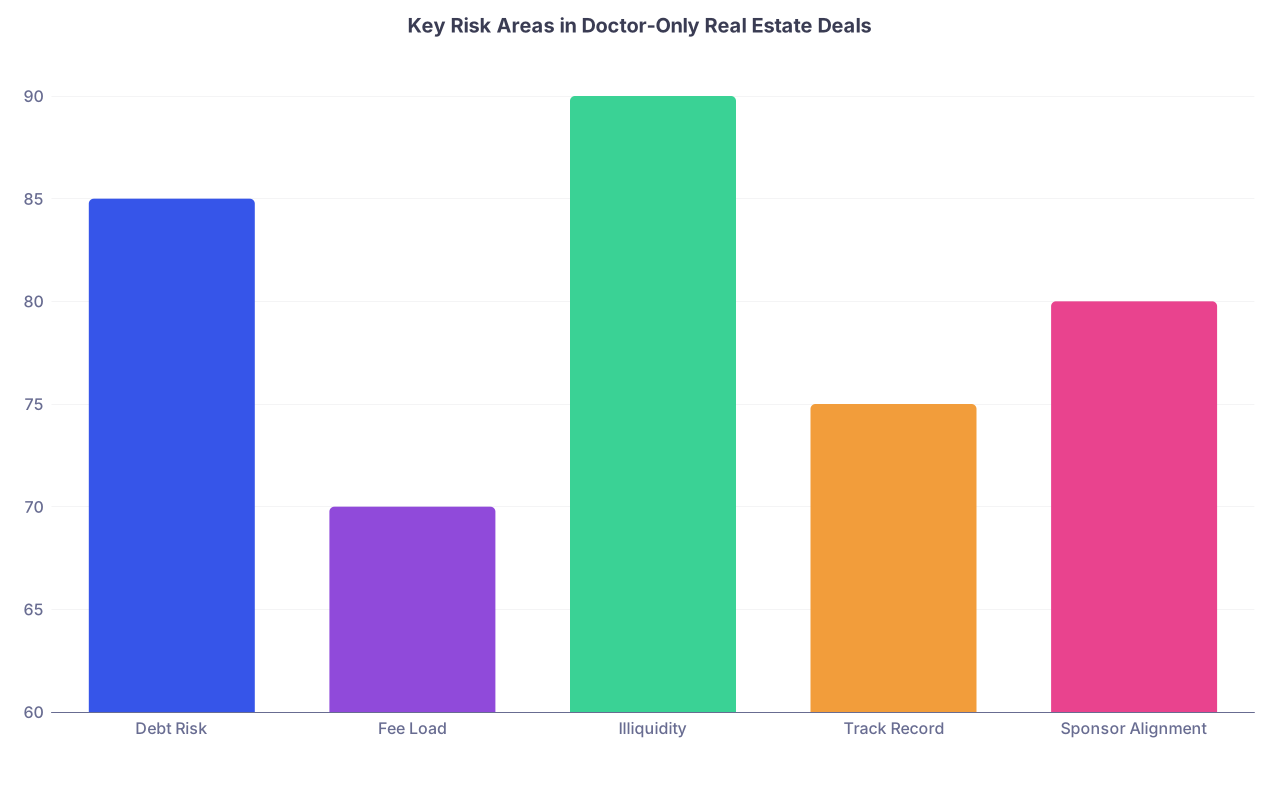
| Category | Value |
|---|---|
| Debt Risk | 85 |
| Fee Load | 70 |
| Illiquidity | 90 |
| Track Record | 75 |
| Sponsor Alignment | 80 |
FAQ: Doctor‑Only Real Estate Deals
1. Are doctor‑only syndications safer than regular real estate deals?
No. In many cases they’re riskier, because they’re marketed to a group that often doesn’t have time to do deep due diligence. Safety comes from conservative underwriting, responsible debt, experienced operators, and aligned incentives—not the profession of the investors.
2. What’s a reasonable minimum investment for these deals?
Common minimums range from $25,000 to $100,000 per deal or fund. If a group is pushing you to put “at least $250k to make it worth it” and you’re early in building wealth, that’s aggressive. For most physicians, a single private deal should be a small fraction of net worth, not a core holding.
3. How do I know if the fees are too high?
You’ll usually see some combination of acquisition fee (1–3%), asset management fee (1–2% of equity or revenue), and a profit split (e.g., 70/30 after a preferred return). When you add them up and see that the sponsor can make a lot of money even if returns are mediocre, be careful. Compare to other sponsors’ fee structures; there’s plenty of information out there.
4. Should I ever invest with colleagues or in a physician‑branded fund?
You can, but treat it exactly the same as any other deal. Ask whether the physician group is actually operating real estate or just raising capital and outsourcing operations. Disclose that relationship to your own advisor or attorney. And never let social pressure or FOMO override your risk limits.
5. What percentage of my portfolio should be in private real estate deals?
There’s no magic number, but for most doctors, total private illiquid investments (including real estate syndications, private equity, etc.) in the 5–20% range of net worth is common. Any single deal usually deserves only 1–5%. If you’re above that, you’re making a concentrated bet, whether you admit it or not.
6. What’s the single biggest red flag in these offerings?
A sponsor who can’t or won’t answer hard questions clearly. Evasive responses about fees, debt terms, downside scenarios, or track record are far more telling than a polished pitch deck. If transparency is weak before they have your money, imagine what it will look like when a project runs into trouble.
Keep three things front and center:
- “Doctor‑only” is a marketing label, not a risk reducer.
- You’re underwriting people, structure, and debt—not just projected returns.
- Any deal you’re afraid to walk away from is exactly the one you probably should.