
The average physician owns way too many funds and understands almost none of them.
Let me give you the straight answer first: most doctors only need 3–6 core funds in their entire investment portfolio. Not 25. Not whatever the hospital advisor stuck you with. Three to six.
Everything else is usually noise, fees, and complexity that doesn’t actually improve your results.
The Short Answer: How Many Funds Do You Really Need?
Here’s the clean framework:
- Ultra-simple “good enough” portfolio: 1–3 funds
- Optimized but still simple portfolio for most physicians: 3–6 funds
- Beyond 10 funds: almost always needless complexity
That’s for your total investment life: 401(k)/403(b), 457(b), backdoor Roth IRAs, HSA, and taxable brokerage. Across everything.
If you’re holding 15–30 different mutual funds and ETFs, you’re not “diversified.” You’re cluttered.
Let’s break down what those 3–6 funds actually are, and when you might reasonably go above that.
The Core Portfolio: What You Actually Need
At a high level, you’re trying to own:
- Stocks – for growth
- Bonds – for stability
- (Optional) Real estate – if you want an extra diversifier without being a landlord
And you want those in low-cost index funds.
Simple Model #1: The Single-Fund Solution (1 Fund)
If you truly want “set it and mostly forget it,” you can get away with one target-date or balanced fund in each account (or even just one main account early in your career).
Example:
- Vanguard Target Retirement 2055 Fund (VFFVX)
- Fidelity Freedom Index 2055 Fund (FDEWX)
- Schwab Target 2055 Index Fund (SWYJX)
Pros:
- Auto-adjusts stock/bond mix with age
- Rebalanced internally
- One line item on your statement
Cons:
- Not always the cheapest in employer plans
- Less tax-efficient in taxable accounts
- You give up some control over exact stock/bond ratios
This works best if:
- You’re early in your career
- Your investing discipline is shaky
- You’re overwhelmed and just need something clearly “not wrong”
Simple Model #2: The Classic 3-Fund Portfolio
This is the workhorse for most physicians who want to be intentional without turning into hobbyist portfolio managers.
The typical 3-fund portfolio is:
- Total US Stock Market Fund
- Total International Stock Market Fund
- Total Bond Market Fund
Concrete examples:
US Stocks:
- Vanguard Total Stock Market (VTSAX / VTI)
- Fidelity Total Market Index (FSKAX)
- Schwab Total Stock Market Index (SWTSX)
International Stocks:
- Vanguard Total International (VTIAX / VXUS)
- Fidelity Total International Index (FTIHX)
- Schwab International Index (SWISX or SCHF ETF)
Bonds:
- Vanguard Total Bond Market (VBTLX / BND)
- Fidelity US Bond Index (FXNAX)
- Schwab US Aggregate Bond Index (SWAGX)
You pick your stock vs bond allocation (e.g., 80/20, 70/30), then decide how much of the stock side is US vs international (e.g., 70/30 or 80/20). That’s it.
So an 80/20 portfolio with 30% of stocks international might look like:
- 56% US total stock
- 24% international stock
- 20% total bond
Rebalanced once or twice a year. Done.
Simple Model #3: Slightly Fancy, Still Reasonable (4–6 Funds)
If you want just a bit more nuance, most doctors can stop comfortably at 4–6 funds total. This usually means:
- Your 3 core funds (US stock, international stock, bonds)
- 1–3 “tilts” or additions, such as:
- REIT index fund (real estate)
- International bonds (optional)
- Small-cap value or factor funds (if you actually understand the evidence)
Now it looks like:
- US total stock
- International total stock
- US bond
- REIT index
- (Maybe) small-cap value
You’re still under 6 line items. Rebalancing is still doable. You can still understand what you own.
Why Doctors End Up With 15+ Funds (And Why That’s a Problem)
I’ve seen a lot of physician portfolios. The bloated ones all share the same story:
- Old 401(k) from residency with random actively managed funds
- Current 403(b) stuffed with whatever the retirement vendor pushed
- “Advisor” account with 10 different active funds, each with a story
- Taxable account with leftover hot tips, sector funds, and ESG experiments
Suddenly:
- 2–3 US stock funds
- 4–5 international funds
- 6–8 bonds and “strategic income” funds
- A sprinkling of sector funds (healthcare, tech, biotech)
- One or two expensive “alternative” or “tactical” funds
What’s wrong with this?
It’s not actually more diversified
Five different US large-cap funds that all own Apple and Microsoft don’t magically reduce risk.You lose control of your asset allocation
Ask yourself: “What percent of my money is in stocks vs bonds across all accounts?”
If you can’t answer within 5 seconds, your portfolio is too messy.You probably pay more in fees and taxes
Active funds, high-turnover funds, and overlapping holdings are a quiet tax/fee drag.You’re less likely to stick to the plan
Complexity is the enemy of discipline. When markets drop, you’ll have no idea what should be bought, sold, or ignored.
How to Decide Your Exact Number of Funds
Let’s set up a quick decision framework.
Step 1: Define Your “Job to Be Done”
Your portfolio needs to:
- Grow faster than inflation
- Provide cash flow later in life
- Be simple enough that you (or your spouse) can manage it without a spreadsheet degree
That’s it. You don’t get bonus points for cleverness.
Step 2: Pick Your Complexity Level
Use this as a guide:
| Investor Profile | Typical Funds Needed | Notes |
|---|---|---|
| Overwhelmed / just starting | 1–3 | Target-date or 3-fund mix |
| Busy but engaged physician | 3–6 | Ideal range for most doctors |
| Hobbyist, reads finance books | 5–8 | Only if you genuinely enjoy it |
| Above 10 | 10+ | Usually cleanup is needed |
If you’re a working physician with call, EMR headaches, and a family, I’m strongly in favor of the 3–6 fund range. You can absolutely become financially independent there.
Step 3: Match Funds to Account Types (Without Adding More)
Here’s where people accidentally multiply fund counts. Every account (401k, 403b, 457b, Roth, HSA, taxable) doesn’t need its own unique fund menu.
You can use the same core idea across all accounts, even if the ticker symbols differ:
- In your 403(b): US stock index + international index + bond index
- In your Roth IRA: mostly US stock index (tax-free growth)
- In your HSA: US stock index fund
- In taxable: US and international index funds (very tax-efficient)
Different accounts, same basic 3–4 fund concept. Don’t invent new strategies just because the plan list is long.
When Does It Make Sense to Add More Funds?
There are reasonable reasons to go above 3 funds. But they should pass a very strict test:
“Does this extra fund clearly change my risk/return profile in a way I understand and actually want?”
Some justified adds:
REIT Index Fund
Gives you real estate exposure without being a landlord. Often 5–10% of the portfolio.International Bond Fund
Reasonable, but not essential. You won’t ruin anything by skipping this.Factor Tilts (Small-cap value, quality, etc.)
Only if you’ve read enough to understand what you’re doing and are willing to tolerate stretches of underperformance that can last many years.TIPS Fund (Inflation-protected bonds)
Some like splitting bonds into nominal + TIPS, especially closer to retirement.
If you’re adding a fund because “it did really well last year” or “the guy in the doctor’s lounge said it’s killing it,” that’s not a good reason. That’s how you end up with 19 funds and no plan.
The Hidden Benefit of Fewer Funds: Behavioral Control
The math of investing is easy. The psychology is the problem.
A portfolio with 20 funds gives you 20 excuses to tinker when markets move. A portfolio with 3–6 simple funds forces you to focus on what actually matters:
- Am I saving enough?
- Is my stock vs bond mix appropriate for my age and risk tolerance?
- Am I staying the course in bad markets?
I’ve watched physicians sell “the worst-performing fund” in their 15-fund salad every year, only to realize later that they were just systematically selling low. Not because they’re dumb. Because the setup made smart behavior almost impossible.
Fewer levers. Fewer chances to do something impulsive.
A Concrete Example: Two Physician Portfolios
Let’s compare.
Portfolio A: Overcomplicated Surgeon Age 45
- 403(b): 9 funds (growth, value, mid-cap, small-cap, global, 3 bond funds, target-date)
- Old 401(k): 6 random active funds
- Taxable: 7 ETFs and 4 individual stocks
- Roth IRA: 3 sector funds
Total = 29 holdings.
When I ask, “What’s your stock/bond split?” she shrugs. “Aggressive, I think?”
Portfolio B: Simple Hospitalist Age 45
Across all accounts:
- 1 US total stock fund
- 1 international total stock fund
- 1 total bond fund
- 1 REIT index fund
Total = 4 holdings.
He knows exactly: “I’m 75% stocks, 20% bonds, 5% REIT. I rebalance once a year.”
Who’s more likely to stick with the plan in a 30% market drop? The second one. By far.
Visual: How Fund Counts Usually Balloon Over Time
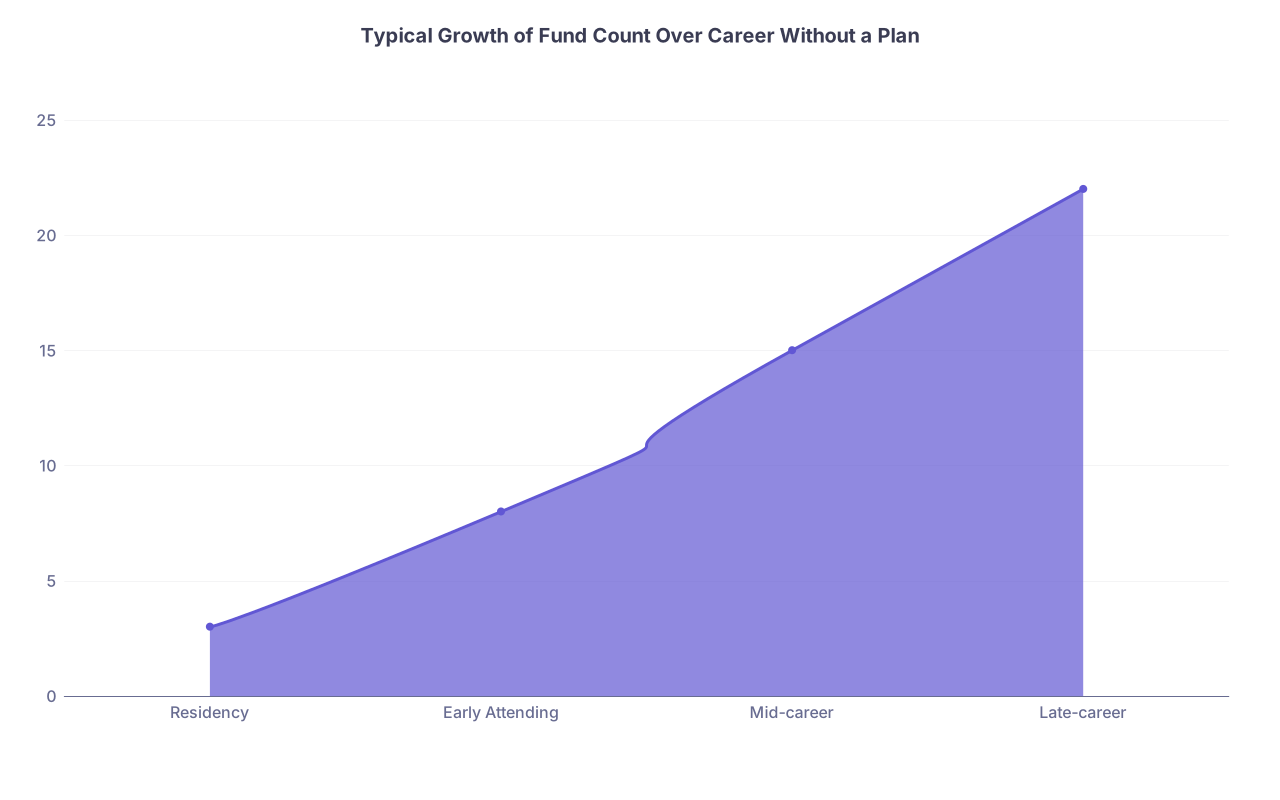
| Category | Value |
|---|---|
| Residency | 3 |
| Early Attending | 8 |
| Mid-career | 15 |
| Late-career | 22 |
And here’s what you should aim for:
- Start low
- Stay low
- Only add new funds with a clear, written reason
How to Clean Up a Messy Portfolio
If you already have 15–30 funds, don’t panic. You can fix it stepwise.

| Step | Description |
|---|---|
| Step 1 | Gather all accounts |
| Step 2 | List all funds |
| Step 3 | Identify core index funds |
| Step 4 | Decide target allocation |
| Step 5 | Sell overlap in tax-advantaged accounts |
| Step 6 | Minimize tax hits over time |
| Step 7 | Consolidate immediately |
| Step 8 | End with 3 to 6 core funds |
| Step 9 | Taxable account? |
Key moves:
- In 403(b)/401(k)/457(b)/IRA: you can freely trade into fewer funds without tax issues
- In taxable: be more careful; you might need to spread simplification over several years to manage capital gains
Your end goal is a short list of core funds that you can hold for decades.
Alternative Asset Temptations (Crypto, Private Real Estate, etc.)
Quick reality check:
You do not need:
- Crypto funds
- Hedge-fund-like mutual funds
- Complicated private real estate funds with 50-page PPMs
- Leveraged ETFs
Could some physicians reasonably put 5–10% in private real estate or a niche area once they’re already set? Sure. But that’s dessert, not the main course. Your 3–6 core funds do the heavy lifting.
FAQ: Physician Fund Count Questions (7 Qs)
1. Is one target-date fund actually enough for a physician?
Yes, especially early on. If using a low-cost index-based target-date fund in your main retirement account, you’re miles ahead of most colleagues. Eventually, you might want more control in taxable accounts, but you can do very well with just one good target-date fund in your 401(k)/403(b).
2. Do I need different funds in every account type?
No. That’s how people accidentally bloat their portfolio. You can use the same basic 3–6-fund structure across all accounts, adjusting only for tax efficiency (more bonds in tax-deferred, more stocks in Roth/taxable). The tickers might differ by custodian, but the underlying roles should match.
3. How many funds is “too many”?
Once you’re past ~10 funds for your entire portfolio, the burden of proof flips: you should be able to clearly explain what each fund does and why it’s necessary. If you can’t, it’s probably clutter. Most physicians should aim for 3–6 core funds and rarely need more than 8.
4. Is owning multiple S&P 500 or large-cap funds a problem?
It’s not “dangerous,” but it’s pointless. Two or three different US large-cap funds usually just create overlap and complexity. You don’t get real diversification; you just own the same companies multiple ways. One broad US total stock fund is usually enough.
5. Should I include a REIT fund in my portfolio?
It’s optional. A 5–10% REIT allocation can add diversification and real estate exposure if you’re not buying physical properties. But if adding a REIT fund pushes your lineup from 6 to 14 funds because everything else is a mess, fix the mess first. Simplicity beats a “perfect” but unmanageable allocation.
6. How often should I rebalance my 3–6 fund portfolio?
For most physicians, once or twice a year is fine. Or when any major asset class drifts more than about 5 percentage points from target. Rebalancing too often just feeds the urge to tinker. The whole point of a small number of funds is that you don’t have to babysit them.
7. What if my employer plan doesn’t have good index funds?
You do the best you can in the plan (pick the lowest-cost broad funds available), then optimize in your IRAs and taxable accounts. You might end up with a “not perfect but fine” bond fund at work and then hold your preferred US and international stock funds elsewhere. You still don’t need more than 3–6 total core building blocks.
Bottom line: Most physicians only need 3–6 well-chosen funds total. Start with broad US stock, international stock, and bond funds. Add one or two more only if you can clearly explain why. Simpler portfolios are easier to manage, easier to stick with, and more than good enough to make you financially independent.