
Is It Ever Smart for Doctors to Speculate in Crypto? A Risk Assessment
What happens when a single bad crypto bet wipes out three years of your attending savings—while you’re still paying off $300k in student loans?
Let me be blunt: most doctors have no business “investing” in crypto. Because what they’re actually doing isn’t investing. It’s gambling with a high income and very little time to recover from big mistakes.
But that’s not the whole story.
There is a narrow scenario where crypto speculation can be rational for a physician. The key word: narrow.
Let’s walk through when it’s dumb, when it’s dangerous, and when it can be acceptable (with hard limits).
First: Crypto Is Speculation, Not a Core Investment
If you take nothing else from this, take this: crypto is speculation, not a foundational investment like index funds, Treasuries, or your 401(k).
Traditional investments:
- Generate cash flow (dividends, interest, rent)
- Have underlying economic activity
- Are regulated, audited, and reasonably transparent
Most crypto assets:
- Don’t generate cash flow
- Are driven heavily by sentiment and narratives
- Can go to zero and never come back
- Live in a regulatory gray zone that changes underneath you
So for doctors, the question isn’t, “Should crypto be part of my retirement portfolio?”
The question is, “Is it ever reasonable to allocate a small, capped, non-essential slice of my net worth to crypto speculation without blowing up my financial life?”
Sometimes, yes. Often, no.
The Doctor-Specific Risk Profile (And Why Crypto Hits All the Weak Spots)
Doctors have a weird combination of strength and vulnerability when it comes to money.
Strengths:
- High, relatively stable income (once attending)
- Strong ability to save aggressively once loans are under control
- Job security in most specialties and markets
Vulnerabilities:
- Late career start
- Massive student debt
- Little formal finance education
- Social exposure to “doctor-adjacent” hype (colleagues, reps, high-income peers)
Crypto feeds directly on the vulnerabilities.
Busy cardiologist hears, “My buddy doubled his money in Solana last year. You’re still in index funds?”
Or the classic: “Bitcoin is digital gold. It’s a hedge against inflation; you’re losing money in cash.”
And suddenly, instead of a rational asset-allocation conversation, you’re fighting:
- FOMO (fear of missing out)
- Overconfidence (“I’m smart, I can figure this out”)
- Time scarcity (you don’t have hours a week to research this space properly)
That cocktail is dangerous.
Hard Truth: When Crypto Is a Flat-Out Bad Idea for Doctors
Here’s where I’ll be uncompromising. If any of these are true, you should not be touching crypto at all:
You’re still building your emergency fund.
If you don’t have 3–6 months of expenses in boring cash or cash-equivalents, you have zero business in crypto. Period.You’re not maxing basic retirement vehicles yet.
Not hitting:- 401(k)/403(b) up to match (at minimum, ideally max)
- Backdoor Roth (if eligible and appropriate)
- HSA (if you have one and it fits your situation)
Then you shouldn’t be chasing upside in speculative assets.
You’re carrying high-interest consumer debt.
Credit cards, personal loans, buy-now-pay-later nonsense. If you’re paying 18–24% interest anywhere, chasing 100%+ returns in crypto instead of killing that debt is backwards.You’d feel sick if it went to zero.
If losing the entire amount:- Delays your retirement
- Affects your ability to pay tuition, mortgage, or loans
- Would cause a major fight with your spouse
It is too much money for crypto. End of story.
You’re thinking in months, not decades.
If you’re telling yourself, “This could 5x in a year,” you’re not approaching this like an investor. You’re a speculator hoping to time a mania.
If you see yourself anywhere in that list, the smart move is: don’t touch it.
The Only Scenario Where Crypto Speculation Can Be Reasonable
Here’s the more nuanced answer.
Speculating in crypto can be defensible for a doctor if all of this is true:
Your financial foundation is solid:
- Emergency fund: built
- Retirement contributions: on track or ahead
- High-interest debt: gone
- Insurance: disability and term life in place if needed
You accept that it’s play money:
- You can genuinely let the entire allocation go to zero
- It won’t change your retirement age
- It won’t change your lifestyle
- You won’t chase losses if it tanks
You cap the allocation:
- Total crypto exposure under 5% of your investable net worth
- For many, 1–3% is more sane
- You rebalance back to that cap, not let it balloon unchecked
You’re willing to do basic due diligence:
- Understand the difference between Bitcoin, Ethereum, and random meme coins
- Keep assets on reputable exchanges or, better, cold storage if long-term
- Know tax implications of every trade (short-term vs long-term gains)
You treat it as an experiment, not a strategy:
- You’re curious about the technology/space
- You want skin in the game to learn
- You don’t tell yourself this is your “ticket” to early retirement
In that window, sure—crypto can be part of your speculative bucket, the same way some people buy angel investments, art, or a tiny slice of a friend’s business.
What Kinds of Crypto Exposure Are Less Stupid? (Relative Scale)
Let’s be clear: all crypto is risky. Some is just “less insane” than others.
| Approach | Relative Risk Level | Typical Use Case |
|---|---|---|
| Broad index funds (no crypto) | Very Low | Core portfolio |
| Small BTC/ETH allocation | High | Speculative side bucket |
| Diversified large-cap crypto | Very High | Higher-risk speculation |
| Small-cap/meme tokens | Extreme | Gambling, lottery tickets |
| Leveraged futures/Derivatives | Catastrophic | Professional trading only |
If you insist on touching crypto at all, most reasonable physicians who are financially stable stick (if at all) to:
- Bitcoin (BTC)
- Ethereum (ETH)
Not because they’re “safe” (they aren’t), but because:
- They have the longest track records
- They’re the most liquid
- They have the deepest institutional and regulatory scrutiny
Once you drift into:
- Tiny altcoins
- Meme tokens promoted on social media
- DeFi schemes promising “30% yield”
- Leveraged trading
…you’re gambling. Full stop. I’ve watched attendings blow $100k on this stuff in a few weeks and then double down because they “used to be up.”
You don’t have the time, tools, or emotional bandwidth to compete with full-time crypto traders and market-makers.
Key Risks Doctors Usually Underestimate
1. Volatility Risk
Crypto doesn’t just dip. It collapses.
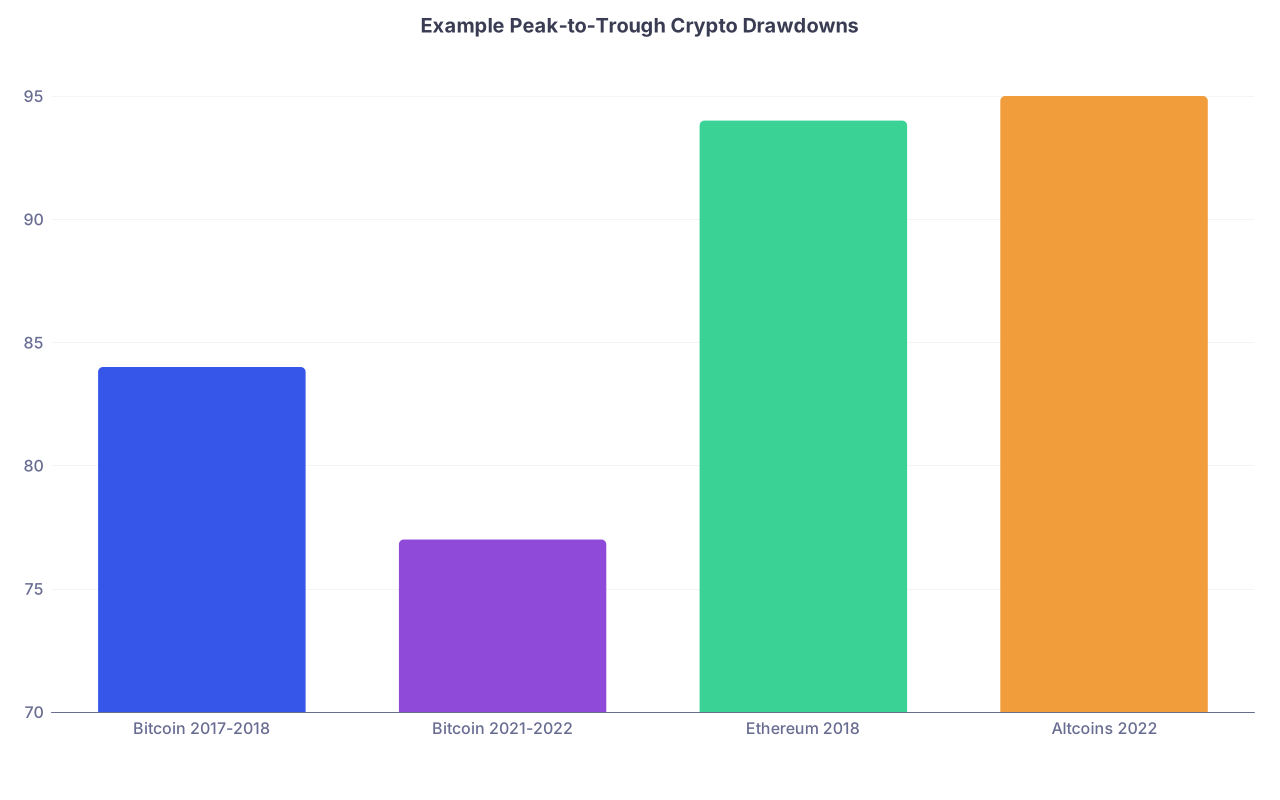
| Category | Value |
|---|---|
| Bitcoin 2017-2018 | 84 |
| Bitcoin 2021-2022 | 77 |
| Ethereum 2018 | 94 |
| Altcoins 2022 | 95 |
Those are not hypothetical. Those are real drawdowns from prior cycles.
Ask yourself: can you watch an asset go down 60–80% and not:
- Panic-sell at the bottom?
- Try to “make it back” with even riskier bets?
Be honest. Most physicians I’ve seen in this game don’t have that temperament.
2. Liquidity and Platform Risk
You’re not just betting the coin. You’re betting:
- The exchange (FTX, anyone?)
- The regulatory environment
- Your own security practices (phishing, SIM swaps, lost keys)
If your “investment” depends on:
- A single offshore exchange staying solvent
or - A yield platform not being a Ponzi
…that’s not an investment. It’s a counterparty bet you probably haven’t fully evaluated.
3. Tax and Legal Risk
Every time you:
- Sell crypto
- Trade one coin for another
- Spend crypto on something
You’ve likely triggered a taxable event.
If you’re flipping coins rapidly on three different platforms and not tracking basis, you’re creating a documentation nightmare. The IRS is cracking down on this stuff, and you don’t want that letter.
For practicing physicians in high brackets:
- Short-term crypto gains are taxed at your top marginal rate
- Those “big wins” are often smaller than they look after federal + state + possibly NIIT taxes
A Sensible Crypto Framework for Physicians (If You Still Want In)
If you’ve read this far and are still thinking, “I get the risks, I still want some exposure,” here’s a rational, boring framework that keeps you from doing something catastrophic.
Step 1: Confirm foundation is done
Emergency fund, retirement contributions on track, high-interest debt gone, insurance in place.
Step 2: Set a hard percentage cap
Something like:
- Max 3–5% of total investable assets
Example: If you have $500k in investments, your total crypto bucket caps at $15–25k.
Step 3: Choose your lane
- Conservative speculator: BTC and/or ETH only
- Higher-risk speculator: small slice into other large-caps, but still majority BTC/ETH
Avoid:
- Margin
- Futures
- Options
- Yield farms you don’t fully understand
Step 4: Decide time horizon and behavior in advance
- “I’m holding this for at least 5 years unless my allocation blows past X% of portfolio.”
- “If it doubles, I’m taking out my principal and letting profits ride.”
- “If it drops 70%, I will not add more.”
Write it down. If you don’t pre-commit, you’ll improvise emotionally. That’s where people blow up.
Step 5: Keep it boring and automated
- Use dollar-cost averaging if you must buy (small, regular amounts)
- Don’t check prices daily
- Rebalance annually so total crypto stays under your cap

| Step | Description |
|---|---|
| Step 1 | Want crypto exposure |
| Step 2 | Do not invest in crypto |
| Step 3 | Set max 3 to 5 percent allocation |
| Step 4 | Limit to BTC or ETH |
| Step 5 | Automate small purchases |
| Step 6 | Rebalance yearly and stick to plan |
| Step 7 | Emergency fund complete |
| Step 8 | Retirement on track |
| Step 9 | High interest debt? |
| Step 10 | Comfort losing all of it |
Psychological Guardrails (Because Your Brain Is the Real Risk)
Your biggest threat isn’t the technology. It’s you.
Watch for:
- Anchoring: “I bought at $60k, I’ll sell when it gets back there.” It might never.
- FOMO: Buying after a rapid run-up because “this time is different.”
- Sunk cost fallacy: Throwing more money in to “average down.”
- Social proof: Believing it’s safe because other doctors in the group chat are doing it.
Good rule of thumb: if you feel the urge to talk about a coin at a dinner party, you’re probably too emotionally invested.
Where Crypto Doesn’t Belong in a Doctor’s Plan
Let’s kill a few bad ideas outright. Crypto should not be:
- Your emergency fund
- Your kid’s 529 money
- Your house down payment
- “The thing that lets me retire at 45 instead of 55”
- A big line item in any serious financial plan
Your core wealth-building engine as a physician should be:
- Your income
- High savings rate
- Broad, low-cost, diversified index funds
- Reasonable real estate if it fits your life
Crypto, at best, is a tiny spice on top. Not the main dish.

| Category | Value |
|---|---|
| Stocks/Index Funds | 65 |
| Bonds/Cash | 20 |
| Real Estate | 13 |
| Crypto Speculation | 2 |
Bottom Line: Is It Ever Smart?
Yes, in a very specific sense:
- If your financial life is already structurally sound
- If you truly cap the allocation and accept total loss as possible
- If you treat it as speculation, not a core strategy
- And if you build rules around it to stop your own worst impulses
…then a very small, disciplined crypto position can be a tolerable speculative hobby.
But if you’re using crypto to:
- Compensate for poor savings habits
- Shortcut a late start
- Make up for underfunded retirement
- Impress colleagues with “smart bets”
Then no. It’s not smart. It’s self-sabotage with good branding.

FAQs

1. How much of my portfolio can safely be in crypto as a doctor?
For most physicians, 0–3% of investable assets is the sane range. Above 5%, you’re taking real balance-sheet risk for something that could still go to zero.
Example: if you have $300k invested:
- 1% = $3,000
- 3% = $9,000
That’s plenty to get “exposure” and stay interested, without wrecking your future if it dies.
2. Should I buy crypto before I finish paying off my student loans?
Usually no, especially if your loans are at a meaningful interest rate. If you’re:
- On track with PSLF and aggressively saving, there’s a narrow argument for a tiny speculative allocation.
But if you’re: - Making standard payments
- Not yet maxing retirement
Then you’re putting speculative upside ahead of guaranteed returns (by paying off debt and getting tax-advantaged growth). That’s backwards.
3. Is Bitcoin “digital gold” and a good inflation hedge for doctors?
Bitcoin has not behaved like a reliable inflation hedge or stable store of value. It behaves more like a high-beta risk asset correlated with tech stocks. Could it eventually act like “digital gold”? Maybe. But you shouldn’t build your financial security on a “maybe” narrative that hasn’t consistently shown up in real data yet.
4. Should I use a financial advisor for crypto decisions?
Most traditional advisors will either:
- Tell you to avoid crypto entirely
or - Allow a tiny allocation (1–3%) inside a broader plan
Very few reputable advisors will encourage heavy crypto exposure. If an “advisor” is pushing large crypto positions, yield schemes, or proprietary tokens, that’s a red flag. At minimum, use an advisor to ensure your crypto bets don’t blow up your overall asset allocation and tax picture.
5. Are crypto yield platforms and staking a good idea for extra income?
For a conservative physician? Usually no. Many “yield” platforms have blown up, frozen withdrawals, or turned out to be outright frauds. Staking major assets (like ETH) directly or through reputable providers is less insane but still carries protocol, slashing, and custodial risks you probably don’t understand deeply. Don’t reach for yield in a space where the rule of thumb is: “If you don’t know where the yield comes from, it’s probably you.”
6. What’s a simple, concrete crypto plan if I insist on having some?
Here’s the stripped-down version:
- Cap total crypto at 2–3% of investable assets
- Use only major coins (BTC/ETH) on a large, regulated exchange
- Buy small amounts periodically (no lump-sum YOLO purchases)
- Don’t use leverage, derivatives, or sketchy yield products
- Review once a year and rebalance back to your cap
If you can’t stick to that level of discipline, you’re better off with zero crypto and a boring but powerful mix of index funds and debt paydown.

Key takeaways:
- Crypto is speculation, not a core investment, and most doctors don’t need it at all.
- If you do play, keep it tiny (0–3%), rule-based, and emotionally detached—money you can truly afford to lose.
- Your real wealth as a physician will come from your income, savings rate, and boring diversified investments—not from chasing the next coin.