
The common investing advice doctors get about disability insurance is backwards.
Most physicians are told, “Max your 401(k). Start investing early. Oh, and maybe look at disability insurance at some point.” That order is wrong for a lot of doctors—especially early-career ones with big income and big debt.
Here’s the blunt answer you’re looking for:
If your income is the engine that funds all your investing, protecting that income with disability insurance is usually more important than starting to invest. For many physicians, disability insurance should come before (or at least alongside) serious investing.
Let’s break down when that’s true, when it isn’t, and how to make a clean, rational decision instead of guessing.
The Core Issue: What Problem Are You Solving First?
Investing solves one problem:
“How do I grow money for my future?”
Disability insurance solves a different, more basic problem:
“What happens if I lose the ability to earn this high physician income?”
If you’re a doctor, your biggest asset is not your 403(b) balance. It’s your future earning power.
Example:
PGY-1 making $65k, planning a 30-year career with attending income averaging $350k. Even with conservative assumptions, your lifetime earnings are easily $6–10 million in today’s dollars.
Lose that? Your Roth IRA and a $15k brokerage account are rounding errors.
This is why, in many cases, it makes more sense to:
- Build a small emergency fund
- Put basic protections in place (disability + term life if needed)
- Then ramp up investing
Skipping straight to “investing first” is like building a fancy deck on a house with no walls.
When Disability Insurance Should Come Before Investing
You do not need disability insurance in every imaginable situation. But if the following are true, it usually belongs at the front of the line.
1. You’re a resident or new attending with no financial independence
If you:
- Could not stop working tomorrow without a financial crisis
- Rely almost entirely on your paycheck for rent, food, loan payments, childcare
- Have minimal investments
…then your future income is your whole financial plan. If that disappears, everything else falls apart.
In this situation, putting several hundred dollars a month into investments instead of protecting your income is a bad trade. One disability event can permanently destroy millions of future earnings. Market returns cannot fix that.
2. You have dependents or big fixed obligations
If any of these apply:
- Spouse/partner relying on your income
- Kids (or planning them soon)
- Large mortgage or private student loans you’re personally on the hook for
- Supporting parents or family
Then disability coverage isn’t optional—it’s risk management 101.
Without your income, your “investment strategy” becomes: hope, GoFundMe, and stressed family members. That’s not a plan.
3. Your employer coverage is weak or misleading
I’ve seen this too many times:
- Hospital offers “60% of income” disability coverage
- But that’s 60% of base salary only, not bonus/call/shift pay
- It’s taxable
- Definition is “own occupation for 2 years, then any occupation”
For a surgeon making $450k with 60% of a $250k base salary, taxable, you’re suddenly living on something like $8–10k per month instead of $25k+. And maybe required to work in any job you’re “fit” for after two years.
If your employer policy has any of these red flags, you likely need an individual policy:
- Pays only to “any occupation” after 2–5 years
- No true “own occupation” or “specialty-specific” definition
- Caps benefits at a low number (e.g., $5k/month)
- Non-portable (you lose it if you leave)
In that scenario, yes—solving this issue should usually happen before aggressively funding a taxable account or dumping extra into loans.
When Investing Can Come Before (or Alongside) Disability Insurance
There are absolutely situations where you don’t need to slam the brakes on investing just to buy disability insurance.
1. You’re financially independent or close
If:
- Your invested assets could support your current lifestyle long term
- Or you’re very close, and losing income would be annoying but not catastrophic
Then disability insurance becomes a “nice to have,” not a must-have. In fact, some FI (financial independence)-level doctors drop their policies entirely.
2. You have strong, specialty-specific employer coverage
Rare, but it happens—especially in large, well-structured academic or hospital systems.
If your employer plan:
- Is own occupation / specialty specific to retirement age
- Replaces a high percentage of your total comp (not just base)
- Is portable or you’re planning to stay put long term
Then an additional individual policy might be less critical, and you can focus more on investing. Still, many physicians layer an individual policy on top to increase benefit amounts and lock in coverage independent of any job.
3. You’re using a temporary “bridge” approach
Some doctors do this intelligently:
- Start investing a little (to build the habit, get employer match)
- Take a smaller disability policy now
- Plan to increase coverage with “future purchase” options as income rises
That’s a reasonable compromise—if you’re using real numbers and not hand-wavy optimism.
The Real Trade-Off: Dollars and Risk, Not Feelings
Let’s put some numbers to it so you’re not making an emotional decision.
Assume:
- PGY-2, age 28
- Income: $70k now, expected $350k as attending in 3 years
- You can free up $400/month right now
Option A: Invest the entire $400/month
Option B: Spend $200/month on a solid individual disability policy, invest $200/month
Over 35 years at 7%:
- Investing $400/month → ~ $790,000
- Investing $200/month → ~ $395,000 (difference ≈ $395k)
So skipping insurance in favor of investing could add maybe ~$400k over decades.
Now compare that to the risk you’re covering:
- Future earnings roughly: 30 years × $350k = $10.5M gross
- Even after taxes and lifestyle, that’s millions of dollars of value
You’re trading a potential extra ~$400k in portfolio value for protection of several million in future income. That’s the cold math. Once people see this, insurance-first no longer looks “overly cautious”—it looks rational.
What a Smart Sequence Looks Like for Most Doctors
Here’s the order I recommend for the majority of residents and early attendings.

| Step | Description |
|---|---|
| Step 1 | Start Residency or Early Attending |
| Step 2 | Build 1 to 3 month emergency fund |
| Step 3 | Get disability insurance quote |
| Step 4 | Buy individual own occupation policy |
| Step 5 | Consider supplement only |
| Step 6 | If dependents buy term life |
| Step 7 | Contribute to get full employer retirement match |
| Step 8 | Increase investing and debt paydown |
| Step 9 | Employer coverage strong? |
Step-by-step:
- Build a small emergency fund (1–3 months expenses)
- Get a disability insurance quote from an independent agent who works with multiple big carriers
- If you have dependents or big debts, also get term life insurance quotes
- Lock in at least a base individual disability policy (with strong “own occ” language and future increase options)
- Contribute enough to get full employer retirement match (never walk away from free money)
- With what’s left:
- Increase retirement contributions
- Pay down high-interest debt
- Build taxable investments
Notice what’s missing? “Max out all retirement accounts first and then maybe think about disability insurance.” That sequence leaves your entire plan sitting on an unprotected foundation.
How To Tell If Your Disability Coverage Is “Enough”
Do not just look at the monthly benefit amount. You need to check:
| Feature | What You Want |
|---|---|
| Definition of disability | Own occupation / specialty specific |
| Benefit period | To age 65–67 |
| Benefit amount | ~60% of gross income (tax-free) |
| Residual/partial rider | Included |
| Future increase rider | Included |
Ask your HR department or benefits portal for the actual policy certificate, not just the glossy summary. You’re looking for:
- “Own occupation” or “regular occupation” wording
- Whether that applies for the full benefit period or only first 2 years
- Whether benefits are taxable (employer-paid usually are)
- Maximum monthly benefit cap
Then compare that to your real lifestyle costs and financial goals. If the numbers look tight even on paper, they’ll be brutal in real life.
Common Doctor Mistakes With Disability Insurance
I see the same bad patterns over and over:
Waiting too long
You get older, maybe develop mild health issues, and suddenly premiums jump or exclusions appear. Residents often get much better pricing and fewer exclusions.Relying solely on group coverage
Group plans change with employers. You switch jobs and suddenly go from fully covered to completely exposed. Or the new plan is garbage.Buying the cheapest policy
Stripped-down policies save $50–100/month now, then fail you when you actually need them. Bad trade.Over-insuring early, under-investing forever
The flip side mistake: buying the absolute max benefit when your savings rate is near zero. You still need to invest. As your net worth rises, your need for disability coverage will eventually fall.Never updating coverage as income grows
You lock in a $5k/month benefit as a resident and never increase it. Then you’re an attending living on $18k/month, and your policy barely covers half your lifestyle. Use the future increase riders.
Concrete Recommendation: So Do You Really Need It Before Investing?
Here’s my direct answer, broken down.
You should strongly prioritize getting disability insurance before significant investing if:
- You’re a resident or early attending
- You have substantial future earning potential (most docs do)
- You have dependents and/or large debts
- Your employer policy is weak, taxable, or not specialty-specific
- Losing your income would be catastrophic, not just inconvenient
You can reasonably prioritize investing (with or without disability insurance) if:
- You’re financially independent or close
- Your employer policy is genuinely strong and you plan to stay
- You have no dependents, modest lifestyle needs, and some assets already built up
For everyone in between: do both, but get at least a baseline individual policy in place early. Then scale investments as your cash flow grows.
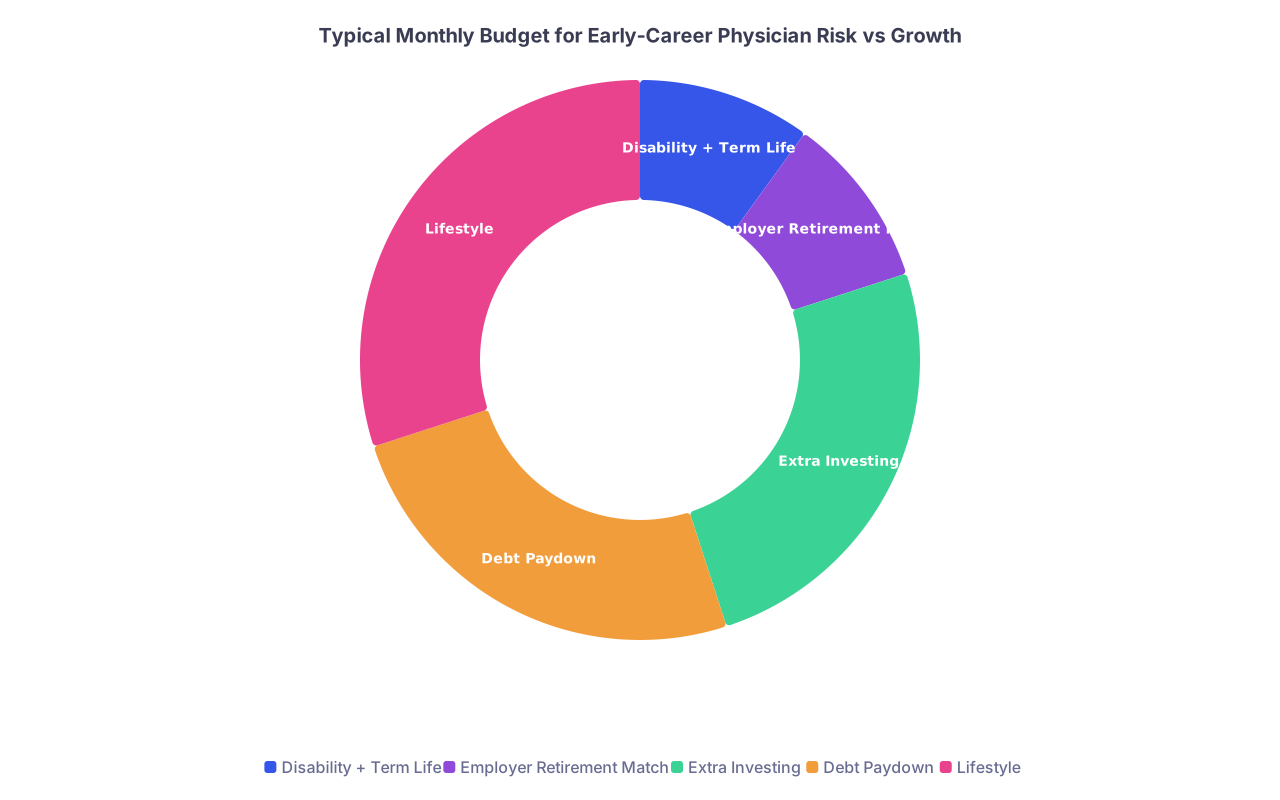
| Category | Value |
|---|---|
| Disability + Term Life | 10 |
| Employer Retirement Match | 10 |
| Extra Investing | 25 |
| Debt Paydown | 25 |
| Lifestyle | 30 |
You’re not choosing between being “responsible” with insurance and “smart” with investing. You’re allocating limited dollars between:
- Protecting the machine that prints money (your earning power)
- Growing the money that machine produces (your investments)
Both matter. The sequence just determines whether your entire investment plan can be wiped out in one event.
FAQ: Disability Insurance vs Investing for Doctors
1. I’m a resident with federal student loans and a 0% interest promo. Should I still get disability insurance before investing?
Yes. Federal repayment options can protect you somewhat if you’re disabled (IDR, discharge in some rare cases), but they do not replace your income. Disability insurance replaces income, not loan payments. Get a resident-level policy with a future increase rider, then invest what you can.
2. My hospital offers “long-term disability” already. Do I still need an individual policy?
Very likely. Most hospital LTD plans are taxable, not specialty-specific, and capped. Use the employer policy as a baseline, then layer an individual “own occupation” policy on top to (1) secure better definitions, and (2) reach a real-world replacement level closer to 60% of your gross income tax-free.
3. Can I wait until I’m an attending to buy disability insurance so I can get a bigger policy?
You can, but it’s a bad gamble. Residents often get cheaper premiums and better underwriting. If you develop a medical issue (back pain, anxiety, mild autoimmune stuff), your future attending policy may have exclusions or be declined. Better move: get a smaller resident policy with a future increase option that doesn’t require new medical underwriting.
4. How much disability insurance coverage do I actually need?
Start with: 60% of gross income, tax-free, to age 65–67, with an “own occupation” definition. Then tailor based on your situation. If you’re aggressively building wealth and could downshift your lifestyle if disabled, you might accept a bit less. If you’re locked into high expenses (private school, big mortgage, one-income household), you may want to push benefits higher.
5. If I can only afford one right now—disability insurance or Roth IRA contributions—what should I do?
If you depend on your income and do not have strong coverage, pick disability insurance first. You can always ramp up Roth contributions later; the market will still be there. A disabling event with no income protection is financially permanent. Open your budget today, find room for at least a starter disability policy, then add investing as your next step.