
Most doctors are funding their investment accounts in the wrong order. They chase “fancy” investments and ignore the simple account sequence that actually builds wealth and cuts taxes.
Here’s the direct answer you’re looking for.
The Short Answer: Ideal Funding Order for Most Doctors
For the majority of attending physicians (W‑2 or 1099, making $200k+), the typical optimal order looks like this:
Grab all “free money”:
Employer 401(k)/403(b)/457 match (or SIMPLE/SEP equivalent) – up to the match.Max tax‑advantaged retirement space:
- Max your 401(k)/403(b) (employee contribution).
- If eligible, use backdoor Roth IRA (for you and spouse).
- If you have a good 457(b), fund it next.
Then taxable (brokerage) investing:
- Broad index funds, tax‑efficient ETFs, or munis if needed.
Layer in special cases where applicable:
- HSA (if high‑deductible plan) – this can actually jump ahead to the top tier.
- Solo 401(k) for 1099 moonlighting income.
- Defined benefit/cash balance plan for high earners wanting more tax deferral.
You’re choosing between 401(k), Roth IRA, and taxable. The practical ordering for most doctors:
- First: 401(k) up to match
- Second: Backdoor Roth IRA
- Third: Max the rest of 401(k)
- Fourth: Taxable investing
Now let’s break down why and when that order changes.
Step 1: Understand What Each Account Actually Does for You
You need to know the tax deal each account gives you. Once you see that, the order becomes obvious.
401(k)/403(b) – Big Shield Today, Tax Later
For doctors, this is your workhorse.
You put in pre‑tax dollars (traditional 401(k)/403(b)):
- Lowers your taxable income today.
- Money grows tax‑deferred.
- You pay ordinary income tax when you withdraw in retirement.
In 2024, the employee deferral limit is $23,000 (under 50) or $30,500 (50+). Employer contributions can push total above that (up to $69,000 or $76,500, depending on age).
Why this is powerful for doctors:
- You’re likely in a high federal bracket (32–37%) + state.
- Every $1 you put into a pre‑tax 401(k) may save you $0.35–$0.45 in current tax.
- In retirement, you might pull it out at 12–24% effective rates if you plan decently.
That spread is real money.
Some plans also offer Roth 401(k) or after‑tax contributions with in‑plan Roth conversions (mega backdoor Roth). Those add nuance, but the basic ranking doesn’t change much.
Roth IRA – Tax Paid Now, Free Growth Forever
Roth IRA is your “never pay tax on this again” bucket:
- You contribute after‑tax dollars.
- Growth and withdrawals (if qualified) are tax‑free.
- No required minimum distributions during your life.
Income limits block direct Roth IRA contributions for most attendings. That’s why you use the backdoor Roth IRA:
- You contribute after‑tax to a traditional IRA, then convert to Roth.
- Works best if you have no pre‑tax IRA balances (or you clean them up into a 401(k)).
Roth is especially valuable for:
- Younger docs with long horizons.
- Those expecting higher future tax brackets.
- Anyone who wants tax diversification in retirement.
Taxable Brokerage – Flexible, Taxable, Essential
Taxable is:
- Just a plain brokerage account in your name or joint.
- No contribution limits.
- No early‑withdrawal penalties.
- You get:
- Dividends (taxed each year).
- Capital gains when you sell (at preferential rates if long‑term).
- Step‑up in basis at death.
If you use low‑turnover index funds or ETFs, taxable can be surprisingly efficient. And it’s your main vehicle for:
- Early retirement before 59½.
- Buying a practice or property.
- Big life goals that do not fit in a retirement wrapper.
Step 2: The Practical Funding Order for Most Doctors
Here’s the clean sequence 90% of physicians should start with.
1. Employer Match in 401(k)/403(b)
If your employer offers a match and you are not taking it, you are voluntarily burning money.
Example:
- Salary: $300,000
- 401(k) match: 50% of first 6% of pay
- You contribute 6% = $18,000
- Employer adds 3% = $9,000
That’s an instant 50% return on the first 6% of your pay you contribute, plus tax deferral.
This beats Roth IRA and taxable, period. Fund this first.
2. HSA (If Available) – Often #1B on the List
If you have a high‑deductible health plan and qualify for an HSA, this is a “triple tax‑advantaged” account:
- Pre‑tax contribution
- Tax‑free growth
- Tax‑free withdrawals for qualified medical expenses
Many doctors rank HSA even before Roth IRA and sometimes right after the 401(k) match. Reason: it often surpasses both 401(k) and Roth on pure tax benefit.
I’ll assume HSA is in the mix and just say: after employer match, prioritize HSA, then continue down this list.
3. Backdoor Roth IRA (You + Spouse)
Once you’re capturing the match (and HSA if you have one), move to the Roth layer.
Sequence:
- Contribute $6,500 (2024) to a traditional IRA (non‑deductible).
- Immediately convert to Roth IRA.
- Make sure you don’t have large pre‑tax IRA balances (otherwise the pro‑rata rule wrecks the tax efficiency).
Do this for:
- Yourself: $6,500
- Spouse (even if not working, via spousal IRA): another $6,500
That’s $13,000 per year into a tax‑free forever bucket.
Why do this before finishing the 401(k)? Because Roth space is uniquely limited and extremely valuable for long‑term, high‑income professionals. You can always defer more into a 401(k) later; Roth IRA access may vanish with income or rule changes.
4. Max the Rest of 401(k)/403(b)
After:
- Match taken
- HSA maxed (if applicable)
- Backdoor Roth done
…then push the rest of your employee contribution into the 401(k)/403(b).
Why now? Because each incremental dollar:
- Saves you your marginal tax rate today.
- Is likely withdrawn at a lower effective rate later.
- Still gives asset protection and forced discipline.
Typical pattern for a 35‑year‑old attending:
- 401(k) match: first 6% of pay
- HSA: $4,150 individual / $8,300 family (2024)
- Backdoor Roth: $6,500–$13,000 total
- Then increase 401(k) deferral rate until you hit the annual limit.
5. Evaluate 457(b) and Other Employer Plans
If you have a governmental 457(b) that’s solid, this may tie or even beat taxable:
- It’s another tax‑deferred bucket.
- You can sometimes access it before 59½ when you separate from service, without penalty.
Non‑governmental 457(b) is trickier (creditor risk, plan quality issues). That needs individual analysis. Many doctors still use them heavily at stable, well‑funded institutions; others skip due to risk.
6. Taxable Brokerage – Your Flexibility Engine
Once the tax‑advantaged buckets are full, or if you have big goals before retirement age, you start building taxable investments.
Taxable is:
- Ideal for early retirement (bridge years before 59½).
- Great for down payments on rental property or a practice building.
- How many high earners eventually save $100k+ per year once they crush debt.
In taxable, use:
- Broad stock index ETFs (VTI, VXUS, etc.) for tax efficiency.
- Municipal bond funds (if you need bonds and are in high brackets).
- Avoid high‑turnover active funds.
When Should a Doctor Prioritize Roth over 401(k), or Vice Versa?
You’re probably wondering where Roth 401(k) fits in versus traditional 401(k).
General framework for physicians:
- Residents/fellows (low income years):
- Use Roth 401(k) and/or direct Roth IRA.
- Your current tax rate is often the lowest it will ever be.
- Early attending in high bracket:
- Prefer traditional 401(k) to get the big tax deduction.
- Still do backdoor Roth IRA.
- Late career with big nest egg and high required minimum distribution risk:
- Consider more Roth 401(k) or partial Roth conversions in lower‑income years.
Bottom line: the account order (match → Roth IRA → full 401(k) → taxable) stays similar. It’s mainly the tax character (traditional vs Roth) inside those accounts that changes with career stage.
Common Scenarios for Doctors
Let me give you three examples I see all the time.
Scenario 1: New Attending, High Debt, High Income
- Age 32, income $350k, $300k student loans, starting 401(k) with 4% match.
Order:
- 401(k) to 4% match.
- HSA (if available).
- Backdoor Roth IRA for you (and spouse if any).
- Increase 401(k) to full $23k.
- Aggressively pay down high‑interest debt.
- Then taxable investing.
Do not skip Roth IRA because of loans, unless cashflow is truly crushed. You’ll be glad you locked in that Roth space.
Scenario 2: Dual‑Physician Couple, Very High Income
- Household income $800k+, no consumer debt, stable jobs.
Order (after basic emergency fund):
- Both capture 401(k)/403(b) matches.
- Both max HSA (if family plan).
- Both do backdoor Roth IRAs.
- Both max 401(k)/403(b) contributions.
- Max governmental 457(b) if good.
- Consider cash balance/defined benefit plan if offered and appropriate.
- Big taxable investing (often $100k+/year).
Here, the “taxable vs retirement” debate is a false choice. You’ll do both.
Scenario 3: Older Doctor, Late Start
- Age 50, income $450k, only $300k saved.
You need tax deferral and catch‑up:
- Max 401(k)/403(b) including catch‑up ($30,500).
- Grab employer match, obviously.
- Backdoor Roth IRA (and spouse, if applicable).
- Evaluate HSA and 457(b).
- Then taxable.
Here I’d lean heavily into traditional, not Roth 401(k), unless you have an unusually low tax rate or huge plans for charity.
Quick Comparison Table: 401(k) vs Roth IRA vs Taxable
| Feature | 401(k)/403(b) | Roth IRA | Taxable Brokerage |
|---|---|---|---|
| Contribution limit | High | Low | None |
| Current tax break | Yes (traditional) | No | No |
| Tax on growth | Deferred | None | Yes (dividends/gains) |
| Tax on withdrawal | Ordinary income | None (if qualified) | Capital gains on sale |
| Access before 59½ | Restricted, penalties | Some exceptions | Full (no penalties) |
Visual: Typical Annual Savings Allocation for an Attending
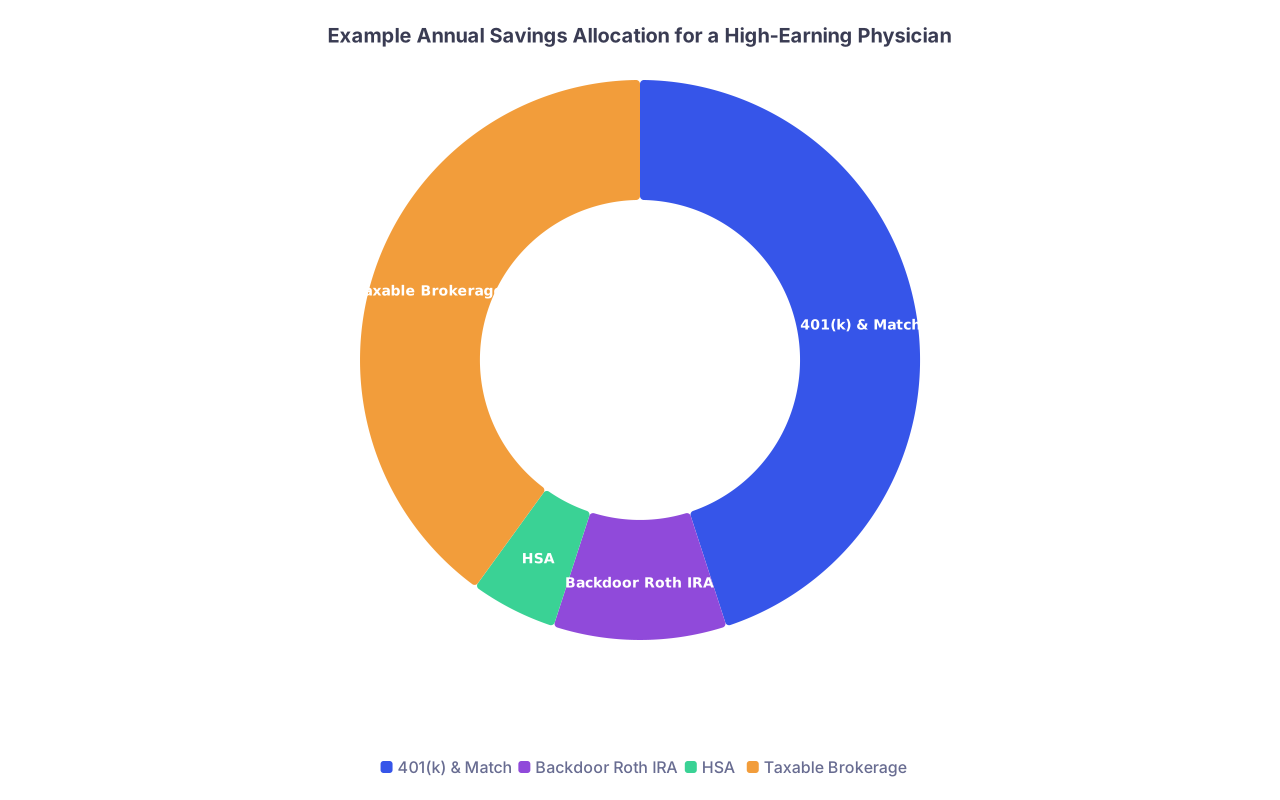
| Category | Value |
|---|---|
| 401(k) & Match | 45 |
| Backdoor Roth IRA | 10 |
| HSA | 5 |
| Taxable Brokerage | 40 |
This is a pattern I see a lot: roughly half going into retirement accounts, half into taxable, once the doc is a few years out and debt is controlled.
Step‑By‑Step Decision Flow
If you like decision trees more than prose:

| Step | Description |
|---|---|
| Step 1 | Start Year |
| Step 2 | Emergency Fund 3-6 months |
| Step 3 | Contribute to 401k up to match |
| Step 4 | HSA Eligible |
| Step 5 | Max HSA |
| Step 6 | Backdoor Roth IRA |
| Step 7 | Max remaining 401k |
| Step 8 | Fund additional plans |
| Step 9 | Taxable Brokerage Investing |
| Step 10 | Employer Match Available |
| Step 11 | Additional Employer Plans |
FAQs (Exactly 7)
1. Should doctors always max their 401(k) before doing a backdoor Roth IRA?
No. Capture the match first, then HSA if you have it, then usually do the backdoor Roth IRA before maxing the rest of the 401(k). Roth IRA space is limited and uniquely valuable. After that, go back and finish maxing your 401(k).
2. If my 401(k) plan is terrible (high fees, bad funds), should I still use it?
Up to the employer match, yes. The match almost always outweighs lousy fund options. After the match, compare the true all‑in fees versus just investing in a low‑cost taxable account or an individual 401(k) if you have side income. Many docs still use the plan because the tax deduction + deferral dominates, even with 0.50–1.0% extra fees.
3. Where do student loans fit into this funding order?
You generally do both: fund retirement and pay loans. At minimum, you:
- Get the 401(k) match.
- Do HSA if applicable.
- Often still do backdoor Roth IRA. Then how aggressively you attack loans versus extra investing depends on interest rate and whether you’re pursuing forgiveness. Above ~6–7% interest, I get much more aggressive about payoff.
4. What if I plan to retire very early (before 50)?
You’ll need more taxable investing and probably more Roth. Still grab match, HSA, and Roth IRA, but push taxable earlier and larger so you have penalty‑free access. You can also use strategies like Roth conversion ladders, but that’s extra complexity. Basic rule: early retirees must lean harder on taxable accounts.
5. Does it ever make sense for an attending to prioritize Roth 401(k) over traditional?
Yes, but it’s not the default. It can make sense if:
- You’re in a relatively low bracket for some reason this year.
- You expect dramatically higher tax rates later (personal or legislative).
- You already have a huge traditional balance and want more tax diversification. Most full‑time attendings in high brackets benefit more from traditional 401(k) during peak earning years.
6. I’m a 1099 contractor. Does the order change for me?
The accounts change names, but the logic is the same. Instead of a work 401(k), you probably use a solo 401(k). Still:
- Build an emergency fund.
- Use solo 401(k) up to your target.
- HSA if available.
- Backdoor Roth IRA.
- Then extra in solo 401(k) and taxable.
You might also add a defined benefit/cash balance plan once income is very high.
7. What if I can’t afford to do all of this yet?
Then you work the sequence in tiers:
- Tier 1: 401(k) match + emergency fund.
- Tier 2: HSA + partial Roth IRA.
- Tier 3: Full backdoor Roth, higher 401(k) percentage.
- Tier 4: Max all retirement + start taxable.
Your income will usually rise quickly after training; just move down the list each year as cashflow allows.
Key points to remember:
- Take employer match and HSA first, then usually backdoor Roth IRA, then max 401(k), then taxable.
- The account order matters more than picking the perfect fund—get the structure right, then optimize inside it.
- As your career and tax bracket change, you’ll adjust Roth vs traditional inside these same account types, but the basic hierarchy stays the same.