
The worst financial mistake most residents make is believing they are “too early” or “too broke” to invest. They are not early. They are already behind.
You build wealth as a physician the same way you built your CV: stepwise, year by year, with deliberate milestones. Not by randomly opening a Robinhood account at 2 a.m. on night float because a co‑resident mentioned options trading.
This is your residency‑to‑attending roadmap for turning investing into a habit, not a phase.
Big Picture: Your 5‑Year Behavioral Game Plan
Before we go year‑by‑year, you need the overarching structure.
At this point you should understand the sequence:
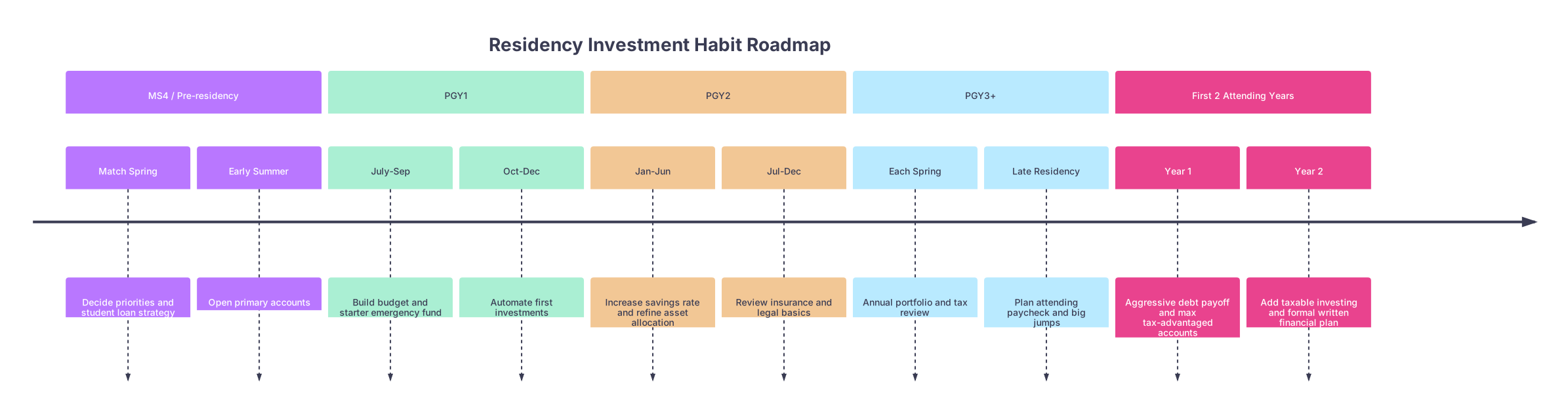
| Period | Event |
|---|---|
| MS4 / Pre-residency - Match Spring | Decide priorities and student loan strategy |
| MS4 / Pre-residency - Early Summer | Open primary accounts |
| PGY1 - July-Sep | Build budget and starter emergency fund |
| PGY1 - Oct-Dec | Automate first investments |
| PGY2 - Jan-Jun | Increase savings rate and refine asset allocation |
| PGY2 - Jul-Dec | Review insurance and legal basics |
| PGY3+ - Each Spring | Annual portfolio and tax review |
| PGY3+ - Late Residency | Plan attending paycheck and big jumps |
| First 2 Attending Years - Year 1 | Aggressive debt payoff and max tax-advantaged accounts |
| First 2 Attending Years - Year 2 | Add taxable investing and formal written financial plan |
Your priorities by phase:
| Stage | Primary Focus |
|---|---|
| MS4 / Pre‑Residency | Setup + basic knowledge |
| PGY1 | Budget, emergency fund, 1st investments |
| PGY2 | Increase savings, asset mix, insurance |
| PGY3+ | Attending transition plan |
| Attending Years 1–2 | Max savings, avoid lifestyle creep |
Good news: you do not need to be perfect. You do need to be consistent.
MS4 to Day 1 of Residency: Set the Foundation Before the Chaos
By the time you sign your residency contract, you should stop thinking of yourself as “a broke student.” You are a future high‑earner with a short runway to fix bad habits.
Spring of MS4 (Match to Graduation)
At this point you should:
Get a brutally honest net worth snapshot
- List:
- All student loans (federal vs private, interest rates)
- Credit cards and personal debt
- Cash in checking/savings
- Any existing Roth IRA or 403(b) from prior jobs
- Put it into a basic spreadsheet: assets – debts = net worth.
- Yes, it will likely be negative. That is fine. You are measuring, not judging.
- List:
Decide your loan strategy “tentative plan” You do not need every detail, but you do need a direction:
- Will you likely:
- Pursue PSLF (Public Service Loan Forgiveness) at a nonprofit hospital?
- Or aggressively pay off loans in 5–10 years as an attending?
- Why this matters now:
- PSLF path → you usually pay as little as legally possible during residency (IDR plans, possibly tax‑protected retirement contributions to lower AGI).
- Aggressive payoff path → you still use IDR, but you will treat loans as a top priority once attending.
- Will you likely:
Open your core financial accounts Minimum accounts before July 1:
- High‑yield online savings account (emergency fund home).
- Roth IRA at a low‑cost brokerage (Fidelity, Vanguard, Schwab – pick one and stop overthinking).
- If your residency sends benefits early:
- Review retirement plan info (403(b), 401(k), or 457(b)) and note:
- Is there a match?
- Are fees and available funds reasonable?
- Review retirement plan info (403(b), 401(k), or 457(b)) and note:
At this point you should not be trading individual stocks. You are building containers, not filling them yet.
PGY1: Survive, Then Automate
PGY1 is controlled chaos. You will not out‑willpower your workload. Systems matter more than intentions.
July–September PGY1: Cashflow and Emergency Fund
Your first three months are about not sinking.
At this point you should:
Build a simple resident budget that actually reflects your life
- Track 1–2 months of spending automatically (Mint, You Need a Budget, or just your bank’s export + spreadsheet).
- Identify:
- Fixed: rent, utilities, required insurance, minimum loan payments.
- Variable: food, rideshares, random Amazon, “because I am tired” spending.
Set your emergency fund target
- Residency reality:
- 1–2 months of expenses is fine for now.
- If your monthly spend is $3,000:
- Target: $3,000–$6,000 in your high‑yield savings.
- This is not an “opinion.” Residents who skip this end up using credit cards as an emergency fund. That is expensive and dumb.
- Residency reality:
Avoid lifestyle traps immediately
- Do not:
- Lease a luxury car in July.
- Move into the priciest building near the hospital because “I deserve it.”
- Your attending self will not thank you for paying 7% on $320k of loans while driving a $700/mo car.
- Do not:
October–December PGY1: Start Investing for Real
Once your emergency fund hits at least 1 month of expenses:
At this point you should:
Automate your first investment contributions
- Priority order for most residents:
- Roth IRA up to what you can afford (the annual max is higher than you think you can do right now; partial is fine).
- If your residency offers a match, contribute enough to capture 100% of the match first.
- Example:
- You can invest $200/month.
- If 403(b) match requires 3%: maybe put $100 into 403(b), $100 into Roth IRA.
- You can invest $200/month.
- Priority order for most residents:
Pick a default investment choice and stop tinkering One fund is usually enough during residency:
- In employer plan: a target date retirement fund (e.g., Vanguard Target Retirement 2060) or a broad US total stock market index fund.
- In Roth IRA: a total stock market index fund or target date fund.
- If expense ratio >0.5% in your plan, you are getting ripped off, but you still might use it for match and tax benefits.
Cap your financial learning to avoid paralysis
- Read one short, physician‑focused money book:
- Example: The White Coat Investor by Jim Dahle.
- Not five books. Not twenty podcasts. One solid framework, then act.
- Read one short, physician‑focused money book:
PGY2: Turn “I Invest” into “I Have a Plan”
By PGY2, PGY1 shell shock fades a bit. This is when you separate yourself from the typical resident who “means to get serious next year.”
January–June PGY2: Increase Savings Rate and Clarify Asset Allocation
At this point you should:
Set a specific savings rate goal
- As a resident, 15–20% total (debt payoff + investments + cash savings) is solid.
- Example:
- Income after tax: $4,500/month.
- Target 20%: $900/month across:
- $300 Roth IRA
- $200 403(b)
- $200 extra loan payments (if not PSLF path)
- $200 to emergency fund until you hit 2–3 months of expenses.
Define your asset allocation once You need a written target split, not vibes:
- Common resident template (age ~28–32, long runway, high future income):
- 80–90% stocks
- 10–20% bonds
- Within stocks:
- 60–70% US
- 30–40% international
- Write it like this:
- “My target is 85% stocks (60% US, 25% international), 15% bonds.”
- Then choose low‑cost index funds to match that.
- Common resident template (age ~28–32, long runway, high future income):
Consolidate stray accounts
- Old 401(k) from premed job?
- Roll it into your IRA or current plan (if low cost).
- Random taxable Robinhood/crypto/etc. with $400?
- Decide: either fully close or treat as “play money” that is irrelevant to your real plan.
- Old 401(k) from premed job?
July–December PGY2: Insurance and Legal Baseline
You cannot build wealth if you leave yourself wide open to catastrophe.
At this point you should:
Lock in disability insurance while you are young and (mostly) healthy
- You want:
- True own‑occupation policy, ideally with a future increase rider.
- Do not rely solely on hospital group coverage:
- Usually not portable.
- Often capped too low for your attending income.
- Get quotes from independent agents who work with multiple carriers.
- You want:
Review term life insurance (if you have dependents)
- If you:
- Have kids
- Have a non‑earning spouse
- Or someone relies on your future attending income
- Then:
- Buy level term life insurance (typically 20–30 years).
- Ignore whole life, universal life, and all their cousins. They are almost never appropriate for residents. If a “financial advisor” is pushing those, hang up.
- If you:
Handle basic legal documents
- At minimum:
- Health care proxy
- Durable power of attorney
- If you have kids or assets:
- Simple will (state‑specific; often cheap templates or low‑cost attorney review).
- At minimum:
You are not becoming a legal expert. You are closing obvious gaps.
PGY3 (and PGY4+ for Longer Programs): Train for the Attending Paycheck
This is where people either set themselves up for millionaire‑by‑45 or golden‑handcuffs‑forever.
Each Spring of Final 2 Years of Residency
At this point you should:
Do an annual financial review One afternoon, once a year:
- Update your net worth spreadsheet.
- Check:
- Are you hitting your target savings rate?
- Is your asset mix still close to target?
- Rebalance if:
- Any major category is >5% away from target.
Estimate your first attending salary and taxes
- Pull job postings or talk to grads:
- Academic hospitalist? Maybe $230k–$260k.
- Outpatient IM private group? $250k–$300k.
- Specialty? Use specialty‑specific data.
- Use a physician paycheck calculator to estimate take‑home after:
- Federal and state taxes
- Retirement contributions
- Payroll taxes
- Pull job postings or talk to grads:
Design your “first attending budget” before the offer letter
- Decide in writing:
- Maxing 401(k)/403(b) + backdoor Roth IRA?
- Monthly student loan attack amount (if not PSLF)?
- How much house or rent is reasonable (hint: keep total housing ≤20–25% of gross pay for the first few years if you want to get ahead).
- Decide in writing:
If you do not decide this on paper now, future‑you will decide emotionally in front of a Tesla showroom.
Attending Year 1: Weaponize the Jump in Income
The jump from $65k to $250k+ is where most physicians either:
- Buy the upgraded life first and invest leftovers (they regret it), or
- Lock in a high savings rate early, then let lifestyle rise slowly.
You already know which group wins.
First 90 Days as an Attending
At this point you should:
Lock in your new savings and investing automations immediately Within the first 1–2 paychecks:
- Set contributions to:
- Max your 401(k) / 403(b) across the year.
- If available and appropriate, use a 457(b) too (especially governmental).
- Set up auto‑transfers:
- Monthly to backdoor Roth IRA process for you (and spouse, if applicable).
- Extra to taxable brokerage only after tax‑advantaged accounts are maximized.
- Set contributions to:
Choose a student loan path firmly
- If on PSLF path:
- Make sure you are on the correct IDR plan under new rules.
- Certify employment annually.
- If not on PSLF:
- Consider refinancing high‑rate loans with a reputable lender.
- Set a target payoff timeline: 5–7 years is aggressive but realistic for many physicians.
- If on PSLF path:
Refine your investment lineup, but keep it simple
- Use your attending plan the same way:
- 3‑fund portfolio (US total stock, international stock, total bond)
OR - A reasonable target date fund if costs are low.
- 3‑fund portfolio (US total stock, international stock, total bond)
- Do not start picking sector funds, day trading, or “diversifying” into complex products you barely understand.
- Use your attending plan the same way:
Remainder of Attending Year 1: Guardrails and Upgrades
You can upgrade your life. You should. Just not recklessly.
At this point you should:
Cap your “lifestyle raise” explicitly
- Example rule:
- First year, only 30–40% of the income increase goes to lifestyle.
- The rest goes to:
- Retirement accounts
- Loan payoff
- Building taxable investments
- Example rule:
Avoid the house trap in Year 1 if possible
- You do not know your group politics yet.
- You do not know if you hate the job.
- Renting for 1–2 years while you stabilize finances and get a feel for the city is not “throwing money away.” Buying too soon and selling with closing costs is.
Create a simple written financial plan One page is enough:
- Target savings rate (often 20–30% of gross as an attending).
- Debt strategy and expected payoff dates.
- Investment accounts and target allocations.
- Guardrails: max car payment, housing budget, how often you review.
Attending Year 2: From Habit to System
By Year 2, the question is no longer “Am I investing?” but “Is the machine running with minimal effort?”
At this point you should:
Max out all tax‑advantaged space if at all possible The rough order:
- 401(k)/403(b) to the annual max.
- Backdoor Roth IRA(s).
- 457(b) if it is a solid, low‑cost governmental plan.
- Health Savings Account (HSA) if you are on a high‑deductible health plan and can afford it.
Start or grow a taxable brokerage account
- This is your flexible wealth:
- Early retirement
- Down payment fund if you intentionally want to buy later
- Major goals that do not fit in retirement accounts
- Invest with the same index‑fund philosophy as your retirement accounts.
- This is your flexible wealth:
Tighten tax strategy
- Consider a CPA who works with physicians if:
- You have side gigs.
- You are married filing jointly with complicated student loans.
- You hold significant taxable investments.
- Learn just enough to:
- Use tax‑loss harvesting if taxable balance gets meaningful.
- Place bond funds and REITs in tax‑advantaged accounts when possible.
- Consider a CPA who works with physicians if:
A Quick Snapshot: Where Your Money Should Flow by Phase
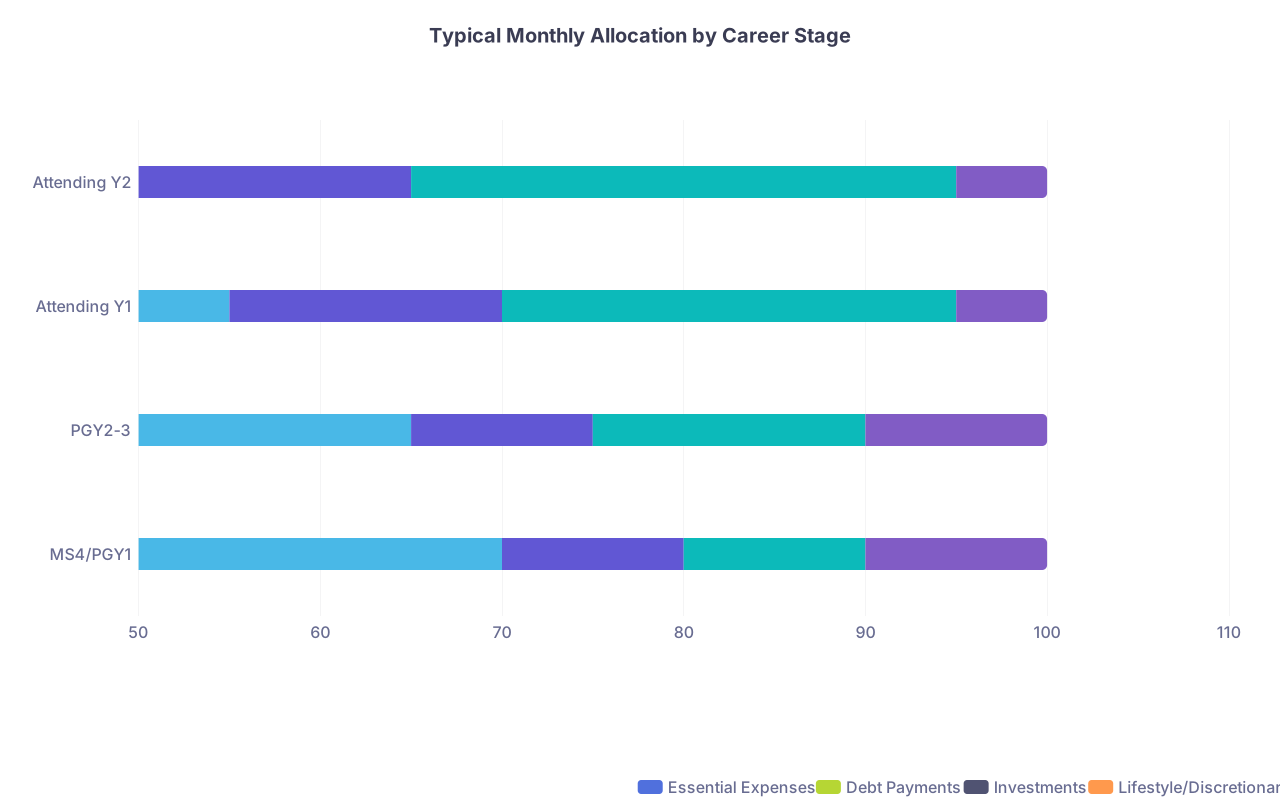
| Category | Essential Expenses | Debt Payments | Investments | Lifestyle/Discretionary |
|---|---|---|---|---|
| MS4/PGY1 | 70 | 10 | 10 | 10 |
| PGY2-3 | 65 | 10 | 15 | 10 |
| Attending Y1 | 55 | 15 | 25 | 5 |
| Attending Y2 | 50 | 15 | 30 | 5 |
These percentages are not gospel. But they are a sanity check. If you hit attending Year 2 and “investments” is still under 15%, you have work to do.
The Habit Layer: Weekly and Monthly Rituals
Year‑by‑year milestones do not work without smaller rhythms.
At this point you should lock in:
Monthly (30–45 minutes)
- Confirm:
- All automatic transfers and contributions processed.
- No weird charges or subscription creep.
- Glance at:
- Portfolio for anything wildly off target (but avoid reacting to normal volatility).
- Decide:
- Any small increase in contributions if paychanged or expenses dropped.
Yearly (Half‑Day)
- Update net worth.
- Rebalance portfolio.
- Review:
- Insurance coverage.
- Loan strategy relative to current job and PSLF eligibility.
- Adjust:
- Savings targets for the upcoming year.
This is how investing becomes a habit instead of a “project” you keep restarting.
One Last Thing: Ignore the Noise
You are going to hear coworkers brag about:
- Timing Tesla
- Leveraged crypto bets
- Meme stocks “that tripled last month”
99% of this is survivorship bias or temporary luck.
You are building a boring, automated system that will quietly make you wealthy while they chase the next thing. That is not less intelligent. It is more disciplined.
Open your last bank statement and your residency benefits summary right now. In the next 20 minutes, write down three numbers: your current savings rate, your emergency fund balance, and your monthly investment contribution. If any of those are zero, your very next step this week is to set up a $50 automatic transfer into a Roth IRA or work plan—small, imperfect, and non‑negotiable.