
Most new attendings waste the first 5 years of high income. Do not be one of them.
You can walk out of fellowship with a negative net worth and, in five years, have a seven‑figure, boring, bulletproof portfolio. Or you can have a Tesla, a big house, and anxiety. This is a choice. And it’s made month by month.
I’m going to walk you through a 5‑year, step‑by‑step timeline: what to do in Month 1, Year 2, Year 4… so that by the end of Year 5, you have:
- A defined investment plan,
- A sane tax and legal structure,
- And a portfolio that grows even if you take a pay cut, switch jobs, or scale back clinically.
No vague “pay down debt and invest.” Concrete moves. Chronologically.
Big Picture: What “Financially Stable Portfolio” Means by Year 5
Before we go month‑by‑month, you need the target. By the end of Year 5 after fellowship, a typical physician aiming for true stability, not Instagram wealth, should be roughly here:
| Category | Reasonable Target by Year 5 |
|---|---|
| Emergency Fund | 6 months of core expenses in cash |
| Retirement Accounts | $250k–$600k total (age & income dependent) |
| Taxable Investments | $100k–$300k invested |
| Student Loans | Paid off or aggressive payoff in sight |
| Insurance | Disability + term life appropriately set |
Are those exact numbers mandatory? No. But if you’re orbiting those ranges, your portfolio is doing its job: backing your life and career, rather than the other way around.
Now let’s build it. Year by year.
Months 0–6: From Fellowship End to First Attending Paycheck
At this point you should lock down foundations and stop financial leaks.
Month 0–1: Contract Signed, Before First Shift
Your job offer is your biggest “asset” right now. Treat it like one.
Finalize your employment/contract structure
- W‑2 hospital employee? 1099 independent contractor? Hybrid? This shapes everything: retirement accounts, taxes, entity choices.
- Red flag I see all the time: people sign 1099 without understanding they just lost employer benefits and have to build their own.
Pick your “money architecture”
- Set up:
- One primary checking account (pay and bills).
- One high‑yield savings account (emergency fund).
- One investment hub (Fidelity/Vanguard/Schwab).
- Stop using three random old college accounts “because they’re already open.”
- Set up:
Define your first savings rate goal
- Minimum target from Day 1: 20% of gross income toward wealth‑building (debt payoff + investing).
- Ideal for physicians early: 30–40% if you’re behind from long training.
Schedule a fee‑only fiduciary planner consult
- One‑time or hourly is fine. Avoid AUM (assets under management) if they’re also selling you funds with 1% fees. That kills future you.
- Agenda: student loans, insurance, entity choice, retirement options, and basic investment plan.
Month 1–3: First Attending Paychecks Hit
At this point you should decide where every new dollar goes before lifestyle creeps.
Create an Attending‑Level Spending Plan
- Start with your fellowship lifestyle and add one or two upgrades, not ten:
- Maybe better housing OR better car, not both.
- Rule I push hard: Do not buy a house in the first year of attending income unless you have lived in the area during fellowship and know you’re staying.
- Start with your fellowship lifestyle and add one or two upgrades, not ten:
Emergency Fund: First Priority
- Goal by Month 6: 1–2 months of expenses in your high‑yield savings if you’re starting from zero.
- If you already have that from fellowship, keep it and move faster to debt/investing.
Student Loans: Set the 5‑Year Strategy
- Decide: aggressive payoff vs. forgiveness path (PSLF/IDR). No drifting.
- If PSLF:
- Confirm qualifying employer, correct repayment plan, and certification forms.
- If not PSLF:
- Consider refinancing to a lower fixed rate once income is stable and job secure.
Insurance: Protect Human Capital
- Own‑occupation disability insurance: non‑negotiable, especially for procedural specialties.
- Term life insurance if you have a family or co‑signed obligations.
- Skip whole life, universal, or variable life in these early years. I’ve yet to meet a new attending who needed them more than index funds and debt paydown.
Month 3–6: Start the Portfolio (Simple and Boring)
Now you start actually investing.
Know your available accounts
- W‑2:
- 401(k)/403(b), maybe 457(b).
- 1099:
- Solo 401(k) or SEP IRA (usually solo 401(k) is better for higher contributions and backdoor Roth compatibility).
- Roth IRA or backdoor Roth IRA.
- Taxable brokerage account.
- W‑2:
Implement an ultra‑simple investment plan
- Target stock/bond mix: at your age (late 20s–40s), common range is:
- 70–90% stocks / 10–30% bonds depending on risk tolerance and timeline.
- Use 2–4 funds:
- US total stock market index
- International stock index
- US bond index
- That’s it. If your new advisor is pushing complicated 12‑fund “strategies,” they’re usually just justifying their fee.
- Target stock/bond mix: at your age (late 20s–40s), common range is:
Automate contributions
- 401(k)/403(b): set a percentage to hit at least the employer match immediately.
- Roth/backdoor Roth + taxable: set automatic monthly transfers from checking to brokerage.
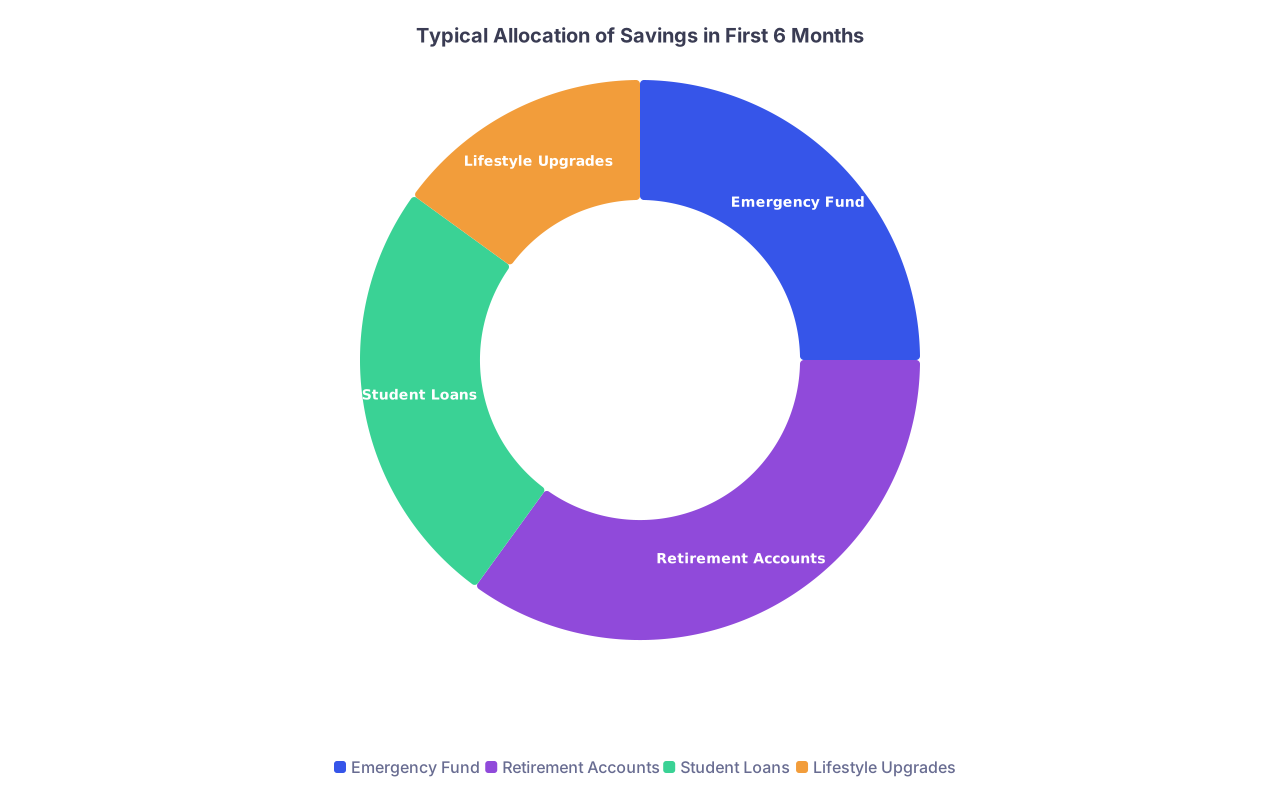
| Category | Value |
|---|---|
| Emergency Fund | 25 |
| Retirement Accounts | 35 |
| Student Loans | 25 |
| Lifestyle Upgrades | 15 |
Year 1: From “New Attending” to “Financially Organized”
By the end of Year 1, you should have:
- A consistent savings rate,
- A defined loan plan,
- A functioning investment portfolio that rebalances automatically or at set intervals.
Months 6–12: Lock in Systems
At this point you should codify your plan so you’re not re‑deciding every month.
Finalize your written Investment Policy Statement (IPS) One page. Example:
- Target allocation: 80% stocks / 20% bonds
- Funds: VTI + VXUS + BND (or similar)
- Rebalance: once/year or when allocation drifts >5%
- Minimum savings rate: 25% of gross
- No individual stocks, no options, no crypto allocations >5%
Maximize tax‑advantaged accounts where possible
- Aim by end of Year 1:
- Max 401(k)/403(b) employee contributions.
- Contribute to Roth IRA/backdoor Roth for you (and spouse if applicable).
- Aim by end of Year 1:
Clean up old accounts
- Roll over any old 401(k)s/403(b)s into:
- Current employer plan if low‑cost, or
- IRA at your main brokerage (unless this breaks your backdoor Roth strategy—watch that).
- Roll over any old 401(k)s/403(b)s into:
Legal basics
- At least a basic will and healthcare proxy in your current state.
- Verify titling and beneficiaries on:
- Retirement accounts
- Life insurance
- Bank/brokerage accounts (TOD/ POD if appropriate).

| Step | Description |
|---|---|
| Step 1 | Fellowship End |
| Step 2 | Job Signed |
| Step 3 | Bank Accounts Set |
| Step 4 | Emergency Fund 1 to 2 months |
| Step 5 | Loan Strategy Chosen |
| Step 6 | Insurance In Place |
| Step 7 | Investing Plan Written |
| Step 8 | Automations Turned On |
Year 2: Scaling Savings and Avoiding Lifestyle Creep
By Year 2, the novelty of attending income wears off. This is when people blow it.
At this point you should push your savings rate higher and keep life reasonable.
Early Year 2: Review and Raise
Annual review (Month 12–14)
- Check:
- Net worth (assets – debts): is it positive yet?
- Savings rate: can you get to 30–35% of gross?
- Increase retirement contributions with any raise or bonus.
- Check:
Student loan milestone
- If you’re not on PSLF:
- By now, you should see a clear payoff date within about 3–7 years from fellowship end.
- Consider one bonus per year earmarked entirely for debt until it’s gone.
- If you’re not on PSLF:
Start meaningful taxable investing
- Once:
- Retirement accounts are on track, and
- Emergency fund is at 3 months,
- Start adding taxable brokerage contributions monthly. This is your medium‑term freedom fund (future down payment, career change buffer, early partial retirement).
- Once:
Late Year 2: First Lifestyle Upgrade (Intentionally)
If you’ve kept things tight so far, you’ve earned one larger upgrade.
Options:
- Home purchase (only if job/location stable and you’ve saved a true 20% down payment plus closing and moving costs).
- Or a nice car (paid off in <4 years, not a $120k status toy).
Rule: any lifestyle upgrade cannot push your overall savings rate below your target. If the new mortgage drops your savings from 35% to 18%, you’re moving too big, too fast.
Year 3: Consolidation and First Level of “Optionality”
By Year 3, your portfolio should be big enough that market swings feel real—but not big enough to be your safety net yet. That’s fine.
At this point you should consolidate gains and reduce fragility.
Early Year 3: Upgrade the Legal & Tax Structure
Entity and tax check (especially for 1099 docs)
- Re‑evaluate with a CPA:
- S‑corp or LLC taxed as S‑corp for your 1099 income?
- Are you using a solo 401(k) to the max for that side income?
- Are you capturing all business deductions (CME, licensing, work‑related travel)?
- Re‑evaluate with a CPA:
Estate planning, version 2
- If you have kids or significant assets:
- Revocable living trust may now make sense.
- Update guardians, trustees, and beneficiaries.
- If you have kids or significant assets:
Capital location optimization
- Tax‑inefficient assets (bonds, REITs) in tax‑advantaged accounts.
- Broad stock index funds in taxable accounts.
Mid–Late Year 3: Portfolio Milestones
At this point, many doctors I’ve worked with hit their first real “oh wow” numbers:
- Retirement + taxable investments: often $150k–$300k depending on start, specialty, and savings rate.
- Student loans: significantly reduced or gone if aggressive.
Your moves:
Set a target “freedom number” for Year 5
- Not retirement. Just the amount at which:
- A job loss isn’t terrifying.
- You could reduce to 0.8 FTE without panic.
- For many, that’s:
- 6 months emergency fund +
- $250k–$500k invested.
- Not retirement. Just the amount at which:
Avoid the “complexity trap”
- This is the stage where people start getting pitched:
- Syndicated real estate,
- Private equity funds,
- Whole life as “tax‑free retirement income.”
- My view: until you’re reliably maxing all tax‑advantaged accounts and saving >30% of income, you have no business locking money into illiquid, opaque deals.
- This is the stage where people start getting pitched:

- Reaffirm your IPS
- Confirm you haven’t drifted into chasing last year’s hot asset class.
- Rebalance if needed.
Year 4: From “Doing Well” to “Structurally Safe”
By Year 4, if you’ve stuck with this, people around you will start saying:
- “You’re lucky.”
- “You must have had help.” No. You just did boring things consistently.
At this point you should fortify your position and start buying back future time.
Early Year 4: Eliminate Remaining Fragilities
Debt status check
- Ideal:
- High‑interest consumer debt: gone.
- Car loans: either gone or on short remaining terms.
- Student loans: gone or near‑term payoff plan.
- If you’re still drowning in loans, it’s usually not the math—it’s spending. Adjust.
- Ideal:
Increase cash buffer
- Build to 6 months of core expenses in emergency fund if you’re not there yet.
- Especially important if you:
- Are in a volatile specialty,
- Have a single income household,
- Or are considering a job change.
Portfolio risk audit
- Check:
- Are you overconcentrated in employer stock?
- Is >20% of your net worth tied up in one speculative thing (single property, startup, fund)?
- If yes, start rebalancing away.
- Check:
Mid–Late Year 4: Introduce Carefully Measured Complexity (Optional)
Only if:
- Savings rate is solid,
- Debt is manageable or nearly gone,
- Portfolio is well‑diversified,
…then you can allocate a small slice (say 5–10%) to “complex” stuff if you want:
- Physician real estate syndications with transparent sponsors,
- A single rental property if you’re actually willing to be a landlord,
- Targeted factor funds if you understand the tradeoffs.
But these are toppings, not the pizza.
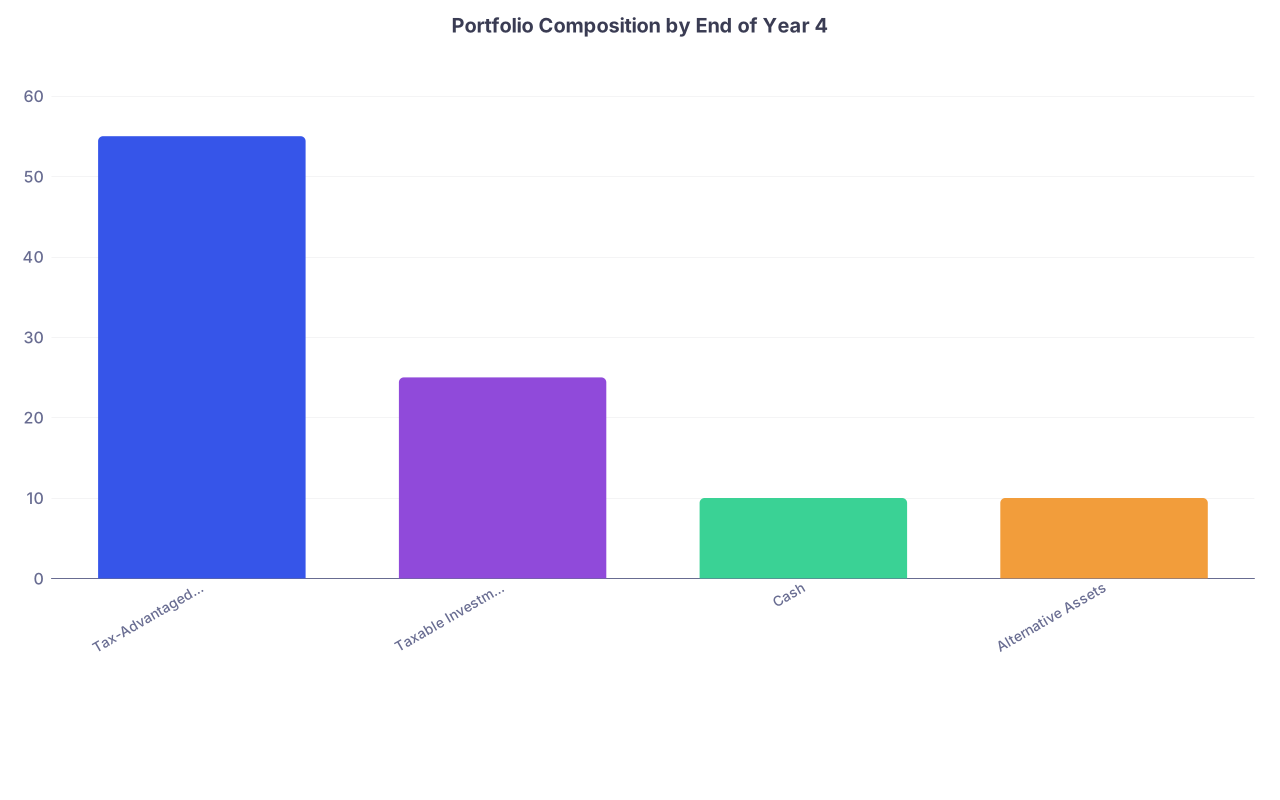
| Category | Value |
|---|---|
| Tax-Advantaged Accounts | 55 |
| Taxable Investments | 25 |
| Cash | 10 |
| Alternative Assets | 10 |
Year 5: Portfolio Stability and Real Optionality
This is where you start feeling the difference. Market drops still sting, but they don’t threaten your rent or your kids’ daycare. That’s the point.
At this point you should convert a strong portfolio into career and life flexibility.
Early Year 5: Formal “5‑Year Review”
Sit down (ideally with your planner/CPA) and quantify:
Net worth trajectory
- Year 0 vs Year 5: how much did you move?
- If your net worth is increasing by more than your annual contributions, that means compounding is finally pulling its weight.
Portfolio metrics
- Total portfolio value (tax‑adv + taxable).
- Allocation vs IPS.
- Annualized savings rate over 5 years.
Risk and insurance
- Any changes in:
- Specialty risk (new procedures),
- Dependents,
- Health status.
- Adjust disability/term life if needed.
- Any changes in:
Mid Year 5: Define Your “Next 5 Years” Plan
This is where the timeline branches, but your portfolio gives you options.
Common directions:
- Stay full‑time, continue compounding toward early financial independence.
- Cut back to 0.8 or 0.6 FTE, funded by the flexibility your portfolio gives you.
- Shift specialties/subspecialize if you hate your current path, because you’re not living paycheck‑to‑paycheck anymore.
- Start a side business with less fear, using a small portion of your free cash flow.
Your portfolio’s job now:
- Provide a growing base that does not require your active work to increase.
- Allow you to make career decisions for fit, not just for dollars.
Late Year 5: What “Financially Stable Portfolio” Should Look Like
Ballpark snapshot for many physicians who followed this aggressively:
- Emergency fund: 3–6 months expenses, fully funded.
- Retirement accounts: $250k–$600k depending on age, specialty income, and how early you maxed.
- Taxable brokerage: $100k–$300k.
- Student loans: gone or within <2 years of payoff if intentionally extended.
- Debt: mostly just reasonable mortgage.

At this level, market drops are annoying, not existential. You have:
- Multiple tax buckets (pre‑tax, Roth, taxable).
- Diversified index fund core.
- Legal/insurance scaffolding to protect your family.
That’s a financially stable portfolio in the real world—not just a big number, but a structure that holds under stress.
Quick Year‑by‑Year Checklist
| Year | Primary Focus |
|---|---|
| 0–1 | Setup, emergency fund, basic investing |
| 2 | Raise savings rate, start taxable |
| 3 | Consolidate, clean up, avoid traps |
| 4 | Reduce fragility, strengthen buffers |
| 5 | Convert stability into flexibility |
FAQ (Exactly 2 Questions)
1. What if I’m starting “behind”—older, big loans, no savings at fellowship end?
You compress the early phases, not skip them. Keep lifestyle at or near fellowship level for 2 full years, drive a paid‑off car, delay the big house, and push your savings rate toward 40% of gross if you can. That usually means roommates a bit longer, fewer expensive trips, and saying “no” when colleagues try to normalize insane spending. I’ve watched 40‑year‑old new attendings with $400k+ in loans still build a 6‑figure portfolio by Year 5 because they refused to inflate their lives.
2. Should I slow investing to crush my student loans faster?
If your loans are at high interest (7–8%) and you’re not on a forgiveness path, a hybrid approach works best: still get any employer match and minimal Roth contributions, but direct a big chunk toward debt. Once rates are below ~4–5% (via refinance or original terms), I usually favor parallel investing rather than pure payoff. You don’t get your 20s and 30s compounding window back; waiting 5–7 years to start investing just to be “debt free” often leaves you behind long term. Balance both.
Key points to walk away with:
- The first 24 months after fellowship make or break your 5‑year outcome—lock down lifestyle and automate investing early.
- A financially stable portfolio is less about fancy assets and more about boring consistency, diversification, and legal/insurance scaffolding.
- By Year 5, the win is not just the balance—it’s the ability to choose how, where, and how much you practice medicine without financial panic.