

The obsession with becoming chief resident has completely warped what “leadership” actually means in medicine.
You’re not crazy for wondering if not wanting to be chief means something is wrong with you. Or that programs will secretly downgrade you as “not a leader” if you don’t throw yourself at the chief job like it’s the holy grail.
Let me just say this plainly: a lot of very strong, very respected residents do not want to be chief. Some turn it down. Some never pursue it. And their program directors still write them glowing letters about leadership.
But of course, my brain works like yours, so here are the intrusive thoughts:
- “If I’m not gunning for chief, will my PD think I’m lazy?”
- “Will fellowship PDs assume I was passed over?”
- “Does not wanting chief mean I’m not ‘all in’ on my program?”
- “What if everyone else is aiming for chief and I’m the only one who’s… not?”
Let’s walk through this like we’re sitting in the call room at 2 a.m., scrolling ERAS horror stories between admissions.
What PDs Actually Mean When They Say “Leadership”
They almost never mean “must become chief.”
When program directors talk about leadership, they’re not secretly thinking “chief or bust.” They’re thinking about who makes their life easier. Who they can trust. Who doesn’t implode when things get chaotic.
Leadership, in real residency language, looks more like:
- The senior who quietly takes the most complicated patient so the intern can finish notes.
- The resident who pulls the attending aside and says, “We’re drowning on the floor; can we redistribute admissions?”
- The person everyone texts when they’re stuck because they know they’ll answer and not make them feel stupid.
You know what I’ve literally heard PDs say on rank committee?
“He’s not chief material, but I’d want him taking care of my own family.” “She’s not loud, but everybody on nights looks calmer when she’s on.” “He never wants attention, but the interns worship him.”
None of those people were chiefs. All of them got described as leaders.
The problem is: applicants get fed this neat little hierarchy in med school:
MS4 AOA → Leadership potential
Chief → True leader
Fellowship → Obviously a star
Reality is messier. PDs know some people chase chief for the title. They also know some of their best leaders want nothing to do with the politics, scheduling drama, and weird half-administration, half-resident role that comes with it.
Reasons You Don’t Want Chief (That Are Completely Rational)
Let’s say the quiet part out loud: chief is not some magical leadership badge. It’s a job. A job with tradeoffs.
Here are totally normal, non-lazy reasons you might not want it:
You want to focus on clinical skills.
You’d rather spend your last year actually seeing patients, scrubbing cases, or doing procedures instead of arguing over call schedules and tracking evaluation completion rates.
You’re aiming for a competitive fellowship.
If you’re trying to match GI, cards, derm, ortho, whatever—and you’re already doing research, maybe QI, maybe teaching—chief might not add enough to justify the time and stress. The extra academic output, presentations, or connections might matter more.
You’re exhausted.
You don’t want another year of residency. You want to move on with your life, maybe start a family, move cities, actually see sunlight again.
You hate conflict.
Chief is 50% scheduling and 50% conflict management. You become the emotional shock absorber between the program and the residents. Some people thrive on that. Others will literally get stomach pain every time their phone buzzes.
You don’t want to blur boundaries.
One day you’re a resident complaining about admin decisions in the work room; the next day you’re asked to defend those decisions to your friends. That transition is miserable for some people.
You value your mental health.
If the idea of chief makes your anxiety spike, that’s data. Not a weakness.
Program directors know all of this. They see residents burn out as chiefs. They see others blossom. They generally don’t sit there thinking, “Anyone who doesn’t want this is a bad leader.” They think, “Is this person a good fit for this job?”
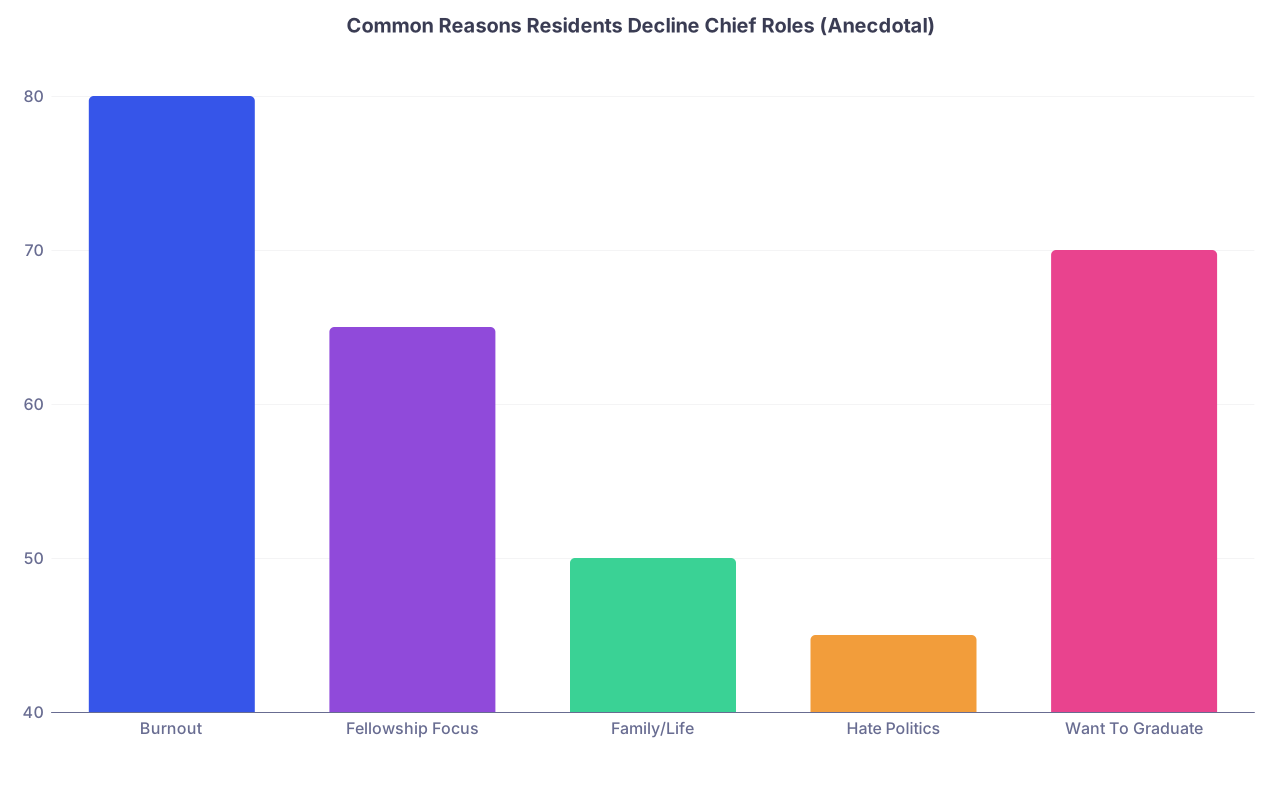
| Category | Value |
|---|---|
| Burnout | 80 |
| Fellowship Focus | 65 |
| Family/Life | 50 |
| Hate Politics | 45 |
| Want To Graduate | 70 |
The Worst-Case Scenarios You’re Imagining (And What Actually Happens)
Let’s take the catastrophizing to its logical end, because I know that’s where your brain is going.
1. “If I’m not chief, fellowship PDs will assume I was passed over.”
Here’s the uncomfortable reality: some places absolutely do over-interpret chief. They see it and think “top-tier resident.” They’re not totally wrong—many chiefs are excellent. But they’re also not carefully reverse-engineering every non-chief.
Fellowship PDs look at:
- Your letters.
- Your clinical reputation.
- Your evaluations.
- Your research/productivity (depending on specialty).
- Your interview.
If your PD writes, “She is one of the strongest residents we’ve had in 10 years. She chose not to pursue a chief year because she wanted to start fellowship, and I fully support that decision,” nobody in their right mind reads that and thinks, “Ah yes, not a leader.”
The real problem is silence or vague wording, not “no chief.”
2. “My PD will think I’m not committed to the program.”
You know what PDs want more than enthusiastic chiefs? Residents who don’t burn out and tank the culture.
If you approach this like:
“I care a lot about this program. I love working with the residents. But I’ve thought carefully, and I don’t think the chief role plays to my strengths or my long-term goals. I’d rather contribute through teaching/journal club/QI/etc.”
That reads as mature and self-aware, not uncommitted.
What does read badly?
- Trash-talking the role.
- Acting like it’s beneath you.
- Obviously wanting it, then pretending you don’t because you weren’t chosen.
You can respect the role and intentionally not pursue it.
3. “Everyone will assume I wasn’t good enough.”
Intern brain loves this story: “If I’m not chief, it’s because I failed.”
But think about your own class. You can probably already name 3–5 people who are incredible and obviously not going to be chiefs. Not because they couldn’t be, but because it just doesn’t fit.
Most programs don’t have that many chief spots. Some choose early. Some rotate monthly or quarterly. Some select based on weird internal history (this attending prefers this style, that division wants someone in their area, etc.).
I’ve seen stellar residents not asked to be chief because:
- They’re going into a subspecialty that needs them to start on time.
- There’s weird political pressure to pick someone from a particular track.
- They were already the de facto leader and the PD wanted to “spread opportunities.”
From the outside, all anyone sees is: three chiefs, twenty non-chiefs. It’s way too blunt a tool to judge people by.

| Stage | Activity | Score |
|---|---|---|
| Early Residency | Hear about chief | 2 |
| Early Residency | Assume must want it | 3 |
| Mid Residency | Realize tradeoffs | 4 |
| Mid Residency | Feel guilty for not wanting it | 5 |
| Decision Phase | Talk to PD | 3 |
| Decision Phase | Decide chief not right fit | 4 |
| After | Still worry about optics | 3 |
| After | Realize nobody cares as much as you feared | 5 |
How To Talk About Not Wanting Chief Without Undercutting Yourself
This is where things actually matter. Not whether you want chief, but how you frame that fact to people who will write about you and advocate for you.
You want your PD and faculty thinking: “This person is a leader, just not through the chief role.”
So you shift from “I don’t want to be chief” to “Here’s what leadership looks like for me.”
When someone (PD, APD, mentor) asks about chief interest, you might say something like:
“I’ve thought a lot about it. I really value supporting the team and I like taking on responsibility. But I don’t think the formal chief role is the best fit for me. I want to focus my last year on [clinical skills/research/teaching prep for academic career/fellowship timeline]. I’m very open to leadership in other ways—like [education chief tasks, QI project lead, curriculum work, mentoring interns].”
That signals a few things:
- You’re not dismissing leadership.
- You’ve made a deliberate choice.
- You still care about the program and your co-residents.
- You understand your own bandwidth and goals.
And then—this part matters—you actually act like a leader in the day-to-day. Because PDs care more about how you behave on wards than whether you wear the chief title.
Leadership behaviors that count, chief or not:
- Staying late to help when the team is imploding, even when you could leave.
- Stepping in calmly when an intern is flustered and a family is angry.
- Offering to run a teaching session, mock codes, or skills workshop.
- Quietly telling faculty when something in the culture is broken—without grandstanding.
- Being the person who doesn’t gossip and doesn’t stir drama.
Those things show up in letters. And those letters overshadow the missing “chief resident” line on your CV.
| Aspect | Chief Resident Signal | Strong Non-Chief Signal |
|---|---|---|
| Formal title | Yes | No |
| Day-to-day behavior | Variable | Can be excellent |
| PD letters | Often strong, but not always | Can be equally or more strong |
| Fellowship impact | Helpful but not required | Solid letters + work matter more |
| Time cost | High | Chosen by you |
The Quiet Thing PDs Won’t Say Out Loud
PDs are under pressure too. They need chiefs. They need people who will plug the gaps, take the pager, run the schedule. So the culture around chief sometimes gets sold like this prestigious, purely honorary leadership coronation.
It’s not purely that. It’s also workforce and admin.
And they know chief isn’t for everyone. But they can’t walk around saying, “You know what, half of you probably shouldn’t do this job” because then nobody will want it.
So you hear all the upside and none of the nuance.
If you strip away the hype, what PDs really want is this: by the time you graduate, you should be someone people naturally look to. Someone who doesn’t fall apart under pressure. Someone who’s not toxic.
You can become that with or without a title.
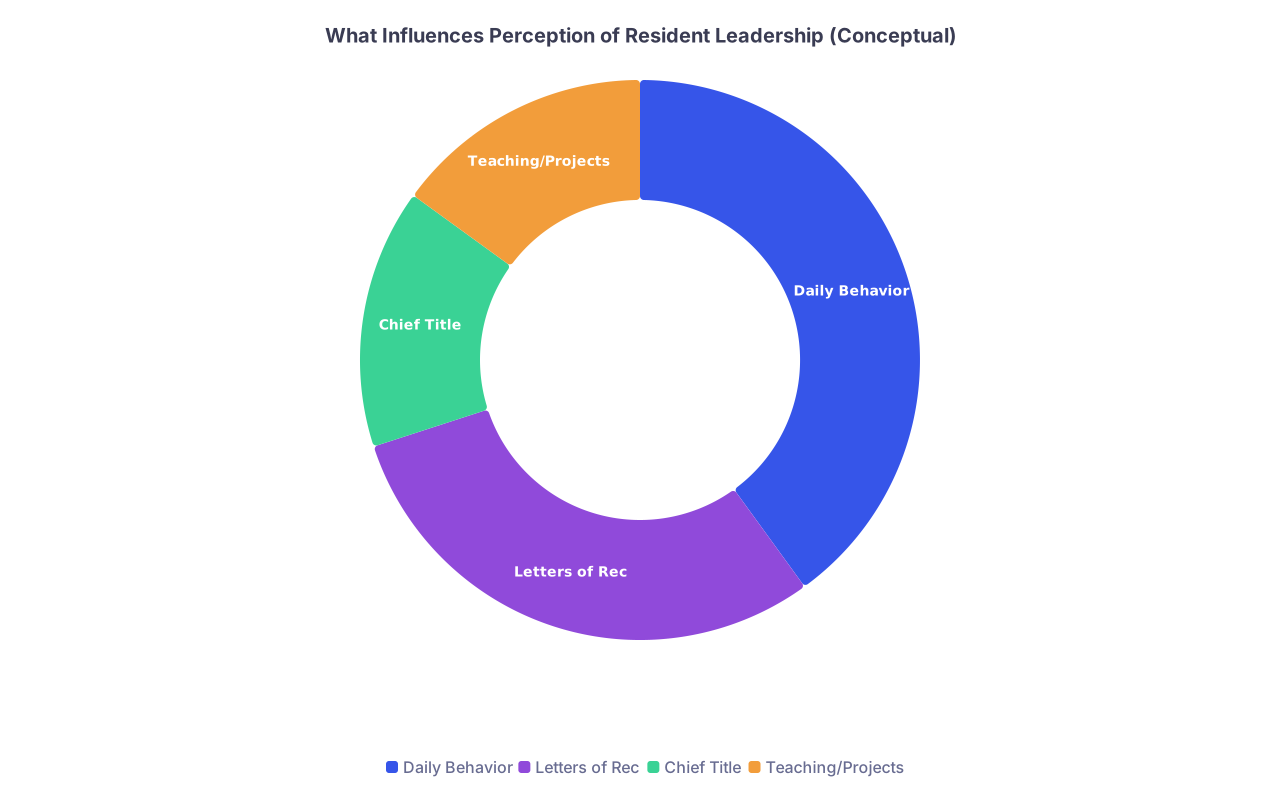
| Category | Value |
|---|---|
| Daily Behavior | 40 |
| Letters of Rec | 30 |
| Chief Title | 15 |
| Teaching/Projects | 15 |
So, Are You Sabotaging Yourself By Not Wanting Chief?
If you:
- Never help others.
- Refuse responsibility.
- Complain constantly but never step up.
Then yeah, not being chief will just be one more symptom of “not a leader.”
But if you:
- Consistently support your team.
- Take ownership.
- Help interns not drown.
- Communicate honestly with your PD about your goals.
Then not wanting chief is just… a choice. One data point in a much bigger picture.
The worst-case story your brain is telling you—“No chief = no leadership = no respect = no fellowship = career over”—isn’t how this works in real life.
Will some people silently over-value chief? Sure. There’s bias everywhere. But you can’t build your whole career on trying to mind-read the most rigid person in the system.
You can build it on this: being someone PDs are relieved to see on the schedule.
Years from now, hardly anyone will remember exactly who was chief in your class. They’ll remember who they trusted at 3 a.m. when things went sideways.

FAQs
1. Do fellowship programs expect chief for competitive specialties?
Not as a hard rule. Lots of cards, GI, heme/onc, surg-onc, or ortho fellows were never chiefs. What matters far more is how your PD and faculty talk about you in letters, plus whatever that specialty values (research, case volume, exam scores, presentations). Chief can help, especially in academic tracks, but it’s not some secret cutoff. A non-chief with phenomenal letters and output will almost always beat a mediocre chief.
2. Should I tell my PD explicitly that I don’t want to be considered for chief?
If your program selects early or there’s obvious discussion starting, yes—have a direct, respectful conversation. Something like: “I’m really grateful to be considered, but I don’t think a chief year aligns with my goals or bandwidth. I’d rather focus on [X]. I still want to contribute through [teaching/QI/mentoring].” That gives your PD clarity and lets them frame your choice positively in the future, instead of guessing.
3. Will people assume I was rejected if I say I “chose not to pursue” chief?
Some gossip-prone residents might. People always invent stories. But what actually matters is how your mentors narrate your trajectory. If they say, “She was highly regarded, would have been an excellent chief, but prioritized starting fellowship and I fully supported that choice,” that’s the story that reaches selection committees. You can’t control hallway narratives; you can influence what goes into your letters.
4. Can I still show leadership on my CV without a chief title?
Absolutely. You can list things like “Resident Mentor for Interns,” “Curriculum Committee Member,” “Quality Improvement Project Lead,” “Simulation Teaching Resident,” “Resident Wellness Committee,” or “Journal Club Organizer.” Then you back those up with specific examples when asked. Selection committees don’t just scan for “chief”; they scan for sustained responsibility and impact.
5. What if deep down I might want chief, but I’m scared I’ll fail at it?
That’s different from truly not wanting it. If it’s fear of messing up, talk to current or former chiefs honestly. Ask what the job is actually like. Ask your PD what support exists, what their expectations are, and what happens when chiefs struggle. If, after hearing the real version, it still feels wrong in your gut, it’s okay to walk away. If it feels scary but exciting and aligned with your goals, then maybe you’re not “not a leader”—you’re just human and anxious, which is very different.
Years from now, you won’t care nearly as much about whether “chief resident” appears on your CV.
You’ll care whether you became the kind of doctor people trusted when things were bad—and you don’t need a title to do that.


