

You are three months into your chief year. It’s 7:45 p.m., you’re finally home, you’ve reheated your dinner twice, and your phone buzzes again.
It’s your co-chief.
Another “quick thing” about the schedule. Another FYI that is actually a decision already made. Another “I went ahead and…” about a major change that involves your name, your residents, and your program director, but not your input.
They rewrite your emails “for tone” before you send them. They jump into resident group chats and answer questions you were already handling. They cc leadership on every minor issue. They “volunteer” you for committees, curricula, and wellness projects you did not agree to. They introduce ideas in meetings with, “We’ve decided that…” when you have not decided anything at all.
You’re not imagining it. You have an overbearing co-chief.
You do not want war. You also do not want another nine months of this. So here’s how to set boundaries—like an adult, like a leader—without turning the chief office into a battleground.
1. Get Clear On The Actual Problem Before You React
Most chiefs in this spot make the first mistake right away: they confront the behavior before they understand the pattern.
Slow down. Collect data for 1–2 weeks before doing anything big.
Pay attention to three things:
Where they’re overstepping
– Schedules and coverage decisions
– Communication (emails, group chats, announcements)
– Resident support and discipline
– Committee work and QI projectsHow it shows up
– They “decide for both of you”
– They override your decisions in front of others
– They check your work or “edit” everything
– They loop in leadership preemptively to “keep them in the loop”What actually bothers you
This matters. Are you angry because: – They are disrespecting your authority?
– They’re creating chaos and mixed messages for residents?
– They’re burning you out by saying yes to everything?
– They’re making you look passive or incompetent?
Write it down. Literally. A running note on your phone with date, situation, what they did, who was there. Not a burn book. A factual log.
Not because you’re building a legal case. Because when you eventually talk to them—or to the PD—you need specifics. “You always undermine me” is useless. “On 6/2 during noon conference, when Sarah asked about night float, you cut in and said, ‘Actually we’ve decided…’ and changed the plan without talking to me” is actionable.
While you’re logging, notice your own stuff:
- Are there areas you’ve been avoidant, so they filled the vacuum?
- Are you delegating and they’re mistaking that for wanting less involvement?
- Are you inconsistent in communication so they “take over to make it simpler”?
You still get to set boundaries. But if your own ambiguity invited some of this, you’ll need to fix that too.
2. Decide What You Actually Want Out Of This Year
Before you confront anything, decide your north star. What does “successful chief year” mean for you?
You only get one chief year. You cannot let one personality dictate the whole thing.
Common chief north stars I’ve seen:
- Protect PGY2/3 wellness and morale
- Clean up the schedule mess and create something sustainable
- Build a culture where residents feel heard and safe
- Impress the program enough to land a job or fellowship letter
You need this because your boundary-setting will be strategic, not emotional. The question becomes:
“Does engaging on this specific behavior move me closer to my goal, or is it noise?”
Example: If your north star is “cohesive leadership in front of residents,” then you might tolerate some annoying micromanagement in private, but draw a hard line at being contradicted publicly.
If your north star is “not burning out,” then you might let them over-own some committees, but draw a line at being volunteered for anything without your consent.
Write a one-sentence north star and keep it somewhere you’ll see it. When they do something overbearing, ask: Is this worth a boundary conversation, or is this me being irritated?
3. Quietly Reclaim Territory: Clarify Roles With Structure
You do not start with a dramatic “we need to talk about your behavior.” That’s how you get war.
You start with structure.
Co-chief roles are usually fuzzy. Use that to your advantage by formalizing things.
You’re going to propose a “roles and responsibilities” framework that sounds collaborative but is actually you drawing a map.
Example script to your co-chief:
“We’re both getting slammed with random asks. I’m worried stuff will fall through the cracks or we’ll duplicate work. Can we sit down this week and divide up main domains so people know who to go to for what, and we’re not both working on the same problem?”
Then, in that meeting, you come in prepared with a draft. Not a blank page.
Bring something like this:
| Domain | Chief A (You) | Chief B (Co-Chief) |
|---|---|---|
| Inpatient schedules | Lead | Backup |
| Clinic templates | Lead | Backup |
| Resident discipline | Lead | Consult |
| Wellness initiatives | Consult | Lead |
| Recruitment/interviews | Co-Lead | Co-Lead |
You are not asking, “What do you want to own?” You are proposing: “Here’s a draft that plays to both our strengths.”
Where they’re overbearing, you put yourself as lead. Where you don’t care as much or they genuinely excel, let them lead.
Then lock it in publicly.
Send an email to residents and leadership:
“To streamline communication, we’re splitting chief responsibilities this way:
– Dr. X will be your main contact for A, B, C.
– I’ll be your main contact for D, E, F.
For anything else, you can email both of us and we’ll route it.”
Now when they jump into things that are clearly in your column, it’s obviously overstepping. Others can see it too, which changes the dynamic.
4. Create Simple Guardrails Around Communication
Overbearing chiefs love information and control. They live in the email “cc all” universe.
You counter that with basic, boring rules.
Propose a communication plan under the excuse of “reducing confusion for residents.”
You and your co-chief meet and agree on:
One weekly email to residents (sent from a shared “Chiefs” account or both of your names) with:
- Schedule changes
- Policy updates
- Important deadlines
One rule: No major changes announced without both chiefs agreeing first.
The pitch:
“Residents are getting whiplash. Let’s commit that any policy/schedule changes go in the weekly email, sent by both of us, once we’ve both signed off. That way they’re not hearing two different things.”
If they push back with “but things are urgent sometimes,” build in a safety valve:
“If it’s truly urgent, text me and we’ll decide within the hour, then send a joint message. If you don’t hear back and it can’t wait, go ahead but put both our names on it and let me know what went out.”
What this does:
- Slows them down.
- Forces them to at least inform you before acting.
- Gives you receipts if they keep skipping you.
Also—stop letting them rewrite your stuff.
If they say, “Send me your draft, I’ll edit and send it out,” respond with:
“I’m fine sending my own emails. To avoid delays, let’s each send for our domains and cc the other. For big stuff, we can look at it together.”
You are withdrawing the invitation to micromanage. That alone cuts half the problem.
5. Have The Actual Boundary Conversation (Without Starting A Fight)
At some point, you will need a direct, private conversation. Not hallway chatter. Not passive-aggressive comments in meetings.
Book a time. “Hey, can we sit down for 30 minutes this week to talk about how we’re working together? I want to make sure we’re both getting what we need out of this year.”
Pick a neutral place. Not the chief office if that’s their “territory.” A conference room, the residents’ lounge off-hours, anywhere you can close the door.
Here’s the structure I recommend:
Start with shared goal
“I want us to come out of this year with residents feeling like they had strong, unified leadership. I also want both of us to feel like we grew, not just survived.”Own your part (briefly)
“I realize I can be slower to respond sometimes because I like to think things through. That might have left room for you to jump in, which I get.”Name the behaviors, not their personality
“What’s been hard for me is a few patterns:
– Decisions announced as ‘we decided’ when we never discussed it.
– Emails going out with my name but written or edited by you.
– Changes to the schedule I built, made without looping me in.”Connect it to impact
“When that happens, I feel undermined and sidelined. Residents also get confused about who’s actually leading what, and it makes it harder for me to build trust when they see plans change under my feet.”Make a clear ask
“I need us to agree that:
– Anything presented as a joint decision is actually discussed first.
– I send my own communications and sign-offs.
– If you want to change something in my domain, text or call me first, unless it’s a true emergency.”Shut up and let them talk
Let the silence hang. They’ll fill it. You’ll hear defensiveness, justification, or sometimes genuine surprise that you feel this way.
Common responses and how to handle them:
“I just thought I was helping because you’re so busy.”
Response: “I appreciate you trying to help. The way it’s showing up feels less like help and more like override. I’m happy to ask for help explicitly when I need it. I just need you not to assume it by jumping in.”“Residents come to me first; I’m just answering their questions.”
“That’s fine when it’s minor. For policy or schedule decisions, can you say, ‘Let me confirm with [your name] and we’ll get back to you together’? That keeps us aligned.”“I have more experience with [X]; it’s faster if I just decide.”
“Then let’s structure it that you lead those areas officially. But where I’m the lead, I need room to actually lead, even if my style is different.”
If they get heated, you keep your affect flat. Do not match their volume or speed. You’re not auditioning for a courtroom drama. You’re putting stakes in the ground.
End with:
“I’m not trying to win arguments. I’m trying to have a year where we both feel respected and residents see us as aligned. These changes would get me there. Can you commit to that?”
If they say yes, you follow up in writing.
“Thanks for talking earlier. Just to keep us on the same page, my understanding is: – We’ll only label things ‘we decided’ if we actually discussed them. – I’ll handle communications for X, Y, Z; you’ll handle A, B, C. – For changes in each other’s domains, we’ll talk first unless it’s an emergency. Let me know if I missed anything.”
Now you have a baseline.
6. Use Small, Immediate Corrections In The Moment
After the big talk, the real work is in your day-to-day micro-boundaries.
When they overstep, you correct quickly and calmly, not three weeks later in an exploded group text.
Examples:
Scenario: They answer a resident’s question about a schedule you own, and change it.
You: “Actually, that’s my service to schedule. Let me confirm the options and I’ll email you both by this afternoon.”
Scenario: In a meeting they say, “We’ve decided to move the night float orientation to…”
You: “I’m still reviewing that change. Let’s say we’re considering it and we’ll confirm by Friday.”
Scenario: They begin rewriting your email in front of you.
You: “I appreciate your eye on this. I’m comfortable with this draft and I’ll take responsibility for it. I’ll send as is.”
Short. Neutral. Firm. You’re not inviting debate. You’re redirecting.
You’re teaching them—through repetition—where the edge of your space is.
7. Decide When To Loop In The Program Director (And How)
Sometimes, despite your best effort, the co-chief keeps steamrolling. Or they escalate—complaining to faculty that you’re “not engaged,” taking credit for your work, or undermining you in private.
That’s when you consider leadership.
Do not go to the PD to vent. Go with a clear narrative and a clear ask.
Your log from step 1 becomes useful here. You can show pattern, not isolated drama.
Email or ask for a meeting:
“I’d like your guidance on something regarding chief leadership dynamics. Is there a time we could talk privately for 20–30 minutes in the next week?”
In that meeting:
Start with your goal:
“I want residents to experience cohesive leadership, and I want to grow as a leader. I’m struggling with how to handle some recurring dynamics with my co-chief.”Present 2–3 specific examples, not your feelings alone.
“On [date]… On [date]…” etc.Mention what you have already tried:
“We set up a roles/responsibilities document. I had a direct conversation on [approx date] where we agreed on XYZ. The patterns continue.”Ask for specific guidance or support:
– “Can you reinforce the domains we outlined when residents or faculty bypass that?”
– “Can you give me feedback on how I’m handling this—am I being too passive or too rigid?”
– “If this continues, what options exist? I’d rather not escalate, but I also do not want this to undermine the program.”
Do not ask the PD to “fix” your co-chief. Ask them to support a structure that allows you to lead effectively. This keeps you looking like a problem-solver, not a complainer.
8. Protect Your Energy: Stop Trying To Fix Their Personality
Let me be blunt: you’re not going to change a deeply overbearing, anxious, control-heavy co-chief into a relaxed collaborator in 9–12 months.
You can:
- Set boundaries.
- Create structure that makes overstepping visible.
- Insist on respect in key areas.
- Inoculate residents against mixed messages by being consistent and transparent.
You cannot:
- Cure their insecurity.
- Teach them emotional regulation if they don’t want it.
- Make them like you, or you like them.
Your job is not to optimize their personality. Your job is to ensure your leadership doesn’t get erased.
So you choose your battles.
If they want to stay 2 hours after conference perfecting slide fonts for a faculty presentation, and it doesn’t impact your life? Let them. Say “Sounds good, send me the final version” and go home.
But if they’re volunteering you for a 6 a.m. wellness series every Friday because “we” committed to it? That’s a no.
“I actually can’t commit to that schedule. Please don’t volunteer me for recurring obligations without checking first. If something comes up that you want both of us at, text me and I’ll tell you yes or no.”
That’s not being “difficult.” That’s being an adult.
9. Don’t Let Residents Use You Against Each Other
One sneaky problem with overbearing co-chiefs: residents will quickly figure out who says yes, who decides faster, and who they can play off whom.
You may think you’re the “nice one” or the “calm one.” Be careful. That turns into “the one we go to when the other says no.”
You need a united front, even if behind closed doors you’re frustrated.
When a resident says, “Co-chief X told me you’d probably agree to switch this call…” you respond:
“I’ll talk with them and we’ll get back to you together.”
When they say, “Can I get your opinion, but please don’t tell Co-chief X I asked?”:
“We function as a leadership team. I can’t promise secrecy about chief-related issues, but I can promise we’ll handle it professionally.”
If your co-chief is giving mixed messages or unilateral promises, you call that out in your 1:1 with them:
“I heard from PGY2 Y that you told them I’d probably approve [change]. Please do not commit my answer in absentia. If you’re tempted to do that, just tell them you’ll check with me.”
Every time you fold and say “sure, whatever,” you train both the resident and the co-chief to bypass, not collaborate.
10. If It Gets Truly Toxic, Shift From “Fixing” To “Limiting Damage”
Occasionally, the situation is simply bad. Your co-chief is embedded with leadership. They undermine you openly. No amount of boundary work changes the power dynamic.
In those cases, your strategy changes.
You stop trying to reform the relationship. You focus on three things:
Protecting your reputation
– Be scrupulously professional in writing.
– Document major interactions and agreements.
– Deliver reliably in your domains so no one can say “they’re not pulling their weight.”Building direct relationships with residents and faculty
– Show up for your people.
– Communicate clearly and consistently.
– Let your work, not your complaints, define you.Planning your exit runway
– Make sure your letters reflect your leadership, not your drama.
– Use this as a story later—how you handled a difficult peer, not how you got chewed up by one.
You do not have to “win” the co-chief relationship. You just have to finish the year with your integrity intact and enough people who saw how you actually led.
11. Quick Reality Check: Common Pitfalls To Avoid
A few traps I see chiefs fall into in this exact scenario:
Waiting 6–9 months to say anything, then exploding.
Fix: address small things early, calmly.Doing all the emotional labor of “keeping peace” and none of the boundary-setting.
Fix: peace without boundaries is just you being steamrolled quietly.Venting constantly to residents about your co-chief.
Fix: residents are not your therapists. They will remember, and it will color their view of you as a leader.Telling yourself “it’s just for one year, I’ll suck it up.”
Fix: this year shapes your identity as a physician leader. Practicing being walked over is not neutral.
If you recognize yourself in any of those, adjust now. You still have time.
12. A Simple Mental Model To Use Every Week
Every Friday (or whatever your post-call brain allows), spend five minutes and ask:
- Where did I feel steamrolled this week?
- Did I say something in the moment, or just swallow it?
- Is this a one-off irritation, or part of a pattern?
- What is one small, specific boundary I can set next week?
That’s it. Not a 3-hour reflection retreat. Five minutes.
Boundary work isn’t one dramatic showdown. It’s a bunch of small, boring corrections stacked over months.
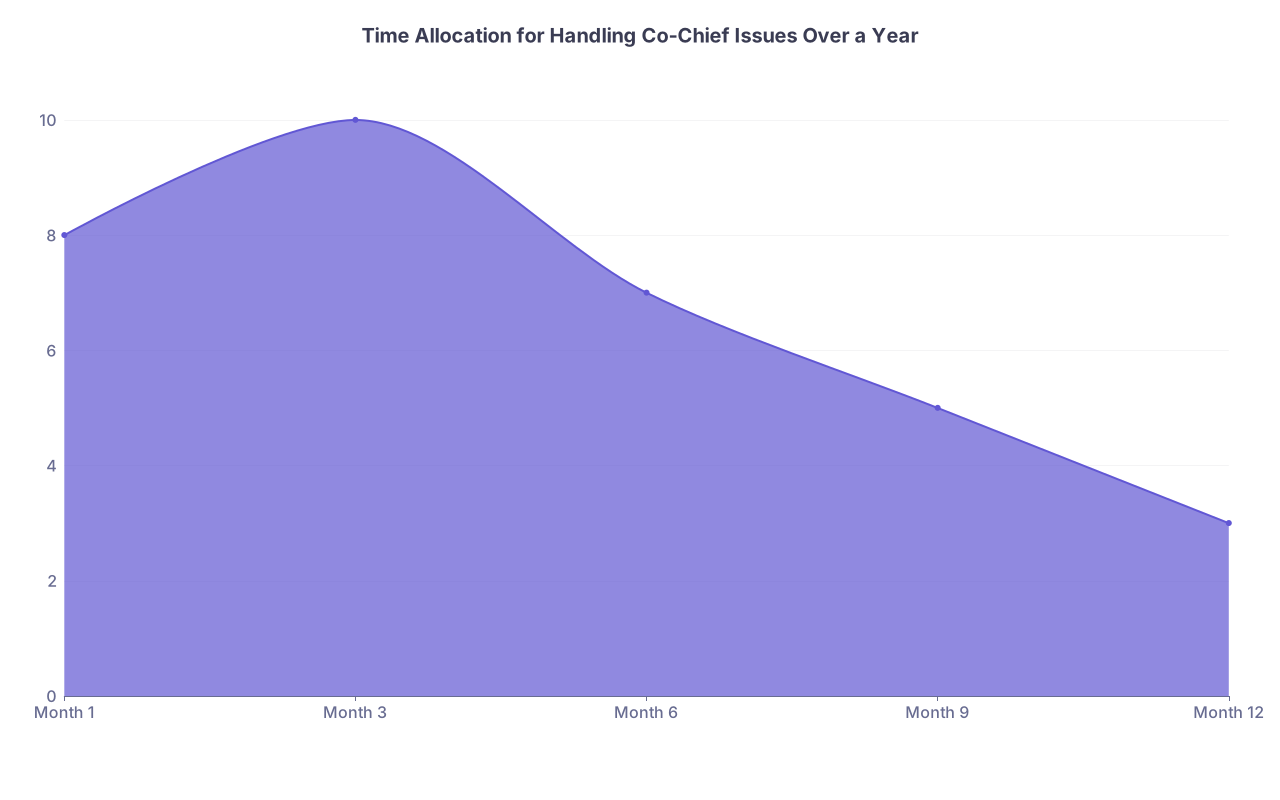
| Category | Value |
|---|---|
| Month 1 | 8 |
| Month 3 | 10 |
| Month 6 | 7 |
| Month 9 | 5 |
| Month 12 | 3 |

| Step | Description |
|---|---|
| Step 1 | Notice pattern |
| Step 2 | Document specifics |
| Step 3 | Clarify domains and roles |
| Step 4 | Private boundary conversation |
| Step 5 | Maintain with micro-boundaries |
| Step 6 | Loop in PD for guidance |
| Step 7 | Shift to damage control |
| Step 8 | Improves? |
| Step 9 | Still toxic? |


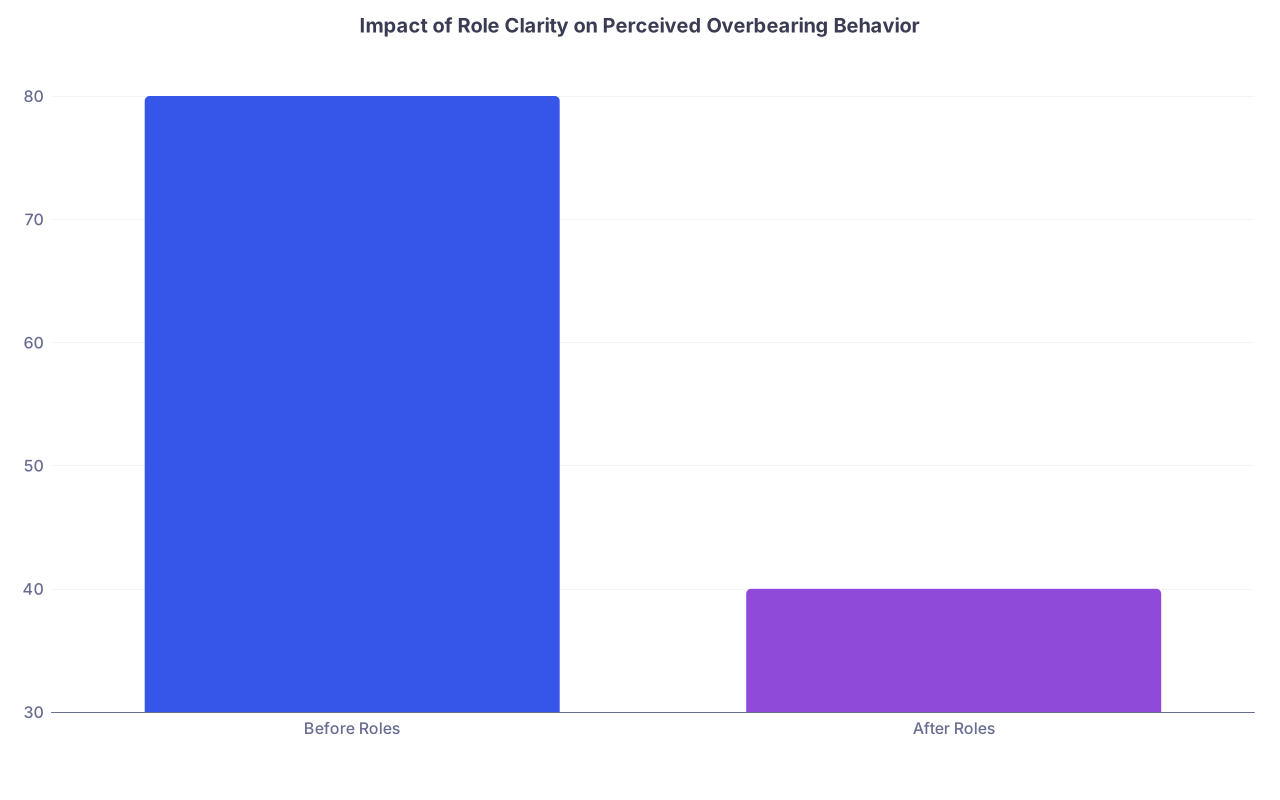
| Category | Value |
|---|---|
| Before Roles | 80 |
| After Roles | 40 |
Key Takeaways
- Do not start with war. Start with structure—clear domains, shared communication rules, and simple guardrails.
- Have one real, direct conversation naming behaviors and making specific asks, then enforce boundaries with small, in-the-moment corrections.
- If they will not change, stop trying to fix their personality. Protect your own reputation, relationships, and sanity, and get through the year with your integrity—and your leadership identity—intact.


