

You’re halfway through a brutal wards month. It’s 7:45 pm, you’re still at the hospital, and an email pops up about “Chief Resident selection process – details to follow.”
You’ve been thinking about it for months. You want to be chief. You think you’d actually be good at it. But you’re stuck on one thing:
“Do I tell my PD I want to be chief… and if so, when and how without sounding arrogant or clueless?”
Here’s the answer you’re looking for.
Short answer: Yes, tell them. But timing and framing make or break it.
If you’re a realistic candidate and you truly want to be chief, you should tell your PD and key faculty. Staying silent is a mistake. Programs don’t love guessing who’s actually willing to take the job.
But there are three big rules:
- Don’t lead with “I want to be chief” before you’ve built credibility.
- Don’t bring it up during a crisis about your performance.
- Don’t make it all about you; tie it to what you’ll do for the program.
Let’s break it into:
- When to tell them (by training year and situation)
- How to assess if you’re actually a viable candidate
- The exact scripts you can use
- What to avoid that kills your chances
When should you tell your PD you want to be chief?
Timing depends on your year, your program culture, and whether chief is a 4th year, a PGY-3 role, or a post-residency position.
General timing by year
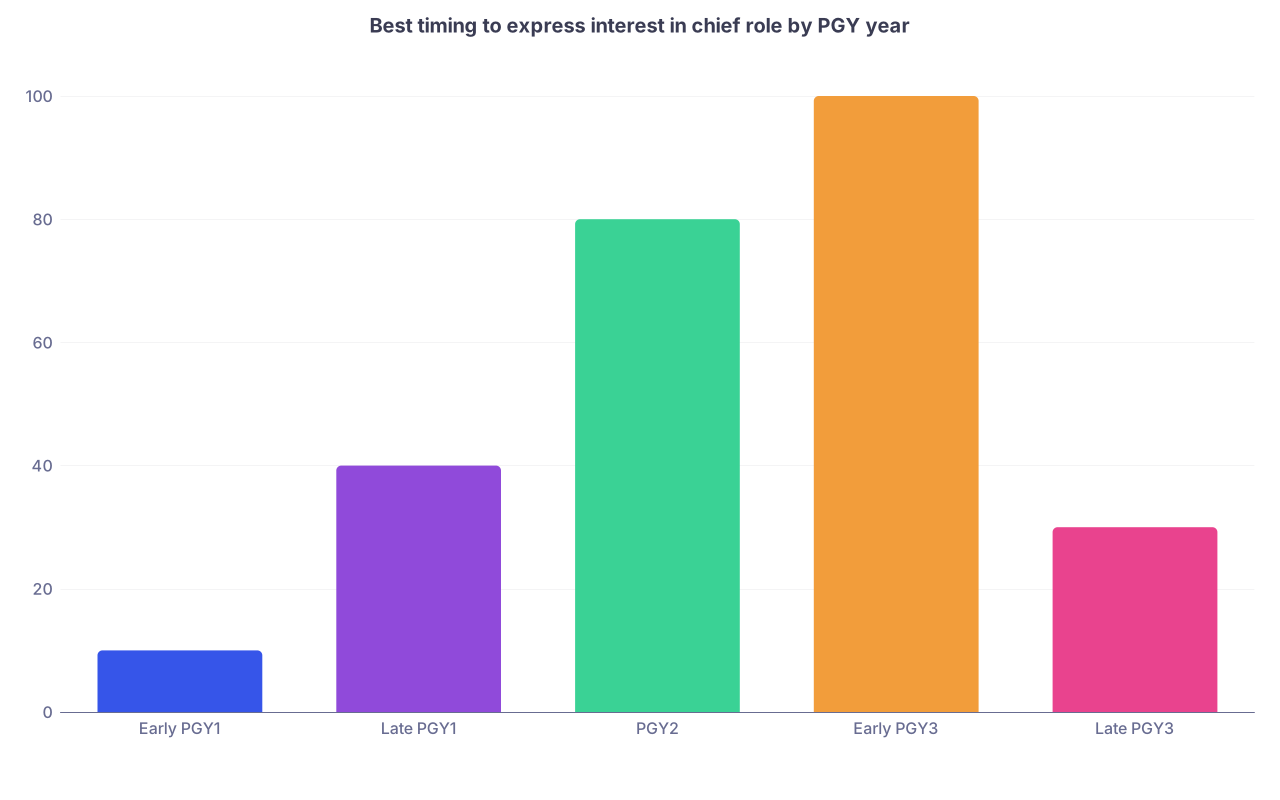
| Category | Value |
|---|---|
| Early PGY1 | 10 |
| Late PGY1 | 40 |
| PGY2 | 80 |
| Early PGY3 | 100 |
| Late PGY3 | 30 |
Here’s how I’d think about it:
Early PGY-1
Keep it to yourself. Focus on learning, not titles. Telling your PD in July you want to be chief screams “doesn’t know how residency works yet.”Late PGY-1
Safe to say: “I’m interested in leadership roles down the line, including possibly chief if that’s appropriate.” You’re signaling potential, not grabbing a job.PGY-2
This is usually the best time to clearly state interest. You’ve got an eval track record, seniors and juniors know you, and selection typically happens late PGY-2 or early PGY-3 in many programs.Early PGY-3 (or final year if chief is post-residency)
If your program picks chiefs late (some do), this is your last chance to state clear interest. At this point, you’re not “planting the seed” anymore, you’re being explicit.Late PGY-3
If selections are already being discussed, you’re probably late to the party. You can still say something, but be aware: unofficial lists form earlier than the official email.
Match your timing to your program’s process
If you don’t know when your program picks chiefs, that’s step one. Ask a recent chief or senior:
“When do they usually pick chiefs, and how much do they care about people explicitly expressing interest?”
Then back-time your conversation. You want your first clear expression of interest at least 2–3 months before serious discussions start.
Step 1: Are you actually a realistic chief candidate?
Before you say anything, be brutally honest. Two questions:
- Are you at least in the top third of residents for reliability and professionalism?
- Would at least 50% of your co-residents say, “Yeah, I could see them as chief”?
If the answer to both is no, your first move is not “tell the PD.” It’s “become the kind of resident people want as chief.”
Quick self-check:
| Domain | Strong Candidate Signs | Red Flag Signs |
|---|---|---|
| Clinical | Rarely late notes, steady on busy services | Chronic late notes, disorganized |
| Team dynamic | Interns ask you for help, attendings trust you | People avoid working with you |
| Professional | Shows up prepared, follows through | Recurrent professionalism comments |
| Culture | Helps juniors, doesn’t stir drama | Known for gossip, negativity |
| Reputation | Your name comes up with words like “solid” | Your name comes with “concerns” |
If you’re in the “realistic candidate” zone, proceed. If you’re borderline, the way you frame your interest matters even more: “I’d like to grow into being the kind of person you’d consider for chief” is smarter than “I should be chief.”
Step 2: Who do you tell, and in what order?
You’re not broadcasting this on day shift while waiting for CT reads. You’re being strategic.
The core people:
- Your Program Director
- Possibly your Associate PD
- A faculty mentor who has actual influence
- An outgoing or recent chief (for intel and feedback)
The order I’d use in most programs:
- Talk to a trusted recent chief or senior: “Am I crazy for thinking about chief?”
- Talk to your faculty mentor: “How do I stack up, realistically?”
- Then talk to your PD with a clear, calm, direct statement of interest.
That way, by the time it reaches the PD, your name isn’t coming out of nowhere.
Step 3: Exactly what to say (scripts you can steal)
Script 1: Early, subtle interest (late PGY-1)
You’re not campaigning; you’re planting a seed.
“I’ve really enjoyed being more involved with the program – things like teaching interns and helping with conference. Down the line, I could see myself being interested in leadership roles like chief resident if I’m the right fit and the program sees that in me.
In the meantime, I’d love feedback on what skills I should focus on building this year so I can contribute more to the program.”
Why this works:
- You say “if I’m the right fit” – not entitled.
- You immediately pivot to feedback and development.
- You’re signaling, not demanding.
Script 2: Clear interest (PGY-2 prime-time)
This is the conversation that matters most.
Ask for a short meeting:
“Dr. [PD], could we set up 15–20 minutes sometime in the next few weeks? I’d like to talk about my development and where I might fit into the program’s leadership needs.”
In the meeting:
“I wanted to be direct with you. I’m very interested in being considered for chief resident if you and the leadership feel I’d be a good fit.
I enjoy the teaching, the scheduling puzzles, and working across teams. I also care a lot about making things better for the interns – we’ve all seen how rough their transitions can be.
I’d really appreciate honest feedback on how you see me right now:
- Do you see chief as a realistic possibility for me?
- What specific things would I need to strengthen over the next 6–12 months to be someone you’d seriously consider?”
Then shut up and listen. And write down what they say. Because that is your actual roadmap.
Script 3: If you’re unsure you’re competitive
This is for the “I want it, but I know I’m not perfect” group.
“I’ll be honest – I am interested in chief, but I’m not sure how competitive I actually am. I’d rather ask you directly than make assumptions. I’d appreciate it if you could be candid.
From your perspective: what are my biggest strengths and what are my biggest concerns if someone brought up my name for chief?”
Then, critically:
“If your sense is that I’m not there yet – is there a path to get there, or do you think my strengths are better used elsewhere?”
If your PD says something like, “I don’t think chief is the right role for you,” that stings. But it’s much better than silently hoping and being blindsided later.
Script 4: If they hint you’re a frontrunner – and you actually want it
Sometimes your PD will test the waters first:
“We’ve been thinking about next year’s chiefs, and your name has come up. Is that something you’d be open to?”
You say:
“Yes, I’d definitely be interested in being considered, as long as you think I’d be the right fit for the program. I understand it’s a lot of work and not just a title. I’m particularly interested in [education / scheduling / wellness / QI] and would want to take ownership of that.
I also want to be respectful of your process – if there are others being considered, I’m happy to be one name in the mix and get your honest feedback either way.”
Confident, but not obnoxious.
What NOT to do (ways people sabotage themselves)
I’ve seen these blow up otherwise decent candidates:
Campaigning with co-residents like it’s an election
Telling everyone, “I’m going to be chief,” asking people to “put in a good word,” or turning it into a popularity contest. PDs hate this.Whining as “advocacy”
It’s reasonable to point out real problems. It’s not reasonable to be the person who only complains and never brings solutions, then asks to be chief. Chiefs are problem-solvers, not professional complainers.Linking chief to fellowship leverage
“I need to be chief to get cardiology” is a bad look. Chiefs are chosen (ideally) for what they’ll do for the program that year, not their personal CV upgrade.Bringing it up right after an evaluation problem
If you just had a remediation conversation, don’t follow it with “also, I want to be chief.” First, fix what needs fixing.Making it about “recognition”
PDs are allergic to “I deserve this” energy. They respond to: “Here’s how I can help you and the program.”
How your PD is actually thinking about this
Strip away the nice language. Most PDs think in a very simple framework:

| Step | Description |
|---|---|
| Step 1 | Resident interested in chief |
| Step 2 | Do not consider |
| Step 3 | Strong candidate |
| Step 4 | Reluctant candidate |
| Step 5 | Reliable clinically |
| Step 6 | Respected by peers |
| Step 7 | Low drama |
| Step 8 | Will make my life easier or harder |
Your goal in that conversation is simple: help them put you in the “strong candidate who will make my life easier” bucket.
So highlight:
- Times you’ve stepped up without being asked.
- Concrete ways you’ve solved problems (schedule glitches, rotation issues, intern struggles).
- Your ability to push back respectfully, not combatively.
Using the conversation even if you never become chief
Here’s the underappreciated part: done well, this whole process helps you even if you’re not picked.
Because what you’re really saying is:
“I care about this program, I want to contribute, and I’m mature enough to ask for blunt feedback.”
That’s the kind of person PDs recommend aggressively for fellowships and jobs.
And if they say no to chief but give you a different leadership role (curriculum committee, QI lead, simulation coordinator) and write a line in your letter like “we considered them for chief,” that’s still very valuable.
A quick reality check on “telling them”
You’re afraid of two things:
- They’ll think you’re arrogant.
- You’ll say you want it and then not get picked and feel humiliated.
On #1: If you frame it as “I want to help the program, here’s how I think I can contribute; please be honest about whether I’m a realistic candidate and what I need to work on,” that’s not arrogance. That’s maturity.
On #2: People overestimate how much others are thinking about them. Residents are busy. In six months nobody will care that you expressed interest and didn’t get it. What will matter is how you responded.
If you don’t get it, the right move is:
“Thank you for considering me. I appreciate the opportunity to even be in the discussion. I’d still like to be involved in [specific project/committee]. If you’re willing, I’d also love feedback on what made the selected chiefs the right fit so I can keep improving.”
That’s how you mark yourself as someone they will remember positively.
FAQ: Chief Interest, Timing, and Scripts
1. What if my program “doesn’t like” people campaigning for chief?
Then don’t campaign. But you still should have a private, direct conversation with your PD. There’s a difference between publicly angling for the job and quietly telling the decision-maker, “If you’re looking, I’d like to be in the mix, and I’m open to tough feedback.” Almost every PD respects the latter.
2. Should I tell my co-residents I’m interested in being chief?
Tell a few trusted people, not the entire residency group chat. A senior who knows the culture, a recent chief, maybe a peer you trust to be honest with you. The more you talk about it loudly, the more political it feels. You want your colleagues to say, “Yeah, that makes sense” if your name comes up, not “Oh, they’ve been talking about this nonstop.”
3. What if my evaluations aren’t perfect – should I still say I’m interested?
You don’t need perfect evals. But you do need a general pattern of reliability and growth. If you’ve had issues, the script shifts to: “I know I’ve had weaknesses in [X], and I’m working on them by [Y]. Long-term, I’d like to be the kind of resident you’d consider for chief. Can we use this year to see whether I can realistically get there?” That shows self-awareness, which counts more than flawless paper stats.
4. Does wanting a competitive fellowship change how I should approach this?
It should change your mindset, not your script. Don’t treat chief as a checkbox for cardiology or GI. PDs can smell that. Say: “I’m interested in [fellowship], but independent of that, I like leadership and teaching and would be excited to serve as chief if it aligns with the program’s needs.” If your PD believes you want chief only as a résumé boost, they’re less inclined to choose you.
5. What concrete step should I take this week if I’m even mildly interested in chief?
Pick one recent chief or trusted senior, send a short message:
“Hey [Name], I’ve been thinking about future leadership roles, possibly chief. Can I grab 15 minutes to get your honest read on whether that’s realistic for me in this program and what people actually look for here?”
Then actually schedule it. That one conversation will give you a much clearer signal than months of overthinking in your head.


