
73% of applicants with Step 2 CK scores ≥250 still apply to a so‑called “backup specialty.”
And most of them are backing up into the wrong things.
Everyone hears the same folklore:
- “If you have a high score, you’re safe anywhere.”
- “Just apply anesthesia or radiology as a backup. They’re easier.”
- “EM is a good backup for surgery.”
- “Worst case, I’ll just match IM and reapply.”
This is how strong applicants end up scrambling on Match Week, or worse, matching into a specialty they never actually wanted and then being stuck.
Let me be blunt: for high‑scoring applicants, the danger is not “being too competitive” for your dream specialty. It is misunderstanding risk, over‑ or under‑applying, and clinging to the myth that some fields are universal safety nets.
They’re not.
Let’s walk through what the data actually shows, and why “backup specialty” is one of the most abused concepts in residency planning.
The Data Reality: “High Score” ≠ “Guaranteed Match”
NRMP data is very clear: high scores help, but they do not erase structural risk.
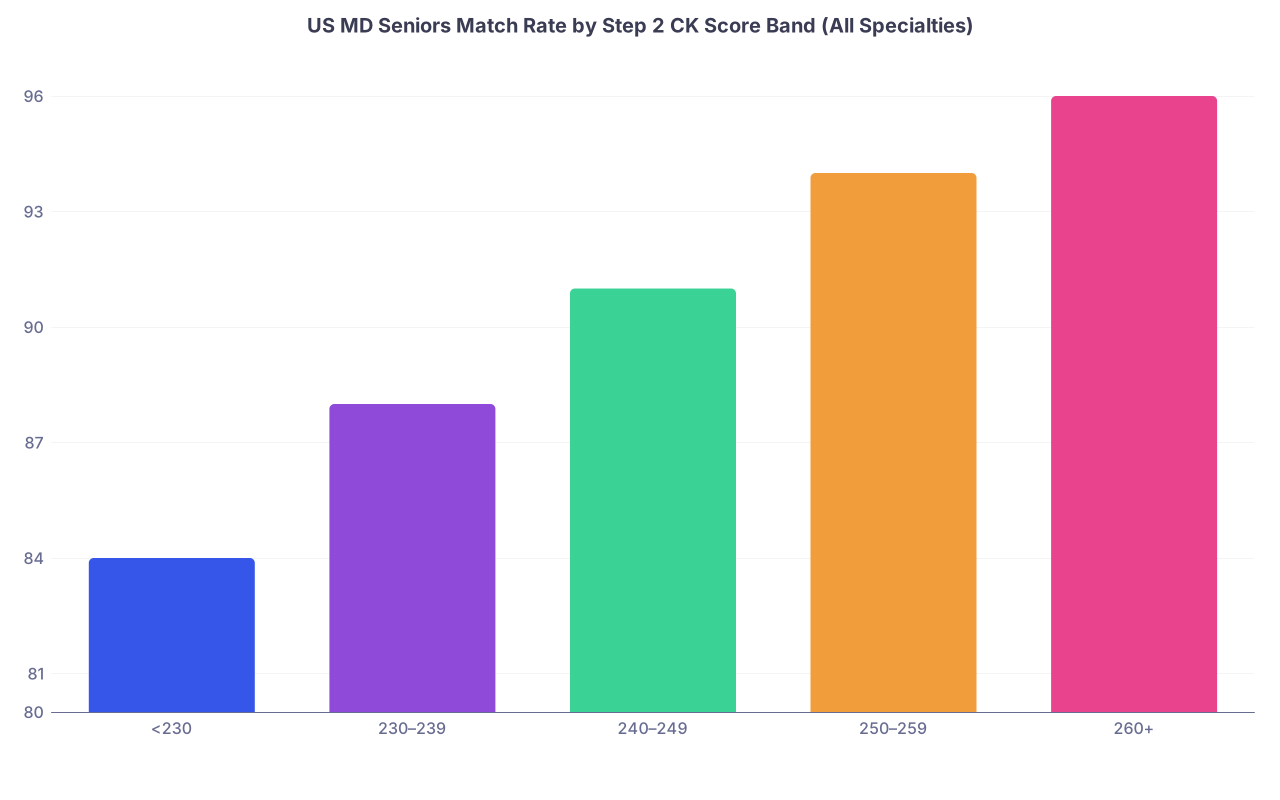
| Category | Value |
|---|---|
| <230 | 84 |
| 230–239 | 88 |
| 240–249 | 91 |
| 250–259 | 94 |
| 260+ | 96 |
A 250+ Step 2 is excellent. But it does not turn neurosurgery into family medicine.
Now look at how match rates change once you aim at the truly competitive stuff:
| Specialty Tier | Example Specialties | Approx Match Rate (%) |
|---|---|---|
| Ultra-competitive | Derm, Plastics, ENT, Ortho | 65–80 |
| Very competitive | Rad Onc, Neurosurg, Urology | 75–88 |
| Mid-competitive | EM, Anesthesia, Radiology, OB | 85–93 |
| Broad-access (but not automatic) | IM, Peds, Psych, FM | 94–98 |
Those are overall match rates for US MD seniors. Your 255 doesn’t magically give you “broad-access” odds in dermatology.
And here’s the kicker: a lot of high scorers blow their advantage by misunderstanding what really drives risk:
- Geographic obsession (e.g., “I have to be in Southern California or NYC”)
- Late decision making (no meaningful specialty exposure until late M3)
- No aligned research or letters
- Sloppy or minimal backup strategy
So no, the answer is not “just add anesthesia as a backup.” The real question is: backup to what, with what kind of application, and how many programs?
The Myth of “Least Competitive Specialties”
Let me kill a popular myth first: there is no single, stable list of “least competitive specialties” that reliably function as backup fields for everyone.
Competitiveness is not just about average Step 2. It’s a mix of:
- Number of positions nationwide
- Number of applicants per position
- How many “high-caliber” applicants use that specialty as a backup or pivot
- Geographic skew (e.g., certain coastal cities are a bloodbath for almost every field)
You’ll see people say stuff like:
- “Psych is easy now.”
- “Pathology is a safety net.”
- “FM is impossible to not match.”
None of those statements is defensible without asterisks the size of a textbook.
What the data actually shows:
- Psych has gotten substantially more competitive over the last decade.
- Pathology has relatively fewer positions and a very bifurcated applicant pool (some stellar, some quite weak).
- Family med and peds have high match rates overall, but competitive urban programs in desirable locations are not “easy.”
If you’re a high scorer, you don’t need a least-competitive specialty list. You need to understand relative safety given your profile, timeline, and geographic rigidity.
The Fake Backups: Specialties People Think Are Safe (But Aren’t)
Certain specialties get abused as supposed “backups” so badly that they’re now saturated with strong applicants who don’t even really want them.
1. Anesthesiology
Classic myth: “Anesthesia is a good backup for surgery or anything surgical-ish.”
Reality:
- It’s now mid‑competitive.
- Many programs quietly expect some anesthesia‑relevant exposure, letters, or at least a credible narrative.
- In coastal and major academic centers, anesthesia is not your safety net.
I’ve seen people apply gen surg + anesthesia with zero anesthesia letters and a personal statement that screams “I actually want to operate.” Programs notice. You look like you’re casually shopping for a pay check and a lifestyle.
Backup test:
If I stripped “backup” out of your mouth, could you sound like someone who genuinely wants to be in an OR every day managing physiology instead of holding the scalpel? If not, do not count on anesthesia to save you.
2. Emergency Medicine
The old play: “If I don’t match surgery or ortho, I’ll just do EM.”
Bad plan now.
EM has had whiplash: swings in applicant volume, talk of oversupply in some markets, and program closures. At the same time, it remains highly desirable in big cities and strong academic centers. Not a simple backup.
Also: the culture mismatch between surgery and EM is real. PDs can smell when you are an OR‑obsessed applicant who’s pitching EM because you like “trauma” but you clearly don’t care about the rest of the job.
3. Diagnostic Radiology
Radiology gets abused by high scorers who like the idea of money + imaging but have done zero legwork:
- No radiology elective
- No radiology‑specific letters
- No research even tangentially related
Programs absolutely look for signs that you’re not going to quit after intern year to reapply derm or ENT.
Again: as a backup for someone who could honestly see themselves happy reading scans all day and has at least one focused elective or letter, sure. For everyone else? No.
The Real Backups: What Actually Functions as “Safer Ground”
There are specialties that, for a high‑scoring applicant, typically offer meaningfully lower risk — if you apply correctly and don’t box yourself into 5 ultra‑competitive programs in one city.
For strong US MD seniors with a 250+ who are even moderately flexible geographically:
- Internal Medicine (categorical)
- Pediatrics
- Family Medicine
- Psychiatry
- Neurology (to a lesser extent, but often still safer than the microspecialties you’re thinking about)
These are not “easy.” They are broad‑access. Big difference.
You can still absolutely fail to match in them if you:
- Apply late
- Apply geographically tiny (e.g., just one state or one metro area)
- Have questionable professionalism/fit issues
- Present a story that screams “I do not want to be here at all”
But if you’re a normal human, OK interviewer, no huge red flags, with a 250+ and a decent number of programs across multiple regions? Your odds in these fields are extremely high.
Here’s a simplified comparison to make that concrete:
| Plan Type | Example Strategy | Relative Risk of Going Unmatched |
|---|---|---|
| All-in ultra-competitive | 40 derm programs only | Very high |
| Single-competitive + weak backup | 25 ortho + 5 anesthesia, no anesthesia prep | Moderate–high |
| Competitive + broad-access | 25 ENT + 25 IM across regions | Low–moderate |
| Broad-access only | 40 IM or 40 FM across regions | Very low |
Again, not NRMP official numbers — but this is how PDs and advisors actually think about it.
The Ugly Truth: Many “Backups” Are Logistically Fake
There’s another dirty secret: timing.
Plenty of students decide their “backup specialty” in October, after they realize their primary field is a lottery for them. Then they fire off a few ERAS applications and call it backup planning.
This is useless.
A functional backup specialty requires:
- At least one rotation (home or away)
- One or two strong letters from that field
- A personal statement that does not read like a hostage note
- A rank list with enough programs to absorb market randomness
If you want a surgical backup (say, general surgery backing up ortho), you still need gen surg exposure and letters. Same for IM backing up cards/impossible derm dreams, and so on.
Think of it as a minimum viable backup:
You should be hirable in that specialty independently of your original dream.
That’s the bar.
High Scorers’ Real Risk: Geography and Ego
Let me be brutal for a moment. The majority of high scorers I’ve seen not match were not “too ambitious” with their specialty. They were too rigid with location and too arrogant about how far their score would carry them.
Example patterns I’ve personally seen:
257 Step 2, wants derm, applies to 45 derm programs — but only on the coasts, plus Chicago. No Midwest, no South outside of 2 “name” programs. Applies to zero backup specialties. Doesn’t match.
252 Step 2, ENT‑or‑bust, applies to 50 ENT programs, zero backup. Also will not leave California. Doesn’t match, then stunned: “But my score…”
260 Step 2, applies radiology as “backup” to neurosurg, but only to 6 elite coastal rads programs, with one generic rads letter and no rotation. Doesn’t match either. Ends up in SOAP scrambling for prelim IM.
None of these people had a “score” problem. They had a strategy problem.
If you’re high scoring and actually serious about avoiding disaster:
- Decide early whether you are willing to leave your favorite coastal city.
- Decide if you’re willing to do a true broad‑access backup like IM, peds, FM, psych, or neuro.
- If yes, build that into your fourth year and ERAS from day one — not in October.
When a “Backup” is Worse Than No Backup
People rarely say this out loud: some backups will make you miserable.
Matching into a specialty you do not respect and have no intention of embracing is not a win. It is a slow‑motion car crash that just happens to pay you a resident salary.
Red flags that your “backup” is fake:
- You routinely trash‑talk the specialty in front of classmates.
- You have never spoken to a happy attending in that field and actually believed them.
- Your entire theory is: “I’ll just do it for a year and reapply my dream.”
Residency is not a holding pen. Programs do not want one‑year tourists who plan to bail as soon as they can reapply ortho or derm. They’re getting burned repeatedly by this pattern and are getting smarter.
If you cannot picture a world in which you stay in that backup field and build a life there — do not lean on it as your safety net. You’re better off:
- Applying smarter (wider geography, enough programs) in your primary field
- Accepting the risk profile and having a realistic SOAP/Supplemental planning conversation with a competent advisor
What a Sane Backup Strategy Looks Like for High Scorers
Let’s make this concrete with a reasonably strong US MD senior (Step 2 CK 252, solid MS3 evals, average research).
For different risk tolerances:
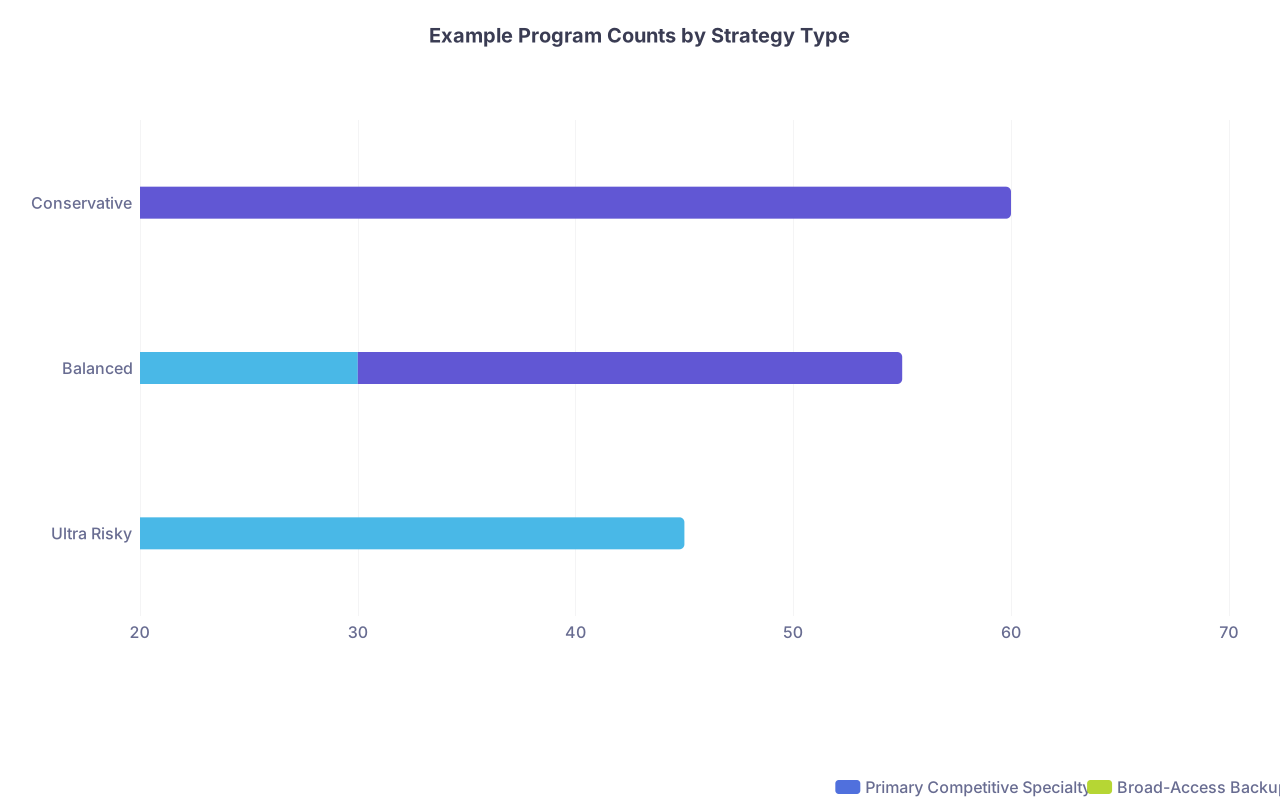
| Category | Primary Competitive Specialty | [Broad-Access Backup](https://residencyadvisor.com/resources/least-competitive-specialties/does-choosing-a-low-competition-specialty-close-doors-to-fellowships) |
|---|---|---|
| Ultra Risky | 45 | 0 |
| Balanced | 30 | 25 |
| Conservative | 20 | 40 |
Ultra‑risky: 45 applications in derm, plastics, ENT, etc. No backup. All in. This is gambling; high reward, genuinely high risk of unmatched.
Balanced: 25–30 programs in the competitive love (e.g., ENT) plus 20–30 in IM/psych/neuro across multiple regions. True backup with credible story and letters in both fields.
Conservative: 15–20 competitive, 35–45 broad‑access backup aggressively across the country. Much lower chance of unmatched, higher chance you ultimately end up in the backup field.
Notice what’s not happening here: “I’ll throw 5 anesthesia and 5 radiology apps on top of my 35 ortho apps and call that a plan.” That’s not a plan; that’s lottery ticket accumulation.
The Bottom Line: What the Data (And Actual Experience) Says
Let’s strip this down.
There is no magic list of “least competitive specialties” that are universal backups. Competitiveness is relative, context‑dependent, and heavily warped by how many ambitious people abuse certain fields as insurance.
For high‑scoring applicants, the real safety net is usually a broad‑access specialty (IM, peds, FM, psych, neuro) applied to in a serious way — enough programs, real letters, real interest — not a handful of random apps in mid‑competitive fields you barely explored.
A high score is leverage, not armor. If you combine it with rigid geography, late decision making, and fake backups, you can absolutely still go unmatched. Use your numbers to buy flexibility, not complacency.