
The comforting myth that “easier” specialties will hide a weak application is wrong. They will just punish a lazy, unfocused one slightly less.
If your file is thin and you are late in the game, you cannot rebuild your whole CV. You can, however, execute a series of targeted moves over the next 4–12 weeks that materially improve your odds in the least competitive specialties.
I am going to show you exactly what to do. Step by step. No fluff.
Step 1: Get Real About Where You Can Actually Match
Start by killing magical thinking. Some specialties are simply off the table for a late, weak application. Others are still very much in play.
For a relatively thin application, your best “easier match” options typically include:
- Family Medicine
- Internal Medicine (community and mid-tier university programs)
- Pediatrics
- Psychiatry (still competitive in some areas, but realistic if you are smart about it)
- Neurology
- Pathology
- PM&R (Physical Medicine & Rehabilitation) – situational, but often friendlier than you think
- Transitional Year / Preliminary IM spots as a foothold
The “easy” list changes by year, but there is a stable core of lower-barrier fields.
Here is a simplified reality check:
| Specialty | Typical Step 2+ for Strong Applicant | Relative Competitiveness |
|---|---|---|
| Derm / Ortho / Plastics | 250+ | Extremely High |
| Radiology / Anesthesia | 240–250 | High |
| EM / Gen Surg | ~235–245 | Moderate–High |
| Psych / Neuro / Path | ~225–235 | Moderate |
| FM / IM / Peds (Community) | ~215–230 | Lower |
If you are trying to repair a thin application late:
- Stop chasing anything in the “Extremely High” bucket.
- Be cautious with “High”.
- Focus your scramble on the “Lower” and some “Moderate” categories.
Action in the next 24 hours:
List 2–3 target specialties from:
- Family Med
- IM (non-top academic)
- Peds
- Psych
- Neuro
- Path
- PM&R
For each, list:
- 5–10 community-focused or mid-tier programs in regions you can realistically live in.
- Your home program(s) in those fields.
This becomes your attack map.
Step 2: Diagnose Your Application Weak Points — Precisely
“Thin” is not a diagnosis. It is a vague excuse. You need precision.
Your file is weak in some of these domains:
- Scores (USMLE/COMLEX)
- Clinical grades / honors
- Letters of recommendation (LORs)
- Specialty exposure
- Research / academic productivity
- Service / leadership
- Personal statement and narrative coherence
- Geography / ties
You do not have time to fix all of them deeply. You do have time to:
- Patch holes that programs consider red flags.
- Amplify one or two strengths you already have.
- Make your story coherent and believable.
Quick self-audit (do this honestly)
Write down, bullet-point level:
Scores:
- Step 1: pass / fail, if numeric, what number?
- Step 2: actual score.
- Any failures or repeats?
Clinical performance:
- Honors vs passes in core rotations (especially IM, Peds, Psych, FM).
- Any failures/remediations.
LORs:
- How many are truly strong and specialty-specific (e.g., “This student is among the top X I have worked with”) vs generic (“hard-working, pleasant”)?
Specialty-specific exposure:
- Rotations or electives in target specialty?
- Any sub-I?
- Any continuity clinic?
Research / leadership / service:
- Anything that shows long-term commitment or responsibility, even if not flashy?
Geographic ties:
- Where can you credibly say, “I want to be here long term”?
Circle:
- 1–2 relative strengths (e.g., “Great clinical comments in FM and Peds”, “Local ties to Midwest”, “One genuinely strong IM letter”).
- 2–3 major weaknesses (e.g., “Low Step 2”, “No psych elective”, “Generic letters”).
Everything that follows is about weaponizing your strengths and neutralizing your worst weaknesses fast.
Step 3: Choose the Right “Easier” Specialty for Your Weakness Profile
Not all lower-competitiveness specialties forgive the same flaws.
Here is where pattern recognition matters.
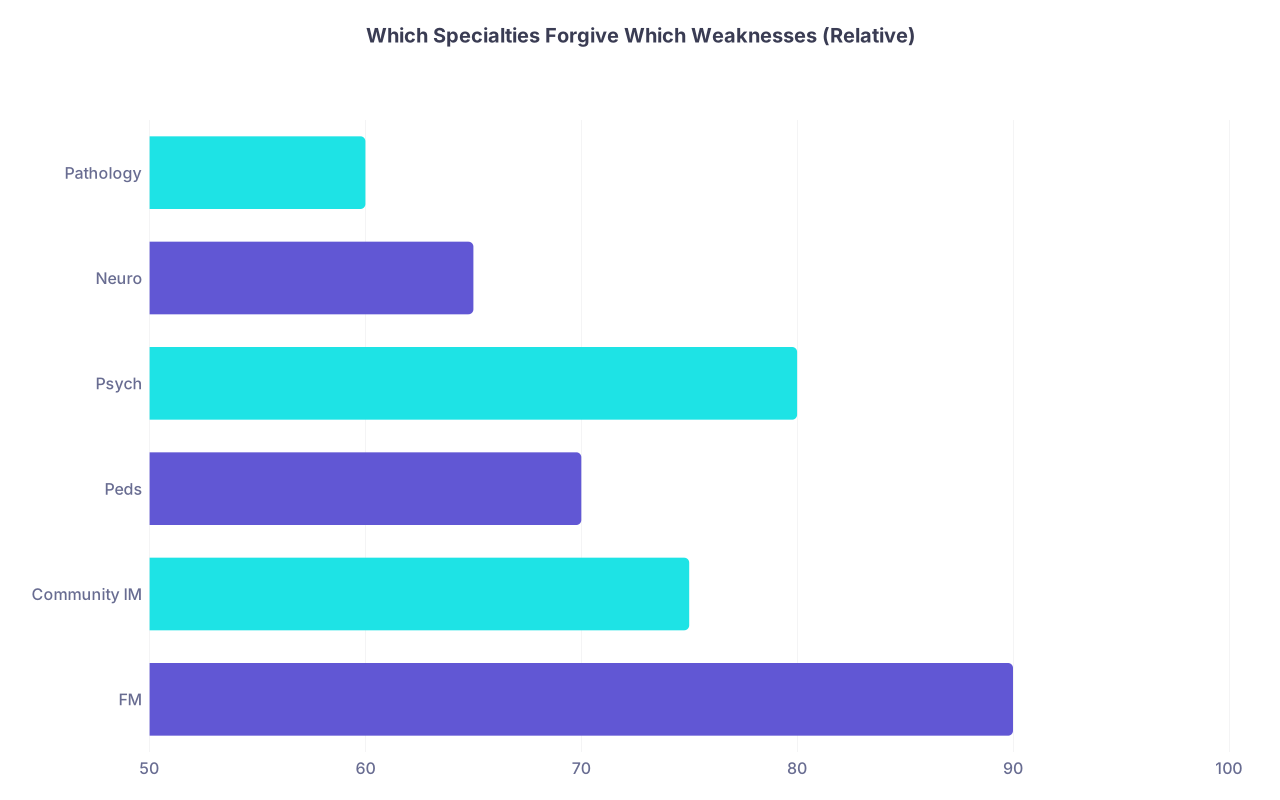
| Category | Value |
|---|---|
| FM | 90 |
| Community IM | 75 |
| Peds | 70 |
| Psych | 80 |
| Neuro | 65 |
| Pathology | 60 |
Think in terms of forgiveness categories:
1. If your issue is primarily low scores but good clinical skills
Consider:
- Family Medicine
- Pediatrics (especially community programs)
- Some community Internal Medicine
- Psychiatry (depending on region)
Programs in these specialties care a lot about:
- Work ethic
- Team function
- Communication skills
- Long-term fit with patient populations
Low scores hurt less if:
- You have strong, specific clinical comments.
- You have at least one rock-solid letter saying you are outstanding on the wards.
- You can tell a coherent story of improvement or resilience.
2. If your issue is few or generic letters, but scores are decent
You need a specialty that will let you repair this quickly:
- Family Med
- IM
- Neuro
- Psych
Why these?
- More flexible about late-arriving LORs.
- Often more open to phone calls or direct advocacy from faculty who know you.
You must manufacture 1–2 strong letters in the next rotation or two (details in Step 4).
3. If your issue is lack of research or academic heft
Good. Most of the “easier” specialties (especially community programs) do not care deeply about publications.
In fact, for:
- FM
- Community IM
- Many Peds and Psych programs
They will take a reliable, teachable clinician over a mediocre researcher any day.
Your job is to stop apologizing for no posters and instead double down on:
- Service
- Long-term interests
- Clear, grounded career goals
4. If your issue is failed exams or course remediations
Then you absolutely need to:
- Show a clear upward trend (Step 2 improvement, strong recent clinical performance).
- Pick programs and specialties known to be more holistic.
Again, FM, Psych, community IM, and some Peds programs are more open to “comeback stories” if your recent record is strong and someone good is willing to vouch for you.
Step 4: Manufacture Stronger Letters of Recommendation — Fast
You cannot rewrite your Step score.
You can generate one or two much stronger letters in the next 4–8 weeks if you are intentional.
The rotation strategy
If you are still on rotations (MS4, transitional year, or prelim):
Pick a rotation in your target specialty (or closest match) now, even if it means swapping schedules.
Identify 1–2 attendings at the start who:
- Like to teach.
- Are known to write good letters.
- Have clout (program leadership, respected clinician, long-standing faculty).
On day 1 or 2, say explicitly:
- “Dr X, I am applying in Family Medicine and hoping to strengthen my application with a strong letter. I would really appreciate specific feedback during this rotation and, if I meet your expectations, a letter at the end. I am prepared to work hard and improve.”
Yes, you say it that bluntly. Early.
Then you perform like a letter is on the line:
- Show up early. Be the last to leave.
- Pre-chart, pre-emptively call consults, follow up on all labs.
- Present concisely, write clean notes, anticipate next steps.
Ask for mid-rotation feedback:
- “What do I need to do over the next 1–2 weeks to be considered a top student you have worked with?”
This gives them permission to later write, “Responded rapidly to feedback and progressed to functioning at the level of an intern.”
- Near the end, ask for the letter like this:
- “Given the rotation so far, would you feel comfortable writing a strong letter for my Family Medicine application?”
If they hesitate or hedge, thank them and pivot to another attending. You do not want a lukewarm letter.
If you are out of rotations, consider:
- Asking a prior attending who liked you to update or strengthen an existing letter with more specific detail.
- Doing a short observership or clinic-based experience where a faculty member can still credibly comment on your clinical performance.
Letter mix by specialty (minimum viable set)
| Specialty | Ideal Minimum LOR Mix (3 Letters) |
|---|---|
| Family Med | 2 FM attendings, 1 IM or Peds |
| Community IM | 2 IM attendings, 1 FM or subspecialty |
| Pediatrics | 2 Peds attendings, 1 IM or FM |
| Psychiatry | 1–2 Psych attendings, 1 IM/FM |
| Neurology | 1–2 Neuro attendings, 1 IM |
| Pathology | 2 Path attendings, 1 IM/medicine-related |
If you cannot hit the “ideal,” get as close as possible and at least have one letter directly in the specialty you are applying to.
Step 5: Create a Coherent “I Actually Belong in This Field” Story
A thin file can still win if the story feels clean and believable.
Programs hate:
- Scattered interests.
- Last-second specialty hopping without explanation.
- Generic “I like working with people” essays.
You are aiming at least competitive specialties. That means you can win with a strong, authentic narrative even if your CV is light.
Build your specialty story in three parts
- Hook – why this specialty speaks to you specifically.
- Evidence – what you have actually done that backs this up.
- Trajectory – where this leads in your career.
Example for Family Medicine:
Hook:
- “I grew up in a small town where the local family physician was the closest thing we had to a healthcare system. I watched one doctor manage diabetes, pregnancy, and end-of-life care in the same week. That model of continuity and broad responsibility is what pulled me toward medicine, and it is what pulls me toward Family Medicine now.”
Evidence:
- List concrete experiences:
- Continuity clinic in FM where you followed a few patients over multiple visits.
- A specific patient story where you coordinated care or navigated social barriers.
- Long-term involvement in a free clinic, community health fair, or outreach.
- List concrete experiences:
Trajectory:
- “I see myself practicing in a community setting in the Midwest, building long-term relationships with patients and working closely with behavioral health and social work to address chronic disease in a realistic way.”
Do the same framework for Psych, Peds, IM, etc. The key is: specific, verifiable, grounded.
Patch obvious narrative gaps
If you switched from a more competitive specialty late (for example, from EM or surgery to FM/Psych):
- Acknowledge it briefly.
- Frame it as a values shift, not a failure.
Example:
“I initially pursued Emergency Medicine, attracted by the acuity and procedures. Over time, I realized that what I valued most were the conversations after the crisis – exploring mental health, substance use, and long-term safety. That led me to seek out additional psychiatry experiences, where I found the longitudinal therapeutic relationships and team-based care that fit me far better.”
One or two sentences like this is enough. Then move on to what you have done in the new field.
Step 6: Aggressively Leverage Geography and Fit
In less competitive specialties, “fit” and geography are not soft extras. They are levers.
Programs strongly prefer:
- People with real ties to their region.
- Applicants who will not bail after one year.
- Candidates who sound like they want their specific job, not any job.
Your geography playbook
Make a list of:
- States where you have:
- Family
- Lived
- Trained (medical school, rotations)
- College or high school
- Underserved or rural areas where you would honestly consider living.
These become priority zones.
Now, adjust your application materials:
- Personal statement version for Midwest FM (for example):
- Explicitly mention wanting to practice in the Midwest.
- If you grew up there, say it. If you trained there, say why you want to stay.
- Short supplemental essays or emails:
- Briefly highlight your connection (“I attended undergrad in Ohio and have extended family within an hour of your hospital”).
Programs want to reduce the risk of “we train them and they leave.” Show them that is not you.
Step 7: Maximize Late-Stage, High-Yield Additions
You do not have time for a PhD or a new degree. You do have time for a few targeted, resume-visible actions that help.
Focus on things that:
- Are easy to explain.
- Signal responsibility, reliability, or service.
- Can be completed or significantly advanced in 4–8 weeks.
Good late-stage adds:
Clinic or call volunteering in your target specialty
- Example: extra FM clinic half-day per week.
- Shows commitment and gives you more patient stories.
Small QI or chart-review project
- Work with a faculty member on something bite-sized:
- Reducing no-show rates in FM clinic.
- Tracking depression screening follow-up in Psych clinic.
- Even if it remains “in progress,” have a concrete description:
- “Working with Dr X on a quality improvement project evaluating XYZ…”
- Work with a faculty member on something bite-sized:
Teaching or mentoring role
- Tutoring junior students.
- Leading a workshop or skills session.
- Supervising volunteers at a free clinic.
Community service directly tied to your specialty’s population
- FM / Peds: vaccination drives, school health events.
- Psych: mental health awareness groups, crisis line volunteering (if you can be trained quickly).
- IM: chronic disease education programs.
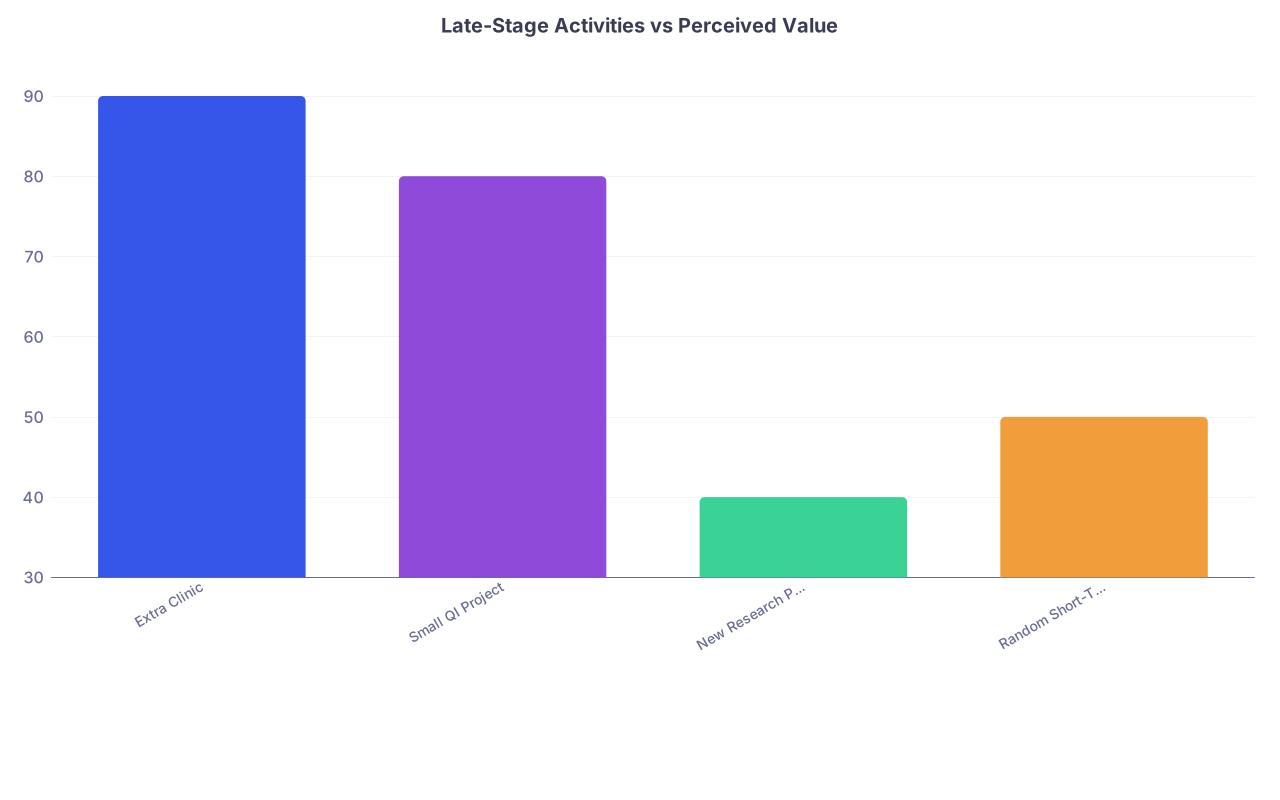
| Category | Value |
|---|---|
| Extra Clinic | 90 |
| Small QI Project | 80 |
| New Research Poster | 40 |
| Random Short-Term Volunteering | 50 |
Programs will not be dazzled by a last-minute poster. They will pay attention to concrete, sustained action that aligns with the work they do.
Step 8: Fix the Two Most Underrated Components — Emailing and Interview Readiness
You can have a thin file and still get interviews if you handle the human side well.
Smart, targeted emails to programs
You are not spamming. You are sending short, precise messages that:
- Highlight a tie to the region or program.
- Reference a concrete aspect of the program.
- Attach or link to your ERAS application if allowed.
- Come with or without faculty advocacy.
Subject line examples:
- “Applicant with strong Midwest ties – Family Medicine”
- “MS4 with local roots and clinical experience in [Program City] – Psychiatry”
- “Reapplicant with updated Step 2 and FM letters – interest in [Program Name]”
Body (trimmed example):
Dear Dr [PD Name],
My name is [Name], a fourth-year medical student at [School]. I have applied to your [Specialty] residency program for this cycle.
I have strong ties to [Region/City] (I attended [College] and my family lives in [Nearby Town]), and I hope to practice here long term. This year I have focused my clinical work on [specialty-related experiences], and I am particularly drawn to your program’s [specific feature – e.g., continuity clinic structure, community partnerships].
I would be grateful if you would consider reviewing my application. I would be excited for the opportunity to train and build my career in [City].
Sincerely,
[Name], [AAMC ID]
Send these:
- After your application is submitted.
- Again (selectively) if you have a meaningful update: new Step 2 score, new strong letter, QI project, etc.
Interview readiness — where thin files die or survive
If you have a thin record, the interview is not a formality. It is the exam you can still ace.
You must be razor-sharp on:
- Why this specialty? (not generic, not rambling)
- Why this program? (with at least 2–3 specific reasons)
- Explain your weaknesses without sounding defensive or defeated
Use a simple pattern to explain weaknesses:
- Acknowledge briefly.
- Provide context without excuses.
- Emphasize what changed and how you improved.
- Tie it back to how this makes you a better resident.
Example (low Step 1, better Step 2):
“I did not perform as well as I had hoped on Step 1. I struggled early with adjusting my study strategy to a large volume of material, and I relied too much on passive review. I took that as a serious wake-up call. For Step 2, I changed approach completely – heavy question-based learning, structured review with a study group, and weekly self-assessment. The result was a Step 2 score of [X], which I think better reflects my current preparation. The process forced me to build habits I still use now on the wards – daily review, honest self-assessment, and adjusting quickly when something is not working.”
This shows growth, not just damage control.
Practice these answers out loud. With a friend, mentor, or honestly just into your phone. But practice them.
Step 9: Be Strategic, Not Desperate, About Overapplying
Yes, you should apply broadly in easier specialties with a thin application. No, you should not carpet-bomb the entire country mindlessly.
Use a tiered approach:
Anchor programs (10–20):
- Where you have real geographic ties.
- Or your home institution / affiliated hospitals.
- Where your school has sent people before with similar stats.
Likely programs (20–40+):
- Community and mid-tier programs in regions you can live in.
- Programs with a track record of taking IMGs or lower-score applicants if that applies to you.
Stretch programs (a smaller chunk):
- Slightly more competitive programs where you still have some angle (research topic, faculty connection, etc.).
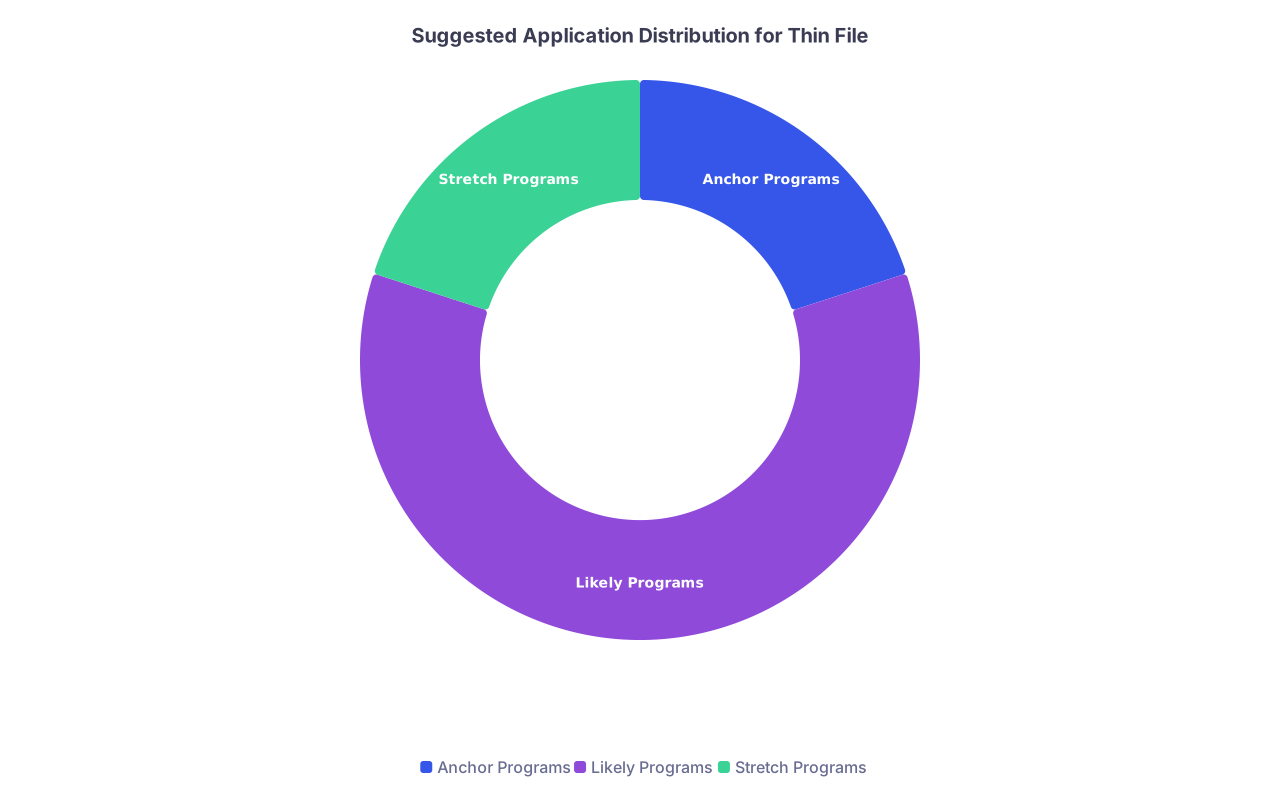
| Category | Value |
|---|---|
| Anchor Programs | 20 |
| Likely Programs | 60 |
| Stretch Programs | 20 |
You will probably end up in the 40–80 program range depending on your risk tolerance and finances, but if your emails, letters, and storytelling are tight, those numbers will actually mean something.
Step 10: Tighten the Logistics So You Do Not Sabotage Yourself
A thin file is vulnerable to stupid errors. You cannot afford those.
Run through this checklist:
- Personal statement:
- No typos.
- Specialty-specific. You are not sending an FM essay to a Psych program.
- CV:
- Entries have clear dates and concise descriptions.
- No obvious padding or invented detail. Programs smell fluff.
- ERAS:
- All scores uploaded.
- All LORs assigned correctly to each program.
- Photo professional, not a selfie, not weirdly cropped.
- Communication:
- Voicemail recorded and professional (no music, no jokes).
- Email signature clean and includes full name and AAMC/ERAS ID.
These sound trivial until a PD tells you, “We moved on because we could not reach them and needed to fill the spot.”
Put It All Together: Your 4–8 Week Rescue Protocol
Here is what a focused last-minute plan can look like on a calendar.
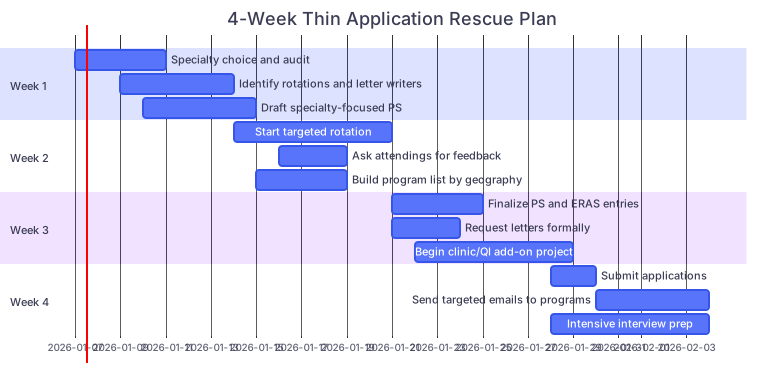
| Task | Details |
|---|---|
| Week 1: Specialty choice and audit | a1, 2026-01-07, 4d |
| Week 1: Identify rotations and letter writers | a2, 2026-01-09, 5d |
| Week 1: Draft specialty-focused PS | a3, 2026-01-10, 5d |
| Week 2: Start targeted rotation | b1, 2026-01-14, 7d |
| Week 2: Ask attendings for feedback | b2, 2026-01-16, 3d |
| Week 2: Build program list by geography | b3, 2026-01-15, 4d |
| Week 3: Finalize PS and ERAS entries | c1, 2026-01-21, 4d |
| Week 3: Request letters formally | c2, 2026-01-21, 3d |
| Week 3: Begin clinic/QI add-on project | c3, 2026-01-22, 7d |
| Week 4: Submit applications | d1, 2026-01-28, 2d |
| Week 4: Send targeted emails to programs | d2, after d1, 5d |
| Week 4: Intensive interview prep | d3, 2026-01-28, 7d |
Adjust dates to your reality, but keep the sequence:
- Decide specialty + audit.
- Lock in rotation + letter strategy.
- Build your story and application.
- Submit.
- Email + interview like your future depends on it. Because it does.
Open your CV right now and circle one attending and one rotation where you can realistically produce a strong, specific letter in the next month. Then send that attending a short, direct email asking to work closely with them on your upcoming days so you can earn that letter.