
You just clicked “Export MyERAS Application” and scrolled through the PDF. It is… fine. Not terrible. But reading it as a PD would, you can see the problem: it is generic enough to fit Internal Medicine, Family, Psych, maybe even PM&R all at once. No clear story. No signal that you actually understand the field you are applying to—especially if it is one of the so‑called "less competitive" specialties.
You are thinking: “It’s a less competitive field. Do I really need to obsess over every section?”
Yes. You do. Because “less competitive” does not mean “they will take anyone with a pulse.”
Here is the reality: in lower-competition specialties (Family Medicine, Psychiatry, Pediatrics, Pathology, PM&R, Neurology, some community Internal Medicine, etc.), your ERAS sections are not about proving you are a genius. They are about proving you are serious, reliable, and a good fit who will actually show up, do the work, and finish the program.
Let me walk you through how to optimize each ERAS section specifically for these fields, with a step-by-step “fix it” approach.
Step 1: Understand What “Least Competitive” Actually Means
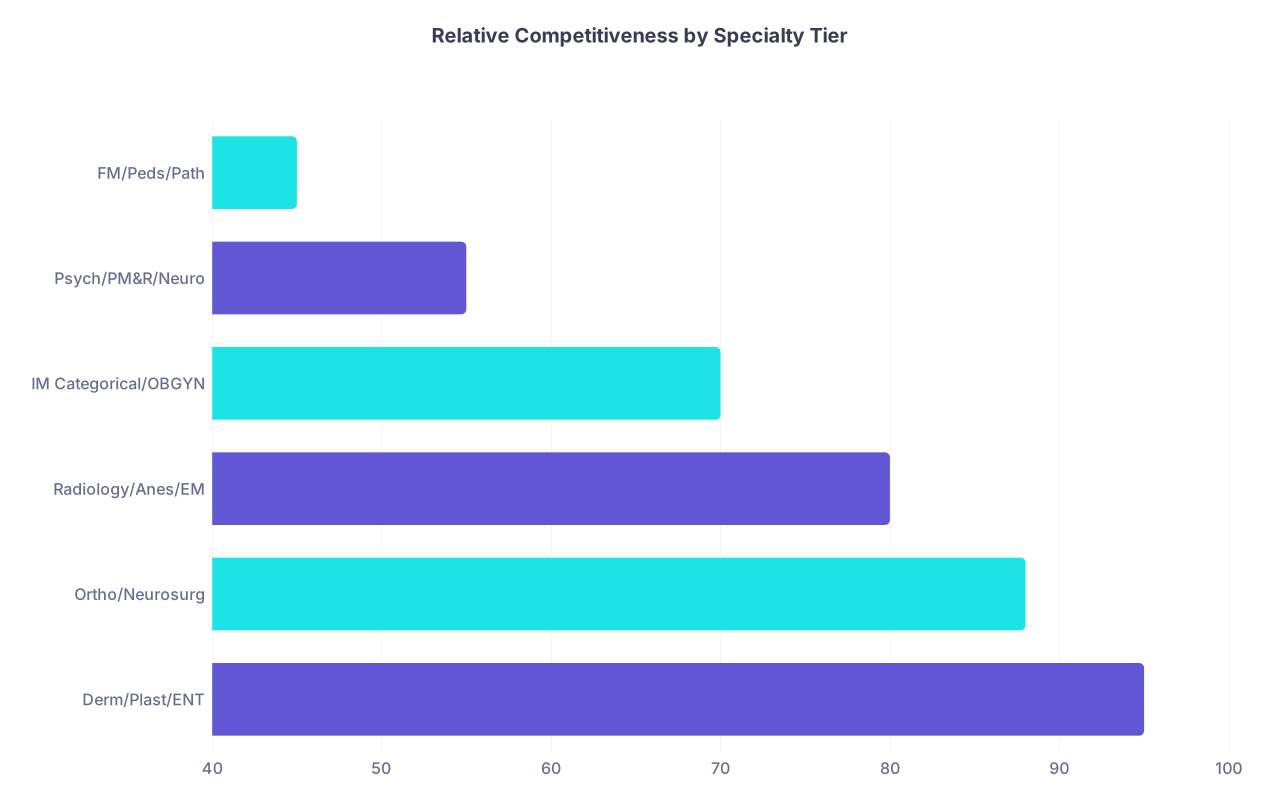
| Category | Value |
|---|---|
| Derm/Plast/ENT | 95 |
| Ortho/Neurosurg | 88 |
| Radiology/Anes/EM | 80 |
| IM Categorical/OBGYN | 70 |
| Psych/PM&R/Neuro | 55 |
| FM/Peds/Path | 45 |
“Least competitive” specialties are not the trash bin of residency. They are simply:
- Less Step-score obsessed.
- More holistic in selection.
- More focused on:
- Communication.
- Reliability.
- Team dynamics.
- Genuine interest in their patient population or workflow.
For ERAS, this changes your strategy:
- Your goal is not to look “impressive.”
- Your goal is to look like:
- Someone who chose the specialty deliberately.
- Someone who will not quit.
- Someone patients and staff can tolerate at 3 a.m.
So every section should scream: “I understand this field and I belong in it.”
Step 2: Core Targeting Move – Make Your Application Monogamous
Needing a backup is fine. Looking like you have not decided is not.
For least competitive fields, PDs are trying to avoid:
- People using them as a backup who will be miserable.
- Residents who will leave after PGY‑1 for anesthesia, radiology, derm, etc.
So first fix:
- Decide what your ERAS application will primarily signal:
- Family Medicine
- Psychiatry
- Pediatrics
- Pathology
- PM&R
- Neurology
- Community-focused Internal Medicine
Then run a quick “specialty coherence audit.”

| Step | Description |
|---|---|
| Step 1 | Pick target specialty |
| Step 2 | Read ERAS PDF start to end |
| Step 3 | Refine language |
| Step 4 | Retarget experiences |
| Step 5 | Edit descriptions and order |
| Step 6 | Does it clearly fit this one field |
If someone reads your ERAS PDF without knowing your specialty, they should be able to guess it from:
- Your experience order.
- Your activity descriptions.
- Your personal statement.
- Your meaningful experiences.
If they cannot, you have work to do. The rest of this article shows you where to fix it.
Step 3: Work & Activities – Rewrite for Fit, Not Flex
This is where most people waste their advantage in less competitive specialties. They list activities like a CV instead of a narrative.
Here is the rule:
Every major experience should either show:
- You understand the typical patient population or workflow of your field, or
- You have the temperament and habits that make residency in that field easier for the program.
A. Reorder Experiences Intentionally
For each specialty, your top 3–5 experiences must match the field.
Examples:
Family Medicine
- Longitudinal clinic work.
- Community outreach / free clinics.
- Primary care electives.
- Chronic disease management projects.
Psychiatry
- Mental health volunteering.
- Crisis line, shelters, addiction centers.
- Research touching on mood disorders, SUD, psychosis.
Pediatrics
- Working with kids: camps, schools, tutoring, pediatric rotations.
- Anything showing patience and communication with parents/families.
Pathology
- Lab-based research.
- Path electives or interest group involvement.
- Detail-oriented roles (QA, data curation).
PM&R
- Rehab units, sports medicine, MSK clinics.
- Work with disability populations.
- Athletic training or physical therapy exposure.
Neurology
- Stroke, neuro ICU, neurology clinics.
- Research on neurodegenerative or demyelinating disease.
- Longitudinal neuro patient follow-up.
If your top entries are random shadowing or a single surgery research project, fix the order. Push field-specific experiences to the top, even if hours are fewer.
B. Rewrite Descriptions With Specialty-Flavored Language
Stop writing:
“I worked with patients in a clinic setting and learned to manage a variety of conditions.”
That means nothing.
Instead, tailor to your field:
Family Medicine example:
Old version:
“Volunteered at a free clinic, taking histories and presenting to attendings.”Optimized:
“Volunteered at a student-run free clinic serving uninsured adults with uncontrolled diabetes, hypertension, and depression. Focused on building continuity by following several patients over multiple visits, reconciling medications, and coordinating referrals with community resources.”
Psychiatry example:
Old:
“Volunteered at a crisis hotline.”Optimized:
“Completed 40 hours of training and 120 hours of overnight shifts at a crisis hotline, using structured risk assessments and de‑escalation strategies for callers with acute suicidal ideation, psychosis, and substance withdrawal.”
Pathology example:
Old:
“Assisted in a research project involving cancer.”Optimized:
“Assisted in a translational pathology project analyzing immunohistochemical patterns in triple-negative breast cancer, double-scoring 200+ slides for inter-rater reliability and managing a database of clinico-pathologic variables.”
You see the pattern:
- Use patient/population details.
- Use field-specific tasks and vocabulary.
- Make it obvious you have seen the real work.
C. Highlight the Right Soft Skills
Programs in less competitive specialties pay close attention to:
- Reliability.
- Communication.
- Adaptability.
- Emotional stability.
So in your bullet points and narratives, emphasize:
- “Consistently covered weekend shifts for understaffed clinics.”
- “Took responsibility for follow-up calls / test results.”
- “Coordinated between multiple disciplines (PT/OT/SW).”
- “Comfortable with high emotional load and difficult conversations.”
Pick 2–3 of these and make sure they appear multiple times in different contexts.
Step 4: The Personal Statement – Stop Sounding Generic
Most personal statements for these fields are terrible. They say:
- “I love working with people.”
- “I value teamwork.”
- “I am passionate about continuity of care.”
Everyone says that. You need to be more specific and more grounded in what the field actually does.
A. One Clear Reason You Belong in that Field
For least competitive specialties, I usually recommend one of these central themes:
- FM: Longitudinal care + community impact.
- Psych: Curiosity about the mind + comfort with ambiguity and long-term processes.
- Peds: Advocacy for vulnerable populations + communication with families.
- Path: Love of pattern recognition + being the “doctor’s doctor” behind the scenes.
- PM&R: Restoring function + team-based care across disciplines.
- Neurology: Fascination with localization + empathetic support for chronic disability.
Pick one primary theme. Not three.
Then build a simple structure:
- Short, specific clinical moment that actually fits your field.
- How that moment connected to your prior experiences.
- How your personality fits the day-to-day of the specialty.
- What you are looking for in a residency program.
B. Remove Red Flags That Scream “Backup Specialty”
Get rid of:
- Long paragraphs about other specialties you “almost chose.”
- Over-explaining why you did not get into a more competitive field.
- Vague “I love all of medicine” with one tacked-on psych example at the end.
If you are applying to a so-called backup field, fine. Just do not confess it. Frame it as:
- You were drawn to X characteristics.
- Your experiences consistently trended in that direction.
- You can see yourself in this work for the long haul.
Step 5: Letters of Recommendation – Use the Field’s Culture
Lower-competition specialties often have tight-knit professional cultures. PDs talk. They recognize names. They understand their own style.
Where possible, you want:
- At least 2 letters from physicians in that specialty.
- At least 1 letter that comments specifically on:
- Reliability.
- Teamwork.
- Communication.
If you must use a non-field letter (like IM or Surgery), brief your letter writer:
- “I am applying to Psychiatry. If you can comment on my ability to build rapport with challenging patients, handle emotionally intense situations, and work well with the team, that would help programs see my fit.”
Do not micromanage, but do orient them.
Step 6: Addressing Weaknesses Strategically (IMGs, Low Scores, Gaps)
Programs in less competitive fields will often accept candidates with:
- Step failures.
- Low scores.
- Non-traditional paths.
- IMG/DO backgrounds.
But they absolutely care how you present those issues. Here is how to handle it.
| Issue | Where to Address | How to Frame |
|---|---|---|
| Step failure | PS or addendum | Brief, accountable, resolved |
| Low scores | Not explicit | Emphasize clinical strength |
| Gap in training | PS | Clear story + productivity |
| Specialty switch | PS + experiences | Coherent, not impulsive |
A. Step Failure or Low Scores
Do:
One clear, short paragraph in PS or a separate explanation field.
Example:
“I failed Step 1 on my first attempt due to poor planning and test anxiety. I completed a structured remediation program, took multiple NBME practice exams, and passed on my second attempt. Since then, I have passed Step 2 on the first attempt and performed strongly on clinical rotations, particularly in Psychiatry and Neurology.”
Do not:
- Blame others.
- Spend half the statement talking about it.
- Leave it completely unaddressed if it is severe (multiple failures).
B. Gaps or Career Changes
If you took time off or changed from surgery/radiology/anesthesia etc., you must control the narrative:
- Own the decision: “I realized I valued long-term patient relationships more than operative interventions.”
- Connect it to your new field’s strengths.
- Show productivity during any gap: research, work, caregiving, something.
Programs in these fields worry less about your scores and more about: “Will this person leave us?”
Step 7: Program Signaling Without Overdoing It
You are not applying to derm. You do not need 12 first-author papers. But you should be selective with where you send your best signals.
For least competitive specialties, strong signals include:
- Doing a home or away rotation there.
- Having a letter from their faculty.
- Mentioning a specific interest that matches their niche:
- FM with strong OB.
- Psych with addiction emphasis.
- Peds with advocacy or hospitalist focus.
- PM&R with spinal cord / TBI focus.
- Path with hematopathology interest.
You do not need a full paragraph on every program. But you can:
- Mention a sub-interest that aligns with what many community programs value: underserved care, primary care, SUD, inpatient psych, general neurology, general peds.
Step 8: Don’t Neglect the “Small” ERAS Sections
These sections are underrated differentiators in less competitive fields, because they show maturity and professionalism.
A. Experiences – Role and Impact
For each major experience, force yourself to answer:
- What exactly did I do that a PD cares about?
- How did this make me a better future resident in this field?
Be explicit:
- “Documented detailed mental status exams and risk assessments on 15–20 patients per shift.”
- “Learned to explain chronic disease management plans in simple language for patients with low health literacy.”
- “Coordinated with lab and pathology to ensure abnormal results were communicated promptly to the care team.”
B. Hobbies and Interests
This matters more than you think, especially in non-malignant, community-focused specialties.
Good hobby entries:
- Specific (not “movies, music, travel”).
- Reflective of stability and teamwork.
Examples:
- “Long-distance running – Completed three half-marathons; I use training as a way to maintain consistency and manage stress.”
- “Board games – Weekly game nights with friends for 5+ years, prefer cooperative games which mirror the collaborative nature of medicine.”
- “Cooking for groups – Frequently host dinners for classmates and use this to bring together people from different backgrounds.”
Programs in FM, Psych, Peds, PM&R especially want to know: are you someone they can sit next to on a long call night without hating it?
C. Volunteer and Leadership
Again, do not list fluff:
- “Attended 3 meetings of a club.”
- “General member of [X] organization.”
Either cut it or rewrite to show continuity and responsibility:
- “Served as treasurer for the Family Medicine Interest Group, managing a $3,000 annual budget and organizing 6 lunchtime talks with community physicians.”
Step 9: Specialty-by-Specialty Micro-Adjustments
Here is where people overcomplicate things. You do not need a different soul for each specialty, but you do need minor tuning.
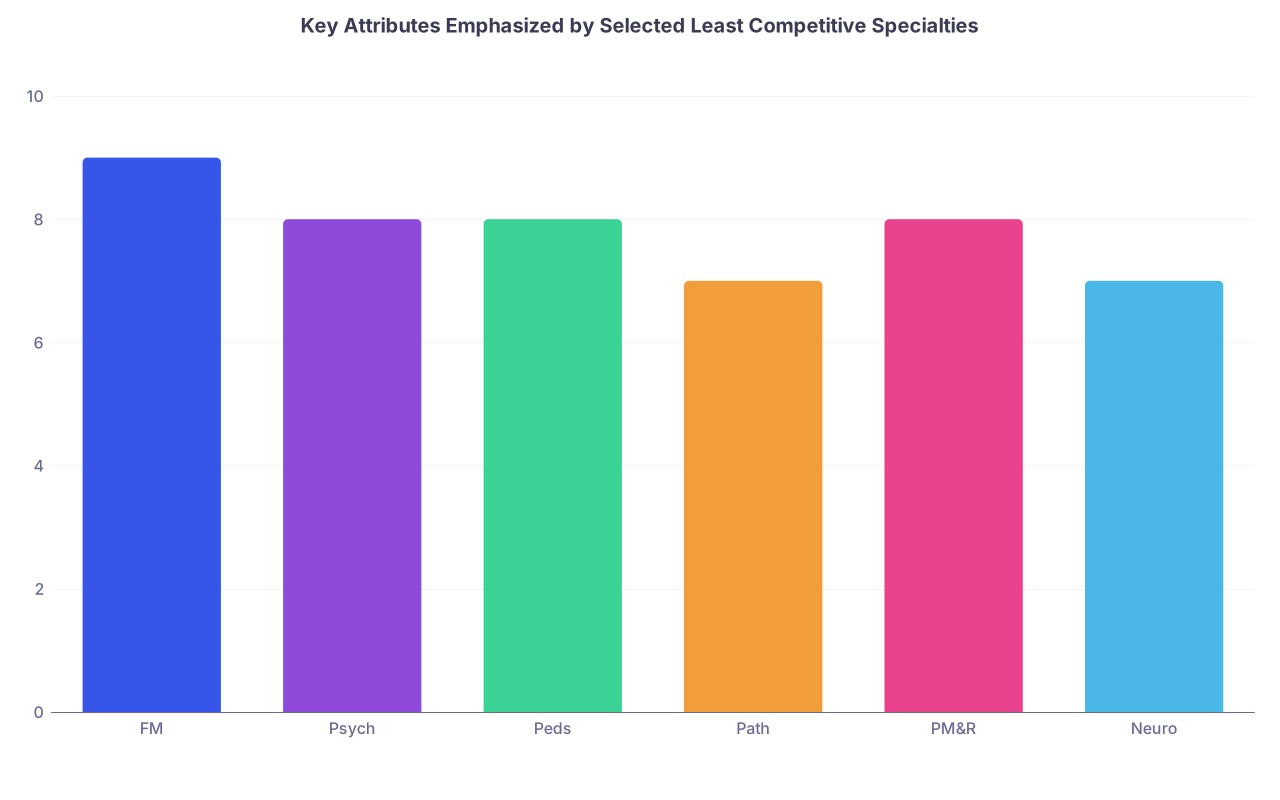
| Category | Value |
|---|---|
| FM | 9 |
| Psych | 8 |
| Peds | 8 |
| Path | 7 |
| PM&R | 8 |
| Neuro | 7 |
Think of attributes on a 0–10 emphasis scale (rough, but useful):
Family Medicine
- Continuity: 10
- Community/underserved: 9
- Breadth/versatility: 8
- ERAS focus:
- Outpatient care, follow-up, chronic disease.
- Hobbies and narrative that show you like real people with real-world problems.
Psychiatry
- Communication: 10
- Emotional resilience: 9
- Curiosity about behavior: 8
- ERAS focus:
- Situations involving de-escalation, listening, complex psychosocial contexts.
- Demonstrate comfort with severe mental illness, not just “I like talking to people.”
Pediatrics
- Advocacy: 9
- Family-centered communication: 9
- Patience: 8
- ERAS focus:
- Examples that show working with children and families.
- Emphasize advocating for vulnerable kids, dealing with anxious parents.
Pathology
- Detail orientation: 10
- Intellectual curiosity: 9
- Independence: 8
- ERAS focus:
- Concrete lab/research detail.
- Quiet leadership, reliability, and comfort working “behind the scenes.”
PM&R
- Team-based care: 10
- Function/rehab mindset: 9
- Long-term patient relationships: 8
- ERAS focus:
- Interdisciplinary work with PT/OT/nursing.
- Patient goals like “getting back to walking,” not just disease names.
Neurology
- Localization thinking: 9
- Chronic disease empathy: 9
- Communication with impaired patients: 8
- ERAS focus:
- Stroke calls, seizure management, neuro exams.
- Coping with uncertainty and slow recovery timelines.
Read your ERAS PDF and ask: if I highlight one color for each of these attributes, which ones dominate? If it does not match the field you chose, you know what to rewrite.
Step 10: Final Pass – Read Like a Program Director
Before you submit, you must stop reading as “the applicant” and start reading as “the PD who has 3 minutes per application.”
Use this quick protocol:

| Step | Description |
|---|---|
| Step 1 | Export ERAS PDF |
| Step 2 | Print or open on tablet |
| Step 3 | Highlight field specific content |
| Step 4 | Rewrite top experiences |
| Step 5 | Check tone and professionalism |
| Step 6 | Have advisor or senior read |
| Step 7 | Submit |
| Step 8 | Clear specialty fit |
- Export the ERAS PDF.
- Take a highlighter (physical or digital) and mark:
- Anything that clearly ties to your specialty.
- Anything that shows reliability/teamwork/communication.
- Count the highlights. Ask:
- Does the pattern clearly say “This person belongs in X”?
- Or could it be any of 4–5 fields?
- Check for:
- Inconsistencies (FM PS with mostly surgery research).
- Typos and unprofessional wording.
- Overly dramatic or self-pitying language around failures.
If possible, have:
- One person in your chosen specialty read it.
- One person outside your field (to see if the signal is obvious).
Your Next Step – Fix One Section Today
Do not try to overhaul everything at once. That is how people procrastinate until October.
Pick one of these and do it today:
- Reorder your top 5 experiences so the most field-relevant are at the top.
- Rewrite 3 activity descriptions to include:
- Specific patient population.
- Concrete tasks.
- A trait that matters in your field.
- Open your personal statement and delete one generic sentence that could apply to any specialty. Replace it with a specific clinical moment from your actual target field.
Open your ERAS PDF right now. Scroll to the Work & Activities section. Pick the single most important experience for your chosen specialty and rewrite that description so clearly that any PD could tell what field you are applying to without ever seeing your specialty name. That one fix will change how the rest of your application reads.