
Low Step scores are not a career death sentence—unless you pretend they are not a problem.
If your Step 1/Step 2 CK is below the typical matched average, you are playing a different game than your classmates. Not worse. Different. And you need a different strategy.
This is where least competitive specialties become your leverage, not your consolation prize.
You are not going to brute-force your way into dermatology with a 215. But you can build a great career, with real autonomy and solid lifestyle, in fields that quietly take care of most of the healthcare workload—while your classmates chase prestige and burnout.
Let me show you, step by step, how to use the less competitive fields strategically instead of stumbling into them in panic in January of your application year.
1. First, Get Real About “Low Step Score” And Competitiveness
You cannot fix what you refuse to quantify.
What “low Step score” actually means
Stop using vibes. Use numbers.
For most current cycles:
- Highly competitive:
- Example: Derm, Ortho, Plastics, ENT, Neurosurgery, Rad Onc
- Successful Step 2 CK often: 250+
- Mid-competitive:
- Example: EM (variable), Gen Surg, Anesthesia, OB/GYN, Radiology
- Successful Step 2 CK often: 240–250
- Less competitive / more forgiving:
- Example: Family Med, Internal Med (community), Psych, Peds, PM&R, Pathology, Neurology
- Successful Step 2 CK can be: low 220s and sometimes below, if other parts of the app are strong
So when I say “low Step score,” I mean:
- Step 2 CK under ~230 if you are targeting moderately competitive fields
- Under ~220 if you are targeting anything labeled “competitive”
- Or any situation where your score is significantly below the typical matched average for that specialty
Your first job: stop comparing yourself to the 260 crowd and start comparing yourself to the actual score distribution of the fields you can realistically target.
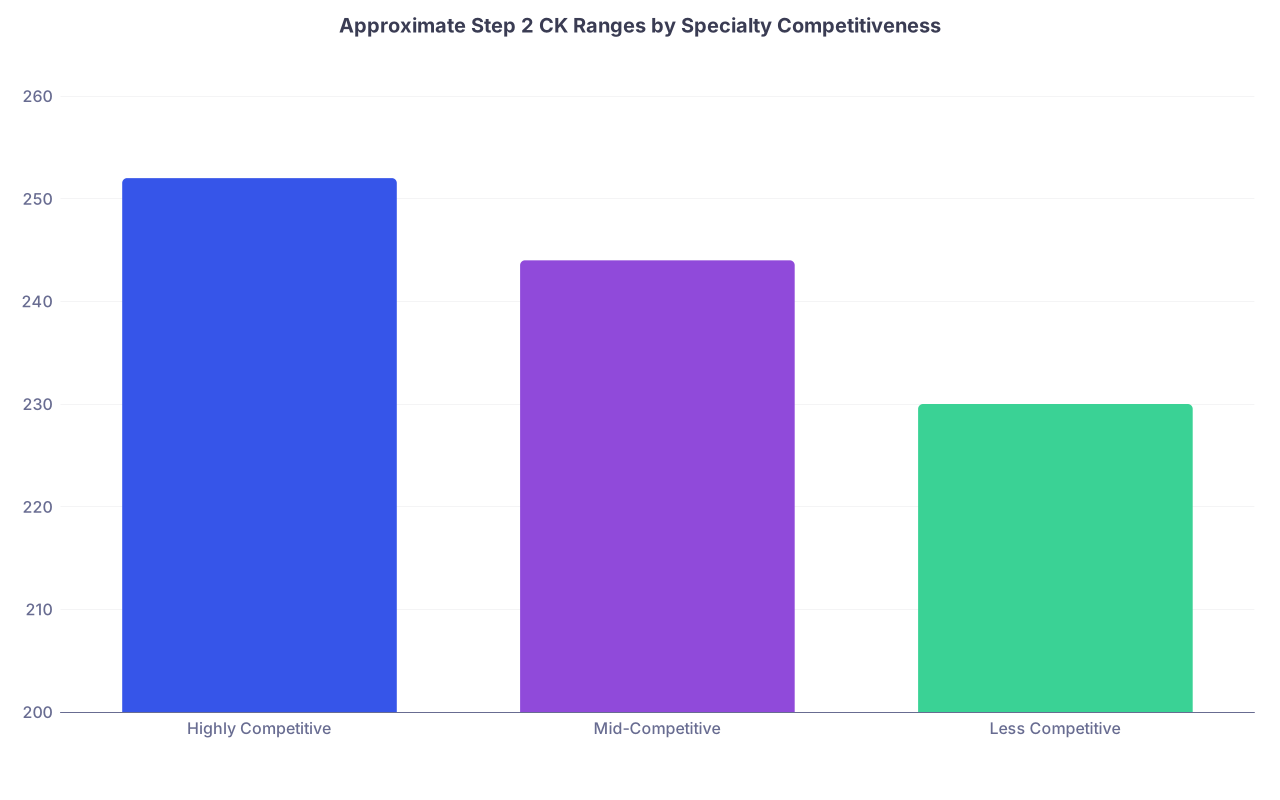
| Category | Value |
|---|---|
| Highly Competitive | 252 |
| Mid-Competitive | 244 |
| Less Competitive | 230 |
Are these exact numbers? No. But they are close enough to highlight the pattern: some specialties can absorb lower scores if you are smart about the rest of your application.
2. The Least Competitive Fields That Still Offer Good Careers
There is a big difference between “less competitive” and “dumping ground.” Some of these “backup” fields are actually terrific careers if you approach them intentionally.
Here are the main buckets you should know.
| Specialty | Typical Setting | Lifestyle | Job Market | Notes |
|---|---|---|---|---|
| Family Med | Outpatient/Primary | Good | Strong | Very flexible career paths |
| Psychiatry | Outpatient/Inpatient | Good | Very strong | Huge demand, telehealth options |
| Pediatrics | Outpatient/Hospital | Moderate | Good | Lower pay but very stable |
| Pathology | Lab/Hospital | Good | Variable | Less patient-facing, academic heavy |
| PM&R | Rehab/Outpatient | Good | Growing | MSK, pain, sports niches |
1. Family Medicine (FM)
Reality check: FM is not “failed Internal Medicine.” It is a very different job.
Upsides:
- Extremely forgiving on scores for many community programs.
- Broad scope: procedures, inpatient, outpatient, sports, women’s health, urgent care, rural ED coverage.
- Job market: excellent. Rural and suburban areas will chase you.
Strategic lever for low scores:
- A 215–225 Step 2 can still match FM if:
- You clearly show commitment (FM rotations, FM LORs, primary care research or QI).
- You are geographically flexible.
- You apply early and broadly.
2. Psychiatry
Psych is quietly one of the best deals in medicine right now.
Upsides:
- Demand is insane. Community psych jobs are everywhere.
- Telepsychiatry, part-time, and flexible schedules are real options.
- Lower burnout than many hospital-based specialties.
Strategic lever:
- Many psych programs care more about:
- No professionalism red flags,
- Genuine interest in mental health,
- Capacity to talk like a human being during interviews.
- A Step 2 in the low 220s can be workable if the rest of your application screams “I belong in psych.”
3. Pediatrics
You will not be rich. You will be needed.
Upsides:
- Scores matter, but not like surgical subspecialties.
- Academic and community slots nationwide.
- Subspecialties (cards, NICU, heme/onc) are more competitive, but general peds is accessible.
Strategic lever:
- Strong clinical evals, good peds rotation comments, and a clear track record with kids go a long way.
- Lower scores are easier to offset with strong letters and consistent pediatric-focused activity.
4. Pathology
Path gets dismissed by students who have never spent more than 2 hours in the lab.
Upsides:
- Minimal patient-facing time. If you love puzzles, histology, and diagnostics, it fits.
- Lifestyle: generally predictable hours outside academic call / frozen sections.
Strategic lever:
- Programs care a lot about:
- Demonstrated interest (electives, research in pathology, knowing what the work actually involves).
- Reliability and attention to detail.
- A lower score is not ideal, but pathology is far less obsessional about Step numbers than procedural fields.
5. Physical Medicine & Rehabilitation (PM&R)
One of the most misunderstood fields.
Upsides:
- Mix of neurology, MSK, rehab, procedures (EMG, injections).
- Strong lifestyle. Often outpatient-heavy.
- Growing demand with aging population and sports injuries.
Strategic lever:
- Mid-tier programs can be friendly to lower scores if:
- You have done rehab rotations.
- You actually know what PM&R does (and can articulate it).
- You have letters from physiatrists.
3. Decide: Pivot Early or Play Chicken With Reality
The worst thing you can do is cling to a super-competitive specialty “just to try” and then switch to a backup in October when interview invites do not come.
You need a decision framework.

| Step | Description |
|---|---|
| Step 1 | Get Step Score |
| Step 2 | Apply dream specialty realistically |
| Step 3 | Research/gap year then re-evaluate |
| Step 4 | Primary in dream + backup least competitive |
| Step 5 | Commit fully to least competitive field |
| Step 6 | Build focused backup application |
| Step 7 | Score near or above target for dream specialty |
| Step 8 | Willing to take 1+ gap years and heavily strengthen CV |
| Step 9 | Willing to dual apply |
Step-by-step decision protocol
- Lookup actual matched stats for your dream specialty.
- Use NRMP Charting Outcomes data, not Reddit rumors.
- Compare your Step 2 to the median matched applicant.
- If you are >10–15 points below for a very competitive field: serious risk zone.
- Decide which of these you are willing to do:
- Take a research year or two.
- Dual apply (dream + least competitive).
- Fully pivot now to a less competitive field.
- Lock in that decision by the start of application season.
- Half-commits get half-results. And often no match.
If you are within ~5 points of the typical matched range and your application is otherwise strong: you can reasonably still aim for your dream. But if you are far below and unwilling to delay graduation or add a research year, you need a real backup—one of the least competitive specialties, done intentionally.
4. How To Build A Dominant Application In A Less Competitive Field
If you choose FM, Psych, Peds, Path, PM&R, etc., stop acting like it is your second choice. Program directors can smell that a mile away.
You will outcompete other low-score applicants by showing focused commitment.
Core elements to prioritize
- Clinical performance > raw Step score
For less competitive fields, your:
- Clerkship grades
- Narrative comments
- Sub-I performance
often carry more weight than the extra 10 Step points you wish you had.
Action steps:
- Schedule a sub-I or acting internship in your chosen specialty at your home institution or a reachable community program.
- Treat it like a month-long interview. Show up early, know the patients cold, ask for feedback by week 1 and correct issues fast.
- Letters of recommendation that say something real
You do not need generic “worked hard, showed up” letters. You need “I would absolutely take this student as a resident” letters.
Protocol:
- Get at least two letters from attendings in your chosen field.
- Give them:
- Your CV
- A short statement of why you are committed to that specialty
- Specific cases or projects you worked on with them (to jog their memory)
- Ask them explicitly if they can write a “strong, supportive letter” for that specialty. If they hesitate, move on.
- Evidence of longitudinal interest
Program directors hate tourists.
Show:
- FM: Free clinic, primary care interest group leadership, QI in chronic disease management.
- Psych: Crisis line volunteer, psych research, addiction clinic work.
- Peds: Tutoring kids, pediatric clinic involvement, camp for children with chronic disease.
- Path: Lab work, pathology interest group, autopsy or tumor board participation.
- PM&R: Rehab center volunteering, wheelchair clinic, sports med or spine rotation.
You are building a narrative: “I am not here because my Step was low. I am here because this field fits me and I have receipts.”
5. Application Tactics: How To Use Least Competitive Fields As True Leverage
Here is where most people mess up. They choose a more forgiving specialty but then apply like they are still in denial.
You need to play the numbers game smarter than your peers.
Strategy 1: Apply broadly and intelligently
- Geographic flexibility is your single biggest weapon.
- If you only apply to coastal big cities, you have learned nothing.
- Aim for:
- 40–60 programs in FM/psych/peds if your score is significantly below average.
- More if you have other red flags (fails, leaves of absence, etc.).
- Community programs.
- Newer programs (less brand name, but often more open-minded).
- States with lower applicant density (Midwest, South, some interior West).
Strategy 2: Polish the parts that actually move the needle in these fields
Program directors in least competitive specialties still care about:
- Red flags: Step failures, professionalism issues, unexplained gaps.
- Communication: Can you talk to human beings without sounding like a robot?
- Reliability: Will you show up and not disappear mid-rotation?
So you:
- Fix your personal statement. One page. Specific about why this field and why your experiences point directly to it.
- Get your CV clean and straightforward. No fluff, no made-up “research” from a one-week project.
- Practice concise, honest interview answers about:
- Your low Step score.
- Why you pivoted to this specialty.
- What you have done to prove this is not a panic decision.
Strategy 3: Own your Step score without groveling
You will likely be asked about your lower score. Here is the structure that works:
- State it once, plainly.
- “My Step 2 score was 221, which is below what I was aiming for.”
- Provide a concise, non-dramatic explanation if there is one.
- “I overloaded that semester with both ICU and research obligations and misjudged my prep time.”
- Emphasize what changed afterward.
- “Since then I improved my test performance on shelf exams by structuring my study with X, Y, Z, and I have performed at or above average on subsequent standardized assessments.”
- Pivot to present value.
- “More importantly, my clinical performance in your specialty reflects how I actually work and think day to day, which is why I prioritized getting strong experiences and letters in [FM/psych/etc.].”
You do not apologize forever. You acknowledge, show growth, and return to what you bring now.
6. “I Still Want A Competitive Specialty” — Using Least Competitive Fields As a Calculated Backup
You can play a two-track game. But you need discipline.
If you are determined to try for something like anesthesia, EM, or a surgical specialty despite a low score, this is how to avoid ending up unmatched.
Dual-application without self-sabotage
Rules:
- Primary identity in your backup field.
- Your personal statement, most letters, and most ERAS choices should look 100% genuine for the less competitive specialty.
- Targeted applications for the more competitive field.
- Maybe 10–20 programs where:
- You have a connection,
- Your school has placed similar applicants before,
- Your mentors realistically think you have a shot.
- Maybe 10–20 programs where:
- One clearly backed-up specialty.
- Not three or four. You do not have the bandwidth to convincingly commit to multiple backups.
Example:
- You love anesthesia but have a 222 Step 2.
- You commit to FM as your leverage field.
- Your ERAS:
- 50 FM programs → tailored PS, FM letters, FM experiences emphasized.
- 10–15 anesthesia programs → separate PS, at least one gas letter, but you accept that this is “reach” territory.
- You emotionally accept that FM is not “failure” but the most likely outcome.
If you match anesthesia, great. If not, you have a stable, high-demand career with FM. That is how you protect yourself.
7. Post-Match Reality: You Got Into A Less Competitive Specialty. Now What?
Here is what nobody tells you: after 6–12 months in residency, almost no one cares what your Step score was or whether your specialty was “prestigious.”
They care whether:
- You can handle your patient panel.
- You are safe.
- You are not awful to work with.
Once you are in:
- Dominate residency.
- Show up early. Read on your patients. Volunteer for procedures or extra learning opportunities.
- Carve out a niche.
- FM: sports medicine, addiction, women’s health, geriatrics.
- Psych: addiction, child, consultation-liaison.
- PM&R: spine, pain, sports, TBI.
- Peds: complex care, behavior, hospitalist work.
- If you still crave a specific niche or acuity level, subspecialize later.
- Many fellowships care more about residency performance and recommendations than your med school Step drama.
I have seen former “disappointed” FM interns become procedure-heavy FM hospitalists pulling in more income and autonomy than their classmates who limped into surgical subs with constant call and no life. Reality has layers.
FAQ (exactly 4 questions)
1. Can I still match a competitive specialty with a low Step score if I apply very broadly?
You might, but you should not bet your entire career on it. Applying to 80–100 programs in a highly competitive field with a significantly below-average score usually results in a few interviews at best, often none. A broad application strategy helps only if you are near the lower end of the competitive range, not far below it. If you are far off, you need either a research/gap year plus serious mentorship or a deliberate pivot to a less competitive specialty as primary or backup.
2. How low is “too low” to even try for a competitive specialty?
If your Step 2 score is 15–20 points below the typical matched average for that field and you have no standout offset (major publications, home program connections, incredible advocacy from big-name mentors), your odds are very poor. At that point, “just trying” without a backup is reckless. You can still send a handful of reach applications if you must, but you should structure your main strategy around a more forgiving field.
3. Will choosing a less competitive specialty now permanently close doors later?
Not necessarily. Once you are a board-certified physician, you have options: fellowships that add procedures or niche expertise, hospitalist tracks, administrative or leadership roles, academic paths, even non-clinical careers. Some fields make crossovers easier than others, but what really matters long term is competence, network, and reliability, not the Step score that pushed you into a less competitive specialty initially.
4. Should I mention my low Step score directly in my personal statement?
Usually no. The personal statement is not the place to re-litigate your score unless there is a very clear context (documented illness, family crisis) and you can connect it to meaningful growth. Programs already see your scores. Use the statement to argue why you fit the specialty and what you bring. Address Step questions briefly and confidently if they arise in interviews or, if needed, in a separate short explanation section, not as the emotional centerpiece of your essay.
Key takeaways:
- A low Step score forces you into a different strategy, not a doomed career.
- Least competitive specialties can be powerful leverage if you commit to them intentionally and build a focused, credible application.
- Protect yourself with realistic decisions now, so you are not explaining an unmatched year later.