
You are three days into your away rotation at a mid-tier community program. Not malignant, not famous, but the kind of “solid” residency where people actually seem… content. You like the residents. The attendings know your name. You could see yourself here.
But you are also painfully aware: you are one of four rotators this month, and another eight are coming before interview season. The PD is polite but hard to read. Nobody has said a word about “we like to recruit our rotators.” And you know your Step scores and home school pedigree are not going to wow any PD on paper.
Here is the reality: in the least competitive specialties and at less competitive programs, away rotations are not magical golden tickets. They are just very efficient auditions. Most students waste them by trying to be “nice” and “hardworking” in a generic way, then hope the program reads their mind.
You are not doing that.
You are going to treat this like what it is: a 4‑week, high-stakes job interview where the bar to stand out is lower than you think, and the cost of being vague or passive is higher than you think.
Let me walk you through exactly how to use an away rotation to turn a “maybe we will interview you” into a “we will rank you to match” at a less competitive program in a least competitive specialty (think FM, IM community, psych at non‑name places, peds at mid-tier, path, etc.).
Step 1: Pick Away Rotations That Can Actually Pay Off
You cannot “lock in” an offer if the program never takes rotators seriously. Some places use students as free labor and nothing more. Others quietly fill half their class with people they met as rotators.
You need to sort these out before you ever show up.
A. Target programs where your profile is at or slightly below their usual
You want to be a “great fit,” not an outlier.
Look at:
- Their recent residents on the website
- Typical Step 2 scores, if listed
- Schools they traditionally recruit from
If you are sitting on a 218 Step 2 and an average school name, you are not trying to impress the University of Top 10 IM at your away. You are aiming for:
- Community IM programs
- Strong but not top‑tier psych or peds
- FM programs that are not the ultra-competitive academic flagships
Your away should be at a place where your scores and background are good enough that, if they like you as a human, they can plausibly justify offering you a spot.
B. Ask directly: “Do you usually rank your rotators?”
Email the coordinator or chief before you apply. Yes, really.
“Do you typically offer interviews or rank positions to away rotators?”
If the answer is:
- “Yes, many of our residents did a rotation here first” → green light
- “Sometimes, depends on performance” → still fine
- “Rotations are educational only; not used in residency selection” → that is a red flag if your main purpose is to secure an offer
If you are spending money and time, choose places where away students actually feed into the match list.
C. Prioritize depth over prestige
In least competitive specialties, fit and presence beat brand.
I would rather see you do:
- 1–2 aways at realistic, mid-tier programs that love rotators
than
- 3–4 aways at “big names” where you are forgettable
Step 2: Show Up Prepared for That Program, Not Just the Specialty
Most rotators arrive clinically rusty and program-ignorant. You are going to look like you already belong there.
A. Learn the program’s culture and workflow ahead of time
You do not need a 30‑page dossier. You do need to stop asking questions that you could have answered yourself.
Before day one:
- Read the program website front to back
- Note:
- Call schedule
- Typical rotations in PGY‑1
- Special clinics or niche services (HIV clinic, addiction psych, NICU continuity, etc.)
- Any “we pride ourselves on…” language
Then, reach out to a current resident (LinkedIn, social media, or via coordinator) and ask:
“I am rotating with you in [month]. Anything I can review or be familiar with to work efficiently with your team?”
You want intel like:
- They pre-round starting at 6:00
- They use Epic order sets heavily
- The PD hates long notes
- They love when students volunteer for admissions
That is gold.
B. Pre-review common problems for that specific service
If this is:
- FM or community IM: uncontrolled diabetes, CHF, COPD, chest pain, basic inpatient pneumonia/UTI, safe discharge
- Psych: initial eval structure, suicide risk assessment, acute agitation management basics, starting SSRIs/antipsychotics safely
- Peds: bronchiolitis, asthma, dehydration, newborn care, vaccine schedule basics
You are not aiming to be brilliant. You are aiming not to be lost.
Targeted prep: 1–2 hours per night for a week before you start.
Step 3: Week 1 – Establish That You Are Safe, Useful, and Easy to Work With
Week 1 is not about being impressive. It is about proving you are not a liability, that you are coachable, and that you make residents’ lives easier. Many PDs will explicitly ask their residents: “Would you want this person on your team for three years?”
You want that answer to be an immediate yes.
A. First impressions: scripts and moves that work
Day 1, to your senior resident:
“I really appreciate the chance to be here. My main goals are to learn and to help the team. How do you like students to work here so I can be most useful?”
Then stop talking and listen.
Common good moves:
- Ask how they want prerounding done (what vitals, labs, where they want summaries written, etc.)
- Offer to:
- Call consults (after coaching)
- Update families
- Pre-chart new admissions
- Draft discharge summaries
You are not above scut. You are auditioning.
B. Build a reputation for reliability in the first 72 hours
This gets you 80% of the way:
- Show up 10–15 minutes before your residents
- Carry a list for every patient, even if not “your” patient
- Never leave a task hanging; if something cannot be done, tell the resident clearly, “I called cardiology; they will see the patient this afternoon. I documented the conversation.”
Most rotators fail on follow‑through. They say “I will do it” and then disappear. If you simply complete everything you say you will do, your residents will trust you. Trusted students get talked up.
C. Do not argue about small feedback
If a resident says, “Shorten your presentations; give me one‑liner, relevant overnight events, assessment, and plan,” then the next patient you present better reflect that exactly.
Least competitive programs care a lot about “teachable and not arrogant.” It is how they avoid malignant interns who cannot be supervised.
Step 4: Weeks 2–3 – Shift from Invisible Workhorse to “Someone We Want Here”
Once you are safe and useful, you need to become memorable. At many less competitive programs, this is where decisions are made: “Are we going to fight to interview and rank this one?”
You are going to do three things: deliberate clinical growth, strategic visibility, and explicit interest.
A. Show visible growth, not random smartness
You are not trying to prove that you read 37 UpToDate articles. You are trying to show that feedback goes somewhere.
Pick 2–3 themes for growth in weeks 2–3:
- Efficiency in presentations
- Ownership of 2–4 patients
- Diagnostic reasoning for common cases (e.g., chest pain, delirium, new psychosis, febrile child)
Then make the growth explicit.
Example:
Week 1, resident says: “Your plans are too nonspecific. You say ‘follow up labs’ without saying what you are looking for.”
Week 2, you say during rounds:
“For Ms. X with sepsis, I want to trend her lactate and creatinine. If lactate is not down by 2 this afternoon or her MAP is under 65 despite fluids, I would discuss starting vasopressors in the ICU.”
Then afterward, say to the senior:
“I am working on being more specific with my plans like you suggested last week. If you see other ways to improve, I would appreciate it.”
That is catnip for residents and attendings.
B. Ask attendings for targeted micro‑teaching, not vague mentorship
Middle of week 2, pull aside an attending you click with:
“Dr. X, I am very interested in [specialty] and particularly programs like this one. If you notice anything that would make me a stronger intern in this setting, I would appreciate specific feedback.”
You just did three things:
- Signaled interest in their program type
- Signaled humility and maturity
- Invited them to start mentally evaluating you as “future resident,” not just “student passing through”
These are the people PDs go to for input later.
C. Increase strategic visibility without being a spotlight hog
You want the PD and core faculty to know your name in a good way. Ways to do that that do not make your co‑students hate you:
- Volunteer for one short, focused case presentation at morning report or noon conference
- 5–7 minutes, one clinical question, clear answer
- If there is a QI project or audit residents are doing, offer to help with chart review or data collection
- Attend optional resident events you are invited to—journal club, simulation, etc.—and engage like a junior resident, not a tourist
Programs remember the student who showed up at 7 a.m. morning report, contributed one or two thoughtful comments, then quietly went back to work.
Step 5: Make Your Interest Explicit (Without Sounding Desperate)
You cannot “hint” your way into a rank list. Less competitive programs especially are trying to avoid getting burned by applicants who treat them as throwaways. You solve that by being professionally direct.
A. The mid‑rotation check‑in
Around the end of week 2 or start of week 3, set up 10–15 minutes with:
- The PD (if feasible)
- Or the APD/associate PD
- Or the core faculty member who seems to run things
Your script (adapted to you, but keep the structure):
“Thank you for having me here this month. I have really enjoyed working with the residents and seeing how your program functions. I am planning to apply to [specialty] this cycle, and I am very interested in training at a program like this one.
I would like to ask for any specific feedback on how I am doing and what I could do in the remaining time here to be a stronger applicant for your program.”
Then stop. Let them talk.
What this does:
- Puts your interest on record
- Signals maturity and self-improvement mindset
- Gives them a chance to say, “We like you; keep it up,” or, occasionally, “Here is a concern” (which you can then fix)
B. End‑of‑rotation closing loop
Last week—ideally last 2–3 days—you need a clean close with the PD or key faculty. This is where many students chicken out.
You say something like:
“Dr. Y, thanks again for the opportunity to rotate here. This month confirmed that your program is exactly the type of place where I would like to train—strong clinical volume, supportive culture, and residents who clearly get good teaching.
I will be applying this season and ranking programs where I can have this kind of environment very highly. If you feel I would be a good fit here, I would be very excited to come back as a resident.”
That is as clear as you can make it without begging. You also give them language they can repeat in selection meetings: “They said this is exactly the kind of place they want.”
Step 6: Understand How You Are Being Scored Informally
Away rotators are rarely judged by one person. You are being “scored”—usually informally—by:
- Residents on your team
- Attendings you worked with
- PD/APD from brief interactions
At less competitive programs, residents’ opinions often carry a lot of weight.
A. What residents actually care about
They are asking themselves:
- Will this person:
- Show up on time?
- Do their share of overnight and weekend work without drama?
- Be safe with orders and calls?
- Be teachable?
- Not be a jerk at 2 a.m. when everything is on fire?
They notice things like:
- Do you offer to stay a bit late if the team is swamped?
- Do you complain constantly about hours or “non‑academic work”?
- Do you help other students or throw them under the bus?
You want residents saying in meetings: “They worked like an intern already. I would be happy to take call with them.”
B. What attendings and PDs care about
Less competitive programs are not chasing national research fame. Their priority is service + safety + a decent team dynamic.
They are asking:
- Is this student:
- Safe? (no wild plans, knows when to ask for help)
- Professional? (on time, respectful, stable mood)
- A good colleague? (supports the team, no drama)
- Likely to stick around and not leave for a “better” program?
Research rarely moves the needle here. A strong, specific letter from a core faculty member who says, “I would be comfortable with this student as a PGY‑1 on my service” matters far more.
Step 7: Secure the Letter That Actually Moves Your Application
You are not just aiming for a generic LOR. You want a letter that says, effectively, “We would take this person.”
A. Ask the right person, the right way, at the right time
Right person:
- Someone who:
- Saw you work on multiple days
- Supervised you directly
- Is tied into residency decision-making (PD, APD, core faculty, big-name clinician in a small program)
Right time:
- Last week of the rotation, after you have already had feedback conversations and explicitly expressed interest in the program
Right way:
“Dr. Z, I have really appreciated your teaching this month and the chance to work closely with you. I am applying to [specialty] this year and would be very interested in training at programs like this one.
If you feel you can write me a strong letter of recommendation based on my performance here, I would be grateful.”
If they hesitate or say something vague like, “I can write you a letter,” without the word “strong,” that is a soft no. Accept it. Do not chase a lukewarm letter.
B. Make their job easy and shape the narrative
Once they agree, send:
- Your CV
- Your Step scores
- Draft personal statement (even if not final)
- A short bullet list:
- 3–5 specific patients or moments where you think you did well
- Your interest in their type of program (community, underserved, etc.)
You are not writing the letter for them. You are reminding them of real cases that support strong statements like:
- “Handled complex family meeting with maturity”
- “Accepted feedback and improved dramatically”
- “Worked at the level of an intern by the end of the rotation”
Step 8: Post-Rotation—Convert “We Liked You” into an Actual Rank
Too many students finish the away, vanish, and hope the program remembers them when they skim 1,000 applications.
You are going to stay on their radar—professionally, not annoyingly.
A. Send a short, targeted thank-you email
Within 3–5 days of finishing:
To PD/APD or key faculty:
Subject: Thank you for the opportunity to rotate with [Program Name]
Dear Dr. [Name],
Thank you again for the opportunity to rotate with your [specialty] service this month. I appreciated the chance to work with your residents and to see firsthand how your program cares for [describe something specific—underserved patients, complex pathology, tight-knit resident culture].
The experience confirmed my strong interest in training in an environment like [Program Name]. I will be applying to [specialty] this cycle and would be very excited to be considered for an interview.
Sincerely,
[Your Name, Med School Year, Contact Info]
Short. Concrete. Clear interest.
B. Stay connected, but sparingly
If you do a small QI project or presentation during the rotation:
- Follow up later with results or a slide deck
- Let them know briefly if it turned into a poster or abstract
If they invited you to a journal club mailing list or similar, engage once or twice if it is natural. You are reinforcing the narrative: “I am already part of your culture.”
C. Use the away intelligently in your application materials
In your personal statement or geographic preference section (if available):
- Mention specific aspects of that program type you value
- Reference concrete experiences from the away that shaped what you want in a residency
Programs like to see that their strengths match your stated preferences, not that you are mass-mailing generic appreciation.
Step 9: Common Ways Students Sabotage Themselves—and How to Avoid Them
You can do almost everything right and still undercut yourself with a few predictable mistakes. I have watched this play out.
Here is a quick list of avoidable self-sabotage behaviors and what to do instead.
| High-Risk Behavior | Better Alternative |
|---|---|
| Complaining about hours or scut | Ask: “How can I help the team run more smoothly?” |
| Flexing obscure knowledge in rounds | Ask focused questions and show applied, not random, knowledge |
| Disappearing after 3 p.m. when work remains | Offer to help with one more task before leaving |
| Trash-talking other programs or your home institution | Keep comparisons neutral and professional |
| Competing aggressively with co-rotators | Collaborate and make others look good too |
If you recognize yourself in any of the left-hand column, fix it now. Less competitive programs are even more sensitive to team culture. They cannot hide problem residents behind huge class sizes or endless fellows.
Step 10: Reality Check – You Are Not Owed an Offer, but You Can Force the Conversation
One more hard truth. Even if you do all of this perfectly:
- Some programs will not have spots in your year
- Some PDs will be locked in on their own pipeline students
- Sometimes you will be their second or third choice, and they will match their first
Your goal with an away rotation is not “guarantee” an offer. Your goal is to:
- Move yourself from “random ERAS file” to “known quantity”
- Make it easy for them to:
- Offer you an interview
- Defend ranking you to match in meetings
The bar to move that needle is lower at less competitive programs, but only if you stop acting like a tourist and start acting like a future colleague.
Here is what success usually looks like:
- You get an early interview invite from your away program
- When you show up, everyone already knows you
- Interview day is 80% catching up and 20% formal questions
- Someone explicitly says, “We liked having you here; we hope you come back”
If you hear that phrase, they are not just being nice. They are telegraphing that, barring disasters, you are in the serious-rank conversation.
A Visual Snapshot: Where Your Effort Should Go Each Week
To make this concrete, think of your rotation in four phases and what matters most in each.
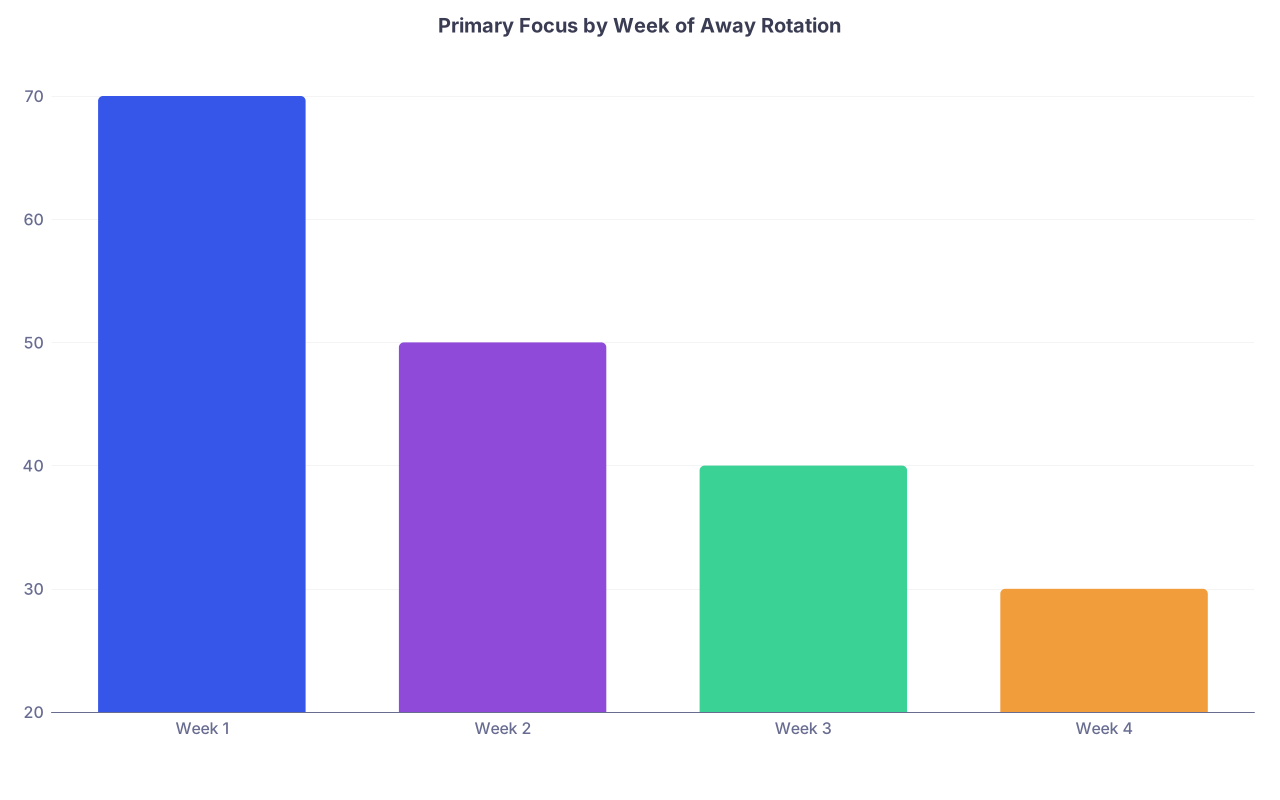
| Category | Value |
|---|---|
| Week 1 | 70 |
| Week 2 | 50 |
| Week 3 | 40 |
| Week 4 | 30 |
(Here, “values” represent the relative focus on proving reliability and safety; as that decreases, your relative focus on visibility, feedback, and closing the loop increases.)
A Simple Flow for Your Away Rotation Strategy
To tie it all together, here is the away rotation as a process. Follow this and you will not wander.

| Step | Description |
|---|---|
| Step 1 | Pre-rotation research |
| Step 2 | Select realistic programs |
| Step 3 | Prepare clinically for common cases |
| Step 4 | Week 1 - Prove safe and reliable |
| Step 5 | Weeks 2-3 - Show growth and interest |
| Step 6 | Mid-rotation feedback meeting |
| Step 7 | Week 4 - Close loop with PD |
| Step 8 | Request strong LOR |
| Step 9 | Post-rotation thank-you email |
| Step 10 | Apply and signal interest |
What You Should Do Today
You do not need to fix everything at once. Start with one concrete action.
Today, do this:
- Open a blank document and list 5–7 programs where:
- Your stats are at or slightly below their usual residents
- The location is somewhere you would actually live
- The culture (from their website and reviews) sounds like your people
Then, for each program, write one email template to the coordinator asking two direct questions:
- “Do you typically interview or rank away rotators from your program?”
- “Approximately what proportion of your current residents rotated with you as students?”
Send those emails.
That single step will filter out dead-end rotations and focus your time on places where a well-executed month can realistically turn into an interview and a rank that matches.
Once you have that list, you can build everything else on top: your prep, your scripts, your mid-rotation meeting plan. But it starts with choosing auditions that are actually winnable.