
Nobody tells you this: in the least competitive specialties, the ranking process is often messier, more personal, and less “holistic” than in the ultra-competitive ones.
In derm or ortho, programs have rigid screens, formal scoring rubrics, and multiple safety checks. In family medicine in a midwestern community program or neurology at a smaller institution? The PD and two attendings can reshuffle your fate over a 10‑minute hallway conversation.
I’ve sat in those rooms. I’ve watched a PD bump someone 20 spots up a rank list because “she seems like she’ll actually stay here and not leave in two years.” I’ve seen another applicant basically doomed because a nurse said, “that student was kind of rude during pre-rounds.”
Let me walk you through how it actually works in the so-called “least competitive” specialties: family med, psych (at many places), peds, IM at lower-tier/community programs, pathology, PM&R in some regions, neurology, etc.
The Myth of “Least Competitive”: What PDs Actually Think
First correction: PDs in these specialties hate hearing their field called “non-competitive.”
They know the reputation. They also know they’re getting applicants who:
- Didn’t get interviews in their first-choice “prestige” specialty
- Are using them as a backup
- Or are genuinely dedicated but look weaker on paper
Behind closed doors, the conversation isn’t: “Who’s the smartest?”
It’s: “Who will thrive here, not quit, not scare patients, and not make my life hell?”
At a mid-sized community family medicine program I know, the PD starts the first rank meeting like this every year:
“Board pass, low maintenance, decent human. That’s our bar. Above that is gravy.”
In less competitive specialties, especially at non-name-brand programs, three core anxieties drive ranking:
- Will this person pass boards on the first try?
- Will this person be safe to let near patients without constant supervision?
- Will this person fit here and actually stay?
Everything else is secondary. Including the shiny stuff you keep obsessing over.
How The Shortlist Is Really Built
In “easier” specialties, the initial filter is less about perfection and more about eliminating risk.
Here’s the rough pathway many programs—especially community ones—are actually using, even if they pretend it’s more formal.

| Step | Description |
|---|---|
| Step 1 | All ERAS Applications |
| Step 2 | Auto screen out |
| Step 3 | Flag by PD or Chief |
| Step 4 | Keep, note concern |
| Step 5 | Shortlist for Interview |
| Step 6 | Meets Basic Filters |
| Step 7 | Red Flags? |
“Meets Basic Filters” in these specialties is not Step 260 and AOA. It’s a much more pragmatic baseline.
| Filter Type | Common Thresholds (Unofficial) |
|---|---|
| Exams | Step 1 pass, Step 2 ≥ 215–225 |
| Attempts | No more than 1–2 failures |
| Time from Grad | ≤ 3–5 years for most programs |
| Visa | Only if program can sponsor |
| Transcript | No repeated failures, few remediations |
At a mid-tier peds program, I watched the coordinator run a simple query: “US grads, Step 2 ≥ 220, Step 1 pass, grad within 3 years.” Two hundred applications dropped to 90 in seconds. That was the real “competition” line.
Then came the PD’s shortlist: anything with “family responsibilities in this region,” “rural background,” “FM interest since M1,” got a manual bump up for interviews because those people are more likely to stay and be happy.
If you’re applying to a so-called less competitive field, understand this:
You’re not fighting 1,000 people. You’re fighting the 100 who survived that first crude filter and don’t trigger immediate anxiety.
The Real Criteria: What Moves You Up or Down the Rank List
Here’s the dirty secret: by interview season in least competitive specialties, most candidates look “fine” on paper. No one has time to microscopically split hairs over who had 200 volunteer hours vs 400.
So behind closed doors, ranking often centers on four things.
1. Board Exam Security: Quiet but Non-Negotiable
No PD will say this to your face. Behind the door, they absolutely do.
Board pass rate is tied to accreditation. Lose that and the program is in real trouble. So any perceived risk to that metric gets disproportionate weight.
The conversation in the room sounds like:
- “He has a Step 1 fail but a 238 on Step 2—he’s probably fine but I want him mid-list, not top 5.”
- “Two Step failures and still barely passed… I like her but I am not putting our board stats on the line.”
- “IMG with 250+? Great, that’s a stabilizer at the top of the list.”
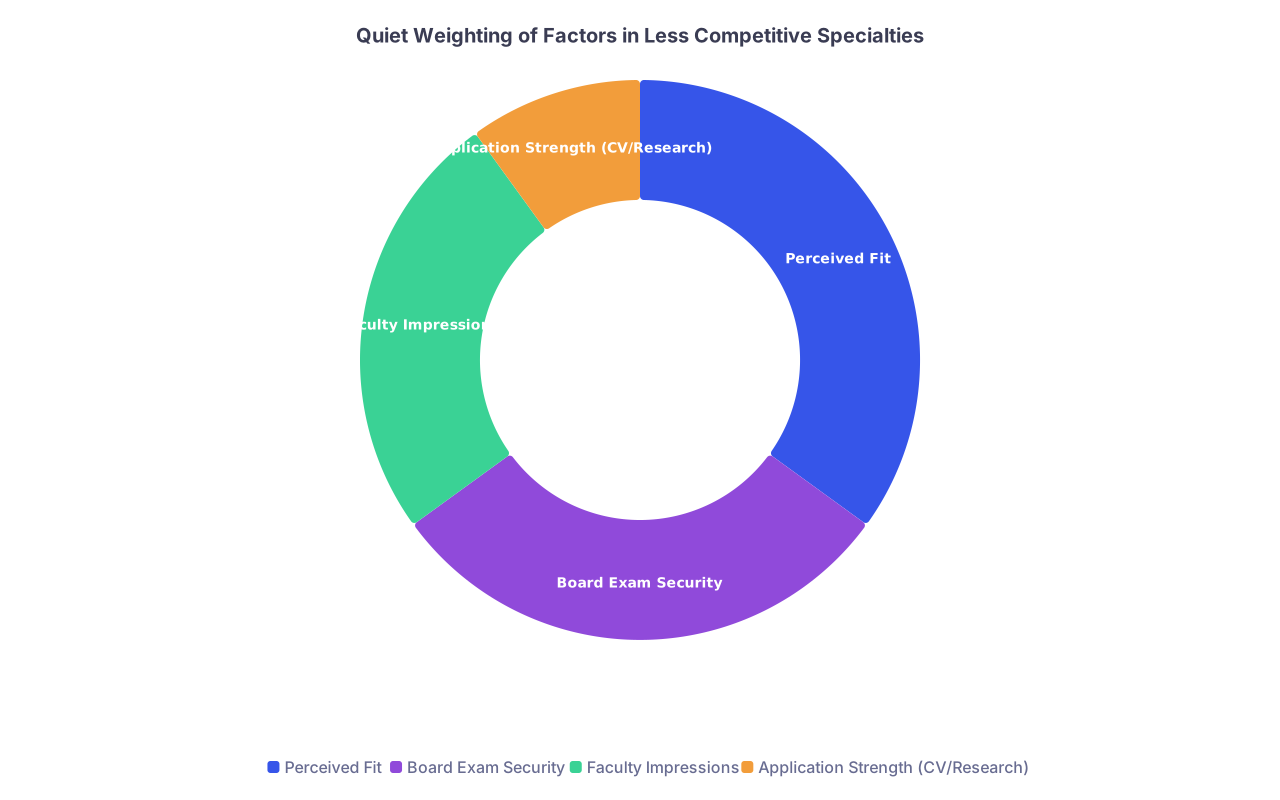
| Category | Value |
|---|---|
| Perceived Fit | 35 |
| Board Exam Security | 30 |
| Faculty Impressions | 25 |
| Application Strength (CV/Research) | 10 |
Notice what’s not on that list: research productivity. Prestige of med school. Fancy publications. In FM, peds, psych, path at many places, that stuff’s icing, not the cake.
If your scores are borderline, how do you counteract that? You:
- Show an upward trajectory (Step 1 marginal, Step 2 solid)
- Get strong letters that explicitly say: “This student is diligent, prepared, and I have no doubt will pass boards on first attempt.”
That exact phrase has come up in multiple meetings I was in. It calms PDs.
2. “Are They Normal?” – The Psychological Gut Check
You won’t see this in any NRMP data chart. But behind closed doors, a shocking amount of the discussion is one question:
“Can I sit next to this person at 6 a.m. for three years without wanting to jump out of a window?”
Especially in smaller or less prestigious programs, where they don’t have 10 residents per class. One toxic person wrecks the vibe.
Comments I’ve literally written in deliberation spreadsheets:
- “Socially odd but kind; will probably be fine.”
- “Talked over other applicants on tour—hard no.”
- “Quiet but engaged. Residents liked her.”
- “Seemed disinterested in our location. Likely to leave.”
You think the 10‑minute “meet and greet” with residents doesn’t matter? That’s where half the real data comes from. Residents walk into the PD’s office after the pre-interview dinner and say, “These three were cool. That one was weirdly arrogant.” That “weirdly arrogant” sticks.
3. Local Ties and Likelihood to Stay
In the glamorous specialties, people chase prestige and fellowships. In the less competitive ones, programs care more about retention.
At a community IM program in the South, the PD had a simple statement:
“If I think they’ll leave the state after residency, they’re not in my top 5, no matter how smart.”
So any hint you might stick around is rocket fuel:
- Grew up in the region
- Partner/family already there
- Mentioned wanting to practice primary care in that area
- Rotated there and openly said, “I could see myself here long-term”
On the flip side, I’ve seen people sink with lines like:
- “I definitely want to do a competitive fellowship somewhere bigger.”
- “I’m only here because my partner is applying to [prestigious specialty] in this city.”
PD interpretation: “Flight risk. Good backup, not top rank.”
4. Letters from People They Actually Trust
In least competitive specialties, the identity of your letter writer matters more than their h‑index.
A tepid letter from a famous researcher? Worth less than a glowing, specific letter from the local FM clerkship director who the PD has known for 10 years.
Behind closed doors, PDs say things like:
- “Oh, that’s one of Dr. X’s students. If he says they’re good, I believe it.”
- “This letter is generic. No real enthusiasm. Pass.”
- “She wrote, ‘Top 10% I’ve worked with in 15 years’—that’s huge.”
You do not need a Nobel laureate. You need someone who:
- Knows you well, and
- Uses superlatives with concrete examples.
What Actually Happens in the Rank Meeting
Let’s pull back the curtain.
Picture a conference room. PD, a couple of core faculty, maybe the coordinator, sometimes chief residents. Laptops open with a spreadsheet of all interviewees. Color-coded columns: scores, school, notes, resident feedback.
Here’s how it really unfolds in a low-to-moderate competition specialty.
Step 1: The Obvious Top Tier
They start with the easy ones: the people everyone liked.
Comments sound like:
- “She’s clearly our #1. High Step 2, great letters, residents loved her, wants primary care here. Anyone disagree?”
- “He’s the IMG with a 250 and crazy work ethic. He stays top 3.”
No one argues. Those names get locked into the top 5–10 spots.
Step 2: The Automatic Drop-Downs
Next, they quietly move down the people with clear issues:
- Odd behavior on interview day
- Big professionalism concerns from away rotations
- Borderline scores plus weak letters
You won’t hear a dramatic speech. Just:
“I don’t feel comfortable putting him above mid-list.”
“Let’s keep her, but not rank too high. If she matches, fine. If not, also fine.”
This is how people with “good” interviews still end up mysteriously low. One faculty member’s discomfort is often enough.
Step 3: The Giant Middle – Where Most of You Live
This is where it gets unstructured and human.
They’ll scroll down the list, and the conversation becomes:
- “I remember him. Quiet, nice. 225 Step 2. No concerns.”
- “She was enthusiastic, asked good questions, borderline Step but strong clerkship comments.”
- “Residents said he was on his phone a lot at the social. I’m a little wary.”
Then you see arbitrary tiebreakers:
- “She rotated here – bump her up.”
- “He’s from this state – bump him slightly.”
- “She wants psych regardless of location – reliable. Up a bit.”
By the end, that mushy middle has a shape. But don’t kid yourself: there’s noise and subjectivity all over it.
Where Applicants Miscalculate in Less Competitive Fields
Let me be blunt: applicants aiming for these specialties often misplay the game because they assume “less competitive = less strategic.”
Wrong.
Here are the most common mistakes I’ve watched:
Thinking scores don’t matter at all
They do. You don’t need 260, but you absolutely can get quietly down-ranked for weak Step 2 or multiple fails, even if everyone likes you.Underestimating the importance of away rotations at their level
In big-name surgical specialties, aways are high-stakes audition.
In these fields, they’re sometimes the single most powerful thing you can do. Especially at community programs. Show up, work hard, be normal, and PDs will say in the room: “We know what we’re getting with her.”Being too honest about using the specialty as a backup
Yes, they know it happens. No, they do not want to hear or sense it. You don’t have to lie, but you do need to articulate a coherent, believable reason you actually like the field.Treating residents like background noise
The PD may not care which lab you worked in. But when three residents say “we’d love to have her,” you shoot up the list.
At one FM program, the PD literally had a “resident favorite” column. If you were marked there, you rarely fell below mid-list.
Strategy: How To Make PDs Comfortable Ranking You High
Let’s flip this. If you’re targeting these specialties, here’s how you position yourself so that, in that closed-door meeting, your name lands in the “easy yes” pile.
Look Like a Safe Bet, Not a Gamble
If your boards are average, your job is not to convince them you’re a secret genius. Your job is to scream reliability.
That shows up as:
- No pattern of professionalism issues
- Consistent comments about being prepared, kind, team-oriented
- Strong Step 2, especially if Step 1 was marginal
- Letters that say “dependable” and “mature” repeatedly
The PD doesn’t need a superstar. They need someone they can trust to cover nights without chaos.
Build One or Two Deep Relationships, Not Ten Superficial Ones
Especially for FM, peds, psych, path, PM&R, smaller IM programs—being the favorite student of one or two respected faculty members is gold.
That gives you:
- A letter with real, specific anecdotes
- Someone who may call or email the PD on your behalf
- A person who can say in rank meetings: “I know this applicant personally. Take them.”
I’ve seen that last line move people 15–20 spots up.
Signal You Might Actually Stay
If you have any legitimate tie to the region or the type of practice, make it explicit:
- “My partner’s family is from this city.”
- “I grew up in a rural area and want to return to that environment.”
- “I want to practice community-based primary care, not academics.”
Programs in less competitive specialties are tired of being everyone’s “backup” or “stepping stone.” If you sound like someone who will be glad, not resentful, to match there, your stock rises.
Special Note on IMGs and Non-Traditional Applicants
In lower-competition specialties, IMGs and non-trads can do very well—if they understand PD psychology.
PDs worry about two things with you:
- Will you pass boards easily?
- Will you adapt to the system and not create drama?
IMG with 245 on Step 2, glowing letters from US rotations, and a calm, humble demeanor? You’re not “backup.” You’re program-saver.
Non-trad with a previous career, strong life stability, and a clear story about why this specialty fits? You seem less likely to burn out or quit. PDs like that.
Where you get burned is:
- Vague reasons for changing careers
- Defensive attitude about prior failures or gaps
- Inconsistent exam performance with no clear improvement story
FAQ (Exactly 4 Questions)
1. If a specialty is “least competitive,” do my scores still matter for ranking?
Yes. You don’t need superstar scores, but you absolutely can be quietly pushed down the list for low Step 2 or repeated failures. Programs in these fields care a lot about board pass rates. A Step 2 in the low 220s with no fails and strong clinical comments is usually fine. Multiple fails or very low scores, even in a less competitive specialty, make PDs nervous and they’ll hedge by ranking you lower.
2. How much do away rotations really help in these specialties?
At many community and mid-tier programs, away rotations are one of the strongest signals you can send. If you show up, work hard, are easy to work with, and seem genuinely interested, PDs will say in rank meetings, “We know exactly what we’re getting with this one.” That familiarity often trumps minor score differences and can bump you significantly up the rank list.
3. Do programs actually care if I plan to stay in the area after residency?
A lot of them do, especially in family medicine, peds, psych, and community IM. In those rank meetings, comments like “She has family here” or “He wants to practice primary care in this state” are taken as strong positives. It’s not that they won’t rank you if you want to leave, but it can be a real boost if they believe you’re likely to stay and become part of the local workforce.
4. If my application is average, what’s the single most impactful thing I can do?
Create at least one champion. That means impressing a clerkship director, rotation attending, or faculty member enough that their letter is not just positive, but specific and enthusiastic—ideally from someone the PD knows or respects. In smaller or less competitive specialties, one trusted voice saying “I would take this person without hesitation” has more impact than polishing another line on your CV.
With this picture of what really happens in those cramped conference rooms, you’re no longer flying blind. You know what PDs are afraid of, what they actually value, and how much of this process runs on human judgment rather than perfect rubrics. Your next move is aligning your story, your rotations, and your interview behavior with that reality. Then, when your name comes up behind closed doors, you’re the easy “yes” near the top of the list—not the shrug in the middle. The interview trail itself? That’s its own game. We’ll get to that another day.