
It’s late January. You’re staring at your email, refreshing way too often, counting your total number of interviews for a “non-competitive” specialty that everyone told you was a safety net.
You’ve got 5 interviews. Maybe 7. Not 15. Not 20. Suddenly “least competitive” does not feel safe at all.
And in the back of your mind, one question keeps chewing at you: what actually happens in that room when they build the rank list… especially at the lower-tier, smaller, “we’ll-take-who-we-can-get” programs everyone talks about?
Let me tell you what really happens.
Because those programs? The ones students on Reddit dismiss as backups? They are often the most human, most chaotic, and, frankly, most political rooms in the entire Match ecosystem.
And if you understand how those rooms work, you can absolutely game your way higher on their list.
First, the lie: “Least competitive” = “They’ll take anyone”
They don’t.
Here’s the dirty little secret: the least competitive specialties and least competitive programs do not select by the same rules as the big-name, high-visibility programs. They filter differently and they care about different things.
Think family medicine at a small community hospital, categorical internal medicine at a middling program, psych or peds at a D-list institution, prelim/TY slots in places nobody can find on a map. Programs that struggle every year to fill. These are the “least competitive” in match data terms.
What that actually means in the room is this:
They’re terrified of getting burned.
Burned = taking someone who quits, can’t pass the boards, can’t function on call, or creates such a nightmare that the program director is answering emails every night at 11 p.m. for three years.
So while prestige programs are chasing “shiny” (high scores, research, name-brand schools), low-competitiveness programs are doing an almost opposite calculation:
“Who will definitely show up? Who will stay? Who can survive our system with minimal drama?”
You’re not competing to be the smartest. You’re competing to be the lowest-risk.
What the room actually looks like at a low-competitiveness program
Strip away the mythology. Here’s the real scene at many smaller, non-elite, or struggling programs.
There’s no war-room with live dashboards and scoring algorithms.
It’s usually something like:
- A program director (who’s also covering clinic or in the ICU between meetings)
- 1–3 core faculty
- One chief resident or senior resident
- A coordinator who knows more about each of you than any of them admit
They’ve all just survived interview season on top of full workloads. They’re tired. They remember maybe five of you clearly. The rest are blurry faces with one or two sticky details.
Someone prints out a list of all interviewed applicants. Sometimes with “scores” from faculty. Sometimes not. There’s usually a whiteboard. Or a shared Excel sheet on a projector that looks like it’s from 2003.
And then, the ranking starts.
They typically break applicants into rough bands, even if they don’t call them that:
| Band | How They Describe It | Real Meaning |
|---|---|---|
| A | Strong, definite rank | We want them, low risk, likely to succeed |
| B | Usable / middle | Safe, acceptable, not exciting |
| C | Backup / maybe | Only if we’re desperate not to go unfilled |
| D | No rank | Too risky, red flags, bad fit |
No one is saying “Band A, Band B” out loud. But that’s exactly how the conversation goes.
The hidden algorithm: the “Will they survive and stay?” test
Here’s the core difference between top-tier and bottom-tier programs:
- Elite programs ask: “How high-performing is this applicant?”
- Least competitive programs ask: “Will this person show up, not implode, and not leave?”
So everything in your application and interview is run through that lens.
There are four main axes they care about, even if they never formalize it:
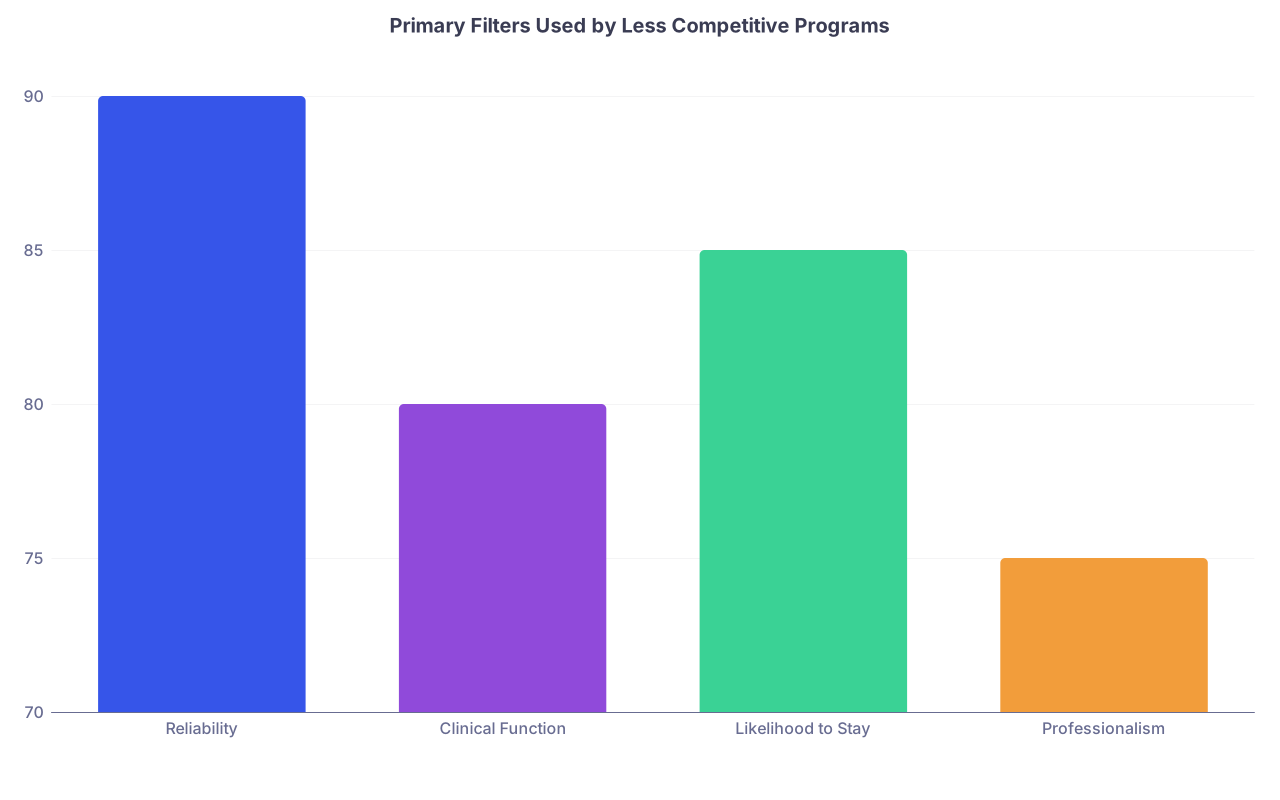
| Category | Value |
|---|---|
| Reliability | 90 |
| Clinical Function | 80 |
| Likelihood to Stay | 85 |
| Professionalism | 75 |
The details under each axis are where the real sorting happens.
1. Reliability and “will they actually come here?”
This is huge. Especially in “undesirable” locations or low-name programs.
They’re looking for any sign that:
- You actually want them, not just “a program”
- You’re tied to the area (family, spouse, med school, undergrad nearby)
- You’re not using them as a backup while you chase something else
That’s why, yes, in these rooms, the phrase “Did they say we were their top choice?” is brought up. A lot.
I’ve heard this exact exchange more times than I can count:
PD: “Anyone get a sense if he’d actually come here?”
Chief: “He said he really wants to be in the Midwest, has family an hour away.”
PD: “Okay, bump him above the other two. At least he won’t ghost us on Match Day.”
If your email, post-interview note, or interview comments gave them any ammunition to say “This person will likely rank us high”, that can move you up multiple slots in low-competitive programs.
Programs that worry about going unfilled will absolutely over-rank anyone who smells like a “sure thing.”
2. Clinical function and the fear of the weak intern
At weaker programs, there’s often less infrastructure, less backup, sometimes fewer fellows, and more service load. They cannot absorb a non-functional intern.
So they obsess over comments like:
- “Strong on the wards”
- “Works independently”
- “Great with nurses, asks for help appropriately”
And they are hypersensitive to vague, lukewarm comments that smell like trouble:
- “Pleasant, quiet” (translation: did nothing, possibly slow)
- “Requires some supervision” (translation: could sink on nights)
- “Good when given direction” (translation: not self-starting)
Internal medicine, FM, psych, peds, prelims — it’s all the same anxiety: “Are we going to have to carry this person for a year?”
If your letters explicitly address being ready to function on day one, that’s gold at these programs. Much more valuable than some abstract research award.
3. Likelihood to stay in the specialty and program
Least competitive programs care a lot about retention because losing a resident can crater their schedule. It’s not about prestige; it’s about survival.
So when they see:
- Someone who switched specialties
- Someone with a non-linear path (multiple years out, prior residency)
- Someone with strong signals toward a more competitive thing (e.g., heavy cardiology research in an average IM FM program, or neurology-heavy background applying to psych)
They ask: “Are they going to bail? Are they going to reapply somewhere else after PGY-1?”
I’ve seen a program bump a “weaker on paper” student above a stronger one purely because:
- Applicant A: average scores, local, clear “I want to be a community doctor here” story
- Applicant B: higher scores, research, big aspirations, no local ties, vague preference for academic careers
Guess who gets ranked higher at the low-visibility community program that’s been burned by early resignations before? Applicant A. Every single time.
4. Professionalism and “will this person create drama?”
Upstairs at the big-name places, they can sometimes afford to roll the dice on a high-octane, slightly abrasive star. Downstairs, at the least competitive places, they absolutely cannot.
So they overreact to.
- Any whiff of entitlement in your interview
- Overly negative talk about prior programs, schools, or systems
- Strange gaps with fuzzy explanations
- A “feel” that you’re going to be a constant complaint factory
Your “pleasant, low-ego, easy to work with” vibe can push you over better-sounding applicants.
How the file actually gets discussed
Let’s get very concrete.
A typical discussion of you might go something like this:
PD: “Okay, next, Patel. IMG. Step 2 is 227. Applied to everything under the sun. Anyone have a strong opinion?”
Faculty 1: “Interview was okay. Quiet but seemed solid. Did a rotation here, right?”
Chief: “Yeah, nurses liked him. Came in early, stayed late. He said he’d be happy to stay here long-term, has an uncle in town.”
PD: “Any red flags?”
Coordinator: “No. All paperwork in on time, responsive.”
PD: “Alright, put him above Smith. At least we know he’ll come and not complain.”
That’s one rank jump.
Now contrast that with this:
PD: “Next, Smith, US grad, Step 2 245, no red flags on paper.”
Faculty 2: “Very strong technically. But… kept talking about wanting Cardiology fellowship at big academic centers.”
Chief: “Yeah, said he really prefers larger cities. Asked how easy it is to moonlight and switch programs.”
PD: “We’ve done that before; they always leave. I don’t want another one-year wonder. Keep him lower.”
You beat a 245 with a 227 because you looked like you’d stay and function with minimal drama.
That is the calculus in a lot of least competitive programs.
Where “signals” and “commitment” are weaponized
You think your polite “Thank you for the interview” email doesn’t matter? At a high-end program, mostly true.
At the bottom end of the competitiveness spectrum, that simple email can be debated in the rank meeting. Because the bar for “interest” is so low.
I’ve seen this play out:
- Applicant sends a specific, personalized post-interview note: mentions local ties, what they liked about the program, why they can see themselves there.
- Another applicant sends nothing. Or a generic paste job.
When they’re close on paper, the PD turns to the room:
“Anyone have a sense which of these two would actually rank us higher?”
Resident: “Patel sent a really thoughtful email, mentioned his family is here. Lee never followed up.”
“Then put Patel above Lee.”
That’s it. That’s the entire decision.
You’re over here obsessing over whether your Step 2 of 234 is “competitive” for a low-tier FM program; they’re moving you up or down on the list based on a three-sentence email and a vague vibe from a 20-minute interview.
The IMGs, DOs, and “backup” crowd reality
Let’s be honest: least competitive programs are often heavy with IMGs, DOs, or applicants who feel like they’re in the second or third tier nationally.
So the internal stratification becomes brutal and very explicit.
They’ll often have mini-buckets like:
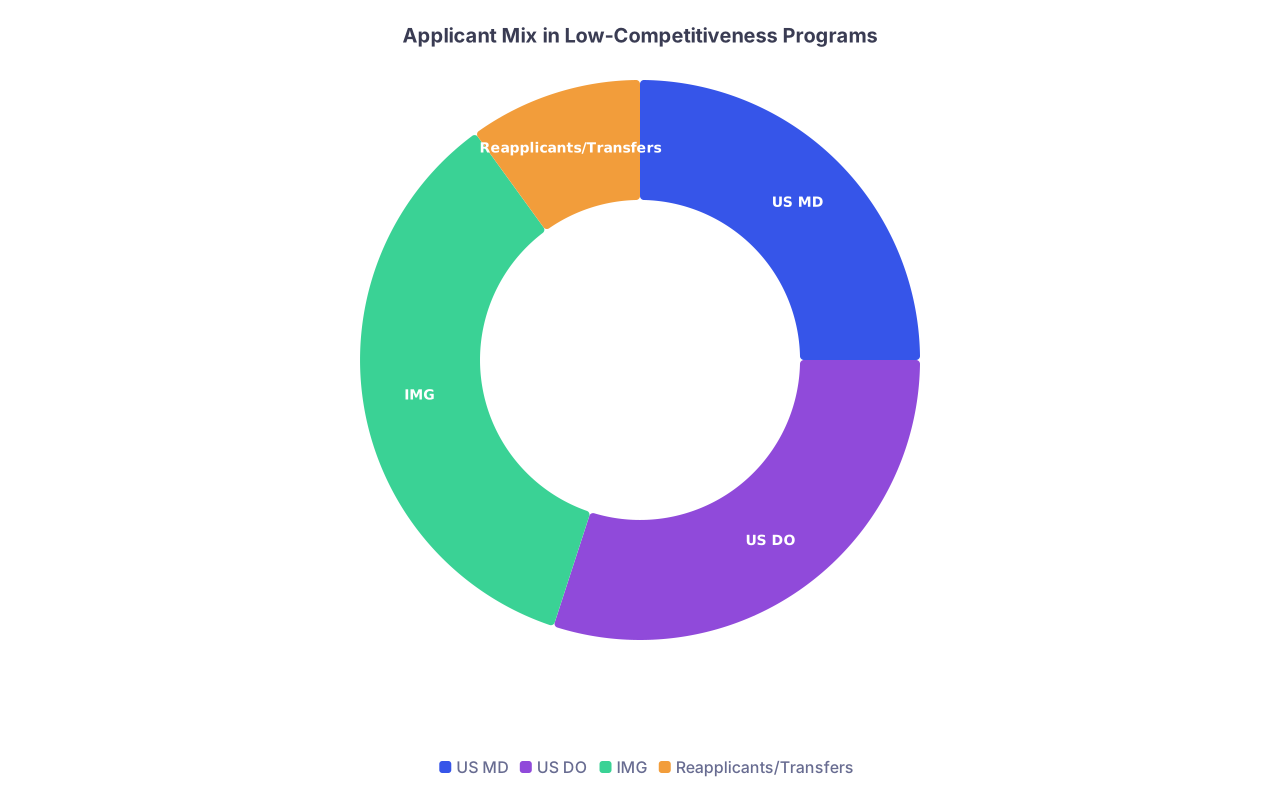
| Category | Value |
|---|---|
| US MD | 25 |
| US DO | 30 |
| IMG | 35 |
| Reapplicants/Transfers | 10 |
And in the room, I’ve heard:
- “Let’s keep a couple of strong IMGs high; they’re more likely to actually come.”
- “We need at least X US grads if we can get them, especially for optics and board pass stats.”
- “This DO is local and rotated here; push them up — they’ll definitely sign.”
Score gaps shrink in importance compared to these practical considerations. A 220 IMG with a great audition month, punctual paperwork, and clear “I want to be here” signals will outrank a 240 IMG who treated the interview like a courtesy.
US DO vs US MD can matter less than “Did they rotate here? Do they know how our hospital works? Are they already in our system?”
If you’re from a “less favored” group on paper, your strategy in these programs is straightforward: overwhelm them with evidence that you’re low-risk and high-gratitude.
- Clean, complete application
- Strong, concrete local ties
- Audition rotation if at all possible
- Explicit “I will rank you highly / I want to be here” energy
You’ll be shocked how far that moves you up.
How the final list is actually built
You probably imagine this super-ordered scoring process.
Here’s what it tends to look like in reality.
Someone pulls up a spreadsheet containing:
- Name
- Basic stats (Step 2, school type, etc.)
- Interviewer scores/comments
- Maybe a “global score” (which is garbage by this point)
Then the group essentially does a pass through the list in several sweeps.

| Step | Description |
|---|---|
| Step 1 | All Interviewed Applicants |
| Step 2 | Remove No Rank |
| Step 3 | Identify Top Tier A group |
| Step 4 | Prioritize Reliable and Likely to Come |
| Step 5 | Middle B group Ordering |
| Step 6 | Backup C group |
| Step 7 | Finalize and Submit NRMP |
Sweep 1: Who’s out?
They quickly eliminate “No rank” candidates: clear red flags, terrible interviews, major professionalism concerns, or obvious mismatch.
Sweep 2: Who absolutely should be near the top?
They identify their “A” group: people they want and feel good about. That’s where stronger US grads, very strong IMGs, local people they love, and “amazing fit” types land.
Sweep 3: Within that A group, who’s actually going to come here?
Now they start reordering based on likelihood to match. They’ll bump up:
- Locals
- People who did rotations there
- People who explicitly gushed about the program or location
- Those they think prefer them more than others
It’s not some abstract “best to worst” anymore. It’s “best we can actually get.”
Sweep 4: The mushy middle (B group)
This is where your fate is often decided if you’re neither a disaster nor a superstar.
Discussions sound like:
“Between these three, which one did we like better?”
“Who wrote the thank-you note?”
“Didn’t that one applicant ask a weird question about vacation policy?”
“That guy had a slightly better Step 2, keep him above the others.”
This is where tiny, stupid things can move you several spots. They’re tired. They’re going on memory. That one resident who connected with you? Might be your entire advantage.
Sweep 5: The C group – the break-glass backup
They won’t say this out loud, but there’s always a tail of “we’ll take them if we must” candidates.
They’ll rank them low, often after a clear psychological cutoff: “Everyone above this line we feel okay about. Below it… we’re hoping not to get there.”
But if the program fears not filling at all, that line sinks lower than you think.
What you can actually control as an applicant
You don’t control your Step scores anymore. You don’t control your med school pedigree. But for least competitive programs, you have more influence than you think.
Here’s the blunt playbook.
1. Play the local card hard
If you have:
- Family nearby
- Spouse/partner job in the area
- Prior training in the same region
- Childhood / meaningful history in that city or state
Say it. In your ERAS. In your PS. In your interview. In your follow-up note.
Not vaguely. Specifically:
“I grew up 45 minutes from here; my parents still live in [town]. I’d love to train close to home and stay in this region.”
That’s the kind of line that gets repeated verbatim in the rank meeting.
2. Make your interest unmistakable
These programs are insecure. Use that.
Post-interview, send something actually tailored:
- Mention specific faculty you enjoyed
- Reference concrete aspects of the program (clinic structure, patient population, schedule)
- Tie those to your values or goals
- Make it obvious you could see yourself there for 3+ years
You don’t have to promise them you’re ranking them #1 (and be careful with NRMP rules), but you can absolutely say:
“I will be ranking your program very highly, and I would be thrilled to match here.”
That sentence moves you up at many low-competitive programs. I’ve watched it happen.
3. Be boringly reliable
You want them to say: “I never had to chase this applicant for anything.”
That means:
- Answering emails promptly
- Completing forms quickly
- Being on time for everything
- Having a clean, typo-free application
This sounds basic. It isn’t. A depressing number of applicants fumble this, and coordinators absolutely speak up when someone was a headache to schedule or had multiple last-minute changes.
The PD trusts the coordinator more than they trust your personal statement.
4. Lean into “I will survive and be low-drama”
During the interview, you want your stories and answers to scream:
- I work hard without whining
- I function well on busy services
- I get along with nurses and staff
- I know I’m not perfect but I seek feedback
If you’re applying to a small, service-heavy community program and give off vibes that you’re fragile, entitled, or rigid, you drop like a stone.
If you come across as resilient, humble, and steady, you float up.
How timing and volume of interviews really interact for you
One more unspoken dynamic.
Programs at the low-competitive end know they are backup plans for many applicants. So they’re paranoid about losing you to “better” places.
They’ll actually ask in the room:
“How many interviews did they say they had?”
That number affects their anxiety.
If you casually brag in an interview, “Yeah, I’ve got like 18 interviews across the country,” and you’re sitting in a small, low-name program in a less desirable city – that makes them less confident you’ll rank them highly.
Sometimes they’ll still rank you high if you’re clearly exceptional. But if there’s a borderline applicant who clearly wants to be there and a stronger applicant who’s shopping? The loyal one often wins.
The bottom line truths no one says out loud
You think least competitive programs are just scooping up whatever’s left.
Inside the room, it’s more nuanced and more emotional than that:
- They’re risk-averse, not standards-free.
- They overweight fit, reliability, and likelihood to stay far more than prestige programs.
- Very small signals — location ties, a sincere email, a calm, grounded interview — can leapfrog you over people with better numbers.
If you’re applying to these programs, stop acting like you’re throwing applications into a black box. You are walking into a room full of tired, practical people trying not to get burned again.
Give them exactly what they’re silently begging for:
Someone who will show up. Stay. Pass. Work. And not burn the place down.
If you do that, you’ll end up much higher on their rank list than your stats alone would ever predict.
Key points:
- Least competitive programs rank for safety and stability, not sparkle. Low-risk beats high-score.
- Local ties, clear interest, and reliable behavior are massively overweighted in their decisions.
- Small human signals — a real connection on interview day, a specific follow-up email, a grounded attitude — can move you multiple slots on their rank list.