
The match in small, low-competition programs is not a meritocracy. It’s a neighborhood. And you’re either in the neighborhood… or you’re the outsider they’re only taking if they have to.
Let me show you how that actually works.
The Myth Of “Least Competitive” – And What Really Decides It
When people say “least competitive specialties” or “easy matches,” they’re usually staring at Step score averages, fill rates, or NRMP charts. That’s surface-level. Program directors in small community programs are not poring over boxplots of national data on a Saturday night. They’re asking much simpler questions behind closed doors:
“Will this person be a headache?”
“Will this person stay?”
“Does anyone here know them, or know someone who knows them?”
“Can I trust them on nights without me?”
In big academic powerhouses, there’s enough volume and prestige that they can treat applicants as data points. Numbers, publications, school name. In small programs—FM, psych, IM at community hospitals, some prelim surgery, transitional years—the politics are local and personal.
That’s why you see bizarre things like:
- A 215 Step 2 applicant matching easily at a small family medicine program.
- A 250+ applicant not even getting an interview from that same program.
From the outside it looks random. It’s not random. It’s political. The politics of relationships, loyalty, and perceived risk.
What “Small Program Politics” Actually Looks Like
Forget the brochure language. Let me walk you into the real room.
Match discussion at a small community internal medicine program, 12 residents per year, no big-name affiliation. It’s 6 pm, everyone’s tired. The PD has a spreadsheet up. On the screen: 60 applicants they could conceivably rank.
They go one by one, and it’s never just about the file.
- “She rotated here in September. Nursing liked her. She stayed late, helped with discharges.”
- “This guy is friends with our current PGY-2—he’s solid, they did med school together.”
- “He’s from this city, family nearby, says he wants to practice here. He’s probably staying.”
- “This one? High scores, but super awkward on interview day. Didn’t talk to the residents at lunch.”
You can almost hear the hierarchy:
- Known quantity we liked.
- Known quantity adjacent (friend of someone we like, home student of faculty we trust).
- Local or “likely to stay” candidate.
- Everyone else.
Step score only really matters to the extent it answers one question: “Will I regret this?” If your numbers are just good enough that they’re not scared you’re going to fail boards, they move on to what they actually care about: whether you fit into their small ecosystem.
Why “Low-Competition” Does Not Mean “Low-Politics”
Here’s the dirty secret: the smaller and “weaker” the program looks on paper, the more politics matter.
Big-name, highly competitive academic programs get so many strong applicants that they can afford to stick to a fairly standardized rubric. They’re biased, sure, but the volume blunts some of the idiosyncrasies.
Small programs? They don’t have volume. They have scarcity and fear.
They’re terrified of:
- A resident quitting and leaving them short-handed.
- A problem resident who poisons the small culture.
- Someone failing boards when they only graduate 6–8 residents a year.
- Someone who hates the hospital and bad-mouths them to med students and on forums.
So what do they do? They make political choices. They lean hard on relationships and familiarity, because that feels safer than a shiny application they don’t truly trust.
, Local ties, Strong interview vibe, US grad neutral, High Step score only](https://cdn.residencyadvisor.com/images/articles_svg/chart-typical-rank-list-priorities-in-small-programs-7209.svg "Typical Rank List Priorities in Small Programs")
| Category | Value |
|---|---|
| [Known rotator](https://residencyadvisor.com/resources/least-competitive-specialties/what-program-directors-privately-look-for-in-low-competition-fields) | 90 |
| Local ties | 80 |
| Strong interview vibe | 70 |
| US grad neutral | 50 |
| High Step score only | 25 |
If you think I’m exaggerating that bias toward “known rotator,” you haven’t been in the room for small-program rank meetings.
Who Actually Controls The Match List In Small Programs
Officially, it’s a “clinical competency committee” or “selection committee.” On paper, there’s a process.
In reality, there are usually three power centers:
- The Program Director
- The Core Faculty “Favorites”
- The Chief Residents / Senior Residents
The PD has veto power. But they’re human. They remember who saved them during that insane July when they were short two residents. That PGY-3? When she says, “I liked this applicant, they were chill and worked hard on my service,” that person climbs on the rank list.
Faculty politics also leak into this. The cardiologist who always complains about residents? If that person randomly says, “That student on my service last month was the best I’ve had in years,” the PD hears that. Same for the outpatient doc who loves “team players” and will absolutely tank an applicant for being even slightly arrogant.
So what shapes your rank position?
- The vibe you gave off to residents on interview day and on wards.
- Who you worked with on rotations and what they say when the PD casually asks, “What did you think of him?”
- The faculty members who unofficially “own” the program culture—there’s always two or three.
Not the ERAS personal statement some consultant charged you $800 to polish.
The Hidden Currency: Rotations And “Known-ness”
Away rotations at small, low-competition programs are like political campaigns. You’re not just doing good work. You’re fundraising goodwill.
Here’s what actually gets noticed:
- You show up 10 minutes early consistently, without making a big performance of it.
- You do scut cheerfully the first week and then progressively start thinking one step ahead by week two.
- You do not try to impress with obscure knowledge; you try to be reliable and safe.
- You don’t disappear when there’s work but you do disappear when residents just want to vent without you around.
Residents will talk.
“I’d take them as a co-intern.”
“They’re quiet but solid.”
“They asked too many weird questions and slowed everything down.”
That casual phrase—“I’d take them as a co-intern”—is program currency. I have literally seen an applicant with a 220 Step 2, no research, average school jump 20–30 spots on a rank list because two residents said, “she was great on wards, we want her.”
So if you’re targeting “easier” specialties in small programs—family med, psych, community IM—you should stop obsessing over whether your 228 Step 2 is enough and start obsessing over where you can rotate and be seen.

| Step | Description |
|---|---|
| Step 1 | Applicant rotates |
| Step 2 | Resident impression |
| Step 3 | Faculty impression |
| Step 4 | Resident feedback to chief |
| Step 5 | Faculty feedback to PD |
| Step 6 | Rank meeting discussion |
| Step 7 | Final rank position |
That’s the pipeline that matters.
How Being “From Here” Warps The Process
You’ll see this line in a lot of small-program websites: “We prefer applicants with ties to the region.” Very sanitized. They’re underselling it.
What they’re really saying is: “We don’t trust that you’ll stay unless you have a reason to be trapped here.”
Harsh, but that’s the thought process. If you are:
- From the state or nearby states
- Have a partner in the region
- Trained at a local med school
- Have family you talked about on interview day
You’re immediately less risky in their eyes. One PD at a small Midwestern FM program said it out loud in a meeting: “I do not want to train coastal kids who will flee to California as soon as they’re done. I want people who will be here in 10 years.”
That’s not an outlier opinion. It’s standard.
| Applicant Type | Likely Interest Level |
|---|---|
| Local med school + hometown | Very High |
| Local med school only | High |
| Non-local but partner nearby | Moderate-High |
| No ties, distant region | Low |
| No ties + says planning to leave area | Very Low |
So if you have any genuine geographic tie, you don’t just casually mention it. You lean into it. Because that single factor can override a lot of “competitiveness” issues.
Where The Backchanneling Really Happens
People love to pretend decisions are made off the ERAS packet only. That’s cute. Let me show you the real game.
Backchannel #1: Faculty-to-faculty emails and texts
“Hey, you’ve got a student applying to us—what’s your read on her?”
I’ve seen this happen between small IM programs in the same state. One email from a trusted colleague: “Hard worker, no drama, would rehire” is better than any LOR you uploaded.
Backchannel #2: Resident-to-resident group chats
“Anyone know this guy from X med school?” gets fired into a group chat of alumni or friends. If one person says, “Oh yeah, he’s a solid dude,” the anxiety drops 50%.
Backchannel #3: Med school administrators and deans
If there’s any red flag—leave of absence, professionalism note—the PD might quietly call your dean. How that story gets framed matters a lot. Some deans are protective, some are blunt.
You do not see any of this. But your behavior in med school, your relationships, your honesty about any issues—that’s what shapes what gets said about you.
The Politics Of Being “Overqualified” In A Low-Competition Spot
This is one that applicants never want to believe: you can absolutely be “too strong” for a small, low-competition program. Not on paper. Psychologically.
Remember their fear list: they’re worried you won’t stay. They’re suspicious if your app looks like it belongs at university hospitals and you’re applying to a small community program in a town no one has heard of.
Here’s how those conversations go:
“Why is this 260, AOA, 3 pubs in JAMA psych applying here?”
“There’s no way they’ll rank us high.”
“We’ll waste an interview slot on someone who doesn’t really want us.”
And the resident who had a miserable experience with a flighty co-resident will chime in: “I’d rather have someone solid who’s actually going to stay.”
So if you’re that “overqualified” candidate targeting so-called easy programs:
- You cannot just send a generic personal statement.
- You need a very clear, specific reason you want that program or region.
- You probably need to show your face—virtual meet and greets, away rotation, emails that don’t feel canned.
Because otherwise, your “great stats” are a liability. They make you look like a flight risk.
How Residents Quietly Gatekeep Culture
In small programs, residents are the culture police, even if no one writes it in their job description.
They remember the one malignant, lazy, or toxic co-intern better than the other eleven decent ones. And they’re determined not to repeat the mistake. So their bar for “vibes off” is much lower than yours.
Here’s what will quietly kill you in their eyes:
- Talking over nurses or dismissing ancillary staff on your rotation.
- Acting like you’re “too good” for a small program and dropping big-name cities you “hope to end up in.”
- Overcompensating with weird hyper-competitive energy—showing off Step scores or research in casual conversation.
- Being too passive and not owning small tasks on the team.
One PGY-2 in a psych program put it perfectly in a rank meeting: “Look, I do not care what their score is. If I have to cover nights with them and they’re arrogant or useless, that’s a no from me.”
That comment carried more weight than the entire ERAS packet.

The Small-Program Specialty Landscape: Where Politics Hit Hardest
When we talk about “least competitive specialties” plus small-program politics, we’re usually talking about:
- Family Medicine (especially community, non-university-affiliated)
- Internal Medicine at small community hospitals
- Psychiatry at non-flagship, regional programs
- Pediatrics in smaller cities
- Transitional Year and prelim IM/surgery at lesser-known hospitals
In these spaces, the game is less “beat the Step 1 average” and more “embed yourself into a network.”
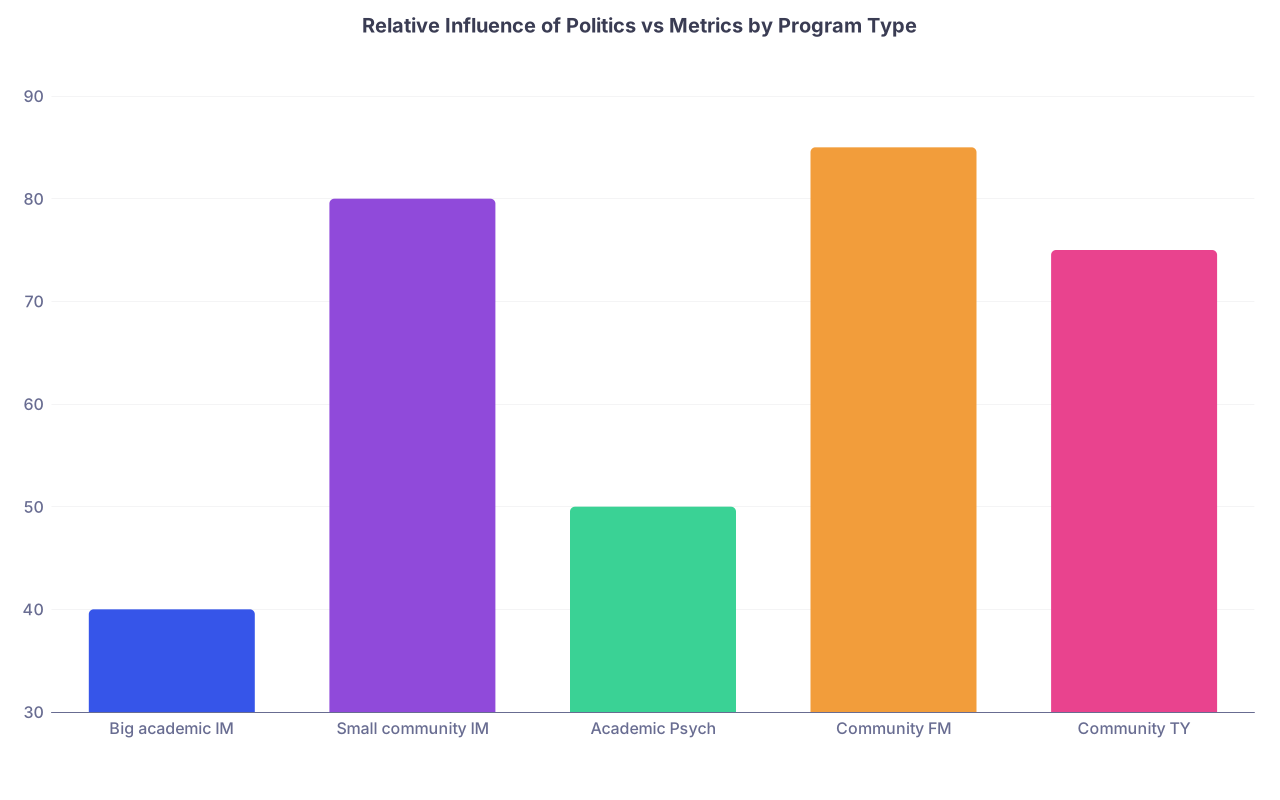
Here’s how it tends to shake out:
| Category | Value |
|---|---|
| Big academic IM | 40 |
| Small community IM | 80 |
| Academic Psych | 50 |
| Community FM | 85 |
| Community TY | 75 |
Those numbers are not from a paper. They’re from watching how many times “I know this person” overrode “their app is slightly weaker” in real rank meetings.
How To Actually Use This To Your Advantage
You can’t change the politics. But you can stop pretending they don’t exist and start playing the game that’s actually being played.
If you’re aiming for a low-competition specialty through small programs:
Prioritize programs where you can be known.
Rotate there. Do a sub-I. Go to their open houses. Email the coordinator like a human being, not a robot.Make your story local and believable.
If you have real regional ties, say it: “My parents live 30 minutes from here; I’d like to settle near family.” Do not bury that on page three of your personal statement.Act like someone they want to be trapped with at 2 am.
On away rotations and interviews, your persona should scream: reliable, not dramatic, honest, not a martyr, kind to staff.Stop worshipping your Step score.
Hit the minimal threshold for them to trust you can pass boards. Beyond that, they care more about whether you’ll sink the ship or help row.Do not oversell how “temporary” this place is for you.
Saying, “I’m hoping to go back to the West Coast eventually” in a small Midwestern program is basically an auto-demotion on the rank list.

What People Inside The System Won’t Tell You Directly
Let me give you two real-style scenarios I’ve seen versions of.
Scenario 1: The “Average” FM Applicant Who Matched Easily
Step 2: 220s. No research. US-IMG. She rotated at a small rural FM program, took ownership of low-glamour tasks, stayed late without being performative, and asked residents what their lives were actually like. She mentioned her husband’s job was in that town and they’d just bought a house nearby.
Rank meeting:
“Her scores are lower, but she was great on the rotation.”
“She’s literally building a life here.”
“Zero ego.”
She matched at the top of their list.
Scenario 2: The “Strong” Psych Applicant Who Got Ignored
Step 2: 250s. Honors in psych. Multiple publications. From a coastal med school. Applied broadly, including a small community psych program in the Midwest “as backup.”
On interview day he talked non-stop about big-city plans, subspecialty fellowships, “probably ending up back on the coasts.” Very nice, very smart, but everything about him said: “I’m passing through.”
Rank meeting:
“He’ll never rank us high.”
“Why waste an interview on someone who’s gone after three years and will never send us students?”
“Honestly, I liked the local kid better.”
They ranked him low. He never knew.
The lesson is simple: in small-program, low-competition spaces, you are not competing on the same axis you think you are. You’re not in a Step-score arms race. You’re in a trust and loyalty test.