
Worried I’m Settling: How to Know If a Low-Competition Field Fits You
What if you pick a “less competitive” specialty… and spend the rest of your career wondering if you sold yourself short?
That’s the fear, right? Not just “Will I match?” but “Will I hate myself later for playing it safe?”
Let me just say this out loud: a lot of very smart, very capable people end up in so‑called “low-competition” fields and are quietly terrified that everyone thinks they couldn’t hack it in derm, ortho, ENT, whatever. I’ve watched people literally apologize for their specialty choice on interview day. Out loud. To attendings.
So you’re not alone.
Let’s untangle this, systematically, before you talk yourself into (or out of) a career for the wrong reasons.
First: What “Low-Competition” Actually Means (Not the Instagram Version)
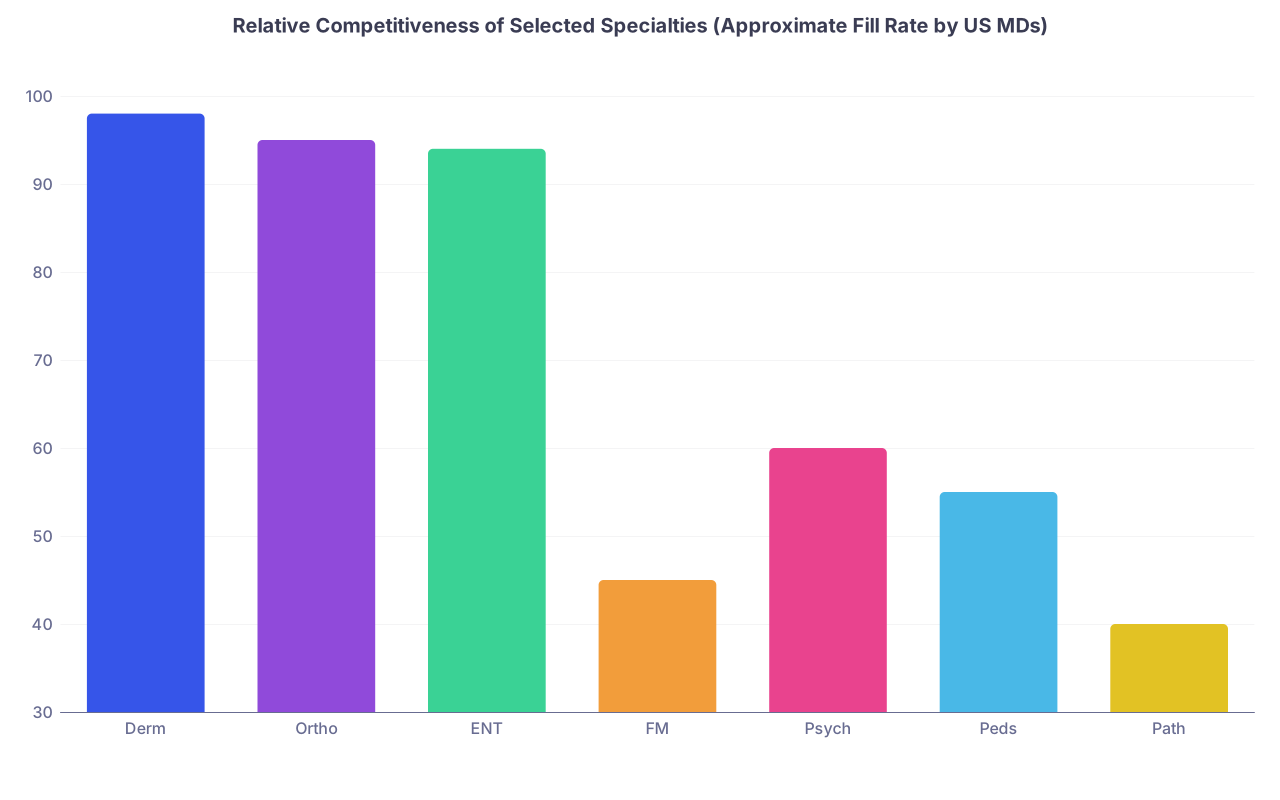
People throw around “least competitive specialties” like it’s a moral ranking. It’s not. It’s math and applicant behavior.
| Category | Value |
|---|---|
| Derm | 98 |
| Ortho | 95 |
| ENT | 94 |
| FM | 45 |
| Psych | 60 |
| Peds | 55 |
| Path | 40 |
Before you panic about labels, let’s define what “less competitive” usually refers to:
- Lower average Step scores of matched applicants
- Higher percentage of unfilled spots
- Fewer total applicants per position
Commonly tossed into this bucket (depending on the year):
Family Medicine, Psychiatry, Pediatrics, Pathology, PM&R, Neurology, Internal Medicine (if we’re talking categorical at community programs), sometimes Anesthesiology in certain cycles.
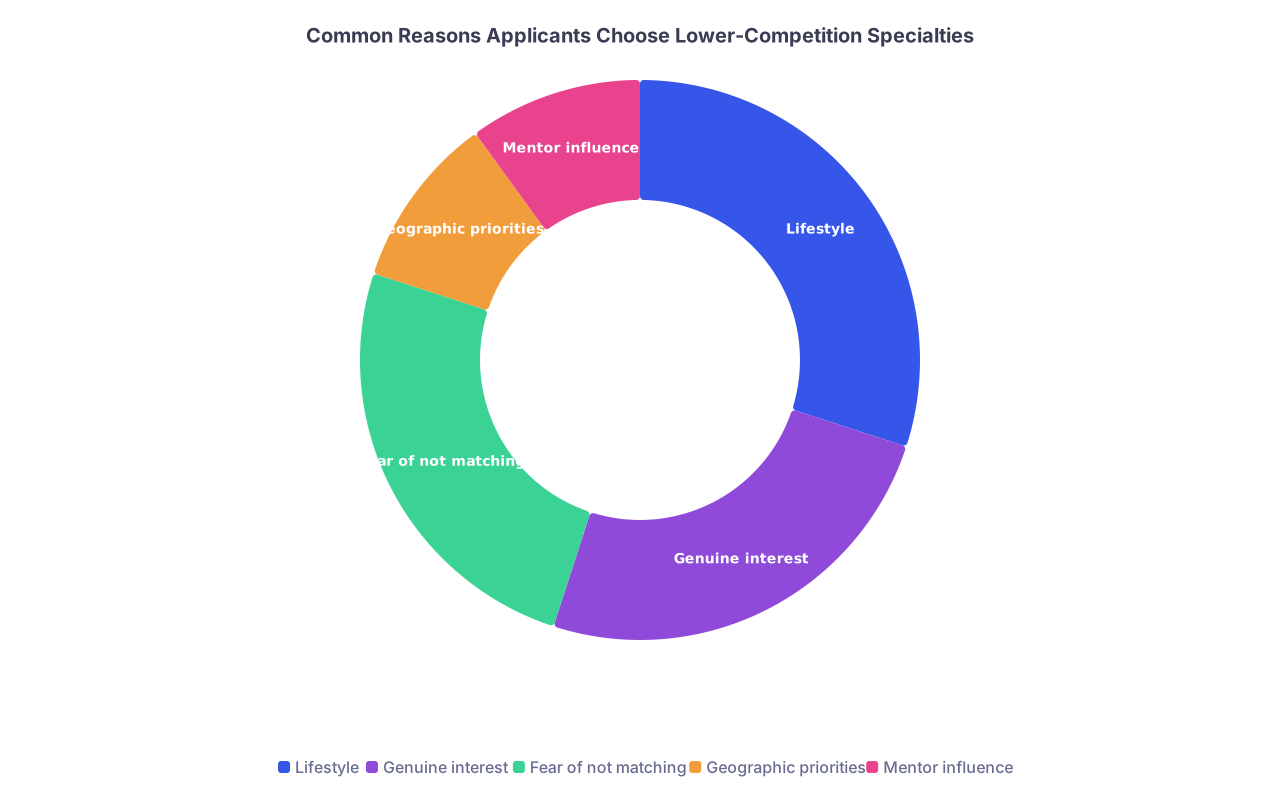
Here’s the uncomfortable truth: the competitiveness of a specialty tells you almost nothing about whether you’ll actually like doing it for 30+ years.
But your brain is probably doing this:
Low competition → “easier” → “I should aim higher” → “If I choose this, it’s because I’m not good enough.”
That narrative is poison. And very popular.
The real question is different:
“Is this field actually a good fit… or am I hiding here because I’m scared I can’t make it elsewhere?”
You can answer that. But you have to be brutally honest with yourself in a few specific ways.
Ask the Hard Question: Are You Choosing This or Retreating Into It?
This is the part that keeps people up at night at 2 a.m. on call.
”Am I picking this specialty…
or just taking whatever will take me?”
Here’s the mental checklist I use with anxious applicants who are torn.
1. What did you like before Step scores and match talk took over?
Think back to preclinical and early clinical, before everyone started flexing about ortho or derm or gas. What actually lit you up?
Not what impressed your attending. What YOU were excited to wake up for.
If, back then, you found yourself saying things like:
- “I really like talking to patients about their life context” → Psych, FM, Peds vibes
- “I like following patients over time, not just fixing something once and handing off” → FM, IM, Peds
- “I love thinking through systems and patterns more than being in the room” → Path, Neurology, PM&R
…and that’s still true now, that’s not settling. That’s consistency.
If the only thing that’s changed is:
“I used to want something else, and after my Step score / grades / advisor conversation, now suddenly I like this lower-competition field”… that’s when I’d pause and interrogate it harder.
Not because that’s bad. Just because fear is clearly in the room and you need to know how loud it’s talking.
2. What do you actually want your day-to-day to feel like?
Not vague “help people” stuff. Concrete.
Picture this:
- Do you want 15–20 patient interactions a day talking about emotions, meds, psychosocial chaos? Psychiatry. Maybe primary care.
- Do you want short, focused visits about bread-and-butter stuff (HTN, DM, URIs, follow-ups) all day? Family med or general IM clinic.
- Do you want long-term relationships with kids and families, growth charts, vaccines, worried parents at 2 a.m.? Pediatrics.
- Do you want minimal direct patient interaction, more behind-the-scenes diagnostic thinking? Pathology.
- Do you want rehab goals, mobility, function, working in teams with PT/OT? PM&R.
If the day-to-day of a so-called “less competitive” field actually sounds like a relief compared to the high-drama procedural specialties… you’re probably not settling. You’re just honest about what life you want.
If, on the other hand, you light up describing the OR, procedures, or acute resuscitations, but you’re telling yourself, “Eh, I guess I could live with clinic in family med,” and it sounds grey and flat when you imagine it—that’s your gut screaming at you.
3. Would you still choose this field if you had a 265 and a glowing dean’s letter?
This is the ugly but necessary thought experiment.
Imagine:
- You aced everything
- Every door is open
- PDs are emailing you, begging you to apply
Would you still choose this “less competitive” specialty?
If you immediately think, “No, I’d do ortho/anesthesia/rads/etc.,” then you’ve identified something important: desire is there, just buried under fear.
That doesn’t mean you’re not allowed to pivot. But you can’t call it “my dream specialty was never really that important to me” and expect your subconscious to buy it.
If, in that fantasy world where you’re a flawless applicant, you’d still pick pediatrics or psych or FM because you like the work and lifestyle better—that’s not settling. That’s… actually confident.
Warning Signs You’re Settling vs. Signs It Actually Fits
Let’s be blunt. Sometimes people really are hiding in lower-competition fields because they’re scared. Other times they’re just tired of pretending they like specialties they actually hate.
Here’s a side-by-side that might help.
| Scenario | Red Flag for Settling | Green Flag for Good Fit |
|---|---|---|
| Emotion driving choice | Fear, shame, “I’m not good enough” | Relief, curiosity, “This feels like me” |
| How you talk about it | Apologetic, defensive | Calm, even if others don’t get it |
| Rotations | Actively disliked this field but now rationalizing it | Consistently enjoyed time in this field |
| Plan B feelings | Constantly fantasizing about other specialty | Mild “what-if” but no deep regret |
| Future self | Imagines being resentful and stuck | Can clearly picture content future self |
If most of your honest reactions are in the red column, I’d seriously consider:
- Doing a focused elective or sub-I in the field you’re afraid to reach for
- Talking to a PD or advisor who will tell you the truth about your chances (not sugarcoat, not catastrophize)
If you’re mostly in the green column and your brain is still whispering “You’re a failure for not doing something more competitive,” that’s not a specialty problem. That’s a perfectionism problem.
Reality Check: “Prestige” vs. Actual Misery Risk
The prestige anxiety is real. You’ve heard it:
- “Oh, you’re ‘just’ doing family med?”
- “With your scores you could have done something more…”
- Or the worst: the comments people don’t say, but you’re sure they’re thinking.
I’ve watched:
- A “top” applicant cry in the hallway during a surgery sub-I because they hated every second of the OR but felt trapped by expectations.
- A resident in a super competitive field quietly admit they wish they’d chosen psych, but “couldn’t waste” their Step score.
- A “backup” psych resident become the most fulfilled person I know because the day-to-day of that work actually matched their brain.
Here’s the messed-up secret:
Choosing a specialty for prestige is way more likely to leave you miserable than choosing a “less competitive” field that genuinely fits you.
You see it in PGY-2 and PGY-3 burnout rates. Prestige doesn’t help you at 3 a.m. when you’re doing something you actively dislike, in a culture that doesn’t fit you, with a lifestyle you never really wanted.
What If I Am Picking It Mostly Out of Fear?
Let’s say you’re reading this and thinking:
“Yeah… I’m pretty sure I’m running away from rejection, not running toward this field.”
Okay. That’s not the worst thing. It just means you need a more intentional plan instead of quietly surrendering.
Here’s how I’d handle it if I were you.
Step 1: Name the “reach” specialty out loud
Not “maybe something surgical.”
Say it clearly: “I wish I could do ortho.”
Or EM. Or rads. Or anesthesia. Whatever.
Anxiety loses a lot of power when you stop letting it stay vague.
Step 2: Ask a brutally honest question: are your chances truly zero… or just not guaranteed?
There’s a huge difference between:
- “Matching plastics with a 205 and no research from a low-tier school” (basically impossible), vs.
- “Matching anesthesia or EM with slightly below-average scores but decent letters and realistic program list” (hard, but not fantasy).
Most applicants put these in the same bucket—“too risky”—because they can’t tolerate the idea of not matching.
That’s how people end up “settling” in fields they don’t actually like… without ever truly testing whether the reach was possible.
Step 3: Design a dual-strategy instead of a panic pivot
You don’t have to go all-or-nothing.
You can:
- Apply broadly in the “reach” specialty
- Also apply to a well-considered lower-competition backup that you could actually live with
- Be strategic about region, program tier, and your application narrative
It’s not cowardly to have a backup. It’s cowardly to pretend you never wanted anything else and then resent your life for 30 years.
How to Know If a Low-Competition Field Really Fits You (Concrete Tests)
You want something more than vibes. Fair.
Here are a few ways to test the fit that aren’t just “think about it harder.”
1. The “I’m exhausted” test
Think back to the end of a long day on that rotation.
Question: Were you “tired but okay” or “tired and hollow”?
- Tired but okay = the work drains you, but in a way that still made sense. You could see yourself recovering on days off, doing this for years.
- Tired and hollow = you felt like your soul was leaking out slowly, even when nothing bad happened.
I’ve seen students utterly beat after a pediatric ward month but still say, “This was hard, but I love these kids.” That’s a strong “yes” signal, even if pediatrics isn’t “glamorous.”
2. The Monday-morning dread check
On that rotation, did you dread Monday?
Everyone hates alarms. I’m talking about the deeper dread.
- If Sunday night you were like, “Ugh, early again, but I want to know what happened to Ms. X,” that’s a good sign.
- If Sunday night you were looking up alternate careers or daydreaming about matching anything else, listen to that.
3. The “jerk attending” stress test
Every specialty has difficult personalities. But here’s the trick:
If you still liked the work even when the people sucked, that’s meaningful.
Example:
- You had a condescending attending in psych but still looked forward to seeing your patients = you probably like psych.
- You had lovely attendings in FM but were bored and counting minutes = maybe that’s not your field, even if everyone was nice.
You can usually survive bad personalities if the work gives you something back.
4. Talk to 3 attendings who actually love it
Not the burned-out one who hates everything.
Ask them:
- “What type of student is miserable in this field?”
- “What type of student grows into it and thrives?”
- “If you had my stats and profile, would you still tell me to do this?”
Watch their face. People are weirdly honest when you ask that last question.
You’re Also Terrified of Regret. Let’s Address That Directly.
The nightmare scenario I hear all the time:
“You’re going to wake up at 40 as a [insert lower-competition specialty here], realize you could have done more, and it’ll be too late.”
Here’s the reality:
- People switch specialties. Not casually, not easily, but they do.
- People also grow into specialties they weren’t initially obsessed with because the lifestyle and patient relationships turn out to matter more than the “wow” factor.
- The bigger regret I actually hear is the opposite:
“I picked something for status, and I wish I’d chosen what fit me.”
You can absolutely have a fulfilling, challenging, respected career in FM, psych, peds, path, PM&R, etc. The ceiling is not lower. The path just looks different.
You can:
- Lead departments
- Do academic research
- Subspecialize
- Work in underserved areas and literally change systems
- Build practices that let you have an actual life outside medicine
None of that disappears because your field wasn’t an NRMP bloodbath.
A Quick Sanity Check You Can Do Tonight
Open a blank page and write, without editing:
- If I knew I’d match anywhere, I would rank: _______ #1.
- The reasons I’m not doing that are: _______.
- The best version of my life in this “low-competition” specialty looks like: _______.
- The worst version of my life in this specialty looks like: _______.
Then ask yourself honestly:
- Can I live with the best realistic version of this specialty?
- Is my fear about the reach specialty based on actual data… or just my catastrophizing brain?
You don’t have to solve all of this in one night. But you do owe yourself honesty about what you actually want.
| Category | Value |
|---|---|
| Lifestyle | 30 |
| Genuine interest | 25 |
| Fear of not matching | 25 |
| Geographic priorities | 10 |
| Mentor influence | 10 |
FAQ (Exactly 4 Questions)
1. Am I “wasting” a strong application if I choose a less competitive specialty?
No. That idea is toxic and wrong. A strong application buys you options, not obligations. Using that strength to choose a life that actually fits you is the opposite of wasting it. I’ve seen 250+ scorers in FM, psych, peds who leveraged their stats into great programs, leadership opportunities, and academic careers. They’re not sitting around wishing they had more malignant call schedules. They’re building lives that make sense for them.
2. What if I’m genuinely torn between a competitive and a less competitive specialty?
Then you strongly consider a dual application strategy. Get real data on your chances in the competitive field from someone honest (not your friend who matched derm with a 269). Do a real elective or sub-I in both fields. Then decide if you want to tolerate risk for the chance at the competitive specialty, or prioritize security and go all in on the lower-competition field. Either way, decide on purpose, not by drifting into your backup out of pure anxiety.
3. Won’t people think I couldn’t match something better if I choose a low-competition field?
Some small-minded people might. Most won’t. And the older you get, the less you’ll care. Residents and attendings who are deep in the grind respect people who clearly like what they do. The “flex” culture is loud in med school, quieter in residency, and almost nonexistent once people are 10 years in and just trying not to burn out. Your patients absolutely will not care what the NRMP fill rate was. They’ll care if you’re present, competent, and not secretly resentful.
4. How do I stop obsessively second-guessing my specialty choice?
You probably won’t stop entirely; that’s how anxious brains work. But you can quiet it. Get more data: more exposure, more honest conversations, more clarity about your non-negotiables (location, lifestyle, patient type). Make a written decision, with your reasons. Share it with one or two people you trust. Then commit to acting as if it’s the right choice for now. Revisit only at defined checkpoints, not every night at 3 a.m. And if your gut keeps screaming in six months, you re-evaluate with a PD or advisor—not with the echo chamber in your own head.
Open your notes app right now and write down the one specialty you’re most afraid to admit you want, and the one lower-competition specialty you keep circling back to—then, tomorrow, schedule a 20-minute meeting (or email) with an attending in EACH of those fields and ask them point-blank if someone like you would be happy in their specialty.