
It’s 8:05 a.m. on interview day. You’re in a bland conference room with stale muffins and a too-big name tag. You’re telling the resident next to you how much you “love outpatient continuity of care,” but what you’re really thinking is, “I just need to match somewhere.”
Across the hall, the program director and two faculty are flipping through your file. One of them says:
“Another one. OB/Anes/EM applications last year, now applying FM and prelim medicine. Let’s see if they pretend this was their dream all along.”
You think you’re there to convince them you’re smart and nice. They’re actually running a different test:
Are you here because you genuinely want this specialty…
or because it’s your safety net?
Let me walk you through how they really figure that out.
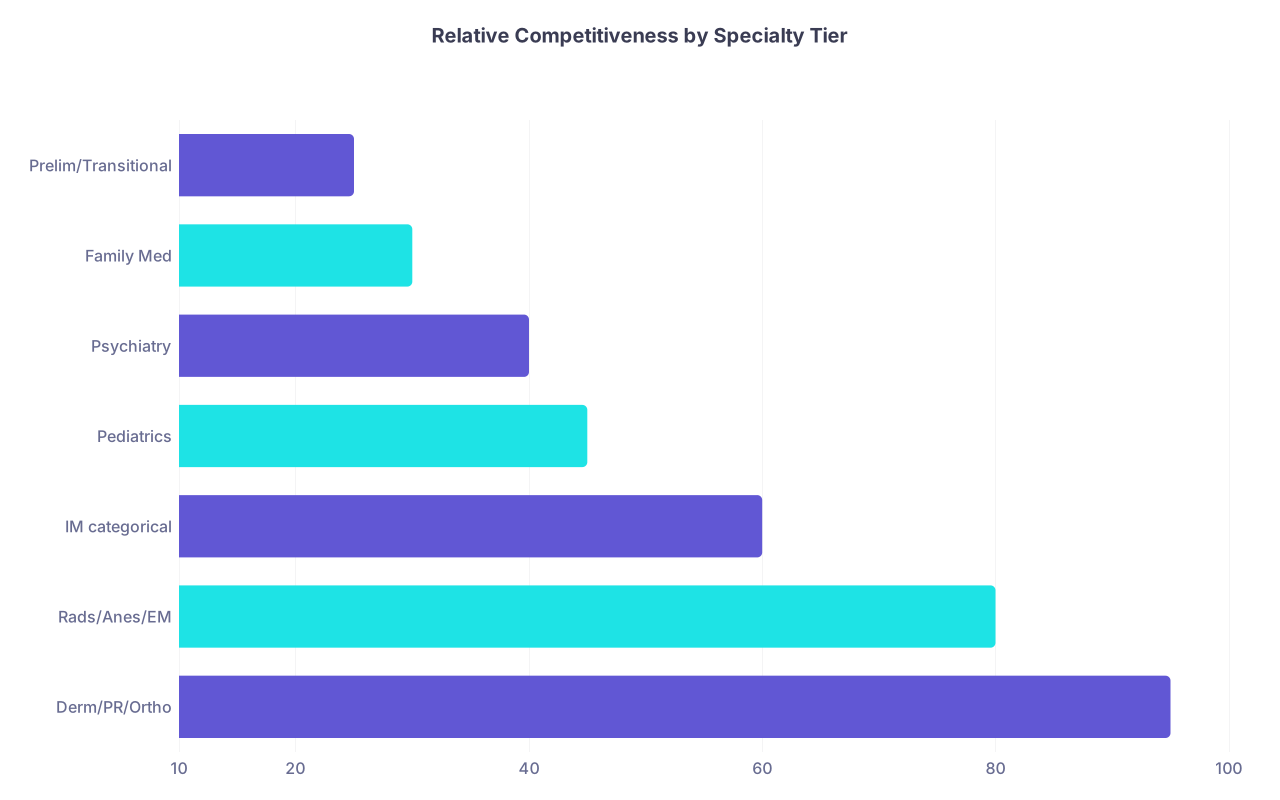
The uncomfortable truth about “easier” fields
| Category | Value |
|---|---|
| Derm/PR/Ortho | 95 |
| Rads/Anes/EM | 80 |
| IM categorical | 60 |
| Pediatrics | 45 |
| Psychiatry | 40 |
| Family Med | 30 |
| Prelim/Transitional | 25 |
First, let’s be blunt.
There are specialties where PDs are drowning in hyper-motivated applicants (derm, ortho, plastics, ENT). No one there is wondering, “Does this person really want my field?”
Then you’ve got the “middle” – internal medicine categorical at solid academic places, anesthesia, radiology. Still competitive, still selective, but they know most people chose them on purpose.
And then there’s the tier you’re asking about. The so-called “least competitive” specialties and tracks:
- Family medicine
- Psychiatry (at most community programs)
- Pediatrics (non-elite programs)
- Transitional year and prelim medicine spots
- Some lower-tier community IM, prelim surgery
These programs live in a different reality.
On paper, they seem like backup plans. High match rate, wide range of applicant stats, and a reputation (often unfair) of being “easier to get into.”
Program directors in these fields know two things:
- A meaningful chunk of their interviewees originally wanted something more competitive.
- Residents who treat the specialty as a consolation prize are more likely to burn out, be miserable, or leave.
So they’ve built their whole interview day around one central question:
Is this applicant actually committed to us — this specialty and this program — or just trying not to go unmatched?
Everything you experience that day is designed, formally or informally, to answer that.
The pre-interview red flags: what they know before you sit down
By the time you shake the PD’s hand, they already have a narrative about you. Most applicants don’t understand just how much pattern-recognition happens before the small talk.
Here’s what they’ve already clocked:
1. Your application “trajectory”
They’re looking at your specialty evolution, not just your final ERAS list.
- You did two away rotations in ortho, one in anesthesia, and suddenly “found your calling” in family medicine in October of M4.
- Your MS3 evals have “interested in EM” written three times. No mention of psych.
- Your Step 1/2 scores are decent but not stellar. You started off shooting for something competitive and quietly pivoted.
They don’t hate that. Many PDs have sympathy. They know people reassess. But they mark you as “possible backup user” and now the burden is on you to prove they’re wrong — or at least that you’ve fully embraced the new path.
2. Your letter pattern
They look at who wrote your letters with brutal clarity.
If you’re applying FM and have:
- 2 letters from ortho
- 1 from anesthesia
- 0 from core FM faculty
It screams: “This was a pivot.”
Same with psych applicants whose strongest letter is from surgery, and no one from their psych department really knows them.
In these so-called easier fields, a surprising number of applicants do not have a single strong letter that actually speaks to their fit for that specialty. PDs notice. And they absolutely talk about it in the pre-interview huddle.
3. Your personal statement tone
They’re not grading your prose. They’re listening for desperation vs. conviction.
This is what sets off alarms:
- “After my experiences across a variety of specialties, I have realized that what matters most is matching somewhere where I can become a competent physician.”
- “While I initially considered fields like anesthesiology and emergency medicine, I have come to appreciate the importance of solid general training.”
Translation to them: “I struck out in the fields I really wanted and now I just want a job.”
Then compare that to someone who can concretely tie their story to this type of work, this patient population, this scope of practice.
They’ll still test you on interview day. But they walk in either suspicious or cautiously optimistic.
Interview day structure: where they test commitment without telling you

| Step | Description |
|---|---|
| Step 1 | Pre-interview file review |
| Step 2 | Morning intro session |
| Step 3 | Faculty interview |
| Step 4 | Resident interview |
| Step 5 | Push on specialty choice |
| Step 6 | Explore program fit |
| Step 7 | Check stories with residents |
| Step 8 | Rank list discussion |
| Step 9 | Backup vibes |
You think the schedule is arbitrary. It’s not. They’ve built choke points where “commitment” gets stress-tested.
The morning overview and “fake casual” interactions
Programs in FM, psych, peds, and community IM often start with a group overview and a resident-only chat. You think this is the fluff portion of the day.
It’s not fluff. It’s reconnaissance.
PDs and coordinators purposely give residents time with you before the 1-on-1 interviews. Then at lunch, residents report back:
- “Who actually asked about our patient population vs. just hours and location?”
- “Who said they were also interviewing at ortho or EM?”
- “Who made it clear they’d take anything this cycle?”
I’ve sat in those debriefs. Comments are shockingly blunt:
“That guy clearly wants anesthesia; he asked if we would let him moonlight in the ICU and train up on procedures so he could apply after.”
“She had no idea what our clinic actually does. Didn’t even know we’re an FQHC track.”
Those comments stick. A resident’s 10-second impression can drop you half a round on the rank list.
The one-on-one faculty interview: where the real screening happens
This is where the “easier” specialty PDs do their best work. Let me break down what they’re actually doing with each type of question.
1. “So, why this specialty?”
You think this is generic. It isn’t. In FM, psych, peds, prelim TY — this is loaded.
They’re not satisfied with:
- “I like continuity.”
- “I want to help underserved communities.”
- “I value work–life balance.”
Everyone says that. What they’re really testing:
- Can you name and discuss actual bread-and-butter scenarios in this field that you enjoyed and could see yourself doing for years?
- Can you distinguish this specialty from the one you obviously pivoted from?
If you say you like variety and procedures and you applied EM last year, they’re going to push:
“So when did you realize EM wasn’t the right fit for you?”
If you flinch, hesitate, or start vaguely talking about “fit” and “culture” without anything specific, they label you as still half out the door.
The applicants who pass this test:
- Name specific patient stories they saw in this specialty
- Know roughly what their future day-to-day would look like
- Can draw a clear, believable line from where they started to why they landed here, without sounding like they’re swallowing their pride
2. The “future plans” question
Here’s where FM, psych, peds, and prelim programs diverge a bit.
For FM/psych/peds:
They’re listening for whether you actually see yourself practicing in that specialty long-term, and whether you understand the realistic job landscape.
For prelim/TY:
They know you’re going elsewhere. So the commitment question becomes:
“Are you going to be miserable and disengaged because you think this year is beneath you?”
Examples of what sets off alarms:
- “I might do a fellowship, not sure which yet, maybe cards or GI” — from a psych applicant.
- “I’m using this prelim year to strengthen my application and reapply ortho” — said too early, too proudly.
- “Honestly I’m pretty open, I just want broad training” — from someone with a history of shooting higher.
For prelim programs, the quiet red flag is contempt. If your tone suggests this is a necessary annoyance on the way to your real life, residents will pick it up and relay it.
3. “What other specialties did you consider?”
Most applicants lie or minimize here. PDs know it. They’ve already seen your prior away rotations and letters.
They’re not mad that you considered other fields. What they’re screening for is narrative coherence.
If you tried for ortho, fine. But you’d better have a grown-up explanation for why you’re not still clinging to it:
- “I loved the OR but didn’t love it enough to sacrifice what ortho demands in terms of training length and competitiveness. When I rotated on FM, I realized I actually cared more about…”
That’s believable.
What kills you is either:
- Righteous bitterness about not getting your original dream
- Overly dramatic “I always secretly wanted FM but somehow did three ortho aways” nonsense
They don’t want a story that makes them feel like the consolation prize. They want a story that makes sense and doesn’t insult them.
Resident interactions: the commitment test you underestimate

If there’s one thing applicants consistently misjudge, it’s how much weight resident feedback carries in these programs.
In hyper-competitive subspecialties, the PD often drives the list. In FM, psych, peds, and smaller IM or TY programs, the residents’ opinions can absolutely make or break you.
Here’s what the residents are quietly grading you on:
1. Do you talk about the work, or just the lifestyle?
When applicants keep asking:
- “How many hours do you really work?”
- “How often do you get called in on weekends?”
- “What’s the moonlighting like?”
…without a single good question about what kind of patients the program sees or what teaching is like, the residents notice. And they’re harsher than faculty about it.
I’ve heard residents say word-for-word:
“He only cared about whether we get out on time. That’s it. Do not rank him high.”
They’re not blind. Everyone cares about lifestyle. But if that’s all you seem to care about, they assume you’ll be the chronic complainer on call.
2. Have you done any homework on this particular program?
The litmus test is frighteningly simple:
- Did you know they serve a large refugee population?
- Did you notice they have a strong addiction track?
- Did you ask even one question that shows you read beyond the first paragraph of the website?
Residents are very sensitive to whether you see them as generic backup vs. actual potential colleagues.
3. Are you honest about your path without being bitter?
Residents are often more forgiving than faculty about failed attempts at competitive specialties — as long as you’re honest and not wallowing.
If you say:
“Yeah, I went for anesthesia initially. In hindsight, I was chasing prestige more than fit. Working with [X type of patients] in [this new specialty] felt more real to me.”
That lands well. You’ve owned it. You’re not still nursing the wound.
What doesn’t land:
“Anesthesia was super political, it’s all about who you know.”
They’ve all been burned by the system too. But they don’t want to hear you trash talk your way into their field.
What happens in the post-interview meeting you never see
| Category | Value |
|---|---|
| Perceived specialty commitment | 30 |
| Resident feedback | 25 |
| Academic record | 20 |
| Letters and MSPE | 15 |
| Geographic/program fit | 10 |
End of the day. You’re heading to your car, exhausted, trying to remember the name of the PD’s dog. Inside, the PD, APD, and chief residents sit down with a stack of notes.
Here’s the part you never see.
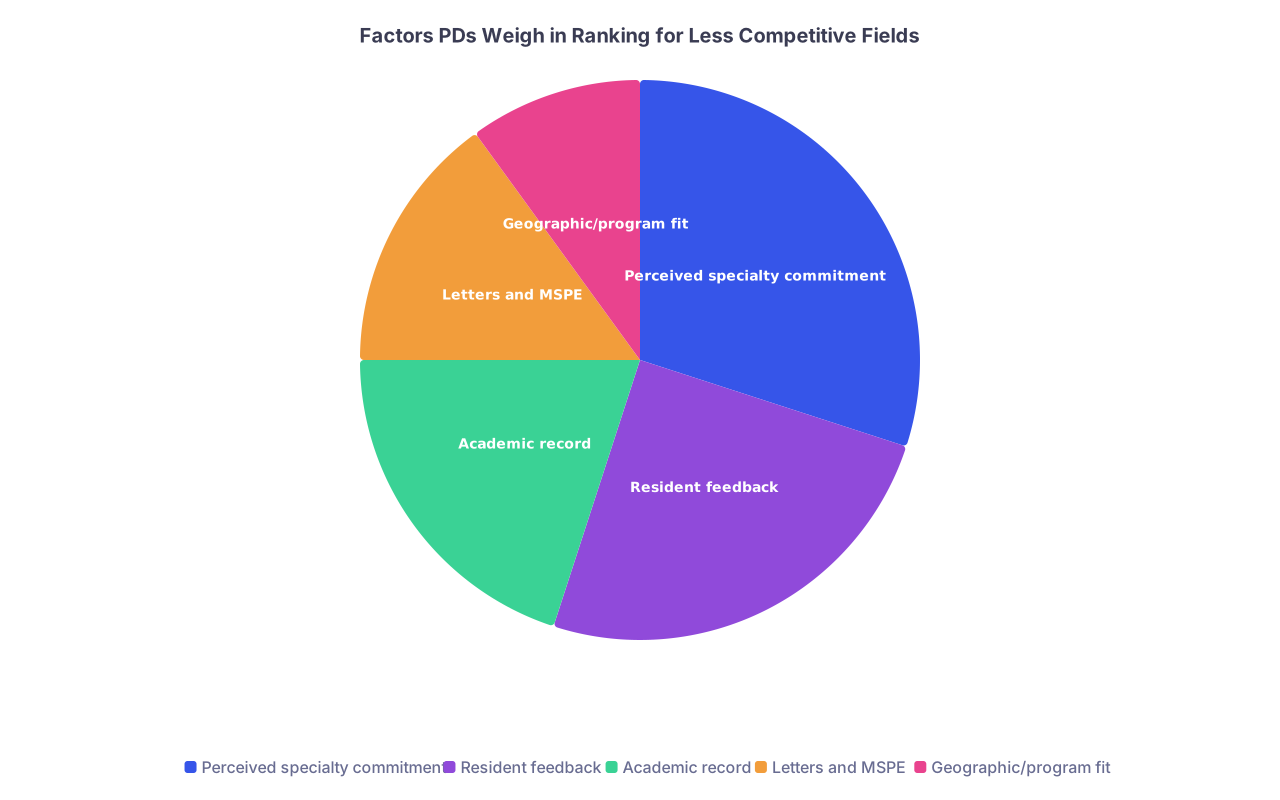
In these “easier” specialties, the conversation very often starts like this:
“Okay, who actually wants to do this specialty?”
They sort the group first by perceived commitment, then by metrics. Not the other way around.
A very typical discussion goes like this:
- Applicant A: 250s, strong research, patchy story, clearly wanted EM.
- Applicant B: 225, weaker research, but has done consistent FM/psych/peds related work for years, knew the program well.
Who gets ranked higher? In derm, ortho, or rads, it’s Applicant A without blinking. In FM, psych, peds, many PDs will put Applicant B ahead. Intentionally.
Why? Because they have lived what happens when they take people who are “settling”:
- Residents leave after PGY-1
- Chronic burnout
- Poor morale, toxic complaining
- Extra call coverage for everyone else when they leave or disengage
They’re not guessing. They’re reacting to actual pain.
So if you wonder why your objectively stronger stats didn’t get you a higher rank at a mid-tier FM or psych program, this is often the reason. They didn’t believe your commitment.
How to actually show commitment when you pivot into an “easier” field
Let me spell out what works when you’re the reformed gunner now applying to a less competitive specialty.
1. Stop pretending you never wanted the competitive field
They know. Your file screams it.
Own it briefly and then move on.
“I was originally pursuing anesthesia. Over M3, I realized I was more energized by my longitudinal clinic and psych/FM/peds experiences than the OR. It took me a while to admit that to myself, but once I did, my choices lined up more consistently.”
That’s miles better than:
“I always loved family medicine” when your CV is wall-to-wall ortho.
2. Build actual evidence of commitment — before interview day
Last-minute sincerity is obvious.
In these fields, what carries enormous weight:
- Taking a true elective or sub-I in the specialty after your change of heart and getting a letter from it
- Joining or re-engaging with that specialty’s interest group
- Doing even a small, focused project or QI with a faculty member in that field
- Asking for honest mentorship from that department about your switch
If your ERAS looks like “last-minute pivot, but then I actually followed through with behaviors consistent with that pivot,” PDs notice. It moves you out of the “backup only” pile.
3. Do real homework on each program
In FM/psych/peds/community IM, cookie-cutter interest kills you.
You should be able to answer, out loud, before you step into the building:
- What kind of patients do they primarily serve?
- What’s one unique strength or niche of this program?
- Why does this field make sense for you long-term, and why could this program deliver that?
You’re not trying to flatter them. You’re trying to make your story and your choice line up like an adult who thought things through.
The myths you need to discard right now

Let me kill a few bad ideas that are floating around your class group chat.
Myth 1: “In less competitive specialties, they’re just grateful you applied.”
No. They’d rather leave spots unfilled than take obviously miserable bodies. It creates more work for everyone later.
I’ve seen programs in FM and psych go partially unfilled rather than rank people who gave off strong “I don’t want to be here” energy. They’ll take the hit and fill with SOAP rather than be stuck with a toxic PGY-1 for three years.
Myth 2: “If I have high scores, they won’t care why I’m there.”
High scores are nice. But they also activate suspicion.
A 255 applying psych or FM? You’ll get interviews. But you’ll also get grilled harder on commitment. PDs have seen enough high-scoring residents who viewed their field as beneath them. They’re not excited to repeat that.
When you’ve got stronger-than-typical stats for the field, your job is not to downplay them. It’s to explain, clearly, why you still chose this work.
Myth 3: “I can fake passion for a day.”
You can’t. Not to people who’ve been doing this 10–20 years and have watched the same movie every cycle.
They watch where your eyes light up. Which topics you drop quickly. Whether your “I love outpatient continuity” actually matches the rest of your application.
They’re not looking for theater. They’re looking for coherence.
What this all boils down to

Program directors in so-called “easier” fields are not stupid and they’re not desperate. They know they’re functioning as the safety net for a lot of you.
So they’ve retooled interview day into a giant filter for one core variable:
Will you actually thrive here, in this specialty, with these patients, for years — or are you just passing through?
If you’re pivoting into FM, psych, peds, community IM, prelim, or TY, stop assuming you only need to show you’re competent. You need to show you’ve grown up enough to really choose them.
Done well, that story is not a weakness. It can be your strongest asset — because PDs in these fields know what it looks like when someone fights their ego, reassesses, and chooses meaning over prestige.
They did it themselves.
Quick takeaways
- In less competitive specialties, perceived commitment often outranks raw metrics in rank meetings.
- PDs and residents use every part of interview day — casual chats, resident lunches, “why this specialty” questions — to test if you see them as a backup.
- If you pivoted from a more competitive field, you must offer a coherent, honest, specific story backed by your behaviors, not just your words.