
The biggest myth in residency hunting is that “rural = bad training” and “urban = better by default.” That lazy binary is how people end up in the wrong program for the wrong reasons.
You are looking at low-competition specialties. Good. That means you actually have options. Now the real question: what kind of training environment are you walking into if you choose a rural low-competition program vs an urban one?
Let me break this down specifically.
1. What “Low-Competition” Actually Looks Like in Rural vs Urban
We are not talking about dermatology in Manhattan. We are talking about specialties and programs that routinely go unfilled or fill deep into the rank lists.
Think of:
- Family Medicine
- Psychiatry (especially community / state hospital–heavy programs)
- Internal Medicine prelims and weaker categorical community IM
- Pediatrics at smaller community hospitals
- Transitional Year in non-glamorous locations
In the low-competition bucket, you see two big archetypes:
- Rural, service-heavy, community-focused programs
- Urban, safety-net / community programs with weaker academic pull
Forget labels like “top” and “bottom” for a second. The real variables are:
- Case mix
- Supervision structure
- Ancillary support
- Autonomy level
- Where graduates actually go
Let’s compare the typical rural vs urban low-competition setups.
| Aspect | Rural Low-Competition Program | Urban Low-Competition Program |
|---|---|---|
| Setting | Small town / micropolitan | Mid-size city or large metro periphery |
| Hospital Type | Small community / critical access | Community, county, or safety-net |
| Academic Affiliation | Often distant or minimal | Often nominal vs strong (varies widely) |
| Patient Population | Underserved, stable, low turnover | Underserved, high turnover, diverse |
| Resident Autonomy | High, earlier | Moderate, often more layers / bureaucracy |
| Competition Level | Low match pressure | Low–moderate, more applicants per spot |
The “least competitive” programs are not identical. A rural FM program in the upper Midwest is a completely different world from an urban community psych program in a rust-belt city. If you treat them as interchangeable just because they are both “easier to match,” you are already making a mistake.
2. Clinical Exposure: Breadth, Volume, and Case Mix
You are training to practice medicine, not to collect a ZIP code. The clinical environment is the core difference.
Rural Low-Competition Programs: Broad, Deep, but Narrower Spectrum
In rural settings, especially in Family Medicine and general IM:
- You see everything that walks in the door because there is no one else.
- You often manage patients longer and more comprehensively.
- Transfers to tertiary centers are common for very complex pathology.
Patterns I keep seeing:
Family Medicine (Rural)
- Heavy emphasis on full-spectrum care: prenatal visits, deliveries (in some programs), geriatrics, chronic disease, ED coverage, nursing home care.
- Less sub-specialty “hand-off” culture. You manage heart failure, COPD exacerbations, diabetic foot infections more completely.
- Less exposure to ultra-rare pathology, more exposure to high-acuity “everyday” emergencies with fewer safety nets.
Psychiatry (Rural / semi-rural)
- Fewer psychiatrists in the region, so you become the de facto mental health workforce.
- You see huge volumes of depression, anxiety, substance use, bipolar disorder, chronic psychotic disorders.
- Less super-subspecialty exposure (consult-liaison, neuropsych, forensics), unless it is built into your rotations at distant affiliate hospitals.
Internal Medicine / Peds (Community Rural)
- Strong continuity with patients. Residents sometimes follow a patient’s entire trajectory: outpatient → ED → inpatient → rehab.
- Narrow specialist availability; lots of “curbside” phone consults with a cardiologist 2 hours away.
- Fewer in-house formal consults, more personal responsibility for diagnostic and management decisions.
In short: rural programs often give you wider responsibility but somewhat narrower tertiary-level exposure. That is not inherently bad. It just fits a specific kind of future practice.
Urban Low-Competition Programs: More Pathology, More Chaos
Urban low-competition programs, especially in safety-net or county hospitals, are a different beast.
- Huge volume, high turnover. Patients cycling through EDs, poor primary care access, severe social determinants of health.
- You see advanced disease: end-stage liver disease in 30s, HIV with OIs, uncontrolled diabetes in every fourth patient, polysubstance use in half the ED board.
- Subspecialties are more present physically, but involvement depends heavily on hospital culture.
Concrete examples:
A community psych program in a large urban center:
- Constant flow of involuntary holds, acute psychosis, meth, fentanyl, alcohol withdrawal.
- Strong exposure to crisis work, inpatient units, forensic evaluations in some locations.
- But outpatient continuity may be fragmented and overburdened clinics can limit depth of follow-up.
An urban community internal medicine program:
- Plenty of bread-and-butter, plus complex multi-system disease.
- Pulm, cards, GI in-house – but you may be primarily a “page operator” for consults, depending on the culture.
- The danger: becoming good at “triage and referral” but weaker at longitudinal, nuanced management if the program does not force you to own patients.
Urban Family Medicine:
- Heavy OB in some programs (particularly at safety-net hospitals), heavy pediatrics, immigrant health.
- Scheduling packed: double-booked clinics, constant overcapacity.
- Risk of burnout from sheer volume and social complexity.
Urban low-competition programs skew toward volume and complexity of pathology, but with more fragmentation and more bureaucracy.
3. Autonomy, Supervision, and “Scope of Practice”
This is where the stereotype has a kernel of truth: rural programs often give you more autonomy, faster.
Rural Programs: High Autonomy, High Responsibility
Common patterns I see in rural low-competition programs:
- Night coverage with fewer layers: one resident (maybe with a midlevel), one attending at home or in-house. That is it.
- You staff procedures yourself: lines, intubations (in some), lumbar punctures, joint injections, OB triage, point-of-care ultrasound.
- Call can be intense because you cover multiple services simultaneously.
This produces:
- Graduates who are comfortable being the only doctor in the building at 2 a.m., which is exactly what community and rural practice really is.
- Early development of clinical judgment without constant attending micromanagement.
The downside:
If the program is poorly structured, you can end up doing too much for your training level with shaky backup, or doing a lot of “scut” because there is no one else.
Urban Programs: More Layers, More Structure, Less Flexibility
Urban low-competition programs vary, but the pattern:
- More hierarchy: interns, seniors, fellows, attendings, multiple consulting services.
- More policies and protocols; less “do what you think is right” freedom.
- Some procedures are eaten up by fellows or specialty services; residents may get less hands-on experience.
Where this is good:
- You receive more structured teaching, formal sign-outs, teaching conferences, morbidity and mortality reviews.
- You are less likely to be left alone out of your depth with a crashing patient and no attending reachable.
Where this backfires:
- You can finish residency having rarely been the primary decision-maker without a fellow or attending shadow.
- You may be weaker when you step into independent community practice where there is no nephrology fellow to bounce a thought off at 2 a.m.
4. Education, Didactics, and Academic Connection
There is a painful truth: in low-competition programs, the formal academic environment is often weaker. The question is how it differs by setting.
Didactics: Rural vs Urban
You will hear versions of this on interview days:
- “We have protected didactics every week.”
- “We emphasize board prep and evidence-based medicine.”
Sometimes true. Sometimes sales pitch.
Patterns:
Rural programs
- Smaller faculty pool; you might have 6–10 core faculty in FM or IM total.
- Didactics can be very practical, case-based, and clinically oriented. Less subspecialty fluff.
- Board prep sometimes under-prioritized if leadership is more service-oriented and less exam-focused.
Urban programs
- More access to subspecialists and guest lecturers.
- More likely to have structured curriculum maps, question banks, and in-house board-review series.
- But didactics can get canceled more from service pressure, especially in safety-net environments where “protected time” mysteriously evaporates when the ED is overflowing.
You have to actually ask residents:
“How often are didactics canceled?”
“Who mainly teaches? Generalists or subspecialists? Fellows?”
“What was your last 4-week didactic block about?”
Academic Affiliation and Research
Most low-competition programs will tell you they are “affiliated with” some university. That might mean anything from:
- Fully integrated academic department, to
- “Our program director once did a rotation at that university 15 years ago.”
Typical differences:
Rural programs
- Research is limited. Maybe one QI project per resident. Real clinical research rare unless tethered to a large academic center.
- Networking to competitive fellowships is weaker but not nonexistent. You need hustle, away rotations, and letters from outside electives.
- If you want a big-name fellowship from a rural FM or IM program, you essentially have to build your own pipeline.
Urban low-competition programs
- Slightly more research opportunities, particularly retrospective chart reviews and QI in high-volume hospitals.
- Potential to collaborate with university faculty if there is a genuine, active link.
- Easier path to community-based fellowships (cards, GI borderline; pulm/CC, heme/onc sometimes reachable from strong community IM with a few publications and strong letters).
If you are dead-set on a competitive fellowship, a truly isolated rural low-competition program will make your pathway harder. Not impossible. Just steeper.
5. Patient Population, Social Complexity, and Lifestyle
The work feels different because the patients are different.
Rural Patient Population: Underserved, Relational, Less Transient
Typical features:
- Patients who have lived in that town or region for decades. Extended families across three generations all seeing the same FM clinic.
- Lower diversity in some areas (e.g., heavily white, older, blue-collar) but not always—border regions, tribal communities, and migrant-heavy regions can be highly diverse.
- Barriers to care are geographic: lack of transport, lack of local specialists, limited home health resources.
Clinical impact:
- You see long-term consequences of limited preventive care: poorly controlled HTN, late-stage cancers, unmanaged mental health.
- You become very good at working within resource limitations: no MRI today, no cardiac cath here, tele-psych only on certain days.
- Relationships matter. Patients know you, recognize you in the grocery store, and hold grudges or loyalty accordingly.
Lifestyle:
- Commute is minimal. You might live 5–10 minutes from the hospital.
- Social options can feel limited if you are used to big-city life. Dating pool is smaller. Restaurants close earlier.
- Cost of living is usually significantly lower. You can live decently on a resident salary without 4 roommates.
Urban Patient Population: High Turnover, High Complexity
In urban low-competition programs, especially in safety-net hospitals:
- Patient population can be highly diverse racially, ethnically, and linguistically.
- Social determinants are brutal: homelessness, substance use, incarceration, food insecurity, unstable immigration status.
- Patients often don’t stay with you long term; they rotate across EDs, clinics, shelters.
Clinical impact:
- You become adept at emergency stabilization, short-term management, crisis planning.
- Continuity care is harder. That longitudinal internal medicine ideal of carefully titrating meds over years? Less common.
- You quickly appreciate the limits of medicine in the face of systemic social problems.
Lifestyle:
- Commute can be painful. Parking can be a war.
- But you have food, culture, nightlife, and anonymity if you want it.
- Cost of living can be crushing, particularly in big cities where the salary structure has not caught up.
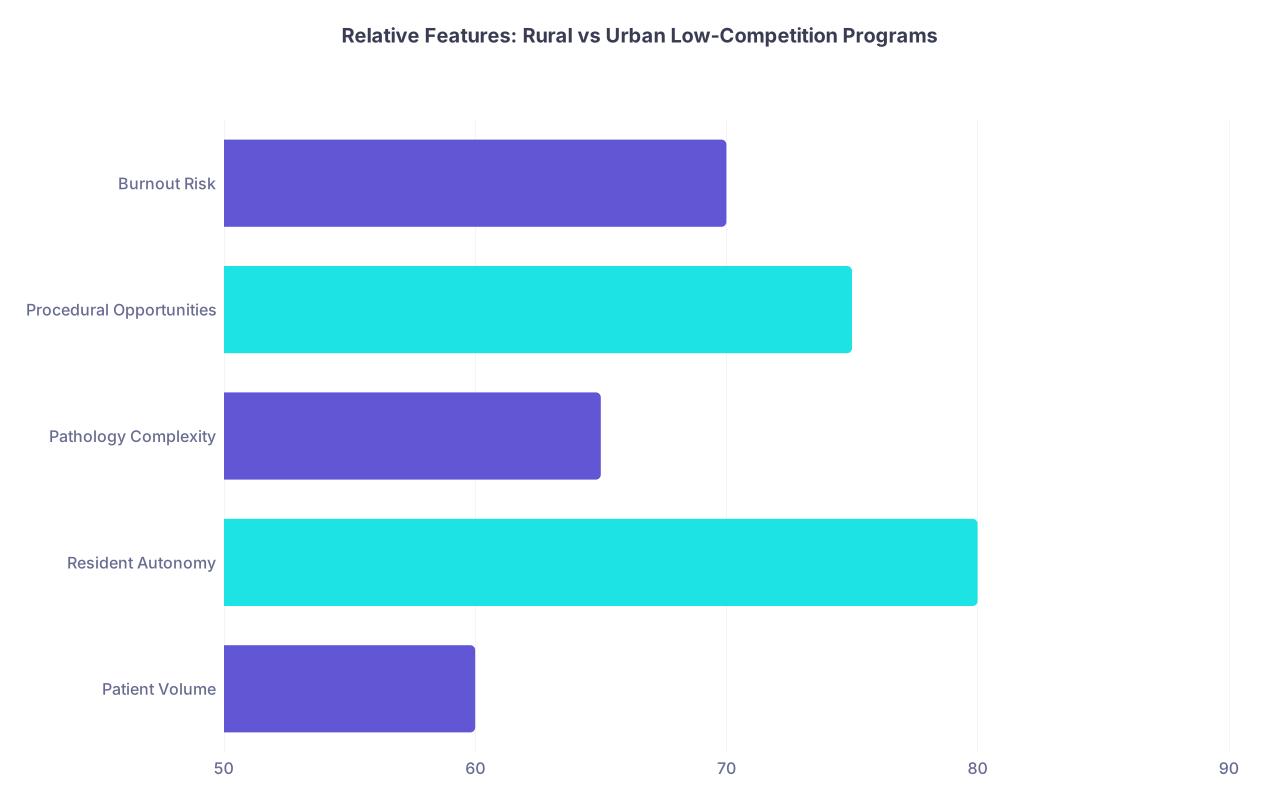
6. Numbers: Volume, Autonomy, and Burnout Risk
Let me quantify the feel of it a bit.
| Category | Value |
|---|---|
| Patient Volume | 60 |
| Resident Autonomy | 80 |
| Pathology Complexity | 65 |
| Procedural Opportunities | 75 |
| Burnout Risk | 70 |
Imagine that chart as “rural” scores; now compare mentally to urban:
- Urban volume often feels like 80–90/100.
- Autonomy more like 60/100.
- Pathology complexity closer to 80–85/100.
- Procedures might sit around 55–65/100 if fellows compete with you.
- Burnout risk? High on both sides, just for different reasons.
Point: neither environment is “easy.” They stress you in different ways.
7. Program Outcomes: Where Do Graduates Actually Go?
This is the part applicants weirdly skip. They look at duty hours and call schedules but never demand hard data on graduate destinations.
You want answers to:
- How many graduates go straight into community practice (and where)?
- How many match into fellowships, and which ones?
- How many leave medicine or switch programs?
Here is the pattern I see repeatedly:
| Outcome Type | Rural Program Trend | Urban Program Trend |
|---|---|---|
| Local Community Practice | High (40–70% stay regionally) | Moderate (20–40% stay locally) |
| Subspecialty Fellowship | Low–moderate (5–15%) | Moderate (10–25%) |
| Hospitalist Jobs (Urban) | Moderate | High |
| Rural / Underserved Jobs | High | Moderate |
Family Medicine rural grads:
- Many become full-scope community docs, sometimes including OB and inpatient.
- A subset go into sports medicine, geriatrics, palliative, but they had to hustle for fellowships.
Internal Medicine urban community grads:
- Lots of hospitalists in nearby cities or suburban hospitals.
- Decent pipeline into mid-tier fellowships if you were proactive.
Psychiatry grads from both:
- Almost all have jobs immediately, but rural grads are often locked into the same region by choice or recruitment deals.
- Urban grads may have more options in metro areas but can still land rural jobs easily.
Bottom line: If your end goal is big-city subspecialty academia, a purely rural low-competition program is an uphill battle. If your goal is competent, independent community practice, rural programs can be absolute gold.
8. Selection Strategy: How to Choose Between the Two
Let me be blunt. Your decision should not be “Which one is slightly more competitive?” It should be “Which environment fits the kind of physician I want to become?”
Ask Yourself First
- Do you prioritize autonomy and broad generalist competence or pathology density and subspecialist access?
- Are you committed (or very open) to practicing in a smaller town after residency?
- Is a competitive fellowship a serious goal, or are you leaning toward straight-to-practice?
If you answer:
- “I want to be a strong, broad, independently functioning community doc, fellowship optional” → Rural, full-spectrum programs move up your list.
- “I might want cards, GI, heme/onc, or academic psych” → A stronger urban program (even low-competition) with solid subspecialist access and research wins.
Red Flags Specific to Rural Low-Competition Programs
I have seen rural programs that are fantastic and others that are human sacrifice zones. Watch for:
- Chronic understaffing, constant violations of duty hours masked as “professionalism.”
- No regular didactics, no board review structure, terrible in-training exam scores.
- Program director absenteeism, leadership turnover, or a “service first, education maybe” vibe.
Red Flags Specific to Urban Low-Competition Programs
Urban does not equal safe. Red flags:
- Residents talking about “toxic” attendings, but speaking in whispers in the stairwell.
- Didactics constantly canceled for “patient care needs.”
- Scut-heavy rotations where you mainly chase labs, do transport, or function as a clerk instead of a trainee.
- Non-existent support for research or QI despite marketing materials claiming otherwise.
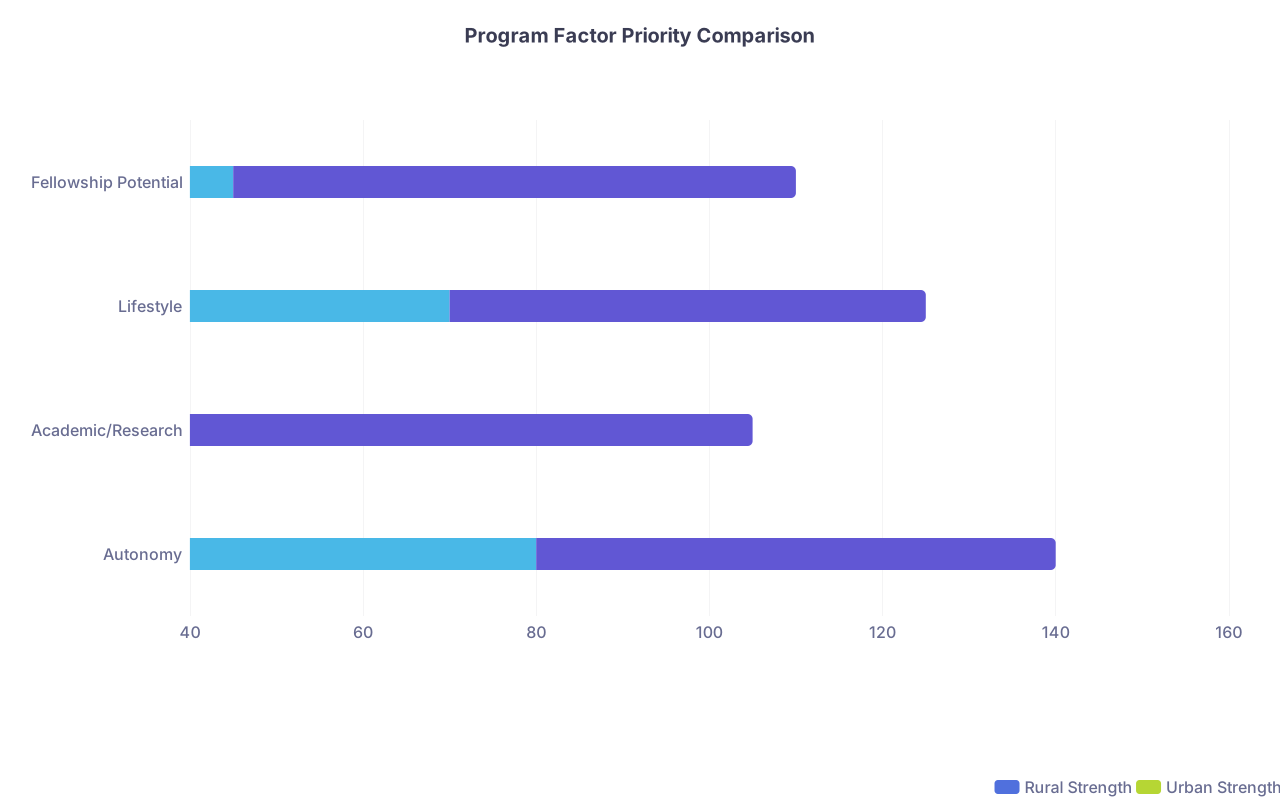
Practical Comparison Framework
When you have a rural and an urban low-competition program on your list, compare them explicitly on:
| Category | Rural Strength | Urban Strength |
|---|---|---|
| Autonomy | 80 | 60 |
| Academic/Research | 40 | 65 |
| Lifestyle | 70 | 55 |
| Fellowship Potential | 45 | 65 |
Translate that into real questions:
- Autonomy: “On nights, who is physically in the hospital? How quickly can attendings come in?”
- Academic/Research: “How many residents present at regional/national meetings each year?”
- Lifestyle: “What is your average commute? How often do you come in post-call? How many residents quit in the last 5 years?”
- Fellowship: “Name the last 10 graduates who matched into fellowships. Where and in what fields?”
If they stumble on those answers, you have learned something.
9. Specialty-Specific Nuances in Low-Competition Fields
Since you are in the “least competitive specialties” universe, let me map this onto a few of them.
Family Medicine
- Rural FM can be extremely strong if:
- You have OB exposure (including deliveries), inpatient FM, ED shifts, and procedural clinics (colposcopy, joint injections, skin procedures).
- Faculty actually practice that same full-scope medicine.
- Urban FM can be ideal if:
- You want urban underserved primary care, HIV care, addiction medicine, or want to later sub-specialize (sports, palliative, academic primary care).
- Research and advocacy are priorities.
Family Medicine is the specialty where rural training can arguably produce the most “complete” generalist if the program is well-run.
Psychiatry
- Rural/small-town psych:
- Incredible for breadth of general adult and some child/adolescent.
- Less access to niche rotations like neurostimulation, ketamine clinics, advanced forensics unless partnered with academic centers.
- Urban psych:
- More likely to have subspecialty clinics (first-episode psychosis, treatment-resistant depression, gender clinics, integrated addiction programs).
- Patient volume and acuity can be overwhelming; staff burnout is real.
If you are fine being a general psychiatrist doing outpatient + inpatient community work, rural or urban both work. For highly specialized academic psych, urban affiliation helps.
Internal Medicine
- Rural / small community IM:
- Strong for hospitalist or outpatient general IM careers, especially in smaller communities.
- Harder pathway to ultra-competitive fellowships unless you deliberately build a CV.
- Urban community IM:
- Better for fellowship prospects, especially if you find mentors and do decent research/QI.
- Be careful of programs where residents are essentially note-writing machines for subspecialties.
If you are already leaning toward hospitalist or outpatient IM, a strong rural IM program can make you very competent. If you want cards/GI, urban with real academic tie-ins is safer.
10. How to Use This When Ranking Programs
You are not picking a vacation destination. You are picking a training ecosystem that will shape your habits, your blind spots, and your career ceiling.
Here is how to apply all this:
Write down your non-negotiables.
Examples: “Must have strong OB in FM,” or “Need a decent shot at pulm/CC fellowship,” or “Cannot live more than 45 min from a major airport.”Classify each program you are considering:
- Rural low-competition
- Urban low-competition
- Hybrid (semi-rural in a small city with university tie-in)
For each program, answer:
- What exactly is the clinical exposure? (Inpatient, outpatient, OB, ICU, ED, subspecialty clinics.)
- What level of autonomy is realistically expected at PGY-1, PGY-2, PGY-3?
- Who are recent alumni and what are they doing now?
Rank for training, not ego.
A “no-name” rural FM program that churns out superb, broad-scope community physicians may serve you far better than a “better known” urban FM program that treats you like cheap labor.Be honest about your own tolerance for environment.
If you know you will be miserable in a small town, do not pretend otherwise. Miserable residents do not magically become better doctors.
You are not just choosing between rural and urban. You are choosing between two different shapes of physician identity:
- The high-autonomy, broad-scope, community-grounded clinician who can handle being the only doc in town.
- The high-volume, high-complexity, system-savvy clinician who thrives in large, messy urban medical ecosystems and may chase subspecialty training.
Both are valid. Both can emerge from low-competition programs. The training environment is the lever.
With this framework in your head, you are finally in a position to judge programs on something more intelligent than ZIP codes and board pass rates. Next step is tougher: having those direct, uncomfortable conversations with residents and faculty on interview day and away rotations. That is where the real data lives. And that is a story for another day.