
The assumption that “less competitive” specialties are cushy and relaxed about boards is wrong.
In fact, the pass rates and exam prep culture in many undersubscribed specialties are more fragile, more variable, and more dependent on program culture than in the big-name competitive fields. When you do not have a constant flood of 260+ applicants and research machines, the system behaves very differently.
Let me break this down specifically.
What “Undersubscribed” Actually Means for Boards
First, clear up the language. Programs and specialties get labeled “least competitive” or “undersubscribed” for a few reasons:
- They routinely go unfilled in the Match or SOAP
- They attract a higher proportion of lower-step-score applicants on average
- They’re located in less desirable geographic regions
- They lack a prestige / lifestyle narrative that drives demand
Think: family medicine in certain community programs, psychiatry before it became hot (and still some community psych), pathology, PM&R in weaker institutions, neurology in non-academic centers, preventive medicine, and transitional-year or prelim IM spots in small hospitals.
This matters for board pass rates because of three structural things:
- Lower average test-taking baseline of incoming residents
- Less institutional pressure from “brand-sensitive” departments
- Highly variable teaching infrastructure and exam prep culture
So you can have a specialty like family medicine with excellent overall national certification pass rates at strong academic programs, and simultaneously see borderline or alarming pass rates at small, chronically under-filled community programs.
How Board Pass Rates Actually Behave in “Less Competitive” Fields
Let’s put some approximate structure on this. I am not giving you secret proprietary numbers. I am giving you the pattern I have seen across specialties and programs.
For ABFM (Family Medicine), ABPN (Psychiatry), ABPath (Pathology), ABPMR (PM&R), ABPN for Neurology, etc., you see three tiers:
- Top academic / well-organized community programs
- Middle-of-the-road but functional programs
- Under-resourced, chronically under-filled, or disorganized programs
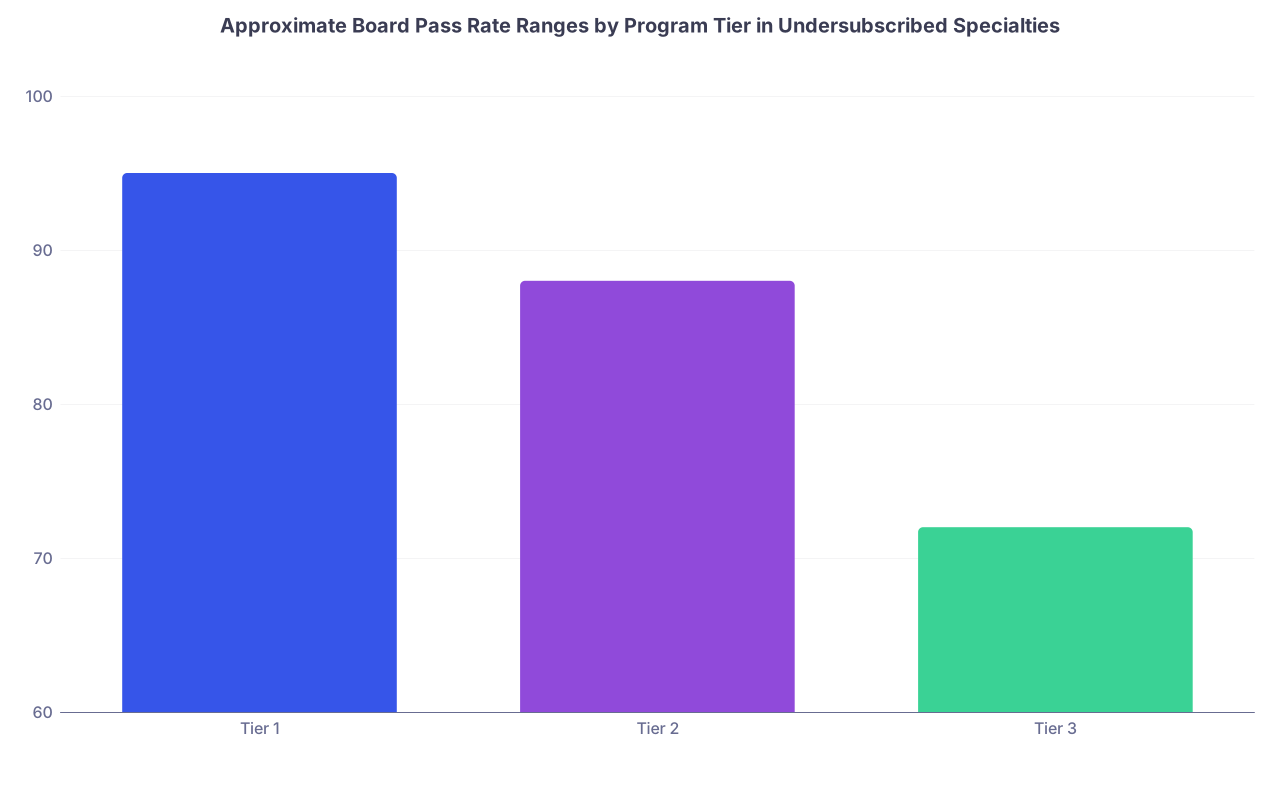
The board pass rate spread between Tier 1 and Tier 3 can easily be 15–25 percentage points.
| Category | Value |
|---|---|
| Tier 1 | 95 |
| Tier 2 | 88 |
| Tier 3 | 72 |
Those numbers are not from one board, but they represent the general story:
- Strong programs: mid-90s+ first-time pass rates are routine
- Decent programs: high 80s, low 90s, relatively stable
- Weak / undersubscribed programs: high 60s to low 80s. And some single years even worse if a class has multiple strugglers
In hyper-competitive fields (derm, plastics, ortho, rad onc), a 70–75% first-time board pass rate would cause an institutional panic and probably a leadership change. In the “least competitive” fields, the same number might be hand-waved as “we had a tough cohort.”
That cultural difference is the real hazard.
Why Pass Rates Are So Volatile in These Programs
The variability is not random. It tracks with five very specific factors.
1. Incoming Test Baseline
You cannot ignore input quality. If a program is consistently filling with:
- Step 1: pass on second attempt or just above minimum
- Step 2 CK: 205–220 rather than 240+
- Multiple remediation events in medical school
then you end up with a resident body that includes more truly board-vulnerable trainees.
Now, plenty of residents with 210s become excellent clinicians and pass the boards. I have seen it many times. But you cannot deny that, statistically, lower prior test performance correlates with harder board prep. In an undersubscribed specialty, a program might have 30–40% of each class in this higher-risk category. In ortho or ENT, that proportion is tiny.
In a small 6-resident-per-class family medicine program, if two residents are board-vulnerable and the program’s support structure is weak, suddenly your class pass rate drops to 66%. Now your program goes on the ACGME radar. It snowballs.
2. Faculty Culture Around Exams
This is where “least competitive” specialties split into two worlds.
World A: exam-aware, academically serious departments
World B: “we’re a clinical field, the test is a formality” departments
In World A, you hear:
- “What are your ITE percentiles?”
- “We expect above the national average; how can we help?”
- “Did you finish your question blocks this month?”
In World B, you hear:
- “You’re smart, you will be fine.”
- “When I took the boards, I just read this one review book.”
- “We are too busy to do in-service review; just study on your own.”
The second group is where residents get blindsided. These comments usually come from older faculty who took a very different exam years ago, with fewer restrictive policies, different item styles, and, frankly, lower expectations for test sophistication.
If you are in an undersubscribed specialty program in World B, your board risk is higher independent of your raw intelligence.
3. Structure (or Lack) of Didactics
In competitive specialties, didactics are often rigidly protected. Conference is sacred. The chair will actually yell if the OR keeps residents from core conference.
In a weaker, less competitive field at a community program, you will see:
- Canceled noon conferences because “clinic is too busy”
- Didactics that are just random case presentations with no curricular backbone
- Faculty who show up unprepared and improvise off fuzzy memory
- No mapped curriculum aligning rotations, didactics, and board content outline
You might still learn good clinical practice from attendings, but your board exposure becomes fragmented. Residents then rely on whatever question bank or resource they happen to buy in PGY-3. Which is often late and disorganized.
4. In-Training Exam (ITE) Follow-Through
Most specialties have an in-training examination that reasonably correlates with board performance. The exam itself is only half the equation. The other half: what the program does with the data.
Let me show you the spread.
| Program Type | Typical Response to <30th Percentile ITE |
|---|---|
| Strong academic | Mandated study plan, assigned mentor, scheduled repeat testing |
| Solid community | Encouraged to study more, maybe optional board review course |
| Weak/undersubscribed | “Try harder next year”, no formal tracking or intervention |
In other words:
- Top programs: treat a low percentile like a serious early warning. They intervene aggressively.
- Middle programs: mildly concerned but not organized.
- Weak programs: shrug.
If you are in category three, your ITE is basically a piece of paper, not a safety net. You have to build your own safety net.
5. Administrative Oversight and ACGME Pressure
Here is the one upside of bad pass rates: they eventually trigger external pressure.
The ACGME and specialty boards do monitor program-level first-time pass rates. Any program that drops too low (usually below some threshold around 80% over multiple years) starts to get attention.
What happens next varies:
- Some departments wake up, hire an associate PD for education, buy a program-wide question bank subscription, and reorganize didactics. Pass rates climb.
- Other departments deny there is a problem, blame “this cohort,” and keep doing the same thing. Residents keep failing and the program slowly earns a reputation.
Undersubscribed specialties have more of the second pattern than they like to admit.
Specialty-Specific Patterns: Who Actually Struggles?
Let us talk about a few classic “less competitive” or historically less sought-after areas and what their exam culture tends to look like.
I will generalize on purpose; your specific program may be an exception.
Family Medicine
Family medicine is bifurcated.
- Strong academic FM programs (major universities, high-volume teaching centers) can have board pass rates in the mid- to high 90s, with excellent curricular mapping to ABFM content and very exam-aware leadership.
- Small community FM programs, especially rural, newer, or frequently under-filled ones, can have volatile rates, sometimes dropping to the 70s in a bad year.
Common exam prep patterns:
- Heavy use of question banks like AAFP Board Review Questions or Rosh Review
- Variable didactic quality. Some programs run structured board review series; others call “journal club” adequate prep.
- A large proportion of residents with non-traditional backgrounds, IMGs, or lower Step scores. This is not inherently bad, but it increases heterogeneity and exam vulnerability.
In a weaker FM program, I see residents who do not start serious ABFM prep until late PGY-3, doing 10 questions here and there, no systematic content review, and no formal board course. These are the ones who come back stunned after failing.
Psychiatry
Psychiatry’s competitiveness has climbed, but pockets of under-subscribed programs still exist, especially in less desirable locations.
The ABPN psychiatry exam has shifted away from the old-style vignettes plus oral exams and toward more standardized MCQs, but many older faculty still think in the “oral boards” era.
Exam culture issues:
- Faculty who assume “everyone passes psych boards” and project their experience from 15–20 years ago
- Residents with weaker baseline test scores but strong interpersonal skills, drawn to psych for the clinical content, underestimating the pharmacology / neuro / forensic heavy parts of the blueprint
- Didactics that are highly psychodynamic or case-discussion oriented, with minimal rigorous pharmacology, neuroscience, or guideline-based care review
Good psych programs now use systematic ABPN-aligned curricula and question banks (e.g., Beat the Boards, BoardVitals, etc.). The bad ones still have random noon conferences on a fascinating, but entirely non-testable niche topic while ignoring bread-and-butter psychopharm.
Pathology
Pathology is a test-heavy specialty. Ironically, it has been one of the most undersubscribed fields in some cycles.
Strong pathology programs are obsessively exam-oriented: daily unknowns, slide sessions, structured review of neuropath, heme, surg path, etc. Residents there live inside question banks and image banks. Their boards reflect that; pass rates are usually high.
Weak or chronically undersubscribed pathology programs look very different:
- Service-heavy with limited structured teaching
- Faculty coverage gaps, especially in niche subspecialties, leaving blind spots in training
- Residents who do a lot of “sign-out” but not enough systematic concept review
Board prep can become a last-minute scramble of buying a big question bank, printing off unknowns, and trying to cram subspecialties that they never saw properly on service. That is where failures cluster.
PM&R and Neurology
PM&R and neurology often live in the “middle-tier” competitiveness space, but there are many under-subscribed programs.
Patterns:
- Highly variable didactics. Some places essentially run a mini-fellowship-style curriculum with excellent neuroanatomy, EMG, rehab medicine, and MSK teaching. Others hand you a pager and say “you will learn on consults.”
- Board prep timing is inconsistent. Some programs start structured board review in PGY-2. Others pretend the written boards do not exist until late PGY-3 or PGY-4.
- In neurology especially, residents with weaker internal medicine / pathophys background can struggle with the basic science components if these are not systematically reinforced.
The result? You can find PM&R and neuro programs boasting near-perfect pass rates and others with repeated classes below national averages.
Exam Prep Culture: What Strong Undersubscribed Programs Do Differently
“Least competitive” does not have to mean “academically sloppy.” Some of the best educational cultures I have seen were in family medicine and psychiatry departments that took pride in building excellent clinicians and strong test-takers from a very heterogeneous applicant pool.
Here is what those programs do that weak programs usually do not.
They Treat The Boards as a Hard Outcome, Not a Formality
In these programs, the chair actually cares about:
- First-time pass rate
- ITE trend lines for each resident
- Aggregate scores compared with national norms
They talk about the exam openly, not as a taboo or as “something we do not worry about here.” They normalize:
- Early identification of struggling residents
- Mandatory support plans
- Using pass/fail data to improve the curriculum
There is no shame culture, but there is accountability.
They Build a Curriculum Backwards from the Board Blueprint
The smart programs literally map the board content outline to:
- Rotations
- Lecture topics
- Journal clubs
- Simulation sessions
They make sure that, for example, the ABFM or ABPN blueprint domains are each covered multiple times over three years with increasing sophistication.
Weak programs run unstructured “interesting cases” conferences that may or may not align with anything testable.
They Institutionalize Question-Based Learning
In strong but “low-competitiveness” fields, you still see:
- Program-funded access to major question banks for all residents
- Dedicated question review times during conference
- Faculty modeling how to dissect questions, not just recite facts
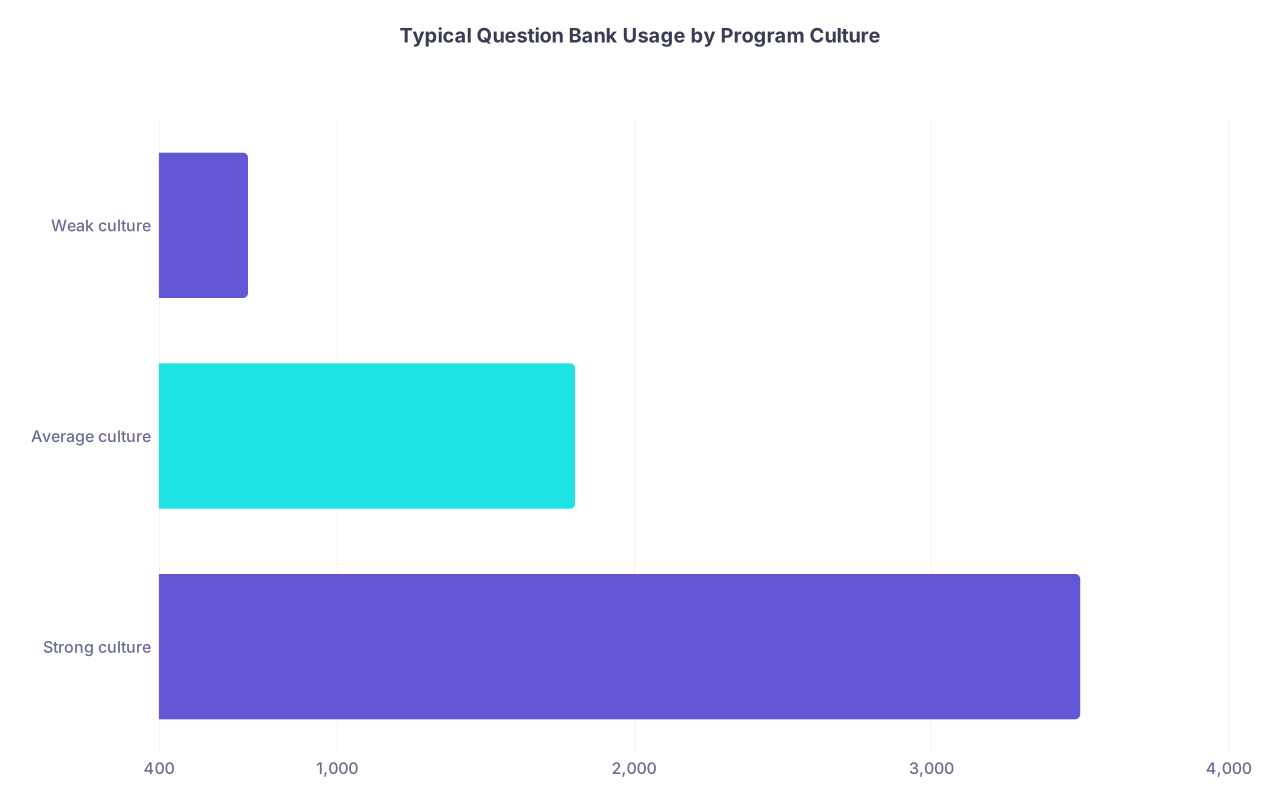
Residents accumulate 2,000–4,000+ questions by graduation. Not 300 done the last month.
| Category | Value |
|---|---|
| Strong culture | 3500 |
| Average culture | 1800 |
| Weak culture | 700 |
Those numbers are typical orders of magnitude. The gap matters.
They Intervene Early and Formally
In these places, scoring below a certain ITE percentile triggers:
- A mandatory meeting with PD or APD
- A written study plan with concrete resources and weekly targets
- Often a requirement to attend a live or virtual review course
- Follow-up, not just “sign this and disappear”
You are not left to drown alone. But you are also not allowed to stay in denial.
What Exam Prep Culture Feels Like on the Ground
Let me give you two contrasting day-in-the-life snapshots; you have probably seen one of these.
Program A – Undersubscribed Specialty, Strong Exam Culture
Noon conference, Tuesday. Residents from all years show up because the chair will walk the halls if they do not.
The topic: “ABFM Cardiovascular Domain Review – Part 2”. The faculty presenter has the board blueprint on one slide, and 15 questions from a board-style bank integrated through the hour. They keep asking: “How would the exam phrase this?” Residents argue answer choices, not just pathophys.
Once a month, everyone reviews ITE-style questions as a group. Senior residents are expected to help PGY-1s learn test strategy. It is in the evaluation form.
There is a visible calendar in the workroom with:
- ITE exam dates
- Board application deadlines
- Benchmark “finish 50% of QBank” dates
Everyone jokes about being tired, but nobody jokes that “boards do not matter.”
Program B – Undersubscribed Specialty, Weak Exam Culture
Noon conference, same Tuesday. Three residents show up. The rest are “too busy with clinic,” which is code for no one fought for protected time.
The lecture: “A Rare Case of Something You Will Never See.” Interesting? Sure. Relevant to the board blueprint? Barely. The PowerPoint has zero exam-style questions.
ITE scores come back by email. A PGY-2 with a 25th percentile is told, “You are fine, just read more.” There is no follow-up after that one conversation.
No one has a sense of how many questions they should finish by PGY-3. Nobody tracks anything. If someone fails the boards, it is treated as random bad luck, not as a system failure.
That second environment is exactly where residents in “least competitive” specialties get caught off guard. Not because they are lazy, but because the culture actively minimizes the exam.
What You Should Do If You Are Entering an Undersubscribed Specialty
You cannot control the NRMP fill rate or your program’s history. You can control how you approach the exam prep culture you find.
1. Investigate Pass Rates and ITE Culture Before You Rank
Residents are often polite to a fault during interviews, but you can ask precise questions.
Ask:
- “What has your board pass rate been over the last 5 years?”
- “What happens if someone scores below the 30th percentile on the in-training exam?”
- “Do you receive program-funded access to any board prep question banks or courses?”
- “Are residents given protected time for board study in PGY-3 / PGY-4?”
If answers are vague, dismissive, or “we do not worry about that,” red flag.
2. Assume You Need an Independent Study Plan
Even in good programs, you should have your own structure.
- Pick a primary QBank early PGY-2 (for 3-year programs) or early PGY-3 (for 4-year programs).
- Aim for a clear numeric question target (for most written boards, 2,000–3,000+ questions is reasonable).
- Tie your reading to the board blueprint, not just what comes through the pager.
Create your own mini-curriculum:
- Each block or rotation: pick one domain (e.g., “cardio,” “psychopharm,” “musculoskeletal”) and systematically hit it.
- Track your ITE scores year over year and be brutally honest about weak domains.
3. Use the ITE as a Full Dress Rehearsal, Not a Throwaway
Residents in undersubscribed specialties sometimes unconsciously internalize the “we are not derm or ortho, we do not live and die by tests” mindset. It bleeds into how they approach the ITE.
Treat ITE like a dry run for your written boards:
- Take it seriously each year; mimic exam conditions.
- Analyze your score report in detail; identify content clusters, not just overall percentile.
- If you land below roughly the 35–40th percentile, assume you are board-vulnerable unless something changes.
Do not wait for the program to initiate a plan. You initiate it and then pull the program in to help.
4. Build Your Own Peer Micro-Culture
In a weaker exam culture, one of the smartest moves you can make is to form a small resident group who do care about the boards.
Even 2–3 peers who:
- Share question progress weekly
- Do 20–30 questions together once a week and argue answer choices
- Swap notes on weaknesses and resources
can create a parallel culture that keeps you on track even when the department at large is drifting.
How This All Plays Out Long-Term
The downstream consequences matter more than just “pass vs fail.”
In undersubscribed specialties, the residents who have strong board performance and can speak to their self-directed exam prep often end up with better fellowships and jobs. Not because programs fetishize scores, but because they signal:
- Reliability under pressure
- Ability to master a broad content base
- Discipline in training
Programs and employers know the difference between someone who coasted through a lax training environment and someone who built structure inside it.

| Step | Description |
|---|---|
| Step 1 | Undersubscribed Specialty Program |
| Step 2 | High ITE scores |
| Step 3 | High board pass rates |
| Step 4 | Low or variable ITE scores |
| Step 5 | Lower board pass rates |
| Step 6 | Competitive fellowships |
| Step 7 | Remediation or delay |
| Step 8 | Strong Exam Culture |
| Step 9 | Weak Exam Culture |
Residents from strong exam-culture programs in “least competitive” fields frequently outperform residents from flashy name-brand but chaotic departments when it comes to actual board outcomes and fellowships.
Key Takeaways
- “Least competitive” does not mean “low risk.” Board pass rates in undersubscribed specialties can be highly variable and fragile, especially in small or under-resourced programs.
- Exam prep culture—how your program handles ITE scores, didactics, question banks, and accountability—matters more than the specialty label.
- If you land in a weak exam culture, you cannot afford to passively absorb it. You need your own structured plan, your own question volume target, and often your own micro-culture of peers who take the boards seriously.