
It’s Monday of Match Week. 10:59 a.m. Eastern. Your email is open, NRMP page refreshed.
The result pops up: “You did not match to any position.”
Your chest drops, but the clock does not care. At 11:00 a.m., the SOAP-eligible list opens. Low-competition programs—FM, psych, peds, IM prelims, maybe community neurology or pathology—are sitting there with unfilled spots. For about 72 hours, it’s a knife fight for those relatively safer specialties.
Here’s the timeline of what you should be doing, hour by hour and day by day, to target remaining low-competition spots without panicking or wasting applications.
Big Picture Timeline of Match Week (SOAP-Focused)
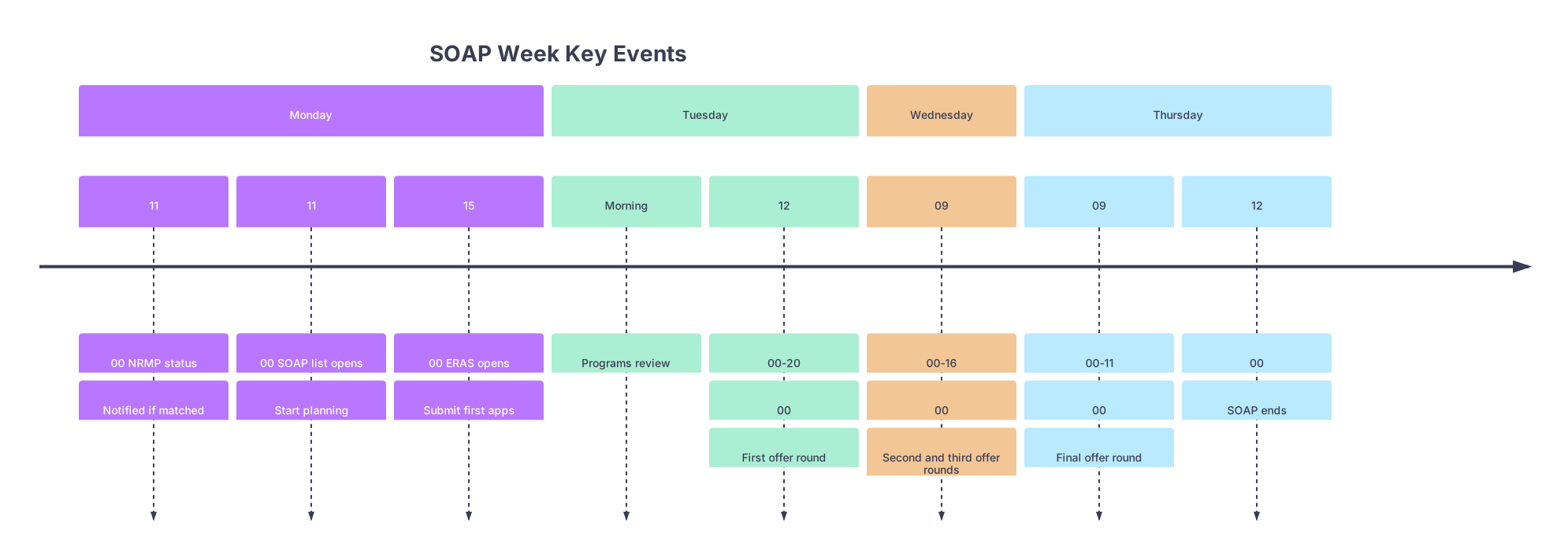
| Period | Event |
|---|---|
| Monday - 11 | 00 NRMP status |
| Monday - 11 | 00 SOAP list opens |
| Monday - 15 | 00 ERAS opens |
| Tuesday - Morning | Programs review |
| Tuesday - 12 | 00-20 |
| Wednesday - 09 | 00-16 |
| Thursday - 09 | 00-11 |
| Thursday - 12 | 00 |
Match Week for SOAP (times Eastern; double-check each year):
| Day | Time | Event |
|---|---|---|
| Monday | 11:00 a.m. | Match status released |
| Monday | 11:00 a.m. | SOAP-eligible list opens |
| Monday | 3:00 p.m. | ERAS opens for SOAP apps |
| Tue–Thu | Various | SOAP offer rounds |
| Friday | 12:00 p.m. | Match results for all released |
You don’t control the clock. You do control how ready you are at each checkpoint.
4–6 Weeks Before Match: Quiet Contingency Planning
If you’re reading this before Match Week, good. This is when adults plan for worst-case scenarios.
At this point you should:
Be brutally honest about your risk profile
- Below-average Step 2, no home program, weak letters, or red flags? You’re at risk.
- Applying to ultra-competitive specialties only (ortho, derm, plastics) without a solid backup? Also at risk.
Identify realistic low-competition landing spots Think: least competitive specialties and community-heavy programs:
- Family Medicine (especially community and rural)
- Psychiatry (community, non-coastal)
- Internal Medicine (community, prelim or categorical in less popular cities)
- Pediatrics (non-children’s-hospital heavy markets)
- Transitional or prelim medicine years in smaller hospitals
- Pathology and Neurology at off-the-radar programs
Draft SOAP-ready materials You don’t need full perfection, but you need usable drafts:
- A generic but solid SOAP personal statement focused on:
- Being coachable
- Strong work ethic and reliability
- Genuine interest in underserved or broad-based training
- Shortened, tweakable variant paragraphs for:
- FM/IM
- Psych
- Peds
- Prelim/Transitional year
- Clean, updated CV in ERAS.
- A generic but solid SOAP personal statement focused on:
Talk to your school early
- Meet with your dean / advising office.
- Ask directly: “If I don’t match, who coordinates SOAP support here?”
- Get:
- The list of faculty willing to call programs.
- The person who will help you prioritize applications in real time.
If you do this, Match Monday hurts emotionally, but logistically? You’re ready to move.
Match Monday Morning: 10:45 a.m.–12:00 p.m.
This is the most emotionally brutal 90 minutes of medical school. You don’t have the luxury of freezing.
10:45–11:00 a.m.
At this point you should:
- Be logged in to:
- NRMP
- ERAS
- Your email
- Have:
- Your CV and PS drafts open.
- A spreadsheet or simple list for programs.
11:00–11:15 a.m. – You Learn You Didn’t Match
You will want to spiral. Don’t. Here’s the order of operations.
Confirm SOAP eligibility
- NRMP page will say if you’re SOAP-eligible.
- If not eligible, this guide is not your path; you’re in post-SOAP scramble world.
Quick emotional triage
- Give yourself 5–10 minutes to crash. Then stand up, drink water, and switch to task mode.
- You don’t need “closure” right now. You need a spot.
Contact your school
- Send one clear message:
- “I am SOAP-eligible and would like help strategizing for low-competition positions. Can we meet ASAP?”
- Your dean’s office is likely already running a SOAP “war room.” Plug into it.
- Send one clear message:
11:15 a.m.–12:00 p.m. – First Look at Unfilled List
The SOAP list is now your universe.
At this point you should:
Scan, don’t obsess You’ll see:
- Program name
- City
- Specialty
- Number of unfilled positions
Focus first on specialty and region, not prestige.
Mark the low-competition targets Make quick tallies:
Roughly tier programs Tier 1:
- Community / safety-net hospitals
- Non-major cities
- Historically fill with IMGs or lower average scores
Tier 2:
- Mid-tier academic affiliates
- Less desirable locations but solid training
Tier 3 (only if desperate):
- Anywhere with notorious reputation, high attrition, or toxic culture rumors.
- Don’t pretend these don’t exist. They do.
Low-competition in SOAP usually means Tier 1 and some Tier 2. That’s your initial sandbox.
Match Monday Afternoon: 12:00–3:00 p.m.
You cannot submit SOAP applications until 3:00 p.m. This window is for strategy, not panic-editing.
At this point you should:
- Decide your SOAP goal: specialty vs any spot
This is critical and people mess it up every year.
- Path A: “I’ll take any PGY-1 to stay in the system”
- Focus: prelim IM, TY, FM, community IM
- Strategy: volume and geographic flexibility
- Path B: “I want to pivot into a less competitive specialty I can stick with”
- Example: From failed gen surg match → target community IM or FM
- Strategy: focused narrative: “I realized what I value is continuity, longitudinal care…”
Decide now. Waffling kills your application quality.
You don’t have time for 15 fully customized PS. But you also shouldn’t send one generic PS to every specialty.
Minimal viable setup:
- 1 PS for IM/FM/prelim/TY (broad internal medicine interest, strong floor work, team player)
- 1 PS for Psych
- 1 PS for Peds
- Optional: 1 PS for Path or Neuro if you see a surprising number of unfilled spots there
Each should:
- Be 3–4 paragraphs.
- Open with a clean, direct statement of interest in that field.
- Address any obvious question (e.g., “I previously applied to general surgery but realized…”).
During SOAP, you can submit applications to a limited number of programs (often 45). That’s your currency.
Break it down:
- 25–30: Your primary low-competition specialty cluster (e.g., FM + community IM)
- 10–15: Adjacent fields or prelims (e.g., IM prelim, TY)
- 0–5: Slightly stronger programs you’d love but might be a stretch
Be realistic. If you’re a 210 Step 2 with several fails, you should not waste slots on big-name university programs.
Match Monday 3:00–7:00 p.m.: Application Submission
ERAS opens for SOAP applications at 3:00 p.m. Programs will start reviewing immediately.
At this point you should:
Submit to your top 20–25 within the first hour
- These should be your best-aligned, most realistic low-competition programs.
- Prioritize:
- Programs in states you can actually live in.
- Programs that historically take IMGs or have high fill from lower or mid-tier schools.
Attach the right PS to the right specialty Don’t send your psych PS to a family med program. Yes, I’ve seen it happen.
Avoid over-customizing per program You don’t have time for 25 custom letters. That’s fantasy land.
- Do:
- Slight tweaks in the opening sentence to reference “your program” or region.
- Don’t:
- Rewrite paragraphs for each address.
- Do:
Submit remaining applications by evening
- Use the early hours for Tier 1 and best Tier 2.
- Use remaining slots for:
- Extra FM/IM prelims/TY
- Reasonable psych/peds/path opportunities.
Once applications are in, the “waiting for calls” phase starts.
Tuesday–Thursday: SOAP Offer Rounds and Real-Time Decisions
Here’s where people really underestimate how chaotic this gets.
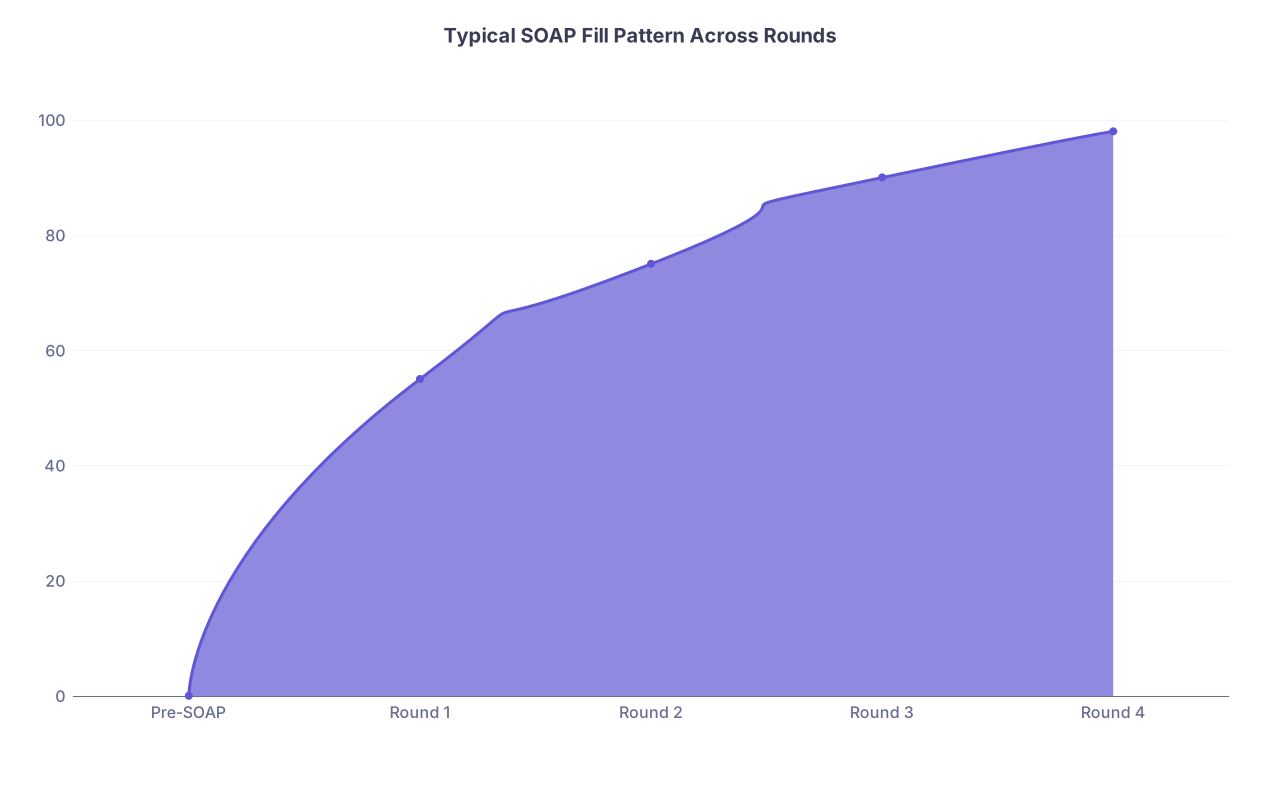
| Category | Value |
|---|---|
| Pre-SOAP | 0 |
| Round 1 | 55 |
| Round 2 | 75 |
| Round 3 | 90 |
| Round 4 | 98 |
Most low-competition spots vanish in Rounds 1 and 2. You need to be ready before those emails hit.
General Rules for SOAP Rounds
- You cannot just “accept everything” and decide later.
- When you accept an offer, you are done. Contractually locked.
- If you decline an offer, you might get another later, but there’s no guarantee.
Your north star: “Is this a program where I can survive and progress toward board eligibility?”
Not: “Is this my dream city?”
Tuesday Morning: Between Silence and Offers
At this point you should:
Be reachable at all times
- Phone ringer on max.
- Email notifications enabled.
- Laptop open with ERAS and NRMP ready.
Prepare your “quick phone script” Programs may call you before ranking their SOAP list. Have a 30–45 second pitch ready:
- Who you are
- Why that specialty
- Why you’d fit their program (community focus, underserved, small team vibe, etc.)
- Close with clear interest: “If offered a position, I would be excited to train there.”
Line up faculty to answer reference calls
- Tell two attendings: “Programs may reach out today or tomorrow; I’ve applied to FM/IM prelim/TY during SOAP.”
Offer Rounds (Exact Times Vary Year to Year)
Typical pattern: multiple rounds Tuesday–Thursday, each a few hours long.
At this point you should:
Before each round opens
- Review your applied programs and identify:
- Accept-without-hesitation programs
- Accept-if-no-better-option programs
- Programs you’re genuinely worried about (toxic reputation, insane call schedule, no teaching)
- Review your applied programs and identify:
If you get an offer from a low-competition specialty you can live with Example: Community FM in a town you’ve barely heard of.
Ask yourself:
- Will this get me board-eligible?
- Is there any credible reason to think this program is unsafe (scut factory, chronic violations, known abuse)?
If no red flags and you’re not holding better offers:
You accept. Instantly. Do not try to game the system waiting for something shinier.If you get an offer from a prelim / TY but you wanted categorial This is where it hurts.
My rule:
- If you have major red flags and no other action: strongly consider accepting a decent prelim/TY to keep moving, especially in IM or TY at a functional hospital.
- If you are otherwise solid and think you might get a categorical FM/IM/psych offer: you can consider waiting through at least the first round.
But be honest—not delusional.
If you get no offers in early rounds This is not unheard of, even for good applicants.
Use the gaps:
- Talk to your dean: “Are programs reaching out? Any feedback from calls?”
- Re-scan updated unfilled lists (programs can add spots as declines happen).
- Consider broadening: if you were FM-only, add more prelim IM or TY if slots remain.
Specialty-Specific Notes for Targeting Low-Competition Spots
These are not absolute, but they reflect what actually happens in SOAP.
| Specialty | SOAP Reality Snapshot | Strong SOAP Angle |
|---|---|---|
| Family Med | Most common unfilled spots | Underserved interest, broad primary care |
| Community IM | Many spots in non-coastal areas | Hard worker on wards, solid Step 2 |
| Psych | Some community/unpopular locales | Longitudinal care, interest in SMI |
| Pediatrics | Variable, more in rural | Family-oriented, child advocacy |
| Prelim IM/TY | Reliable SOAP backup | Pathway toward another specialty |
Family Medicine
- Often the backbone of low-competition SOAP opportunities.
- Programs love:
- Actual interest in primary care.
- Commitment to underserved, rural, or community medicine.
- Your PS and calls should lean on:
- Communication skills.
- Breadth of interest rather than hyper-specialization.
Community Internal Medicine
- Second main landing zone.
- You sell yourself as:
- Reliable workhorse on the wards.
- Comfortable with high patient volume.
- Liking complex adult medicine.
Be explicit: “I enjoy inpatient medicine and continuity clinic; I see myself as a general internist, possibly hospitalist.”
Psychiatry
- More competitive than FM but still has SOAP openings in certain regions.
- Programs flag red flags harder here (substance use, professionalism).
- Emphasize:
- Patience.
- Longitudinal relationships.
- Insight into mental health systems, not just “I liked my psych rotation.”
Pediatrics
- Fewer SOAP spots than FM/IM, but they exist.
- Show:
- True interest in working with families and kids.
- Comfort with communication at different developmental levels.
Prelim / TY
These are your keep-a-foot-in-the-door options.
- Safe move if:
- You’re reapplying to a competitive specialty.
- You have notable red flags and need a strong clinical year to rebuild your application.
- Less ideal if:
- You already feel burnt out and unsure if you can tolerate another high-intensity year.
After SOAP Ends: Thursday Afternoon–Friday
By Thursday late morning, SOAP is over. Some people matched through SOAP, some did not.
At this point you should:
If you SOAPed into a low-competition specialty
- Stop apologizing to yourself. You’re in residency. That’s the win.
- Start learning about your new field seriously.
- Plot how to be a top 25% resident in that program.
If you did not get a spot This is crushing. It’s also not the end of your medical career unless you let it be.
First 48 hours:
- Meet with your dean and a brutally honest advisor.
- Decide:
- Reapply next cycle? To what specialty?
- Do research, prelim/TY next year (if you can find a non-NRMP spot)?
- Take a year to address gaps (exam failure, professionalism, etc.)?
Then:
- Get off social media for Match Day.
- Tell a small circle of people what happened and how they can support you. Don’t explain yourself to the entire world.
Common Tactical Mistakes to Avoid
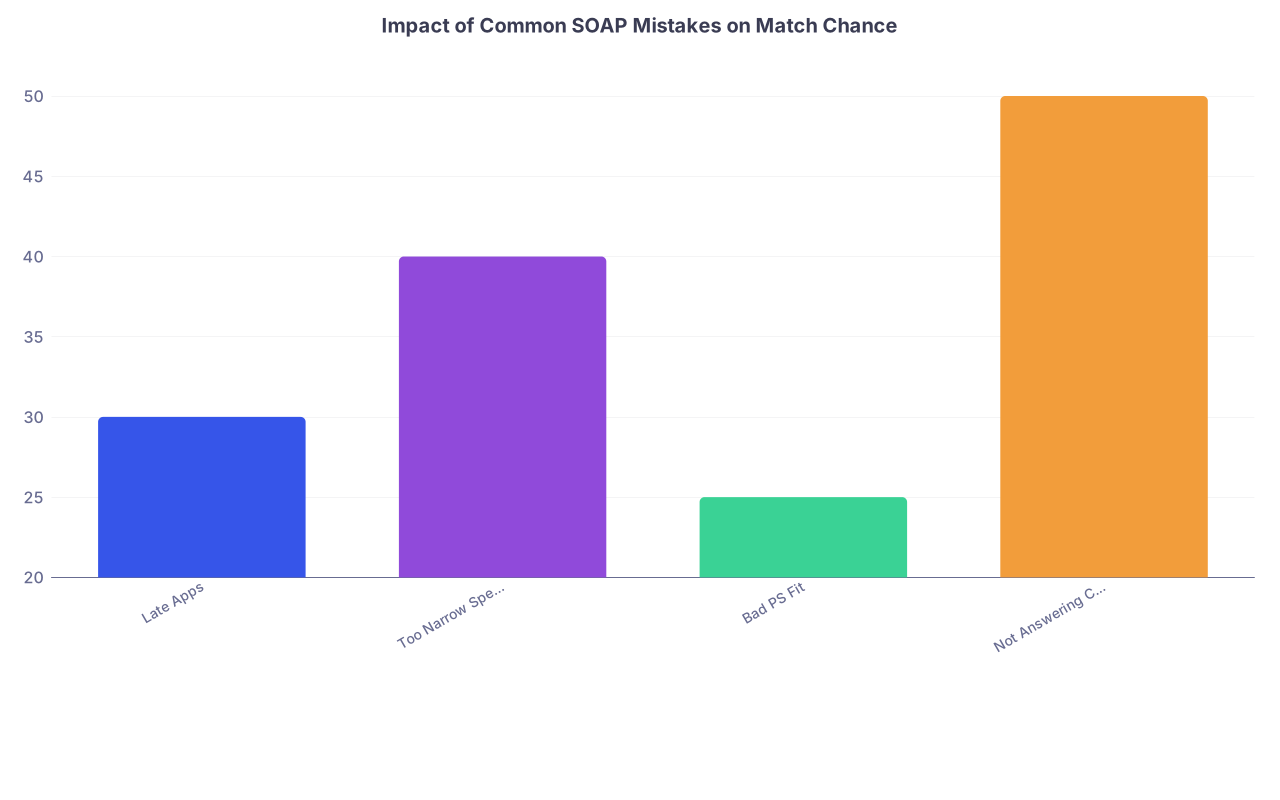
| Category | Value |
|---|---|
| Late Apps | 30 |
| Too Narrow Specialty | 40 |
| Bad PS Fit | 25 |
| Not Answering Calls | 50 |
I’ve watched these errors sink people who were absolutely SOAP-able:
Waiting to submit until late Monday night
Programs start reviewing the second applications open. Be in the first wave.Applying only to “nice city” programs
SOAP is not the time to be picky about nightlife.Sending one generic PS to every specialty
Programs can smell this. If a psych PD reads “I love broad-spectrum internal medicine,” you’re done.Ignoring prelim/TY options entirely
Sometimes your best long-term move is to take the prelim, crush it, and re-enter the match as a stronger candidate.Over-fixating on why you didn’t match during SOAP**
Post-mortems are for April, not Tuesday of Match Week.
Quick Mental Model: How Aggressive Should You Be?
Use this rough mental slider:

| Step | Description |
|---|---|
| Step 1 | SOAP Eligible |
| Step 2 | Prioritize any safe PGY1 |
| Step 3 | Target FM/IM/Psych strongly |
| Step 4 | Balance categorical with prelims |
| Step 5 | Red flags or low scores |
| Step 6 | Applied to ultra competitive only |
- Heavy red flags / 1+ failures → Aggressive: prioritize any decent FM/IM/prelim/TY.
- Solid but unlucky in a competitive specialty → Moderately aggressive: prioritize categorical FM/IM/psych with prelim/TY as backup.
- Already FM/IM applicant who just barely missed → Targeted aggressive: strong push for community FM/IM with some geographic flexibility.
Core Takeaways
- Match Week is about speed plus realism. Have SOAP materials and a low-competition specialty plan in place before Monday 11:00 a.m.
- Low-competition does not mean low value. FM, community IM, psych, peds, and prelim/TY spots can absolutely launch a solid career if you commit and perform.
- During SOAP, decisiveness wins. Get apps in early, answer the phone, and accept good offers instead of gambling on perfect ones that may never come.