
The fear of being “stuck” in a small, low-competition program is a lot more about shame than about training.
Let me just say the quiet part out loud: you’re not only scared you won’t match; you’re scared you will match… somewhere “small,” “unknown,” “low tier,” and you’ll be stuck there, watching your classmates post “Matched at [Big Name]!” while you google whether your program even has a Wikipedia page.
You’re not crazy for thinking this way. Almost everyone does. They just don’t admit it.
The ugly story playing in your head
Here’s the mental horror movie I’m guessing you’re running on repeat:
You don’t have top scores or insane research. So you start looking at “least competitive specialties” or small community programs in less desirable cities. You tell yourself, “I’ll just apply broadly, I just need a spot,” but deep down you feel like if you land in one of these low-competition programs, that’s it. Career capped. No fellowships. No academics. No prestige. Just some tiny hospital no one’s heard of, with maybe one attending and a fax machine that never works.
And then the spiral:
What if I match there and I hate it?
What if the training is bad and I’m unsafe?
What if I can never leave?
What if everyone thinks I wasn’t good enough?
You’re not actually asking, “Will I learn medicine?” You’re asking, “Will I be trapped and judged forever?”
Let’s pull this apart, because some of this fear is nonsense, and some of it is real enough that you should plan for it instead of just panicking about it.
What “low-competition” actually means (and what it doesn’t)
“Least competitive specialties” or “low-competition programs” sounds like a scarlet letter. But what it usually means is:
- The specialty or program fills spots but doesn’t get flooded with 260+ Step 2 scores and 10+ pubs
- It’s in a less popular location (rural, Rust Belt, deep South, etc.)
- It’s community-based or smaller, not a giant university tertiary center
- It may have fewer fellowships or less hardcore research infrastructure
It does not automatically mean:
- Bad training
- Unsafe patient care
- No fellowship opportunities
- No one will ever respect you
- Your career is over before it starts
I’ve seen residents from tiny community internal medicine or FM programs match GI, cardiology, heme/onc. I’ve seen people from no-name psych programs get top fellowships. It’s harder, yes. But “harder” is not “impossible.”
To ground this a bit:
| Specialty | Typical Fill Rate | Research Heavy? | Common Program Type |
|---|---|---|---|
| Family Medicine | High | Usually no | Community / unopposed |
| Psychiatry | High | Mixed | Community + university |
| Pediatrics | High | Mixed | Children’s / university |
| Pathology | Moderate | Yes-ish | Academic-heavy |
| PM&R | Moderate | Mixed | Medium-sized programs |
Notice how none of those say “trash training” or “no future.” Your brain added that part.
The three real risks of a small, low-competition program
I’m not going to gaslight you and pretend all programs are the same. They’re not. There are risks, but they’re specific, not the vague dread cloud you’re living under.
1. Exposure and case mix
Smaller or community programs may have:
- Less super complex, rare pathology
- Fewer subspecialists in-house
- Less cutting-edge tech and procedures
This can affect:
- How competitive you are for very elite fellowships
- How confident you feel with extremely rare conditions
But here’s the grim little secret: a lot of giant name-brand programs also have huge service burdens, malignant cultures, or hideous call schedules. There is no perfect program. You’re trading one set of problems for another.
If you’re in a small place, you compensate: away rotations, electives, networking, conferences, targeted case logs. It’s not magical, but it’s doable.
2. Reputation and letters
Yes, some fellowship directors will unconsciously rank “Mass General” letters higher than “St. Smalltown Regional Medical Center” letters. Prestige bias is real.
But here’s what they actually care about when it comes time to pick fellows:
- How strong your chair/PD letters are (detailed, specific, clearly supportive)
- How your evaluations and responsibilities look
- Any research or scholarly work you squeezed out of your environment
- How you perform on interviews and how you talk about your training
You’re not doomed by your program’s name. You’re judged on what you did with it.
3. Culture and support
This one matters a lot more than the line on your CV.
Small program + poor leadership + no mentorship = miserable.
Small program + tight-knit residents + attendings who actually care = honestly, often better than the big fancy places.
Here’s what can make a small program objectively bad:
- Chronic understaffing, unsafe resident workloads
- Zero feedback, zero interest in your growth
- PD who doesn’t advocate for residents
- Toxic co-residents or attendings
Those are red flags anywhere. The scary part with low-competition programs is that some of them are… low competition for a reason.
Your job isn’t to fear all small programs. It’s to identify the bad ones early and not end up there if you can help it.
“Stuck” isn’t as permanent as you think
The word you keep using in your head is “stuck.” Trapped. Fixed. Doomed.
Let’s be clinically honest about the types of “stuck” you’re imagining:
- Stuck geographically
- Stuck in the specialty
- Stuck career-wise (no fellowship, no advancement)
1. Geographically stuck
You’re imagining matching to a 6-resident FM program in a town with one Walmart, three churches, and no Starbucks, and never leaving.
Reality:
- Residency is 3–4 years for most least-competitive specialties. That’s a long time, but it’s not a prison sentence
- People move after residency all the time
- Small-town programs often have strong ties with regional systems; if you want out, you can usually find a job in a city after
Are there golden handcuffs? Sometimes. A program might heavily recruit you to stay on as faculty or join their system. You can say no. It might feel emotionally hard, but it’s not legal bondage.
2. Stuck in the specialty
You’re wondering, “If I do FM or psych or peds because it’s less competitive, and then regret it, am I screwed?”
Switching specialties after PGY-1 or PGY-2 happens. It’s not super common, and it’s not simple, but it’s not fictional. The people who actually manage it:
- Have honest talks with their PD early
- Are solid residents (no one helps a struggling, bitter complainer pivot)
- Are strategic about networking and timing
You should not pick a specialty you hate “just to match.” That does risk a few miserable years. But picking a less competitive specialty that you can live with is not the same as voluntarily walking into a lifelong cage.
3. Stuck career-wise
Here’s the part that’s probably gnawing deepest:
“If I go to a small low-competition program, I’ll never get competitive fellowships or academic positions.”
That’s not completely fake. It is easier to get Hopkins GI from Hopkins IM than from a tiny community place. But easier isn’t the same as only.
What actually sinks people from small programs is usually:
- They never built any relationships outside their program
- They didn’t ask for projects, so they have no scholarly work
- Their letters are generic because they never stood out
- They let the “I’m just from a small place” narrative sink into their own self-story
If you’re the resident who went to regional conferences, emailed people, joined virtual journal clubs, took on even small retrospective projects, and your PD is your fan? You’re in the game.
To visualize how much program name isn’t the only variable:
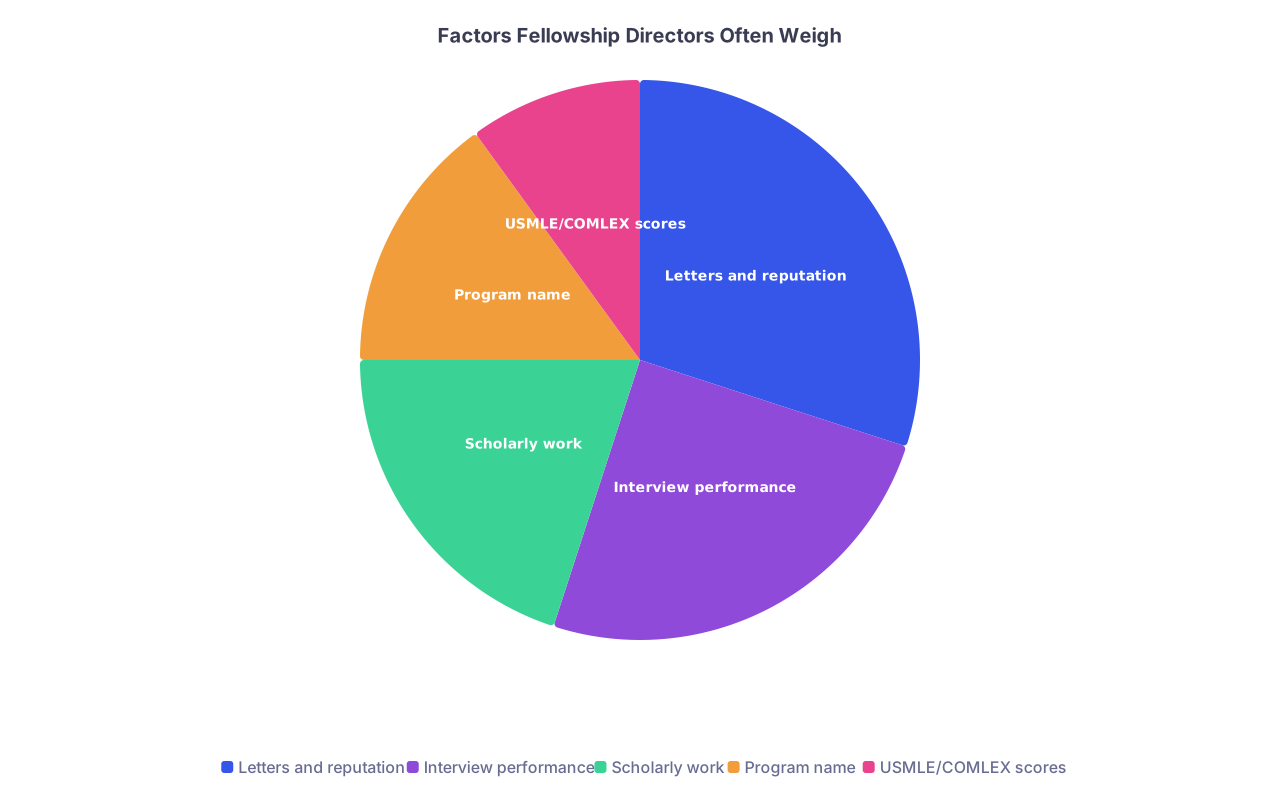
| Category | Value |
|---|---|
| Letters and reputation | 30 |
| Interview performance | 25 |
| Scholarly work | 20 |
| Program name | 15 |
| USMLE/COMLEX scores | 10 |
Program name matters. It’s not the whole story.
How to evaluate a “small/low-competition” program so you’re not blindly walking in
If you’re going to be in a place that doesn’t impress your non-medical relatives when they Google it, you at least want it to be solid.
You can’t fix low prestige. You can avoid low quality.
Things to actually ask about or stalk (without sounding like a maniac):
- Where do your grads go? Jobs? Fellowships? Which ones?
- How many faculty in each subspecialty? Any gaps?
- How is call? How many patients per resident on a typical day?
- How often do residents fail boards?
- Any residents leave the program in the last few years? Why?
Pay absurd attention on the interview day and socials:
- Do residents look exhausted or… resigned?
- Do they speak freely, or in rehearsed, vague “we’re like a family” lines?
- Does anyone mention wellness without sounding like they’re reading from a brochure?
If you find a small program where residents say stuff like, “Our PD really goes to bat for us,” and, “Yeah, I got my top fellowship choice from here,” that’s a completely different situation than a place where people dodge every question.
Here’s a simple comparison to keep in your back pocket:
| Aspect | Green Flag Small Program | Red Flag Small Program |
|---|---|---|
| Graduates | Jobs/fellowships in reasonable places | No one knows where people go |
| PD involvement | Knows residents well, advocates | Vague, distant, absent |
| Resident vibe | Honest, mixed but mostly positive | Guarded, canned answers |
| Case volume | Busy but manageable | Either too low or dangerously high |
| Board pass rate | High, consistent | Spotty, “it varies” |
If you end up at a small program with green flags, you’re not “stuck.” You’re just not branded with a shiny logo. There’s a big difference.
Coping mentally when you feel like you “settled”
Let’s say the worst-case you’re rehearsing actually happens: you don’t get the dream specialty or the name-brand place. You match into a small, low-competition program in a city you’ve never heard of. Your classmates are flexing on Instagram. You feel embarrassed telling family where you’re going.
Here’s what actually happens after Match Day that no one tells you:
By October of PGY-1, everyone is just tired.
No one cares anymore who matched where.
Everyone is just trying to get their notes done and not fall asleep standing up.
But you might still be carrying shame. That can poison your entire experience if you let it.
Things that help, from people who’ve lived it:
Give yourself a defined grieving period.
Yes, grieving. You lost a fantasy. Take a week or two to be mad, sad, whatever. Then deliberately shift into: “Okay, this is the residency I have. How do I make it work for me?”Decide your personal non-negotiables.
Maybe it’s: solid clinical skills, passing boards on first try, one decent research project, and not hating your life daily. Focus on those, not on comparing your life to the friend doing IR at UCSF.Attach yourself to one or two good attendings early.
In small programs, one supportive faculty member can change everything. Look for someone who actually likes teaching and seems to respect residents. Ask for feedback. Ask to help with a case report. That’s how you get the kind of letters that cut through the “small program” noise.Keep a lifeline outside the program.
Virtual journal clubs, online interest groups, mentors from med school, national societies. If you want fellowship or options, this matters more than you think.Stop saying “just” when you talk about your program and specialty.
“I’m just at a small community program.” “I’m just doing FM.” You’re teaching other people how to view you. If you talk about your program like it’s garbage, don’t be surprised when they treat it that way.
To see how quickly this “hierarchy” obsession fades compared to what actually matters to you:
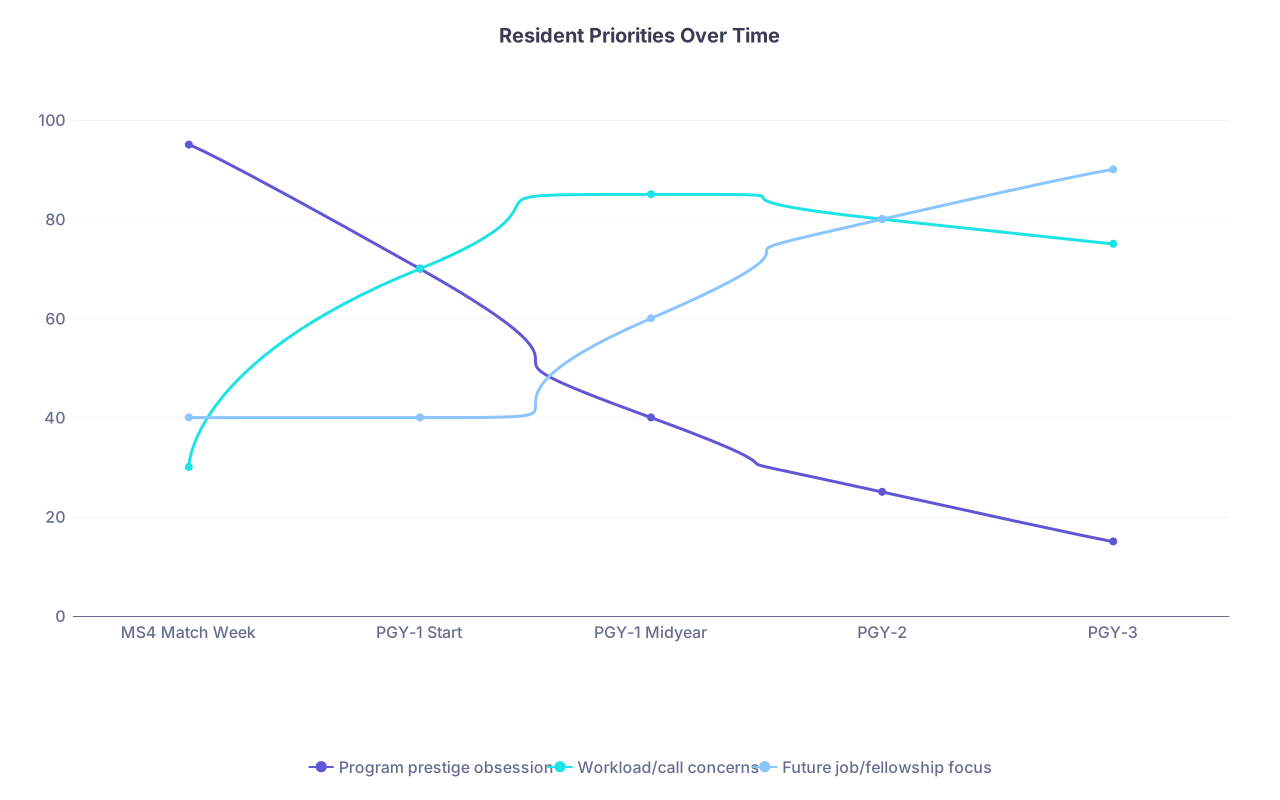
| Category | Program prestige obsession | Workload/call concerns | Future job/fellowship focus |
|---|---|---|---|
| MS4 Match Week | 95 | 30 | 40 |
| PGY-1 Start | 70 | 70 | 40 |
| PGY-1 Midyear | 40 | 85 | 60 |
| PGY-2 | 25 | 80 | 80 |
| PGY-3 | 15 | 75 | 90 |
Your brain will reorder what feels terrifying vs what actually matters.
Planning now so you don’t feel trapped later
If you’re looking at least competitive specialties or small programs because your stats aren’t monster-level, you’re not failing. You’re being realistic.
But there’s a difference between realistic and defeated.
Basic strategy so you have options even if you end up in a small program:
- Don’t pick a specialty you actively dislike just to “guarantee” a match. That will haunt you more than a non-fancy name.
- Apply to a mix of program types: some university, some community, some hybrid. Options matter.
- On interviews, quietly collect data about outcomes and culture. You’re not begging for any spot; you’re investigating where you can function.
- Mentally commit to being a top third resident wherever you go. That does more for your career than your program logo.
And use this as a blunt filter:
If a program is small, low-competition, and the residents seem genuinely okay, grads get decent jobs, and the PD is clearly invested? That’s not a trap. That’s just not glamorous. You can build a life from there.
The real trap is letting your shame about not being at a Big Name make you coast, disconnect, and stop advocating for yourself. That’s how people get “stuck.”
To map it out visually:

| Step | Description |
|---|---|
| Step 1 | Small or low competition program |
| Step 2 | Strong letters and skills |
| Step 3 | Minimal growth |
| Step 4 | Options for fellowship or good job |
| Step 5 | Limited options and feeling stuck |
| Step 6 | Engaged resident |
Where you start isn’t fully in your control anymore. How you show up once you’re there absolutely is.
FAQ (exactly what your brain is asking at 2 a.m.)
1. If I match into a very small, low-competition program, am I basically done for competitive fellowships?
No, but you probably won’t be auto-invited. You’ll need stronger letters, clear advocacy from your PD, and some kind of scholarly work or networking. People do match competitive fellowships from small places every year. They’re just not as loud on social media as the Harvard crowd.
2. Are least competitive specialties all “dumping grounds” for weaker applicants?
No, and that mindset will poison you if you walk in with it. Family medicine, psych, peds, PM&R, pathology—these attract people who genuinely want those fields. Yes, they’re more accessible, but that doesn’t make them lower value. I’ve watched “top” students burn out in ultra-competitive surgical spots and be much happier switching to FM or psych later. There’s nothing inherently lesser about these fields.
3. What if I absolutely hate my small program once I start—am I stuck until the end?
You’re not automatically stuck, but your options are limited. Transfers are possible but rare and require: honest communication with your PD, a real reason beyond “I wanted a bigger name,” and an available spot somewhere else. Usually, the smarter move is to fix what you can (mentorship, rotations, electives) and ride out the 3 years while setting yourself up for a good job or fellowship after.
4. Will program prestige matter when I’m applying for my first attending job?
At some fancy academic centers, yes, they’ll quietly prefer big-name training. But in the majority of community and regional jobs, they care more about: whether you’re board certified, whether your references like you, and whether you seem competent and not horrifying in an interview. By the time you’re a few years into practice, no one cares where you trained unless you’re chasing very high-level academic roles.
5. Should I rank a small, safe-feeling program higher than a bigger, more prestigious place that seems a little toxic?
If the toxicity is real (bad resident vibes, horror stories, obvious burnout), I’d go with the small safe one every time. Prestige does not tuck you into bed after a 28-hour call. Misery will erode your confidence and make it harder to actually become good at your job. A supportive smaller program can get you solid training and a much better day-to-day life.
6. How do I stop feeling embarrassed about not matching at a top program like my classmates?
You won’t flip a switch and suddenly feel zen. But you can shrink the shame. Limit social media around Match. Talk to residents or attendings who trained at smaller places and are doing fine. Re-focus on what you actually want your life to look like in 5–10 years (not just “impress people”). And once residency starts, throw yourself into becoming undeniably good. It’s very hard to stay embarrassed when your attendings trust you, your patients like you, and you can feel yourself turning into a real doctor.
If you remember nothing else:
- Small and low-competition is not the same as bad.
- You’re not “stuck” if you stay engaged and intentional once you match.
- Prestige feels huge as a student; competence and support matter far more once you’re actually living it.