
The idea that “least competitive” specialties are easy landings is a lie that quietly destroys applications every year.
Program directors in low-competition fields may not be chasing 270 Step scores, but they are absolutely hunting for red flags. Different kind of screening, same level of scrutiny. And the worst part? The red flags that get you tossed in family medicine, psych, peds, IM, or pathology are almost never the ones students are obsessing about.
You’re worried about being “not impressive enough.”
They’re worried about: “Am I going to regret working with this person at 3 a.m. for three years?”
Let me walk you through what really happens behind those closed-door rank meetings – especially in the so‑called “safe” specialties.
The Myth of “Least Competitive” and How It Backfires
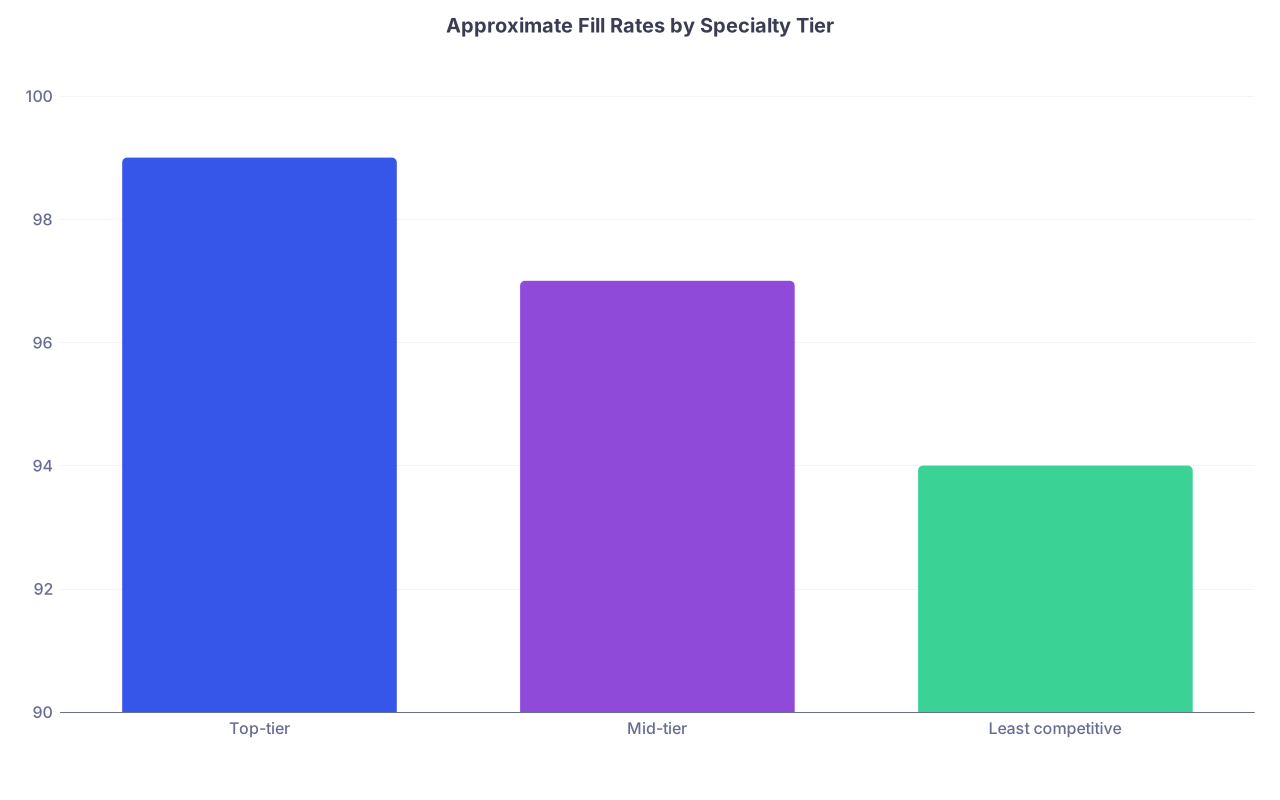
| Category | Value |
|---|---|
| Top-tier | 99 |
| Mid-tier | 97 |
| Least competitive | 94 |
Here’s the dirty secret: “Least competitive” doesn’t mean “we take everyone.” It means:
- Fewer applicants per spot
- Lower average board scores
- Much higher tolerance for non‑traditional paths and imperfect files
But that tolerance has a limit. And the way PDs protect that limit is by becoming hypersensitive to behavioral and professionalism signals.
In derm or ortho, you get screened out for a 230 Step 2.
In family medicine, you get screened out for being flaky, unfocused, or obviously using them as a backup.
I’ve sat in rooms where a PD for a community FM program said, “I don’t care that he has a 260. He wrote ‘if I do not match into ortho’ in his personal statement. Hard no.” And that was that. No one argued.
Low-competition specialties expect you to come with dents and scratches. That’s fine. What they will not accept is risk to the team: unprofessionalism, chronic disorganization, attitude problems, or people who clearly don’t want to be there.
The Red Flags PDs Actually Talk About (But Rarely Say Out Loud)

Let’s go specialty by specialty and then I’ll call out the universal red flags.
1. Family Medicine: “Backup Energy” and Chaos
Family medicine PDs are used to being Plan B. They hate it, and they’re very good at spotting it.
Unspoken red flags they talk about in their offices:
The “generic service” personal statement
They’re looking for some sign you understand family medicine, not just “I like continuity of care and working with diverse populations.” I watched one FM PD read a statement and say, “This is the same essay they’d send to IM, peds, psych. They’re not ranking us high.”Chaos in your record
Repeated tardiness comments on clerkships. “Slow with documentation.” “Requires frequent reminders to complete tasks.”
In a busy community FM clinic, that screams: “This person will drown.” A lot of those apps never see an interview.No primary care exposure at all
If you “love family medicine” but have zero FM, primary care, or outpatient continuity experiences and everything on your CV screams subspecialty or high-acuity inpatient… they don’t buy it. One PD: “If they wanted us, they’d have at least one meaningful thing pointing in this direction.”Sloppy application = sloppy future resident
Misspelled program name in the personal statement. Wrong city. Wrong specialty mentioned. FM PDs see a ton of apps; when yours is careless, they read it as a preview of your notes, scripts, and follow‑up habits.
2. Internal Medicine (Least Competitive Tier): “Fellowship-Only” Vibes
I’m not talking MGH or Hopkins. I’m talking the lower- to mid-tier IM programs that still fill easily but are not prestige magnets.
Their biggest quiet fear: someone who views them purely as a step stool and will be annoying about it.
Things they flag internally:
Personal statement that never once sounds like you want to be a general internist
If every sentence is about cardiology, GI, heme/onc, “clinician-scientist,” and “tertiary referral center,” and you’re applying to a small community IM program with minimal research… they feel used. And they resent it. Many won’t blacklist you, but they’ll push you way down the rank list.“Too good” with a bad attitude
This is where high Step scores can hurt you. Strong numbers plus a letter that says, “Very bright, occasionally dismissive of nursing staff” or “reluctant to perform procedural tasks beneath his level” – I’ve literally seen PDs say “Hard pass, he’ll be miserable here.”Zero interest in the population they serve
Community-heavy IM programs in rural or underserved areas want at least one sign you can tolerate – ideally value – that setting. When your whole CV screams coastal academic bubble and your statement talks only about NIH-funded lab work, you look misaligned.
3. Pediatrics: The “Too Fragile for Call” Applicant
Peds PDs are often very nice in public. Behind closed doors? They’re blunt.
What they quietly screen for:
Emotional fragility without coping skills
It’s not that they hate vulnerability. They worry about who can actually function when a child dies, parents scream, or CPS gets involved. Personal statements that are 90% about your own trauma, mental health struggles, or burnout without any sign of insight, treatment, structure, or resilience are a problem.
I’ve heard: “I’d be worried about this person on PICU nights.”Overly “cute” application with no proof of work ethic
All the kid’s camps and volunteer fairs in the world don’t fix evaluations that say, “frequently left early,” “limited initiative,” or “needed prompting to perform basic tasks.” Peds residents still run codes at 3 a.m. PDs know this.No hard rotations mentioned
If your MSPE barely references your performance on NICU/PICU or tough inpatient services, and your narrative focuses only on clinic and play therapy, they assume someone is soft‑pedaling. They read the omissions.
4. Psychiatry: “Unboundaried” or Naïve
Psych’s competitiveness has gone up, but compared to ortho or derm, it’s still considered “gettable.” That misconception gets a lot of people in trouble.
Red flags psych PDs love to whisper about:
Over-identification with patients
“I have struggled with X, so I will be the perfect psychiatrist” can come across as unboundaried if you don’t clearly show distance, treatment, and stability. I’ve seen PDs ask, “Are we becoming this person’s therapy?” That’s an automatic no.Romanticizing mental illness
Any tone that glamorizes, mystifies, or over-spiritualizes psychiatric illness sets off alarm bells. They want residents who can manage lithium levels, not write poetry about suffering.No demonstration of reliability
Psych residency is heavy on documentation, follow‑up, and outpatient consistency. Clerkship comments about lost pages, late notes, or poor follow‑up are killers here. They’ll forgive average scores before they forgive unreliability.
5. Pathology: The “I Failed Everything Else” Signal
Pathology is the classic “least competitive” dumping ground in some students’ minds. PDs know this. They watch for it.
What gets you quietly buried:
Zero pathology‑specific interest
No elective, no shadowing, no pathology‑adjacent research, no mention of why you actually like diagnostic work. Just “I realized I enjoy the science of medicine.” Translation to them: “I didn’t match into anything else.”Bottom-of-class with no explanation
Path is tolerant of non‑linear paths, but if you have multiple fails, low scores, and not even a coherent story about why you struggled and what’s different now, they don’t trust you to get through boards or handle independent sign‑out one day.Weak English or communication with no remediation plan
This one is touchy but real. Pathologists still have to communicate clearly in reports and tumor boards. Consistent comments about “difficult to understand spoken English” with no sign you’re working on it can kill your chances.
Universal Red Flags That Matter More in Low-Competition Fields
| Red Flag Type | PD Interpretation |
|---|---|
| Sloppy application | Sloppy resident, risky to trust |
| Non-specific specialty fit | Backup applicant, low commitment |
| Repeated professionalism notes | Chronic behavior, not a one-off |
| Unexplained gaps/fails | Ongoing performance or life chaos |
| No local ties (for small programs) | Flight risk, likely to leave |
These apply almost everywhere, but they loom larger when programs aren’t killing themselves to compete with Harvard. They have to protect culture and workload very carefully.
1. Sloppy, Low-Effort Applications
PDs notice:
- Wrong program name
- Wrong specialty mentioned
- Same generic paragraph 40 other programs got
- Typos in the first few lines of your statement
At a high-prestige program, there’s at least some temptation to say, “Well, they’re strong on paper, we’ll overlook it.” In lower-competition specialties, PDs are very aware that they live and die by how reliably their residents show up, document, and follow through.
Bad application = preview of your charting and patient care.
I’ve watched PDs literally say, “If they don’t care enough to proofread their application, they’re not going to care about double-checking meds.”
2. Non-Specific, “Any Specialty Will Take Me” Energy
If your personal statement reads like it could be used for FM, IM, peds, and psych with only the specialty name swapped, that’s a huge quiet turnoff.
They don’t need a tearful origin story. They need evidence that you’ve actually thought about this specialty. Things like:
- A specific patient scenario that only makes sense in that field
- A faculty mentor in that specialty writing you a strong letter
- A sub‑I or elective where you clearly did well
When none of that is present, and your CV shows random, unfocused experiences, the PD’s internal monologue is: “We’re just a safety net.” That moves you down.
3. Repeated Professionalism Concerns
One comment? Maybe bad luck.
Two or three across rotations? Pattern.
Common ones that sink you:
- “Frequently late”
- “Needs frequent reminders to complete tasks”
- “Defensive when given feedback”
- “Intermittent tension with nursing staff”
In the rank meeting, this is the stuff that actually moves needles. Not your Step 2 being a 221 instead of 235.
Low-competition specialties survive by having residents who simply show up, work, and don’t create drama. If your file suggests drama, they’d rather take a lower‑scoring but stable applicant.
What PDs Look At When Scores Aren’t the Filter
, Scores/Grades, Geographic Ties](https://cdn.residencyadvisor.com/images/articles_svg/chart-relative-weight-of-factors-in-low-competition-prog-4303.svg "Relative Weight of Factors in Low-Competition Programs")
| Category | Value |
|---|---|
| Professionalism/Work Ethic | 30 |
| Specialty Fit | 25 |
| [Letters of Recommendation](https://residencyadvisor.com/resources/least-competitive-specialties/lor-mistakes-that-make-you-look-weak-in-least-competitive-specialties) | 20 |
| Scores/Grades | 15 |
| Geographic Ties | 10 |
When everyone has “average-ish” numbers, PDs shift the weighting without telling you.
I’ve watched this happen live at a mid-tier IM and a community FM program:
- First pass: toss the obvious disasters (multiple fails, no Step 2, catastrophic MSPE comments)
- Second pass: read MSPE narratives and clerkship comments for patterns
- Third pass: look at letters for actual content (not just “excellent” boxes)
- Only then: personal statement, research, extras
This is the opposite of what many students obsess over. You’re rewriting your personal statement 19 times; they’re spending 40 seconds on it and 3 minutes on your MSPE narrative.
The quiet hierarchy looks roughly like this in many low-competition programs:
- Will this person show up and not cause problems?
- Do they actually want this specialty and type of program?
- Are they at least minimally likely to pass boards?
- Do their letters suggest they function on a team?
- Everything else.
How to Scrub Your Application for These Red Flags

| Step | Description |
|---|---|
| Step 1 | Start Review |
| Step 2 | Read MSPE carefully |
| Step 3 | Address in advisor meeting |
| Step 4 | Review personal statement |
| Step 5 | Rewrite with concrete examples |
| Step 6 | Check LOR content |
| Step 7 | Request new targeted letter |
| Step 8 | Proofread entire ERAS |
| Step 9 | Fix typos and wrong names |
| Step 10 | Ask trusted mentor to sanity check |
| Step 11 | Submit with confidence |
| Step 12 | Any professionalism issues |
| Step 13 | Specialty specific enough |
| Step 14 | At least one strong in specialty |
I’m not telling you this to make you paranoid. I’m telling you so you can be deliberate.
Here’s how you actually reduce the quiet red flags:
Get your MSPE and read it line by line
If there are soft professionalism hits, you need a faculty mentor or dean who can contextualize them in your MSPE addendum or in a letter. Silence looks like avoidance.Make your personal statement un‑recyclable
If you can swap “family medicine” with “internal medicine” and nothing else needs to change, it’s too generic. Add specific FM or psych or peds content – cases, mentors, clinics – that make it obvious you’re not shotgun‑applying.Secure at least one letter that says more than “pleasant and adequate”
In low-competition specialties, a single strong letter that says, “This person is reliable, humble, and I would gladly work with them as a colleague” is worth more than some generic “excellent” SBAS template from a big name who barely knows you.Clean your ERAS like your license depends on it
Because it does, indirectly. Names right. Cities right. Dates accurate. Descriptions specific and readable. PDs notice care.If you have major blemishes, own them with a plan
One failed clerkship, a Step fail, a leave of absence – these are survivable in low-competition fields if you show maturity, remediation, and a track record since then. The red flag is not the failure; it’s the vagueness and denial around it.
FAQs
1. I’m applying to a “least competitive” specialty with a Step 2 below 220. Is that the main red flag?
No. Your score will limit some doors, but in many FM, peds, psych, IM, and path programs, the bigger question is whether they trust you to show up, pass boards on the second try if needed, and not blow up the team. If your low score sits alongside chaotic evals, professionalism problems, or no clear specialty interest, that combination is what kills you. A low score + clean narrative + focused interest is often acceptable.
2. I did audition electives in a more competitive specialty and now I’m switching to a “safer” one. Do PDs see that as a red flag?
They see it. Whether it hurts you depends on how you frame it and what you’ve done since. If you pretend it never happened, you look dishonest or lost. If you acknowledge you explored another field, learned from it, and can clearly articulate why this specialty fits you better – and back that up with at least some concrete exposure – many low-competition programs are fine with that.
3. I have minor professionalism comments (late a few times, needed reminders) but no major incidents. Should I be worried?
Yes, but not panicked. In lower-competition specialties, those small comments can carry disproportionate weight because reliability is their currency. The move here is to show a clear upward trajectory: later rotations with comments like “always prepared, improved greatly,” plus a letter or mentor who can say: “Early on they struggled with time management, but they responded very well to feedback and now function at a high level.” That turns a red flag into a growth narrative.
Bottom line:
Least competitive doesn’t mean least selective.
They’ll forgive average numbers; they won’t forgive obvious backup energy, sloppiness, or professionalism risk.
If you want these programs to take you seriously, clean your narrative, show real specialty fit, and stop assuming “low competition” equals “low standards.”