
The idea that “least competitive” specialties make safe backups is dangerous—and often flat-out wrong.
Let me be blunt: treating an entire field as your plan B is one of the fastest ways to torpedo your match prospects and your future job satisfaction at the same time. Programs can smell it. Faculty can smell it. And the match data quietly punishes it.
You are not “outsmarting the system” by deciding, in October of fourth year, that you’ll just tack on Family, Psych, or PM&R as an insurance policy. You’re walking into a trap a lot of smart people fall into.
Let’s walk through the biggest mistakes I see, and how to not be the cautionary tale people whisper about on Match Day.
1. Misreading “Less Competitive” as “Easy to Match”
The first fatal error is semantic. You hear “less competitive” and your brain quietly translates it into “easy, guaranteed, safety field.”
That’s not what the data says.
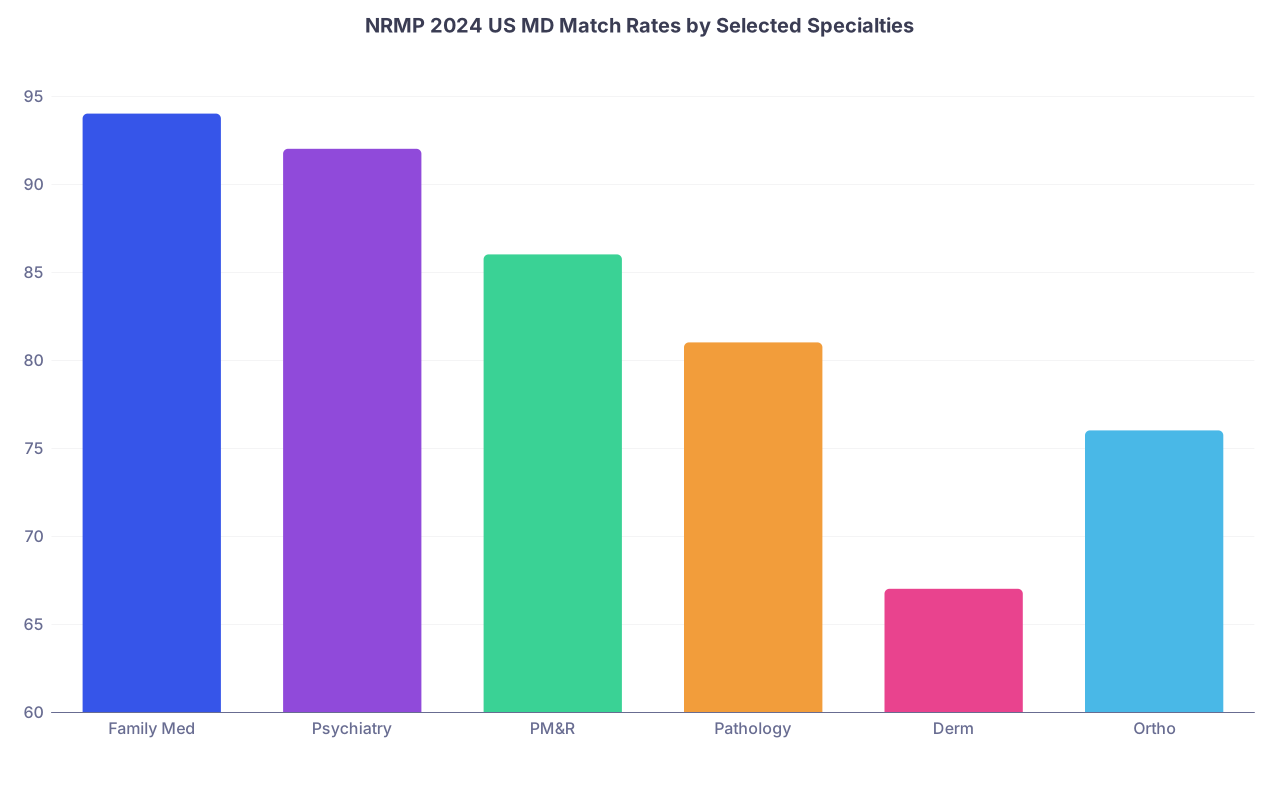
| Category | Value |
|---|---|
| Family Med | 94 |
| Psychiatry | 92 |
| PM&R | 86 |
| Pathology | 81 |
| Derm | 67 |
| Ortho | 76 |
Look closely. Even in so-called “backup” fields, people still do not match:
- Family Medicine: great match rate, but not 100%
- Psychiatry: rising popularity, rising bar
- PM&R & Pathology: fewer spots, more variability, and not immune to applicant surges
The trap: applicants confuse odds for a committed, prepared applicant with odds for a last-minute, half-invested backup.
Programs aren’t just checking board scores. They’re asking a simpler question:
“Does this person actually want to be here, or am I their consolation prize?”
If the honest answer is “consolation prize,” you’re playing with fire.
2. The “Spray and Pray” Dual-Apply Disaster
The next mistake is ugly but common: deciding to dual apply to a “less competitive” field at the last second—with almost no tailored preparation—and assuming volume will save you.
I’ve watched this play out:
- Student spends all of MS3 doing surgical rotations and research, planning on Ortho.
- Summer of M4: realizes Step score is weak, letters are mediocre.
- August: panics and adds 40 Psych programs “as backup.”
- Application reads: 95% surgery, 5% “I find the mind fascinating.”
- Result: rejected by the surgical programs and by the Psych programs that quickly recognize the lack of commitment.
The core problems:
No coherent story
Your ERAS screams one specialty. Your personal statement claims another. Your letters talk about you as a future surgeon, but you’re applying to Psych or FM. That mismatch is not subtle.Letters that don’t match the field
Two Ortho letters and one generic IM letter are not magically “fine” for PM&R or Psych. The faculty on those committees can see exactly what happened: you pivoted late and didn’t bother to do the groundwork.Personal statements that reek of backup
I’ve read lines like:
“While I originally considered a surgical career, I now realize psychiatry offers…”
Translation to the reader: “I didn’t get the scores I wanted, so… here we are.”
You can dual apply and still be smart about it. But throwing a dozen applications at a field you barely explored is not a strategy. It’s denial.
3. Underestimating How Fast “Chill” Fields Heat Up
Another mistake: assuming that once a field has a “less competitive” label, it stays that way. That’s not how this works.
Look at the last decade:
- Psychiatry used to be an afterthought for many schools. Then lifestyle awareness, growing mental health demand, and salary shifts happened. Now it’s a hot field with more serious applicants every year.
- PM&R was once the quiet kid in the corner. Now sports medicine, pain, and MSK rehab interest have driven real competition at strong programs.
- Pathology oscillates—when jobs tighten in some regions, suddenly programs can be very choosy.
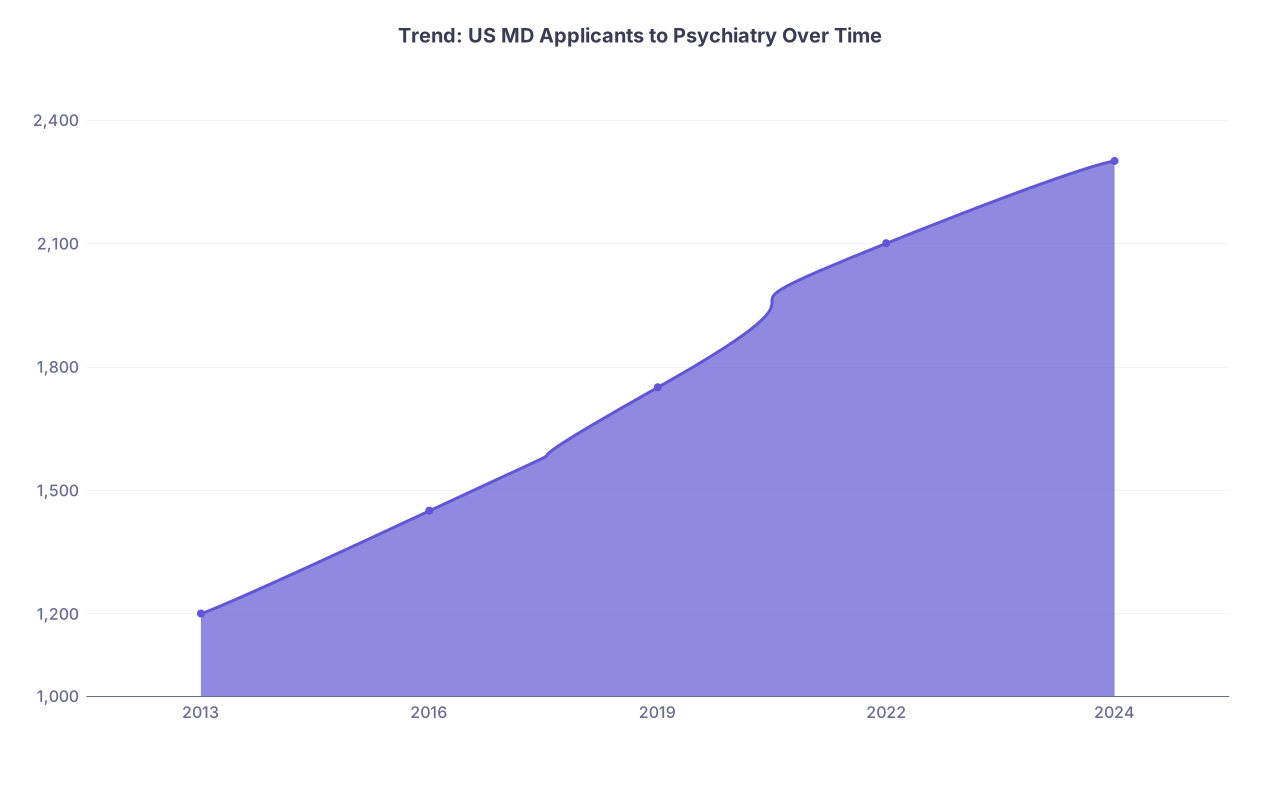
| Category | Value |
|---|---|
| 2013 | 1200 |
| 2016 | 1450 |
| 2019 | 1750 |
| 2022 | 2100 |
| 2024 | 2300 |
Fields don’t announce when they shift from “backup” to “real first choice for many.” They just quietly fill with stronger applicants who:
- did dedicated sub-Is
- have targeted research or meaningful experiences
- wrote specific, thoughtful personal statements
- got strong specialty-specific letters
If you walk in late, thinking you’re competing against the candidate profile from five years ago, you’re the one that’s out of date, not the programs.
4. Ignoring the Red Flag: “This Applicant Doesn’t Actually Want This”
Programs are not only looking for “qualified.” They are filtering for “likely to stay in and contribute to this field.”
This is where backup-thinking destroys you.
Common red flags that scream “I don’t really want this specialty”:
Zero or one rotation in the field
If you’re applying to Psych or Family Med as backup and you did not bother to schedule more than a token elective, you’re clearly not invested.No specialty-specific letters
A backup application to PM&R with letters only from Gen Surg and IM is a dead giveaway. Same with Psych applications with only Medicine and Neurology letters.Generic cut-and-paste statements
Psych statements that could have been written after a single week on a unit. Family Medicine essays that never mention continuity, community, or broad scope in any concrete way.
Programs see hundreds of applications. They know what a real specialty choice looks like.
| Signal Type | Strong Applicant | Backup Applicant |
|---|---|---|
| Rotations | 2–3 in specialty | 0–1 in specialty |
| Letters | 2–3 from specialty attendings | All from unrelated fields |
| Personal Statement | Specific, field-grounded examples | Vague, could fit any people-oriented job |
| CV Activities | Some field-related interest | Zero direct specialty engagement |
If you’re thinking, “Well, I’ll just fake the interest,” understand this: it’s excruciatingly obvious when an essay is written from Google instead of lived experience.
5. Destroying Your Own Credibility With Mixed Messaging
Probably the most painful mistake: trying to keep all doors open and ending up convincing no one.
I’ve seen this version:
- Student applies to Anesthesiology and Family Medicine.
- Uses one personal statement but edits the first paragraph to say “anesthesiology” or “family medicine” as needed.
- Rest of the statement is generic: “I love physiology, procedures, and longitudinal patient care.”
Programs read that and think: “So which is it? OR or clinic? Acute resuscitation or prenatal care? What are we even evaluating you for?”
Another version:
- Applicant sends one letter writer a request for “a strong letter for Internal Medicine, but I may also consider applying to Psychiatry.”
- The letter ends up maddeningly vague, because the writer cannot credibly argue you’re perfect for both at once.
You can absolutely have more than one interest. You’re allowed to change your mind. But on paper, your application has to tell one coherent story per field.
If your materials read like you’re hedging your bets, programs worry they’ll lose you after investing years of training. That’s an easy “no” from their side.
6. Underpreparing for Interviews Because “It’s Just My Backup”
This one kills people who actually get as far as invites.
They think:
- “It’s just Family, I’ll wing the interview.”
- “Psych interviews are super chill, it’ll be fine.”
- “PM&R is more laid back; they’re just happy I applied.”
And then they show up and make three fatal interview errors:
They cannot articulate why that specialty specifically.
Answers sound like:
“I really like talking to patients and I want good work–life balance.”
That’s not a reason for Psychiatry. That’s a reason to not pick Gen Surg.They cannot answer basic field questions.
For example, Psych:
“What parts of psychiatry worry you the most?”
Weak answer: “Umm… I guess maybe like burnout?”
Or FM:
“How do you feel about managing chronic pain or addiction in primary care?”
Weak answer: “Oh, I didn’t really see that on my rotation.”They reveal in body language that this wasn’t their first choice.
Residents watch you. Faculty watch you. Saying “this is my top choice” while you look bored on clinic tour doesn’t land.
If a “backup” field was important enough to submit 30+ applications to, it’s important enough to treat each interview as if it may be the only one that stands between you and not matching.
7. Completely Ignoring Long-Term Fit and Career Reality
Here’s the mistake almost no one talks about: backing into a specialty you don’t actually want to live in for the next 30+ years.
I’ve seen students say:
- “I’ll do Family as backup, then maybe I’ll pivot or do some cool fellowship and essentially be a different kind of doctor.”
- “I’ll get into Psych and then I can always reapply to Derm or something later.”
Listen carefully. Re-training is possible. It’s also extremely hard, disruptive, and sometimes unsuccessful. You are not guaranteed a second shot.
Least competitive does NOT mean:
- You’ll automatically love the day-to-day
- You’ll be sheltered from burnout
- You’ll have endless job options in your dream city
Examples:
- Family Medicine in many regions is swamped with RVU pressure, 20–25 patients a day, admin overload. If you hate chronic disease management and long-term relationships, this will eat you alive.
- Psychiatry involves very sick, complex patients, heavy documentation, and increasingly tough cases: suicidality, substance use, trauma. If you’re using it as “easier IM,” you’re in for a rude awakening.
- PM&R is not just “sports and spine.” There’s inpatient rehab, strokes, spinal cord injuries, traumatic brain injury. If you only pictured yourself in an outpatient sports clinic, you may be miserable in residency.
The worst-case scenario isn’t not matching. The worst-case is matching into a field you chose out of fear, slowly realizing you can’t stand it, and then feeling trapped.
8. Timing Mistakes: Last-Minute Specialty Swaps
Another common disaster: deciding to pivot to a “less competitive” field too late for your application to look authentic.
This usually looks like:
- No core rotation in the field until late MS4 (or not at all).
- No sub-I or away rotations.
- No time for a meaningful project or case report.
- Letters requested last-minute from attendings who barely know you.
You end up depending on:
- Weak, short letters.
- Vague, rushed personal statements.
- Irrelevant experiences stretched to “fit” the specialty.
Could a late pivot still work sometimes? Yes. But only if you’re aggressively realistic:
- You immediately schedule what rotations you can.
- You focus on programs that historically have taken nontraditional or late-decider applicants.
- You do not pretend your application is competitive for top-tier academic programs in that field just because the field is “less competitive overall.”
And you don’t wait until September to admit the original plan failed.
9. Not Matching Strategy to Reality for Each “Backup” Field
Each so-called “less competitive” specialty has its own landmines. Treating them all as one generic backup option is lazy and costly.
Let me spell a few out.
Family Medicine
Big mistake: assuming FM takes “everyone.”
Programs still care about:
- Genuine interest in primary care and continuity
- Comfort with underserved or complex populations
- Evidence you won’t bail for a specialty later
Red flag behavior: CV full of hyper-competitive surgical research, zero outpatient or community work, and a last-second FM personal statement.
Psychiatry
Big mistake: thinking “I like talking to people” is enough.
Psych programs look for:
- Emotional maturity and boundaries
- Comfort with very ill, sometimes volatile patients
- Some understanding of psychiatric conditions beyond Step 2 clips
Red flag behavior: no real Psych experience, minimal mental health exposure, and a personal statement that could belong to any “people person.”
PM&R
Big mistake: assuming it’s Ortho-lite or sports medicine with less trauma call.
PM&R programs expect:
- Evidence you understand inpatient rehab realities
- Interest in function, disability, and long-term recovery
- At least some exposure to EMG, MSK exam, or neuro-based rehab
Red flag behavior: one outpatient sports rotation and no clue what an inpatient rehab unit actually does.
Pathology
Big mistake: thinking you can hide from patients here and “coast.”
Path programs look for:
- Genuine interest in morphologic thinking and diagnostics
- Academic curiosity and attention to detail
- Some evidence you know what the day-to-day work actually is
Red flag behavior: zero Path elective, generic letter from IM, and absolutely no idea how specimens move from OR to report.
If you’re going to call a field your backup, at least learn its rules. Otherwise you’re just guessing with your career.
10. How to Use “Less Competitive” Fields Without Sabotaging Yourself
If you’re still with me, you’re probably wondering how to not screw this up if you really do need a wider net.
Here’s the non-delusional version:
Pick one true primary specialty.
Commit on paper. Your core rotations, letters, and statement should align with it.If you dual apply, treat each field like its own application.
Separate personal statements. Separate letters. Tailored program lists. Not copy–paste.Do at least one substantial rotation in any “backup” field.
Ideally early enough for a letter and genuine reflection on fit.Be honest with yourself about long-term fit.
If you would be miserable in that field, it is not a backup. It’s a setup for burnout.Talk to people who actually work in those specialties.
Not just residents on Reddit. Attendings. Program directors. See what they screen for.
FAQs
1. Is it always a mistake to dual apply with a “less competitive” specialty as backup?
No. The mistake is doing it sloppily and dishonestly. Dual applying can be smart if:
- You prepare early for both paths.
- You have at least one solid rotation and letter in each field.
- You’re genuinely willing to train and practice in either specialty if that’s where you match.
If you’d be devastated to end up in your so-called backup long term, that’s not a backup. That’s a panic choice.
2. I realized late that my dream specialty is unrealistic; should I still apply to it plus a backup?
Sometimes. But do not over-invest in a doomed primary at the cost of making your realistic option look half-baked. A sane approach:
- Modest number of applications to the reach field.
- Serious, fully built application to the realistic field (rotations, letters, tailored essays, thoughtful program list).
- Clear-eyed understanding that your backup may become your actual career—and you need to be OK with that.
3. How can I prove to a “backup” specialty that I’m serious if I decided late?
You can’t fully erase the timeline problem, but you can reduce the damage:
- Get at least one strong letter from that specialty, even if it means a late rotation.
- Rewrite your personal statement from scratch with concrete, field-specific experiences.
- Be candid—but not self-sabotaging—in interviews: “I explored X earlier, but after my experience in Y rotation, I recognized this is a better fit for how I want to practice.”
- Apply broadly and focus on programs that have historically taken nontraditional paths.
Key points to walk away with:
- “Least competitive” is not the same as “guaranteed,” especially if your application screams “afterthought.”
- Backup specialties can save your match year—but only if you treat them as real options, with real preparation and respect.
- The bigger risk than not matching is matching into a field you chose out of fear rather than fit. Don’t make that mistake.