
The way most people “dual-apply” to backup specialties is self-sabotage disguised as strategy.
You’re told it’s “smart” to hedge your bets. What nobody tells you is how often it quietly wrecks both applications—especially when one of your targets is a less competitive specialty you barely understand and don’t respect.
I’ve watched this unfold up close. The internal medicine program director who says in the conference room: “Half these applications are clearly ortho fails.” The family medicine faculty who delete personal statements after the second “my passion for anesthesiology…” reference. The student crying in February because they aimed for derm, “backed up” with psych, and looks unfocused to both.
Let’s prevent that from being you.
The Core Mistake: Treating “Least Competitive” as “Dumping Ground”
Least competitive does not mean least serious.
If you remember nothing else, remember this: residency programs in so-called “backup” or “less competitive” specialties hate being treated like the consolation prize. And they can smell it instantly.
What you’re probably thinking:
- “I’ll apply to my dream field AND a less competitive one, just in case.”
- “I don’t need to fully commit to the backup; it’s just insurance.”
- “They’ll be happy to have me. I’m strong for their field.”
That last thought is where you’re dead wrong.
Here’s the quiet truth:
Many “less competitive” specialties are now flooded with:
- Burned-out reapplicants from hyper-competitive fields
- People who never explored the specialty seriously
- Students who think, “Worst case, I’ll just do X and switch later”
Programs are not blind to this. They’ve adapted. They’re stricter than you think.
The biggest hidden landmine
If you dual-apply badly, you don’t look cautious.
You look:
- Uncommitted
- Confused
- Potentially unhappy in their specialty
- Like a future transfer risk
And no decent program wants to waste a spot on someone who will leave if their “real” specialty opens a door.
The Specific Ways Dual-Applying Backfires
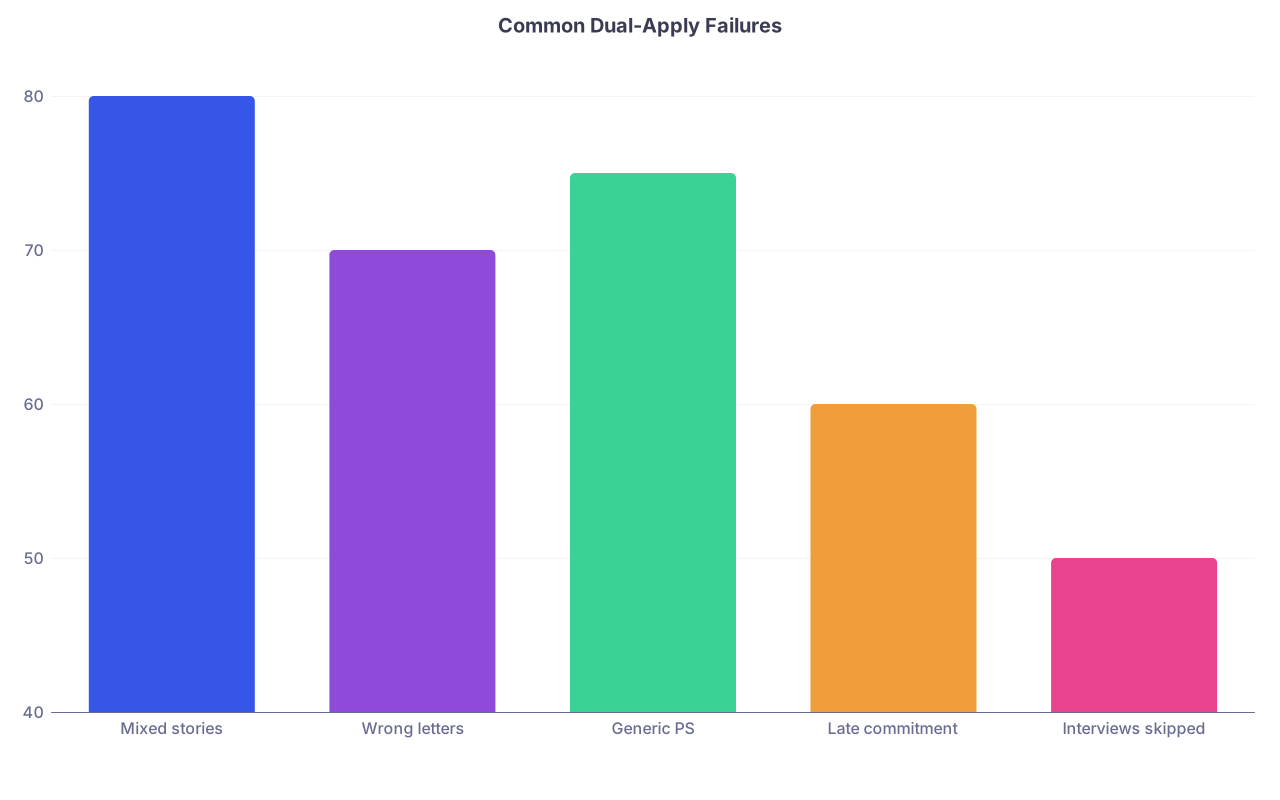
| Category | Value |
|---|---|
| Mixed stories | 80 |
| Wrong letters | 70 |
| Generic PS | 75 |
| Late commitment | 60 |
| Interviews skipped | 50 |
Let’s walk through the most predictable, avoidable errors.
1. One Personal Statement, Two Specialties
This is the laziest—and most damaging—move I see.
You write a single core personal statement, then tweak a few sentences for each specialty. Problem: your examples, tone, and language still scream the “primary” field.
What it looks like in practice:
- Radiology backup app where 80% of the essay is about patient continuity and family dynamics (you clearly wrote it for FM/IM).
- Psychiatry personal statement that talks mainly about procedures, OR time, and technical mastery.
- Pathology essay where your only genuine example is “I liked looking at slides in second year.”
Programs notice. Then they draw the only logical conclusion: you don’t actually want this.
Avoid this mistake by:
- Writing two fully separate personal statements from scratch
- Using specialty-specific stories (actual rotations, patients, mentors)
- Avoiding “copy-paste with find/replace” for specialty names—it’s transparent
If you can’t generate enough genuine material for a full, specific PS in the backup field, you don’t know that specialty well enough to apply to it.
2. Letters of Recommendation That Betray Your True Priority
Programs read letters like tea leaves. Who wrote them—and how—is often more revealing than your entire CV.
Common self-sabotage patterns:
- Applying to psychiatry with:
- 2 letters from surgeons
- 1 from an internal medicine hospitalist
- 0 from psychiatry faculty
- Applying to pathology with:
- All letters from clinic-heavy specialties
- No mention of your diagnostic reasoning, interest in lab/bench work, or pathology elective performance
- Applying to family medicine with:
- Strong letter from ortho attending praising your “OR focus” and “surgical hands”
- No FM continuity clinic letter at all
What they think: You’re clearly using us as backup. Pass.
Avoid this mistake by:
- Getting at least 1–2 letters from the backup specialty itself
- Making sure those writers know you’re serious about that specialty—not just fishing for a safety net
- Dropping letters that “out” your primary specialty priority if they make you look misaligned
If your letter set screams “I’m a failed applicant from X,” you will struggle in your so-called backup.
The “Least Competitive” Trap: Misjudging the Specialty Itself

A lot of people pick backup specialties based on one dumb heuristic: “low Step score requirements” or “low fill rates.” Dangerous way to make a career decision.
Here’s how that goes wrong.
3. Ignoring What the Specialty Actually Values
Every field has its own personality and culture. You can’t fake it.
Examples:
- Family medicine cares about:
- Long-term relationships
- Breadth over depth
- Tolerance for ambiguity
- Psychiatry cares about:
- Emotional insight
- Comfort with uncertainty and complexity
- Interest in mental health beyond “neuro is cool”
- Pathology cares about:
- Meticulousness
- Intellectual curiosity for disease mechanisms
- Comfort working “behind the scenes”
If you apply to FM talking only about procedures and trauma bay adrenaline, or to psych only about neuroanatomy, or to path with zero actual pathology exposure, you signal: I haven’t thought this through at all.
Red flag for you:
If your entire reason for choosing a backup specialty is:
- “It’s less competitive”
- “I heard it’s a good lifestyle”
- “I can always switch later”
…you’re playing with fire.
4. Faking Interest in the Backup Specialty Too Late
Another common failure: students spend 3 years courting one field, then suddenly try to bolt on a backup in October of application year.
They scramble to:
- Add a 2-week elective
- Attend one or two noon conferences
- Beg for a last-minute letter from someone who barely knows them
Programs know exactly what they’re seeing. The “oh no I might not match, time to panic” applicant. That reads as desperation, not genuine interest.
Better approach:
If you even suspect you might need to dual-apply, you must lay groundwork early:
- 3rd year: take a real rotation in the potential backup field
- Get to know one faculty member well enough for a solid letter
- Show up, ask questions, go to conferences—not just when you need something
If you fail to do this, don’t pretend your snap interest will impress anyone.
The Identity Problem: Sending Conflicting Signals Across Applications
| Red Flag Signal | How Programs Interpret It |
|---|---|
| Different stories in PS and interview | You are telling people what they want to hear |
| ERAS experiences weighted toward one field | Backup specialty is an afterthought |
| Late away rotations in primary field only | You committed to them, not us |
| Social media all about one specialty | Your professional identity is elsewhere |
5. Telling Two Different Career Stories
Here is where dual-applying goes from “risky” to “self-destructive”.
You:
- Tell specialty A: “I’ve always known this is the field for me.”
- Tell specialty B (your backup): “I realized during third year that this is my true passion.”
They talk. Faculty know faculty in other fields. Program directors share impressions.
If they hear incompatible versions of your “why this specialty” story, you’re done. You look like someone who says whatever is convenient.
Avoid this by:
- Having one coherent underlying narrative that can honestly reach both specialties, even if framed differently
- Example: core identity as:
- “I’m drawn to longitudinal relationships and complex chronic care” → can support IM and FM
- “I love diagnostic puzzles and pattern recognition” → can support radiology and pathology
- Avoid applying to wildly incompatible pairs unless you’re truly prepared to burn one bridge
If your explanation for A and B couldn’t coexist logically in the same conversation, you’re over-stretching.
Hidden Consequences in the Backup Specialty
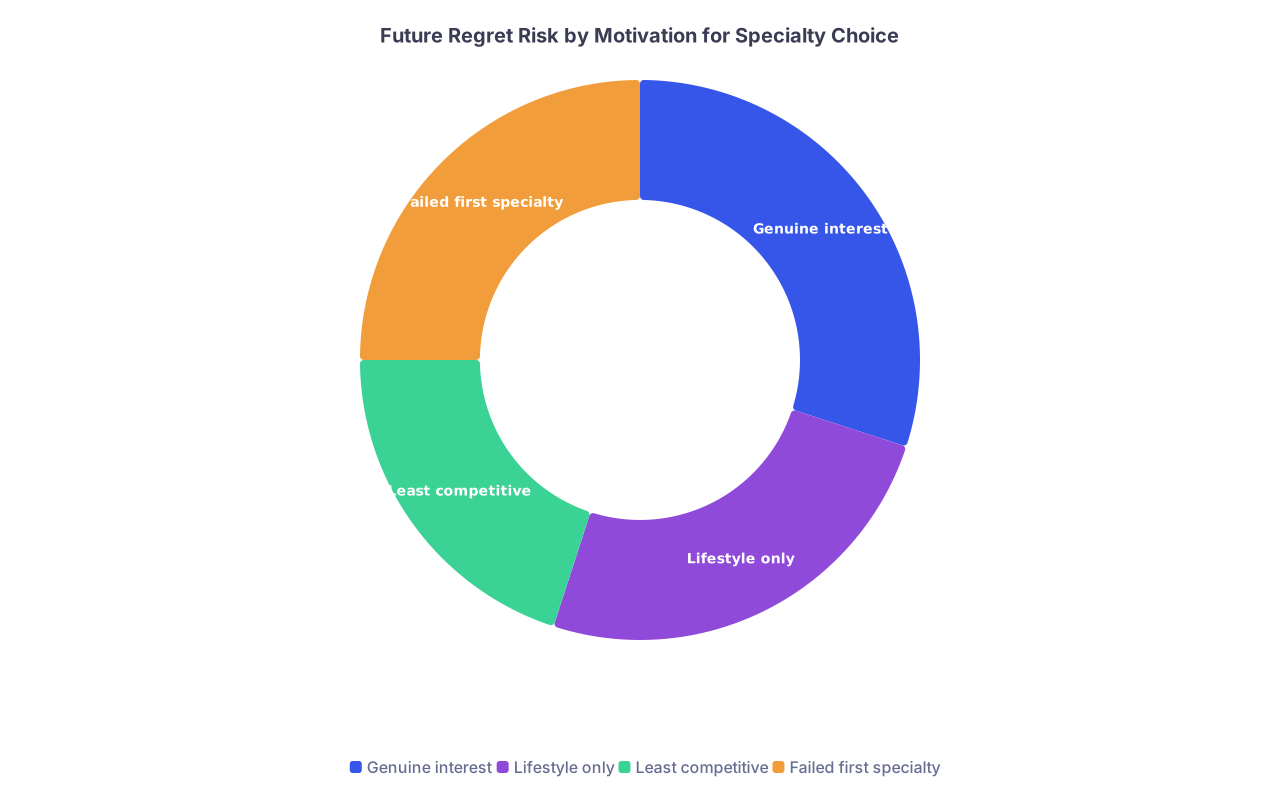
| Category | Value |
|---|---|
| Genuine interest | 30 |
| Lifestyle only | 25 |
| Least competitive | 20 |
| Failed first specialty | 25 |
Let’s talk about what happens if you actually match into your backup done badly. This is the part almost nobody thinks through.
6. Becoming “That Resident Who Never Wanted to Be Here”
I’ve sat in resident evaluations where faculty say:
- “She’s clearly bitter she didn’t match derm.”
- “He keeps telling students not to do our specialty.”
- “He’s always talking about applying out to rads.”
That reputation sticks. It closes fellowship doors. It poisons recommendations. You become a walking cautionary tale for future applicants.
Psych, FM, path, PM&R—these “backup favorites”—are small worlds. People remember.
If you apply to a field purely to have a safety net, without ever confronting whether you can be happy there, you’re setting yourself up for a slow, demoralizing burn.
7. Underperforming Because You Never Bought In
The reality of residency:
- It’s hard.
- Every specialty has misery built in.
- The only thing that protects you is actually caring about the work.
If you end up in a field you never respected and barely understand, that safety net becomes a trap.
You’re more likely to:
- Struggle with motivation
- Do the bare minimum
- Miss out on chances to grow because you secretly feel “above” the specialty
Programs can’t fix that attitude. They just work around you.
When Dual-Applying Can Be Smart (and How Not to Screw It Up)
Let me be clear: dual-applying itself isn’t always wrong.
What’s wrong is sloppy, disrespectful, last-minute dual-applying.
There are ways to do this that don’t wreck your chances or your integrity.
8. Choosing Reasonable Specialty Pairs
Some pairs make sense. Others look incoherent.
Reasonable, if done right:
- Internal medicine + family medicine
- Neurology + psychiatry (with a clear story)
- Pathology + radiology (diagnostic identity)
- IM + prelim medicine as a backup structure (not a separate specialty identity)
High-risk, incoherent on paper:
- Orthopedic surgery + psychiatry
- Dermatology + family medicine (without a very clear longitudinal care narrative)
- Neurosurgery + pathology (unless extremely well-justified)
If your pair looks like two totally different lives, programs will wonder which story is real.
9. Being Honest With Yourself About “Could I Actually Do This?”
Before you submit a single backup application, ask yourself:
- Can I imagine waking up in 5 years, working full-time in this field, and not hating my life?
- Do I respect the residents/attendings I’ve met in this specialty?
- Have I seen the worst parts of this specialty and still thought, “Yeah, I could handle that”?
If the honest answer is no, backup is not strategy—it’s denial.
Practical Rules to Dual-Apply Without Undermining Yourself

| Step | Description |
|---|---|
| Step 1 | Thinking about dual applying |
| Step 2 | Do not apply to backup |
| Step 3 | Schedule real rotation |
| Step 4 | Reconsider seriousness |
| Step 5 | Write separate PS |
| Step 6 | Adjust specialty choices |
| Step 7 | Submit targeted apps |
| Step 8 | Genuine interest in backup? |
| Step 9 | Got strong specialty letter? |
| Step 10 | Coherent career story for both? |
Here are the guardrails that actually protect you:
Separate personal statements, fully rewritten
- Each must stand alone as if it’s your only specialty.
- No leftovers from the other field.
At least one strong letter from each specialty
- Not a casual “sure I’ll sign something” letter.
- A real, detailed letter from someone who has seen you in that field’s core work.
At least one real rotation in each
- Not two afternoons shadowing.
- Long enough that you saw boredom, frustration, and routine—not just highlights.
Consistent core identity
- Your ERAS experiences, PS, letters, and interview stories must point to the same person, even if applied to two fields.
Interview honestly and strategically
- Don’t lie if asked whether you applied elsewhere.
- But you don’t have to overshare your internal ranking.
- Focus on why you’d be fully committed if you matched here, not on your regret story.
Don’t blow off backup interviews
- Programs talk.
- Ghosting or clearly phoning it in at backup interviews can get around.
FAQ (Exactly 5 Questions)
1. Is dual-applying always a bad idea?
No. It becomes a bad idea when you do it without genuine interest in the backup specialty or without laying any real groundwork. If you’ve done meaningful rotations, have strong letters, and can see yourself actually practicing either specialty long term, dual-applying can be rational. The mistake is treating one field like a throwaway pile of applications.
2. Can I reuse parts of my primary specialty personal statement for my backup?
You can reuse core themes (e.g., you like longitudinal care, diagnostic puzzles, complex patients), but you should not reuse paragraphs. Different specialties care about different expressions of those themes. If your backup PS sounds like you lightly edited the primary one, most program directors will spot it by the second paragraph and mentally file you under “not serious.”
3. What if my letters are all from my primary specialty—should I still apply to a backup?
If you have zero letters from the backup field, that’s a major red flag for them. It screams “panic backup” or “I don’t know anyone in your specialty because I never cared.” At minimum, secure one real, solid letter from the backup specialty before applying. If you cannot get even that, you should strongly question whether you’re truly ready to apply there at all.
4. How do I answer if a program asks whether I dual-applied?
Do not lie. People talk across specialties. A reasonable, honest answer sounds like: “Yes, I did apply to both X and Y. I genuinely like both for different reasons. If I match in X, I’ll be fully committed and I see a clear path for myself in this field.” Then you give a specific, specialty-relevant reason you’d be happy and successful in their field, not a generic “I’ll be grateful anywhere.”
5. Are there specialties I should never treat as backups?
You shouldn’t treat any specialty as a disrespectful backup, but it’s especially toxic with so-called “least competitive” fields like family medicine, psychiatry, pathology, and some community IM programs. Those programs are already used to being treated as consolation prizes and are particularly sensitive to insincerity. If you can’t articulate why you’d be proud and satisfied to work in that specialty long term, you have no business applying to it—even as a backup.
Key points to walk away with:
- Dual-applying isn’t the sin. Doing it lazily and dishonestly is.
- Least competitive doesn’t mean “no standards”—backup programs can smell disrespect.
- If you wouldn’t be okay truly living that specialty, don’t apply to it. You’re not hedging your risk—you’re shifting it into your future life.