
The idea that “easy” specialties make the personal statement less important is dangerous nonsense.
If you are applying to so‑called least competitive specialties and you treat the personal statement like a throwaway, you are doing two things at once: insulting the people who actually work in that field, and quietly pushing your application into the “meh” pile. I have watched applicants with solid scores and decent letters get passed over again and again because they wrote a lazy statement for a “noncompetitive” specialty.
You cannot afford that mistake.
This is especially true for specialties like Family Medicine, Psychiatry, Pediatrics, PM&R, Pathology, or even some community Internal Medicine or Neurology programs. These fields are more holistic. They read. They actually care what you write. They are screening for red flags in judgment, self‑awareness, and fit. And the personal statement is where you either reassure them—or set off alarms.
Let’s walk through the mistakes that quietly sink “easy” specialty applications and how to avoid them.
Mistake #1: Treating “Least Competitive” As “Least Serious”
The biggest unforced error: writing like you are doing the specialty a favor by applying.
I have seen versions of this line in too many drafts:
- “I originally wanted a more competitive specialty like dermatology, but after not matching I decided to pursue Family Medicine.”
- “Although I did not get the Step scores to pursue Orthopedic Surgery, I am still excited to apply to PM&R.”
- “Because other specialties are very competitive, I believe Psychiatry is a good fit for my skills.”
This is an instant soft rejection at many programs. Not because you lacked the score, but because you lacked basic respect.
Low‑to‑moderate competitiveness does not mean low standards for professionalism. These programs are tired of being treated like a backup plan. They know what those lines really mean: “If I had the numbers, I wouldn’t be here.”
Here is what goes wrong when you write this way:
- You telegraph that your primary motivation is failure elsewhere, not genuine interest.
- You force reviewers to wonder if you will be unhappy and uncommitted.
- You hint at entitlement: as if this specialty is where people “end up” rather than where they choose to train.
Do not do this.
What to do instead
You can acknowledge a journey, even a pivot, without trashing the field:
Acceptable framing:
- You started with one interest, then discovered a better fit through experiences.
- You realized what kind of patient care, lifestyle, or team environment you value.
- You learned something about yourself that changed your direction.
Unacceptable framing:
- “I settled for…”
- “I ended up…”
- “Given my scores, I decided to apply to…”
If you absolutely must explain a change from a more competitive path, 1–2 lines is all you get. And it needs to be humble, specific, and forward‑looking. No complaining about Step cutoffs. No resentment about “unfair” competitiveness. Keep the focus on what you are choosing now, not what you could not have.
Mistake #2: Generic “Helping People” Statements That Fit Any Specialty
Least competitive specialties attract a lot of people who “just want to help people” and “enjoy continuity of care” or “like forming relationships with patients.” Those are fine values. They are also useless if that is all you say.
I have sat in rooms where faculty flip through personal statements and say, “Family Med? Peds? Psych? I honestly cannot tell what this person is applying to from this essay.” That is not a compliment.
If your statement could be used—unchanged—for Pediatrics, Family Medicine, Psychiatry, and Internal Medicine, you have written a non‑statement. It does not hurt you dramatically. It just fails to help you. And in large piles of “average” applicants, failing to stand out is its own quiet death.
You need specialty‑specific signals. They do not have to be dramatic, but they must be real.
Examples of dangerously generic phrases:
- “I value continuity of care.”
- “I want to form long‑term relationships with patients.”
- “I enjoy working in a team‑based environment.”
- “I like solving complex problems and thinking critically.”
These are fine as supporting points, but if they are the spine of your statement, you have told the reader nothing.
Make it specific to the specialty
Here is the difference between generic and grounded:
Generic FM: “I value continuity of care.”
Stronger FM: “Following a patient from their first prenatal visit through the delivery and then seeing the newborn in clinic showed me how family medicine weaves together generations, not just encounters.”
Generic Psych: “I like hearing patients’ stories.”
Stronger Psych: “Sitting with a patient through multiple ECT treatments, watching her regain affect and re‑engage with her children, showed me how psychiatric treatment can rescue not only individuals but family systems.”
Generic Peds: “I enjoy working with kids.”
Stronger Peds: “The honesty of a 5‑year‑old telling me ‘you’re not good at this yet’ when I fumbled a throat exam ended up being exactly what I liked about pediatrics—children force you to be present, honest, and adaptable.”
You do not need a dramatic story. You do need details that cannot be copy‑pasted across every specialty.
Mistake #3: Over‑Explaining or Hiding Weak Metrics
Here is a specific trap for “easy” specialties: applicants assume, “My Step is fine for this field, so I do not need to address it.” Or the opposite: “Because my score is below average, I have to use the personal statement to fix it.”
Both approaches go wrong.
I have read statements that spend half their length explaining a single Step failure, remediation, or low score while saying almost nothing about the actual specialty. Oversharing. Over‑defending. It rarely helps.
Programs in less competitive specialties see weak metrics all the time. They know what to do with them. What they are actually nervous about is lack of insight or blame‑shifting.
So the mistake is not having a weakness. The mistake is:
- Making your entire identity about that weakness.
- Or pretending it does not exist when it clearly does.
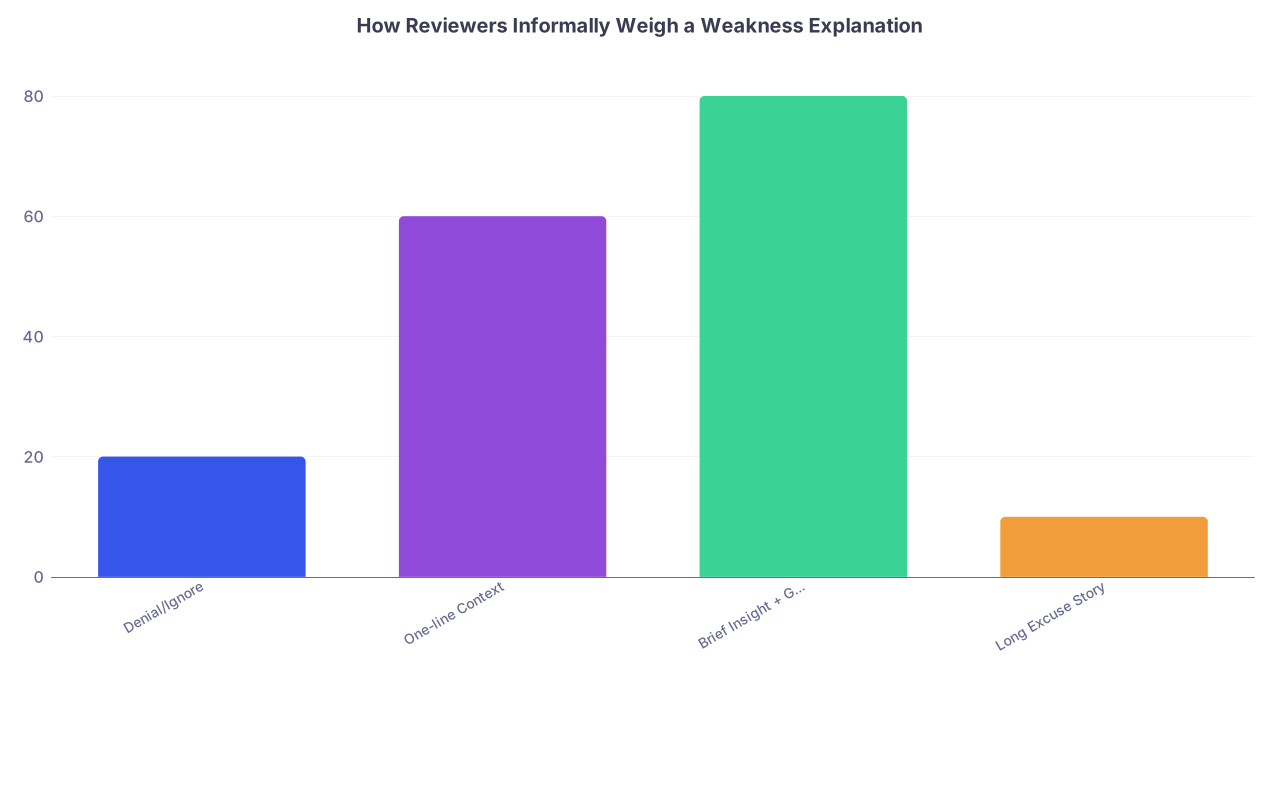
| Category | Value |
|---|---|
| Denial/Ignore | 20 |
| One-line Context | 60 |
| Brief Insight + Growth | 80 |
| Long Excuse Story | 10 |
How to handle this without sinking yourself
Use this rule:
- 0–2 sentences if it is already addressed elsewhere (MSPE, advisor note, ERAS explanation).
- 3–4 sentences maximum if this is your only place to offer context.
Good structure for a brief explanation:
- Clear, factual description (no drama, no self‑pity).
- One line accepting responsibility.
- One line about what you changed.
- One line connecting to how you now approach learning / patient care.
Then move on. Fast. The rest of the statement must make the reader forget your score and remember your judgment.
What you must not do:
- Blame other people (bad proctor, unfair shelf, “everyone struggled”).
- Blame the exam itself as “not reflective of real medicine” (even if you privately think that).
- Spend a full paragraph reliving your anxiety.
You are not being tested on perfection. You are being tested on adult behavior.
Mistake #4: Making the Specialty Look Like a Lifestyle Escape Hatch
Certain least competitive specialties are lightning rods for lifestyle‑hungry applicants: outpatient‑heavy Family Medicine, Psychiatry, PM&R, Pathology. Program directors can smell “I want easier hours” from a mile away.
You might think you are being clever writing lines like:
- “I value a balanced life and believe Psychiatry will allow me to pursue interests outside of medicine.”
- “Family Medicine offers a schedule that will help me maintain my wellness and avoid burnout.”
- “PM&R will allow me to have a sustainable lifestyle while still practicing medicine.”
You are not being clever. You are waving a red flag.
No attending in these fields thinks their job is easy or part‑time. They see burnout, complex patients, emotionally draining encounters. They are evaluating whether you will show up when it is hard, not just when clinic ends on time.
If you come off as primarily seeking comfort, stability, or “protected lifestyle,” you will quietly drop down the rank list. Especially at solid community programs that actually work very hard.
How to mention lifestyle without sounding lazy
You are allowed to care about a sustainable career. You just need to frame it like a physician, not a tourist.
Acceptable:
- “I have seen how the continuity and outpatient focus of family medicine can support a long career of patient care without losing your own humanity.”
- “I am drawn to Psychiatry because it offers deep clinical relationships that I believe I can sustain over decades without emotional exhaustion, especially in a team that values supervision and reflection.”
Unacceptable:
- “I want time for my hobbies and family, which is why I am choosing this field.”
- “Other specialties are too demanding, so I believe this will be a better balance.”
One signals long‑term sustainability and maturity. The other signals avoidance and fragility.
Mistake #5: Using the Statement to Prove You Deserve a “Prestige” Specialty You Left
This one is subtle, and I see it especially with applicants pivoting from surgery, radiology, or a failed “top specialty” match.
They are technically applying to a less competitive field, but their personal statement is still written to impress the people from their previous dream. So they overload the essay with:
- OR war stories for Psych or FM applications.
- Prolonged discussions of advanced imaging for Pathology applications.
- Emphasis on “high‑acuity inpatient care” for outpatient‑heavy specialties.
What this tells the reader is simple: your heart is still somewhere else.
I once watched a faculty member reading a Psychiatry personal statement that spent 75% of its length describing trauma surgeries and ICU nights. She put it down halfway through and said, “He needs to go do surgery. I am not going to compete with that fantasy.”
Do not force your new specialty to compete with your old one. Show that you understand and actually want the core of what they do.
You can mention past interests. You can even draw useful skills from them—procedural comfort, acute care thinking, imaging literacy—but those should be single lines, not the backbone.
Try this mental check: If someone who loves your target specialty read only your anecdotes, would they recognize their world? Or would they see you chasing something else?
Mistake #6: Over‑Sharing Personal Mental Health or Trauma Without Boundaries
This one is tricky, especially in Psychiatry and Family Medicine, which draw applicants who care deeply about mental health and often have personal experiences.
There is a line between thoughtful disclosure and uncontained oversharing. Cross it, and reviewers worry less about your empathy and more about your current stability, boundaries, and readiness for residency.
Signs you are crossing into risky territory:
- Graphic description of your own or a family member’s suicidality, self‑harm, or psychosis.
- Multiple paragraphs about your own psychiatric treatment, still clearly unresolved.
- Statements like “Psychiatry saved my life” without any reflection on current coping or distance.
- Presenting yourself as “broken but grateful” in a way that feels actively raw rather than integrated.
Program directors are human. Many have their own histories. They are not judging you for having struggled. They are judging whether you can reliably care for patients in crisis without collapsing yourself.
Safer way to handle lived experience
- Keep personal disclosure brief and purposeful.
- Focus on insight: what you learned about vulnerability, stigma, treatment, or systems of care.
- End with concrete evidence of functioning: academics, responsibilities, longitudinal commitments.
A solid approach:
“I first encountered serious depression in my own family, an experience that introduced me early to both the power and the limits of psychiatric care. Over time, this has shaped the way I listen to patients and their families: with attention to how illness affects relationships, not just individuals. In medical school, this perspective led me to seek out rotations where I could follow patients across multiple admissions, watching how small shifts in trust and alliance changed outcomes over months, not days.”
No gore. No active crisis. Enough to show why you care, not enough to make them worry if you can handle night float on an inpatient psych unit.
Mistake #7: Copy‑Pasted, Template‑Like Statements Across All Programs
Here is an unspoken truth about “less competitive” specialties: many applicants treat them as volume plays. They apply broadly and blast the exact same generic statement everywhere.
Programs notice. Especially the ones in less desirable locations.
I have seen statements that literally reference wanting to work “in a busy urban academic center” sent to a small community program in a rural town. Or applicants talking about “my commitment to underserved Hispanic communities” sent to a program in a region that is overwhelmingly not Hispanic, with no explanation of why that specific place.
This kind of sloppiness is survivable in hyper‑competitive specialties where everything is numbers‑driven and the PS is window dressing. In holistic fields, it hits harder.
You do not need 50 different statements. You do need to avoid obvious mismatches and show that you at least glanced at where you are applying.
| Approach | Risk to Your Application |
|---|---|
| Single generic PS with no specialty tailoring | Very High |
| One specialty‑specific PS for all programs in that field | Moderate |
| Minor regional tweaks (urban vs rural, academic vs community) | Low |
| Thoughtful program‑specific lines for top‑choice programs | Lowest |
You do not have time to fully individualize every statement. So be strategic:
- One strong, specialty‑anchored core statement.
- Slight variants for major context shifts (rural‑focused FM vs urban underserved FM; research‑heavy Psych vs community Psych).
- A short, specific line or two for your top 5–10 programs where you actually explain why you care about them.
Always run a quick scan for:
- Wrong program name.
- Wrong city or region referenced.
- Phrases that make no sense for that setting (e.g., “I hope to care for refugees at your program” when the program has zero global health footprint).
Yes, I have watched applicants get mocked in committee for copying another program’s name. They did not match there.
Mistake #8: Writing a Boring, Perfectly Polished Essay That Says Nothing Real
This one is subtle but deadly. Especially common among high‑achieving applicants “trading down” into a less competitive category.
They know how to write. They have been edited to death by advisors. So they turn in a technically flawless, grammatically perfect, totally lifeless personal statement.
It hits all the safe beats:
- Childhood curiosity about medicine.
- Caring for a beloved grandparent.
- Realizing they like “the whole patient,” “the mind and the body,” or “the growing child.”
- A rotation where “everything just clicked.”
- A generic paragraph about being a team player, hard worker, and lifelong learner.
No edges. No specificity. No risk. No signal.
Program directors look at these and shrug. “Seems fine.” Then move on to the person who actually feels like a human they could work with at 3 a.m.
In least competitive specialties, this matters. They are often choosing between many people with similar metrics. The personal statement is one of the few places to differentiate you as a colleague, not just a CV.
You do not need to be dramatic or quirky. But you must be concrete and honest enough that another physician can vaguely imagine you in a clinic room or on the ward.
Ask yourself:
- Could someone who read only your statement accurately predict a typical day in the specialty you are applying to from your descriptions?
- Do you show any moment where you were wrong, then learned? Or are you the hero in every paragraph?
- Is there a single sentence that only you would write?
If the answer is no to all three, you are aiming too hard for safety and not enough for reality.
Mistake #9: Ignoring the Hidden Red Flags of “Fit”
Least competitive does not mean indiscriminate. Programs have strong personalities. And they read your statement for fit as aggressively as the derm programs do—just in different ways.
Here are some quiet red flags that show up in personal statements:
- For Family Medicine: Never mentioning families, communities, prevention, or outpatient continuity at all.
- For Psychiatry: Glorifying acute danger, seclusion, restraints, or “crazy stories” instead of thoughtful alliance and recovery.
- For Pediatrics: Talking mainly about adult medicine and “tolerating” kids instead of enjoying them.
- For Pathology: Focusing solely on avoiding patient interaction and desiring a “quiet lab job.”
- For PM&R: Treating it like “lighter orthopedics” with better lifestyle, with no mention of function, disability, or interdisciplinary rehab teams.
These do not always kill an application outright. But they make programs wonder whether you actually get what they do. Which lowers your chances, especially for interview offers.
You should be able to describe:
- Typical patient populations.
- Common settings (inpatient, outpatient, consult, rehab, etc.).
- The central questions clinicians in that field ask each day.
If you cannot, you probably have not spent enough time really understanding the specialty. That lack of understanding reads as casual disrespect in fields that are very used to being misunderstood.
Your Next Step Today
Do not write a new sentence yet. Open your current personal statement draft—or your blank page—and do one ruthless thing:
Write the name of your chosen specialty at the top. Then go line by line and ask:
“Could this same sentence make sense in at least three other specialties?”
If the answer is yes, highlight it.
Your job over the next week is to systematically replace as many of those highlighted lines as possible with specific, grounded, specialty‑anchored details from your real experiences.
That one exercise will eliminate half the mistakes I just described.
Start with paragraph one today. Make it impossible for a reviewer to confuse which specialty you are choosing—and why you meant to choose it.