
It is January. You are on your family medicine rotation, the attending is relaxed, the clinic staff likes you, and you are thinking, “You know… this life is not bad.”
Then you say out loud in the workroom: “Well I am probably going into something more competitive, but this has been fun.”
Everyone hears it.
They smile politely.
And your evaluation just quietly downgraded itself from “highly recommend” to “solid, pleasant student.”
You did not mean to insult anyone. You did not think you were burning a bridge. But in low‑competition specialties, this type of accidental signaling is exactly how people talk themselves out of strong letters, away rotations, and interview enthusiasm.
This is the problem:
Low-competition does not mean low standards.
And the people who control your chances can smell even mild condescension from across the clinic.
Let me walk you through seven specific ways applicants accidentally signal disinterest in so‑called “less competitive” fields like:
- Family medicine
- Pediatrics
- Psychiatry (depending on cycle / region)
- Internal medicine at community programs
- PM&R, pathology, or prelim years in non‑hot locations
and how to stop stepping on these landmines.
1. Treating the Specialty as a “Backup” Out Loud
You can think “backup” all you want. The mistake is saying it. Or implying it. Or writing it.
I see this constantly on rotations and in application materials:
- “I am applying EM but I am keeping IM as a backup.”
- “I am mostly interested in ortho, but I thought peds would be a good safety net.”
- “I am dual applying with anesthesia as my main focus.”
To you, that sounds honest.
To the people in that so‑called “backup” specialty, it sounds like:
- “I am here because I think I can get in easily.”
- “I think your field is plan B for people who cannot cut it elsewhere.”
- “I will probably leave if I ever get a better offer.”
Programs do not want that. Even the least competitive specialties still reject large numbers of applicants. They are not desperate. They value residents who actually want to be there.
Red flags they notice:
- Saying “backup,” “safety,” or “just in case” in front of attendings, residents, or in your personal statement.
- Personal statements that clearly scream loyalty to another specialty but are copy‑pasted and barely edited.
- Telling one resident you are “really aiming for derm, but you know, gotta match somewhere.”
How to avoid this mistake:
Internally, fine, you have tiers of preference. Externally, you have “interests,” not “backups.”
Write a fully genuine, specialty‑specific personal statement for each field you apply to. Yes, that is more work. Do it anyway.
If you are asked, “Are you applying anywhere else?” your safest answer is:
“I have explored a few areas, but I can see myself very realistically and happily in [this specialty], which is why I am focusing my energy here.”
You do not need to oversell, but you do need to stop insulting the specialty’s dignity.
2. Under‑Preparing for “Easy” Interviews
There is a dangerous myth:
Low‑competition specialty = low‑stakes interview = “I can wing it.”
That mentality leaks through your body language, your answers, and the way you talk about the field.
I have watched candidates walk into community family medicine interviews with:
- No real knowledge of the program beyond “in my home state”
- Generic answers clearly recycled from IM or EM interviews
- No questions for faculty besides “What is the call schedule?”
- Virtually no idea what the specialty’s core issues or trends even are
Faculty notice. Residents definitely notice.
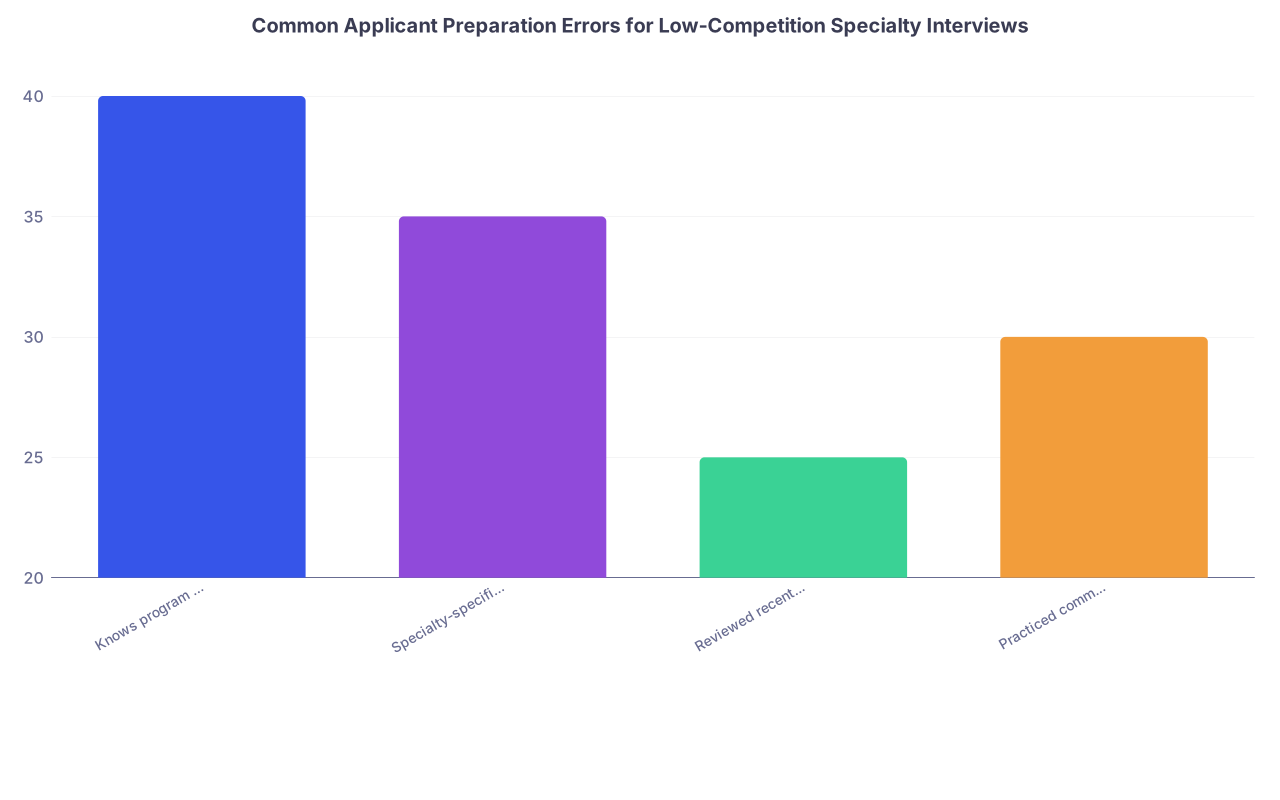
| Category | Value |
|---|---|
| Knows program specifics | 40 |
| Specialty-specific questions prepared | 35 |
| Reviewed recent guidelines | 25 |
| Practiced common questions | 30 |
Where you quietly signal disinterest:
- When you say, “Honestly, I just want a chill lifestyle” as your main reason for the specialty.
- When your examples of clinical experiences are all in another specialty and you cannot produce one solid story from this field.
- When you ask, “So what exactly do you see here?” at a site that advertises its patient mix on the first page of its website.
How to avoid this mistake:
Before every interview, even at a small community program in a non‑coastal town:
- Read the program website thoroughly. Especially rotations, clinic structure, and any tracks (underserved, rural, sports, etc.).
- Have at least 2–3 genuine reasons you would choose that specialty over more “prestigious” options. Not lifestyle. Not “I like people.” Actual content.
- Prepare 4–5 questions specific to that program, not copy‑paste filler.
If you walk into a “low‑competition” interview underprepared, you do not look casual. You look like someone who will rank them low and complain during residency.
3. Doing the Bare Minimum on Rotations You Think “Do Not Matter”
Here is the script I hear all the time:
“I am going into surgery. This outpatient peds month is just a formality. As long as I do not fail, it won’t matter.”
Wrong. Two ways.
- Those “non‑core” rotations still feed into your MSPE and eval summaries.
- If you later pivot to peds or family or psych because your “competitive” plan falls apart, that “bare minimum” month is suddenly your main evidence of interest in the new field.
I have seen that pivot. It is not hypothetical. Student aiming for ortho. Scores come back mediocre. Research falls through. Suddenly they want PM&R or family medicine. The only people who have seen them in those spaces? The attendings they ignored and the residents they shrugged off.
What “bare minimum” looks like from faculty side
- You consistently leave as early as allowed.
- You avoid procedures or new patients because “I have to study for Step.”
- You volunteer for almost nothing that is not strictly required.
- Your notes are technically correct but clearly lazy and template‑driven.
- You show no curiosity about the bread‑and‑butter issues of that field.
Residents see it and tell each other: “They are chasing something more competitive.”
How to avoid this mistake:
On ANY rotation in a specialty that might even remotely become your home if Plan A fails:
- Show real engagement with at least a few core topics (e.g., well‑child care, depression management, diabetes control, stroke rehab).
- Ask 1–2 thoughtful questions per day that show you are paying attention.
- Volunteer for something: present a brief teaching topic, help with QI, or follow a complex patient longitudinally.
You are protecting your optionality. You are building insurance. This is not about pretending to love every field; it is about not leaving a trail of “unimpressed” evals in the very specialties that might save your match.
4. Writing a Personal Statement That Quietly Insults the Field
Personal statements for low‑competition specialties are often… lazy. Because students think “I will get in anyway.”
Here is where you signal disinterest without realizing it:
- Spending 75% of your essay talking about a different specialty you “always dreamed of” before this one.
- Over‑emphasizing ease and flexibility: “I value work–life balance and the lighter hours of [field].”
- Writing about the specialty like a generic primary care blob. (I have seen psych statements that could have been FM statements with two words swapped.)
Programs read hundreds of these. They can tell when their field is just the consolation prize.
| Aspect | Weak Signal Example | Strong Signal Example |
|---|---|---|
| Focus of narrative | Mostly about another specialty | Specific stories in chosen field |
| Motivation | Lifestyle, hours, “chill” | Patient populations, clinical problems |
| Specialty knowledge | Vague “I like continuity” | Concrete mention of bread-and-butter conditions |
| Program fit | Generic “anywhere with good training” | Tied to specific types of practice / settings |
| Tone | Backup / safety vibe | Long-term commitment and curiosity |
How to avoid this mistake:
- Pick 1–2 concrete patient encounters in that field. Anchor your essay there.
- Talk about what you want to do in that specialty: rural primary care? Child psych? Academic hospitalist? Addiction medicine? Rehab for athletes?
- Avoid phrases that scream “easy road”: “less intense,” “less stressful,” “more manageable,” etc.
You are not writing to justify why you are not in a more competitive specialty. You are writing to show why this field deserves your attention.
5. Ranking Programs in a Way That Exposes Your Real Priorities
You think your rank list is private. Technically, it is. But people are not stupid.
When you:
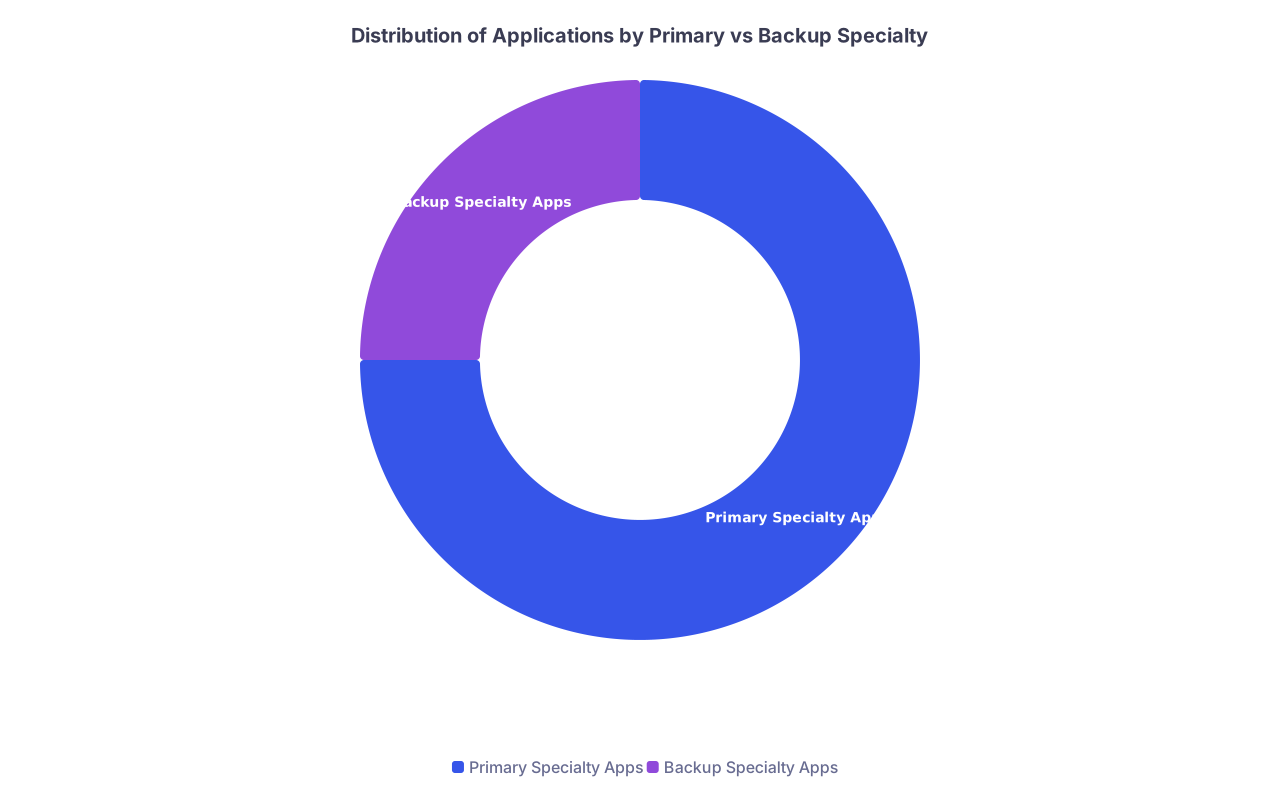
- Apply to 60 EM programs and 12 family med programs
- Or 50 anesthesia programs and 8 psych programs
- Then “mysteriously” only interview at a small handful in the less competitive specialty
it becomes pretty obvious that you are not truly invested.
The deeper issue: you underestimate how often you might need those “backup” interviews to turn into your actual match outcome.
| Category | Value |
|---|---|
| Primary Specialty Apps | 75 |
| Backup Specialty Apps | 25 |
Where you signal disinterest without saying a word
- You cancel low‑competition interviews late “because something better came up.” That gets noticed and remembered.
- You do virtual interviews with your camera off or with obviously bad preparation.
- You tell residents at one program that another, more “prestigious” specialty is actually your real goal.
All of this adds up to a reputation: you are not serious.
How to avoid this mistake:
- If you are dual‑applying, commit to treating both fields as real options. That means enough applications and genuine interview effort in both.
- Do not cancel low‑competition interviews at the last second to chase a “better” one unless you are sure you will rank them below NRMP’s “do not rank” threshold anyway.
- On interview day, always behave as if this could be the place you end up. Because it might.
You cannot half‑signal interest and then expect people to assume you really care.
6. Talking Down the Specialty’s Bread‑and‑Butter Work
Nothing kills enthusiasm from faculty faster than a student who clearly thinks the core work is beneath them.
Common examples:
- On family med: “I am just not sure I want to spend my life doing HTN and DM refills.”
- On peds: “Well visits all day seem kind of repetitive.”
- On psych: “I miss ‘real medicine’ and procedures.”
- On PM&R: “It is cool, but it is mostly social work and disposition stuff.”
You might assume you are just “being honest.” That is not how it lands.
It lands as:
- “I am bored by the patients you have devoted your career to.”
- “I do not respect the complexity of your daily work.”
- “I think this is below my level.”
In lower‑competition specialties, where people already fight the stereotype of being “less than,” this cuts deep. You will not get a strong letter from someone who thinks you look down on their life’s work.
How to avoid this mistake:
- If you are frustrated with repetitive or chronic care, keep that for your friends, not your evaluator.
- Ask deeper questions about the “boring” stuff: Why did this patient’s A1c actually improve? How do you handle resistant hypertension? How do you talk to parents about vaccines?
- Show that you appreciate the intellectual and relational complexity of “simple” cases.
You do not have to fake passion for every UTI. But you absolutely should not publicly roll your eyes at the main work of the specialty you claim to be applying to.
7. Failing to Build Any Specialty‑Specific Signal at All
The final and most silent mistake: you are “interested” in a low‑competition field, but your file shows virtually nothing that connects you to it.
No:
- Specialty‑specific electives
- Longitudinal clinic in that area
- Research, even small QI projects
- Volunteer work that aligns with the patient population
- Mentors or letters from within the field
Programs do not think, “This student is keeping their options open.” They think, “This student will leave us the second they get a better offer.”

| Step | Description |
|---|---|
| Step 1 | No clear specialty interest |
| Step 2 | No elective in specialty |
| Step 3 | Weak or generic letters |
| Step 4 | Generic personal statement |
| Step 5 | Program sees low commitment |
| Step 6 | Lower ranking or no interview |
In a competitive specialty, sometimes your Step score or big‑name research can carry you a bit. In lower‑competition fields, programs are often more focused on:
- Will this person actually stay?
- Do they understand what we do?
- Are they dependable and aligned with our patient population?
If you give them nothing to say “yes” to those questions, they assume the answer is “no.”
How to avoid this mistake:
If a low‑competition specialty is even your possible Plan B:
- Do at least one elective or sub‑I in that field, ideally at a program you might want to match at.
- Get at least one letter from an attending in that specialty who has seen you work for more than a few days.
- Find a small, realistic project: case report, chart review, QI, or patient education resource. It does not have to be glamorous. It needs to exist.
- Join the student interest group, or at least show up to one or two events and meet people.
This is not about padding your CV. It is about answering the question: “If we take a chance on you, will you stay and thrive here?”
Quick Recap of the Seven Signals to Stop Sending
You accidentally signal disinterest in low‑competition specialties when you:
- Call them “backup” or “safety” out loud or in writing.
- Under‑prepare for interviews because you assume they do not matter as much.
- Sleepwalk through rotations in that field, leaving weak evals behind you.
- Write personal statements that essentially say “I wanted something else.”
- Treat interview invites and rank lists in ways that make your real priorities painfully obvious.
- Talk down the bread‑and‑butter work as boring, easy, or beneath you.
- Build zero specialty‑specific signals, making programs doubt your commitment.
Low‑competition does not mean low‑standards, and it absolutely does not mean low‑pride. If you want these fields as real options, start behaving like they are worthy ones. Because they are.
FAQ (Exactly 4 Questions)
1. Do programs in low‑competition specialties really care if I am dual‑applying?
Yes, they care. What they care about even more is how you present it. If your entire application screams, “I am only here because I could not get into X,” they will be wary. If you can credibly articulate why you would be happy in their field and show at least some real engagement (elective, letter, basic knowledge), most programs in these specialties accept that dual‑applying is common. Just do not rub their nose in the fact that you rank them second emotionally.
2. Is it a mistake to openly say I care about lifestyle in these specialties?
It depends how you say it. If lifestyle is your primary and only talking point—“I want something less intense, more chill, good hours”—you sound shallow and opportunistic. If you frame lifestyle as one piece of a broader fit—“I value having enough bandwidth to build long‑term patient relationships, teach, and be involved in my community”—that is fine. Nobody expects you to want to be miserable. They expect you to value the actual work, not just the schedule.
3. How many specialty‑specific experiences do I need to not look disinterested?
You do not need a 20‑page research portfolio. For most low‑competition specialties, a baseline that avoids the “disinterest” label looks like:
- 1 core clerkship where you performed well
- 1 elective / sub‑I in the field
- 1 meaningful letter from someone in that specialty
- 1 small project, involvement, or initiative that clearly aligns with the field or its patients
That is enough to show, “I did not just pivot here in November because I panicked.”
4. If I realize late that I am switching from a competitive to a low‑competition specialty, what is my biggest priority?
Stop talking about the old specialty as the love of your life. Immediately. Then, triage:
- Secure at least one strong letter in the new specialty, even if it means a late elective.
- Rewrite your personal statement so it is fully oriented to the new field, not a rebranded version of your old one.
- Reach out to the new specialty’s advisors or program leadership and be transparent but respectful: explain your pivot without insulting either field.
Your late switch is not what will kill you. The way you keep signaling that you still wish you were somewhere else—that is what will.