
The idea that “prestige doesn’t matter anymore” is fantasy. It matters. But not the way most people think—and not equally across specialties.
If you’re going into an “easier” or less competitive field, the prestige game does not disappear. It just mutates. And if you misunderstand how, you’ll either over-invest in brand-name chasing that never pays off—or underplay reputation in the one setting where it still punches you in the face: your first job search.
Let’s dismantle some myths.
Myth 1: “Prestige only matters for super competitive specialties”
This is wrong on two levels.
First, yes, prestige is turned up to 11 in plastics, derm, ortho, neurosurg, ENT. Nobody’s arguing that. Those programs live and die on brand. Residents self-select for it. Applicants worship it.
But here’s the lazy assumption: that “easier” or less competitive specialties—family medicine, internal medicine (community programs), psych, peds, PM&R, path, even some neurology—somehow exist in a prestige-free vacuum.
They do not. They just have:
- Different prestige currencies
- Different prestige stakes
- Different prestige timelines
In the ultra-competitive fields, reputation hits you during the match. In less competitive ones, it hits later—when you’re trying to land the job you actually want, not just any job that will sign your contract.
You feel it most when:
- You want a job in a saturated metro area
- You’re trying to join a high-paying private group instead of a safety-net clinic
- You’re aiming for academic or subspecialty fellowship from a “chill” core specialty
Programs absolutely judge: “Which residency were you at?”
The question is not whether they care. It’s: what exactly are they inferring from the answer?
Myth 2: In “easy” specialties, all residencies are basically the same
That’s comforting. It’s also false.
Programs in less competitive specialties differ less in board scores and swag factor, more in:
- How hard they work you
- How competent and autonomous you become
- Whether local employers trust their graduates
Here’s where reputation quietly shows up: hireability. Not “fancy on paper,” but “do local attendings think your residency makes good doctors?”
An honest breakdown:
- Family medicine: A lot of jobs everywhere. But in competitive suburbs or affluent areas, private groups and health systems absolutely have “yes” and “hard no” FM programs they gossip about.
- Psychiatry: Everybody thinks “psych is wide open.” Yes—if you’re okay with any job. The cush, well-compensated outpatient gigs in desirable cities often screen by “program I know and trust.”
- Pediatrics: Fewer jobs than people assume. Children’s hospitals and subspecialty groups lean on reputation heavily—especially if you want outpatient subspecialty or academic roles.
- PM&R: Small world. Fellowship and sports/Spine/pain groups care a lot which PM&R program trained you.
- Pathology: The job market is not as rosy as students pretend. Certain programs are golden tickets. Others… not so much.
- Community IM: For straight hospitalist work in many regions, almost any IM residency is fine. For cush lifestyle jobs, desirable markets, or certain subspecialties, your program name suddenly starts to matter again.
So yes, prestige differences exist. They’re just less about Step scores and more about signal-to-local-employers.
Where prestige actually bites in “easier” fields
Let me be concrete. The three big places reputation still matters in less competitive specialties:
- The zip code you end up working in
- Your ability to get the “good” job, not just any job
- Fellowship access within that field
You might match a low-reputation family med program in a random Midwest town and think, “Whatever, I’ll just come back to my big coastal city after residency.” Then PGY-3 hits, you send out applications, and suddenly:
- The big city private groups are “not currently hiring”
- The hospital-owned clinics “already filled the position internally”
- The only people eager to sign you are rural clinics two states away or a safety-net system with high burnout
Meanwhile your co-resident from a better-known regional program gets pulled into a higher-paying suburban group with a lower panel size and better work-life balance.
Did their Step score matter? No.
Did their residency’s brand among local attendings matter? A lot.
That’s prestige. Just stripped of Instagram aesthetics and shoved into HR workflows and physician whisper networks.
Data reality check: competitiveness vs outcomes
Let’s put some structure on this instead of vibes.
| Specialty Type | Match-Day Competitiveness | Residency Name Impact on Matching | Residency Name Impact on First Job |
|---|---|---|---|
| Derm/Plastics/Ortho/ENT | Very High | Huge | Moderate |
| Radiology/Anesthesia/EM | Moderate–High | Significant | Significant |
| Internal Med (university) | Moderate | Moderate | Significant |
| Psych/Peds/PM&R/Path | Low–Moderate | Low–Moderate | Significant |
| Family Med/Community IM | Low | Low | Moderate–Significant |
Translation: the supposedly “least competitive” fields often have more of their prestige influence shifted to the job market phase instead of the match phase.
You don’t feel it as an MS4. You feel it when the credentialing office or group partners quietly sort applications based on where you trained.
Myth 3: If the field is easy, you should just go where you’ll be happiest
“Happiness” gets abused as justification for some very bad decisions.
The classic line from fourth years:
“I’m going into family med / psych / peds, so I’ll just pick the chillest place in the best city. Program name doesn’t matter for me.”
Here’s the uncomfortable part: sometimes that’s fine. A well-run community FM program in a medium metro with great teaching and sane hours can be a fantastic life + career move.
But the lazy extension—“prestige doesn’t matter at all”—is how you end up at a place that wrecks your training and limits your mobility later.
There are three layers of “reputation” you should care about in less competitive fields:
- Clinical reputation – Do local hospitals and attendings think this program produces competent doctors?
- Workload reputation – Does this place undertrain? Overservice? Burn people out?
- Brand reputation – Does the name spark recognition anywhere beyond a 50-mile radius?
The first one is non-negotiable. If local attendings think a program is weak, your job options in that region will be narrower and worse.
Local vs national brand: the quiet trap
In competitive specialties, the same handful of national names dominate conversations—Mass Gen, Mayo, Hopkins, etc.
In less competitive specialties, the local and regional ecosystem dominates.
A psych residency you’ve barely heard of in the Midwest may be a powerhouse in its region, with strong ties to every major health system in a 300-mile radius. Meanwhile a “mid-tier” coastal academic name that sounds slick to a med student may have almost zero pull in the Midwest private sector.
Where you train heavily influences:
- Where your attendings can effortlessly call on your behalf
- Where your alumni are already seeded in jobs
- Where local hiring committees have direct experience with “your program’s” graduates
That is why “I’ll go anywhere for residency, then move to X big city after” is often much harder in practice—especially in less competitive fields where regional networks matter more than national brands.
Where prestige really is dead (or close)
Let’s be fair. There are aspects where prestige has genuinely lost oxygen.
Basic employability in shortage specialties
In rural and many community settings for FM, psych, peds, and general IM, if you are board-certified, can speak full sentences, and are willing to show up, you’re getting a job. Program prestige is nearly irrelevant here.Telehealth and locums work
A lot of telepsych, tele-primary care, and even subspecialty remote gigs barely glance at residency pedigree beyond accreditation. They care about licensing, no major red flags, and willingness to swallow their productivity model.Straight-out-of-residency “warm body” jobs
Some systems just need coverage. They’ll take a wide range of candidates as long as your references don’t quietly torch you.
But read that carefully: this is the bottom threshold. “Will someone hire me?” In most less competitive specialties, yes, unless you’ve really set yourself on fire.
The better question: Will someone hire me into a job I want, in a place I want, with a schedule and pay that don’t hollow me out?
Prestige—or more precisely, program reputation—comes roaring back there.
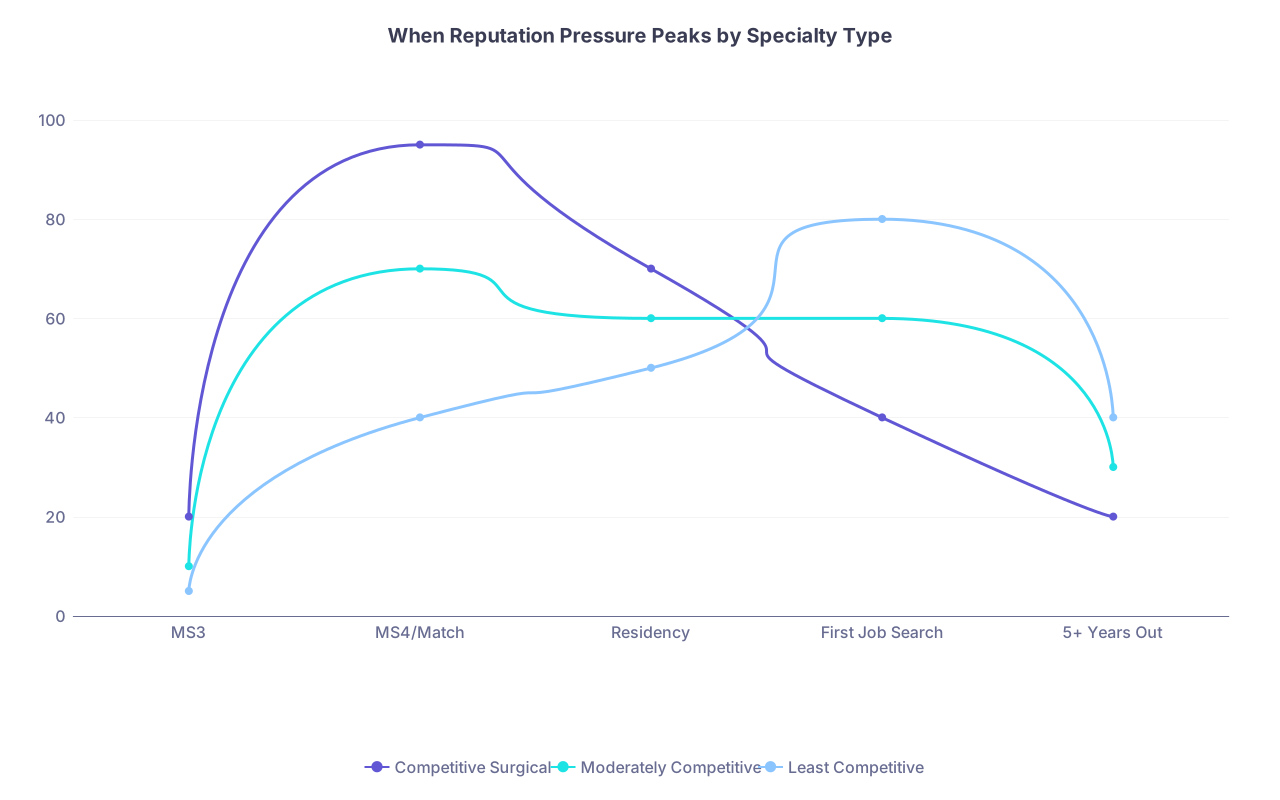
Charting how “prestige pressure” shifts over time
| Category | Competitive Surgical | Moderately Competitive | Least Competitive |
|---|---|---|---|
| MS3 | 20 | 10 | 5 |
| MS4/Match | 95 | 70 | 40 |
| Residency | 70 | 60 | 50 |
| First Job Search | 40 | 60 | 80 |
| 5+ Years Out | 20 | 30 | 40 |
For least competitive specialties, you can see the basic pattern: match is not where prestige hurts you the most. The first job search is.
Myth 4: “If I’m good, I’ll rise no matter where I train”
I like the sentiment. Reality is more blunt.
Individual excellence helps, a lot. But the idea that you can simply “out-talent” deep structural reputation issues is naïve. Here’s what actually happens:
- Great resident at a weakly-regarded program: You get a decent job, maybe a good one, but you’ll fight more uphill battles for competitive locations or elite fellowships.
- Mediocre resident at a solid regional program: You coast farther on the program’s reputation than you probably deserve.
- Excellent resident at a strong program in a shortage field: You will have options that your classmates at no-name, poorly run programs never see.
You can be the best resident in your program. But if the program is known locally for producing underprepared graduates, every hiring committee filters you through that lens first.
The worst version of this: undertraining. Some “cush” FM or psych programs barely push residents. Light call, minimal inpatient exposure, weak supervision. Residents feel happy… until they hit the real world.
You do not want to be the undertrained new attending in a high-acuity setting from a program everybody quietly knows is weak.
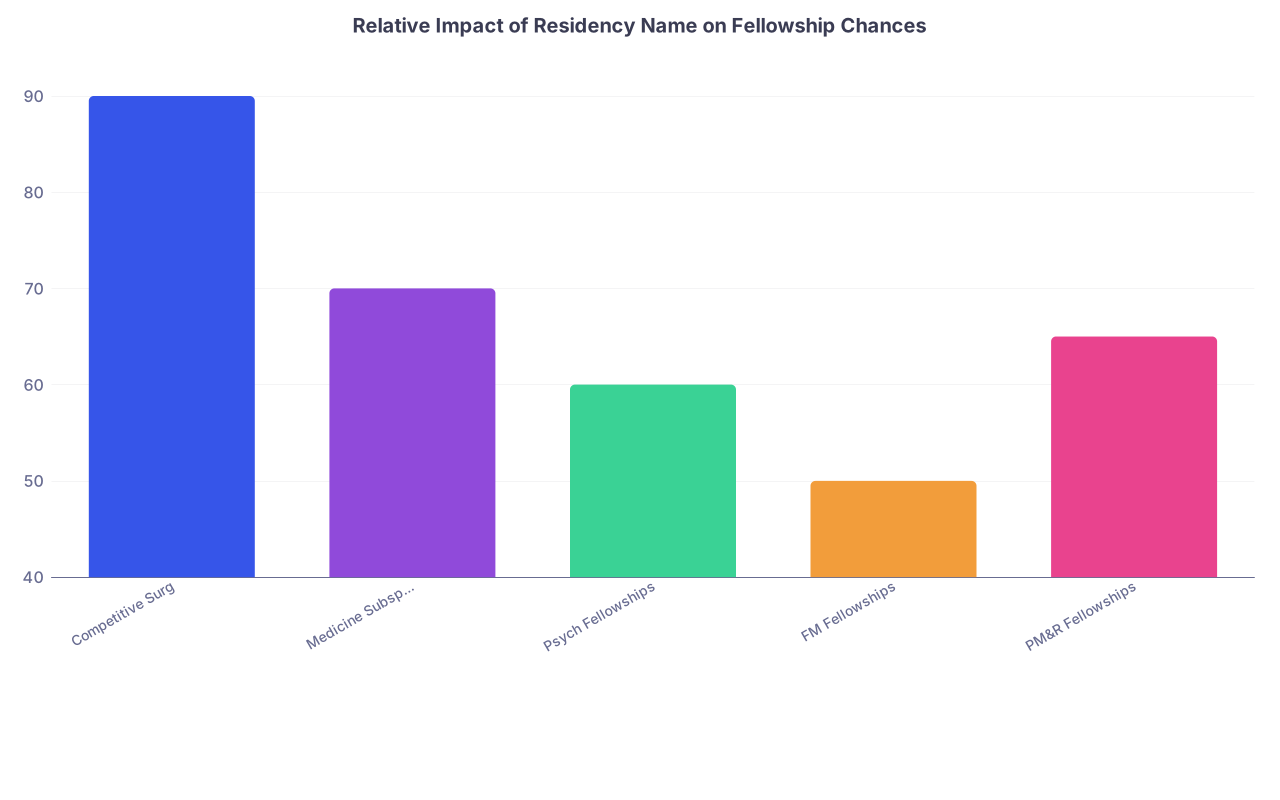
Fellowship: the hidden prestige choke point in “easy” fields
You think prestige doesn’t matter in psych. Then you want:
- Child and adolescent psych at a top children’s hospital
- Addiction at a name-brand university
- Forensics at a historically strong program
Suddenly pedigree matters.
Same in:
- Family med → sports medicine, OB, palliative, addiction
- PM&R → sports, pain, spinal cord, TBI
- Peds → NICU, cards, heme/onc, GI
- Path → heme, dermpath, cytopath, transfusion
Fellowship directors are not immune to lazy filtering. They know which residencies consistently send great fellows and which do not. They rank accordingly.
| Category | Value |
|---|---|
| Competitive Surg | 90 |
| Medicine Subspecialties | 70 |
| Psych Fellowships | 60 |
| FM Fellowships | 50 |
| PM&R Fellowships | 65 |
So if your plan is, “I’ll do a chill psych / FM / PM&R program, then go for a high-end fellowship,” program reputation is not optional background noise. It’s a gating factor.
How to think about prestige rationally in less competitive fields
Here’s the adult way to look at this.
Stop asking:
“Does prestige matter in my specialty?”
Start asking:
- “In the geographic area I might want to work, which programs are trusted?”
- “Does this program’s training actually make me competent and confident?”
- “If I wanted a fellowship or an above-average job, where do alumni from this program end up?”
You don’t need a “top 10” program. In least competitive specialties, chasing brand names like you’re applying for derm is often pointless. What you need is:
- Solid training – Enough volume, acuity, supervision, and responsibility that you graduate ready.
- Decent local/regional reputation – Employers in at least one region think “those grads are good.”
- Alignment with your actual goals – Outpatient-heavy vs inpatient-heavy, academic vs community, fellowship vs straight-to-work.
Prestige is not dead. It just stopped wearing an Ivy League sweatshirt and started wearing a nametag at the credentialing office.
Quick visual: how employers actually screen you

| Step | Description |
|---|---|
| Step 1 | CV received |
| Step 2 | Check license and red flags |
| Step 3 | Offer interview |
| Step 4 | Review residency program |
| Step 5 | High interest |
| Step 6 | Lower interest or reject |
| Step 7 | Interview and references |
| Step 8 | Specialty shortage? |
| Step 9 | Known and trusted? |
In shortage settings, program name is muted. In saturated or desirable markets, it becomes a much louder filter.
Where this leaves you
If you are heading into a “least competitive” specialty, here’s the stripped-down truth:
- You will almost certainly match somewhere if you’re reasonable.
- You will almost certainly find a job.
- The type and location of that job, plus your fellowship options, will be shaped more than you think by where you trained.
Prestige is not a binary switch. It’s a gradient of trust, familiarity, and expectation. In high-competition fields, you feel it early. In easier fields, you feel it later—and often when changing course is much harder.
Prestige isn’t dead. It’s just quieter, more local, and more tied to the kind of life you end up living than the logo on your white coat. Years from now you won’t care what anyone thought of your match list; you’ll care whether the choices you made gave you options when it actually counted.