
The generic residency advice falls apart the second you apply to more than one specialty.
Most timelines assume you’re a tidy, single‑specialty applicant. You are not. You’re hedging with two or three “backup” specialties. That changes everything—what you do in March, what you ask for in July, and what can blow up your rank list in February.
I’m going to walk you month‑by‑month, then week‑by‑week through peak season, and I’m not sugar‑coating the crunch points. This is written for people applying to less competitive fields (FM, IM, peds, psych, neuro, PM&R, path, OB in many regions, etc.) but to multiple of them at once.
Think: IM + Neuro. Psych + FM. Peds + Child Neuro. Or even three: IM + Neuro + PM&R.
The risk isn’t that you will not match at all. The bigger risk is you match somewhere you never really wanted because you mis‑timed letters, signals, and interviews.
Let’s build the calendar so you do not.
Big‑Picture Calendar: What Changes When You Add Backup Specialties
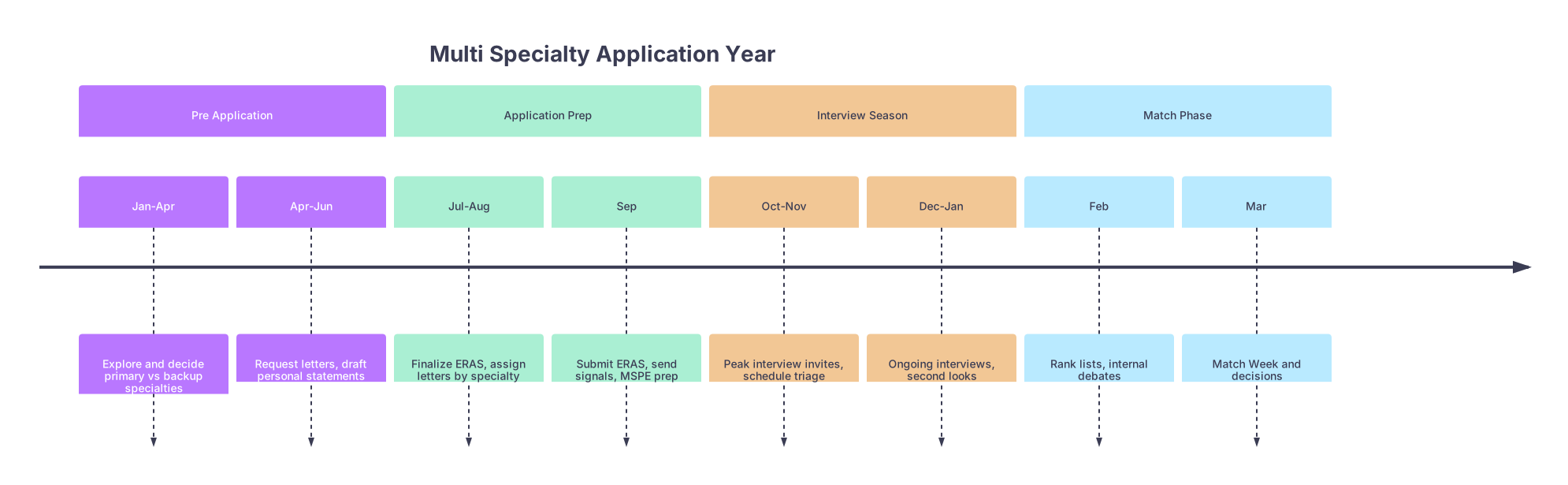
Here’s the high‑level year. I’ll assume ERAS/NRMP style timing (US MD/DO or IMG aiming for July start).
| Period | Event |
|---|---|
| Pre Application - Jan-Apr | Explore and decide primary vs backup specialties |
| Pre Application - Apr-Jun | Request letters, draft personal statements |
| Application Prep - Jul-Aug | Finalize ERAS, assign letters by specialty |
| Application Prep - Sep | Submit ERAS, send signals, MSPE prep |
| Interview Season - Oct-Nov | Peak interview invites, schedule triage |
| Interview Season - Dec-Jan | Ongoing interviews, second looks |
| Match Phase - Feb | Rank lists, internal debates |
| Match Phase - Mar | Match Week and decisions |
When you apply to one specialty, the calendar is mostly linear.
When you apply to two or three, you add:
- Extra letters to chase
- Multiple personal statements to polish
- Conflicting interview dates
- Confusing narratives (“Why psych here but FM there?”)
You can’t fix that with “being organized.” You fix it by front‑loading and sequencing specific tasks.
Let’s go chronologically.
January–March: Decide Your Primary vs Backup Specialties
At this point you should stop pretending you have infinite options.
By the end of March, you want:
- 1 clear primary specialty
- 1–2 realistic backup specialties (not 5; that’s chaos)
January
At this point you should:
- Reality‑check your competitiveness
- Look at your:
- Step 2 / Level 2 (or projected)
- Clinical grades
- Any red flags (repeats, LOA, failed board)
- Compare to approximate target ranges:
- Look at your:
| Specialty | Step 2 Target | # Programs Commonly Applied |
|---|---|---|
| Family Med | 215–230 | 20–40 |
| Internal Med | 220–235 | 25–50 |
| Pediatrics | 215–230 | 20–40 |
| Psychiatry | 220–235 | 25–50 |
| Neurology | 220–235 | 25–50 |
If you’re well within range for psych but borderline for IM, psych becomes a strong “co‑primary” or even your safer primary.
- Shortlist specialties
- Make a 3‑column list:
- “Love it”
- “Like it”
- “Can tolerate if I must”
- Any backup specialty that falls into “I will be miserable” should be deleted. Matching there is worse than not matching and retooling.
- Make a 3‑column list:
February
At this point you should:
Shadow or rotate with intent
- Use remaining core or early electives to:
- Spend a week on psych consults if you’re considering psych
- Join an FM outpatient clinic for a block
- Spend time on neuro or PM&R if those are on your list
- Use remaining core or early electives to:
Ask two hard questions for each specialty:
- Could I do this daily without hating my life in PGY‑3?
- Would I be content if this were the only offer I got?
If the answer is “no” for a backup, that’s not a backup. That’s a trap.
March
By the last week of March, lock in:
- Primary specialty (the one you’ll lead with on your MSPE, dean, and most letters)
- Backup specialty #1 (serious option)
- Optional Backup specialty #2 (only if logical: IM + Neuro, Peds + Child Neuro, etc.)
At this point you should also:
- Identify 1–2 attendings in each chosen field you could ask for a letter from by June.
- Roughly map how many programs you’ll apply to for each.
April–June: Letters, Rotations, and Parallel Personal Statements
This is where multi‑specialty applicants either quietly set themselves up for success… or sabotage themselves with vague planning.
April
At this point you should:
Plan rotations strategically
- Late spring / summer:
- One sub‑I in your primary specialty
- One strong experience in your backup specialty (doesn’t have to be a sub‑I, but should be solid enough for a letter)
- Avoid three random electives that have nothing to do with your possible fields.
- Late spring / summer:
Start your “master” personal statement
- Not for ERAS yet.
- A 1–2 page doc that answers:
- Why you chose patient care
- What kind of work you like (inpatient, outpatient, psychodynamics, procedures, longitudinal care, etc.)
- What kind of team environment you thrive in
You’ll later branch this into:
- PS #1: Primary specialty
- PS #2: Backup specialty
- PS #3 (if needed): Second backup
May
At this point you should:
- Ask early letter writers (LORs)
- Target:
- 2 letters in your primary field
- 1–2 letters in your backup field
- 1 strong general letter (e.g., IM hospitalist who can be used for multiple fields)
- Target:
When you ask, be explicit:
“I’m applying to internal medicine as my primary and neurology as a backup. I’d like to use your letter for both, focusing on my general clinical skills and suitability for medicine‑based specialties.”
That transparency prevents awkward letters that scream, “They’re really a psych person” when sent to FM.
June
At this point you should:
Draft specialty‑specific personal statements
- Version A (primary): clear narrative, 80–90% specific to that field
- Version B (backup): direct and honest:
- Lean toward: “I’m drawn to X because of Y experiences and Z aspects of the specialty.”
- Avoid: “I always knew I wanted psych” if you’ve clearly lived in IM world.
Make a letter allocation plan
- Example (IM primary, Psych backup):
- IM programs:
- 2 IM letters
- 1 psych letter (if it speaks to your insight, communication)
- 1 general medicine letter
- Psych programs:
- 2 psych letters
- 1 IM letter (shows internal medicine strength for C‑L psych, etc.)
- 1 general letter
- IM programs:
- Example (IM primary, Psych backup):
Write this down. Don’t trust your memory in September.
July–Early August: ERAS Build and Pre‑Submission Prep
Applications don’t open and complete themselves. This is where multi‑specialty applicants can quietly wreck their season by being vague.
Early July
At this point you should:
Create a separate “track” for each specialty in your planning doc
- Columns: Specialty | Target # programs | LORs used | PS version | Signals (if applicable)
Refine experiences for each specialty
- Same ERAS experiences, but reorder and rephrase bullets:
- For psych: highlight communication, motivational interviewing, behavioral health work.
- For FM: emphasize continuity, outpatient, broad care.
- For IM: talk about acuity, ICU, complex medical decision‑making.
- Same ERAS experiences, but reorder and rephrase bullets:
You’re not lying. You’re highlighting different aspects of the same life.
Late July
At this point you should:
-
- Print each and read them back‑to‑back:
- Do they accidentally contradict each other?
- Is there a core thread (values, style of practice) that makes both believable?
- Print each and read them back‑to‑back:
Confirm letters are uploaded
- If a letter writer is delayed, send one polite reminder now. Not in September.
Early August
At this point you should:
Build your program lists
- For each specialty, have:
- “Must apply” list
- “Nice to apply if budget allows” list
- For each specialty, have:
Align geography expectations
- Multi‑specialty applicants often scatter too widely.
- Decide:
- Are you okay with matching in any of your specialties in any region?
- Or do you care more about region than specialty?
Answer that now, because it controls how many programs of each type you choose per region.
Late August–September: Submission, Signaling, and the First Landmines
This window is where being multi‑specialty gets messy with signaling and program communication.
Late August
At this point you should:
Lock in your “story” hierarchy
- Example:
- Primary: Psych
- Backup: FM
- Internal rule:
- If a psych and FM program both ask “Why this specialty?” you will give a clear, committed answer for whichever you’re interviewing at. No hedging about your other field unless directly asked.
- Example:
Double‑check letter assignment in ERAS
- For each program, manually verify:
- Correct PS
- Correct LOR mix
- Yes, it’s tedious. The alternative is sending your psych PS to an FM program. I’ve seen it. They remember.
- For each program, manually verify:
Early–Mid September (ERAS submission, signals)
At this point you should:
Submit early
- Within first 24–48 hours of ERAS opening for submission.
- Multi‑specialty apps get screened more carefully; you want no technical delays.
Use signaling carefully (where applicable)
- If your primary specialty has preference signals:
- Do not waste them on pure backups.
- Example: If psych is primary and FM is backup:
- All psych signals go to psych.
- FM gets no signals (or only if they’ve published guidance that encourages multi‑interest applicants).
- If your primary specialty has preference signals:
Prepare scripts for program messages
- Template if asked about multi‑specialty applying:
- “I’m primarily interested in [specialty] and have also applied to [other specialty] because my experiences sit at the intersection of both. If given the opportunity, I’d be fully committed to training in [program’s specialty] and see a clear path to a satisfying career in it.”
- Template if asked about multi‑specialty applying:
October–November: Peak Invite Season and Calendar Triage
This is where people panic. Too many invites. Or too few. And multiple specialties fighting for the same dates.
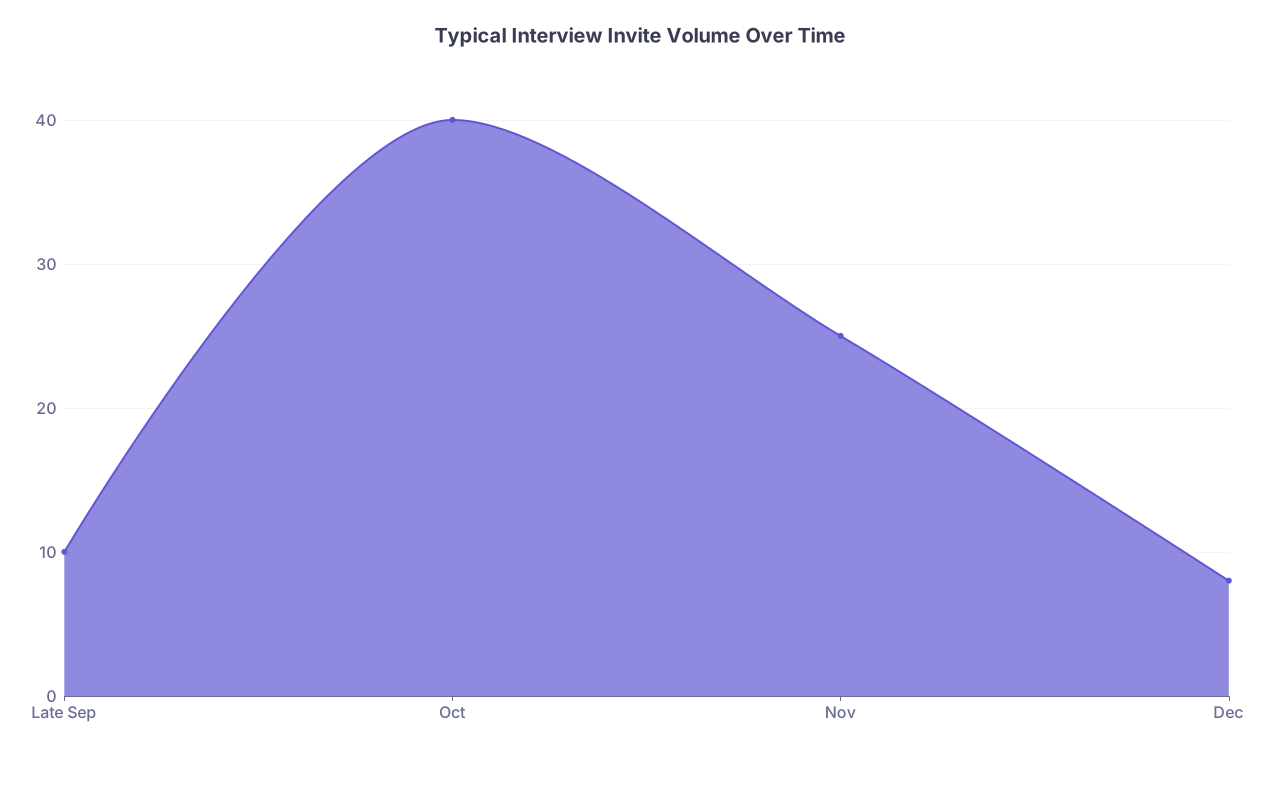
| Category | Value |
|---|---|
| Late Sep | 10 |
| Oct | 40 |
| Nov | 25 |
| Dec | 8 |
Late September–October: Invite Wave 1
At this point you should:
Set hard rules before the chaos hits
- Example rules:
- “I will accept all psych interviews until I have 12, then I’ll start trimming.”
- “I need at least 10 FM interviews to feel safe.”
- “I will prioritize primary over backup on conflicting dates unless it’s a top‑tier geographic or program fit in backup.”
- Example rules:
Track invites by specialty
- Simple table or spreadsheet:
- Date
- Program
- Specialty
- Tier (A/B/C)
- Response (accepted/declined/waitlisted date change)
- Simple table or spreadsheet:
Mid–Late October: Overlap and Cancellations
This is where you will be tempted to get greedy and keep everything. Don’t.
At this point you should:
Resolve conflicts within 24 hours
- If two programs on same date:
- Compare:
- Specialty priority (primary vs backup)
- Program reputation
- Geographic desirability
- Cancel one, politely, immediately.
- Compare:
- If two programs on same date:
Guard against burnout
- Multi‑specialty applicants often end up doing 18–25 interviews “because what if.”
- That’s insane and unnecessary for less competitive fields.
- Reasonable targets:
- Primary: 10–14 interviews
- Backup: 6–10 interviews
If you’re already above those numbers by mid‑November, start trimming lower‑tier options—especially in backup specialties you’d be less happy in.
December–January: Late Interviews, Second Looks, and Mental Sorting
By now you’ll have a messy pile of impressions from multiple fields.
Early December
At this point you should:
- Review by specialty, not by date
- Make 3 lists:
- Primary specialty programs (rank them preliminarily)
- Backup #1 programs
- Backup #2 programs (if any)
- Make 3 lists:
Inside each list, sort them:
- Tier 1: I’d be thrilled
- Tier 2: I’d be okay
- Tier 3: Only if I absolutely must match
Late December–Early January
At this point you should:
Do targeted second looks (if programs allow and it makes sense)
- Focus on specialties where you feel more uncertain.
- Example: You thought psych would be backup but now you loved most psych visits and only tolerated IM.
- A half‑day second look can clarify if that’s a fluke or real.
Revisit your original priorities
- Ask yourself:
- If I had an equal‑strength offer from my top psych and top FM program, which would I take?
- Am I still pretending one is “backup” when emotionally it’s become my real first choice?
- Ask yourself:
Your answer here will shape your rank strategy.
February: Rank List Strategy When You Applied to Multiple Specialties
Now the stakes are real. This is where many multi‑specialty applicants quietly sabotage themselves by ranking “safety” higher than honest preference.
Early February
At this point you should:
- Clarify your hierarchy—again
- Example final truth:
- “Honestly, I’d rather do psych at an average program than FM at my dream geographic location.”
- Or the reverse.
- Example final truth:
You must answer this before you build your list.
Building Your Rank List
General rule (which too many ignore):
Rank in the exact order of where you’d be happiest on Match Day.
Not:
- “What I think I deserve”
- “What others expect”
- “What seems logical”
That means you may have:
- Top slots: all programs from your “backup” specialty because you realized it’s actually your preferred field
- Then primary specialty programs
- Then remaining backup programs
Or the opposite. The point is honesty.

Mid–Late February
At this point you should:
- Reality‑check with someone who knows you
- Advisor, trusted attending, or PD you’re close with.
- Show them your ordered rank list (without program names if you’re nervous) by specialty and tier.
- Ask:
- “Does this ranking match who I am and what I’ve said all year?”
If there’s a huge mismatch, fix it now, not on Match Eve at 1am.
March: Match Week and Aftermath Planning
You’ve already done 99% of the work. Match Week isn’t planning; it’s outcome.
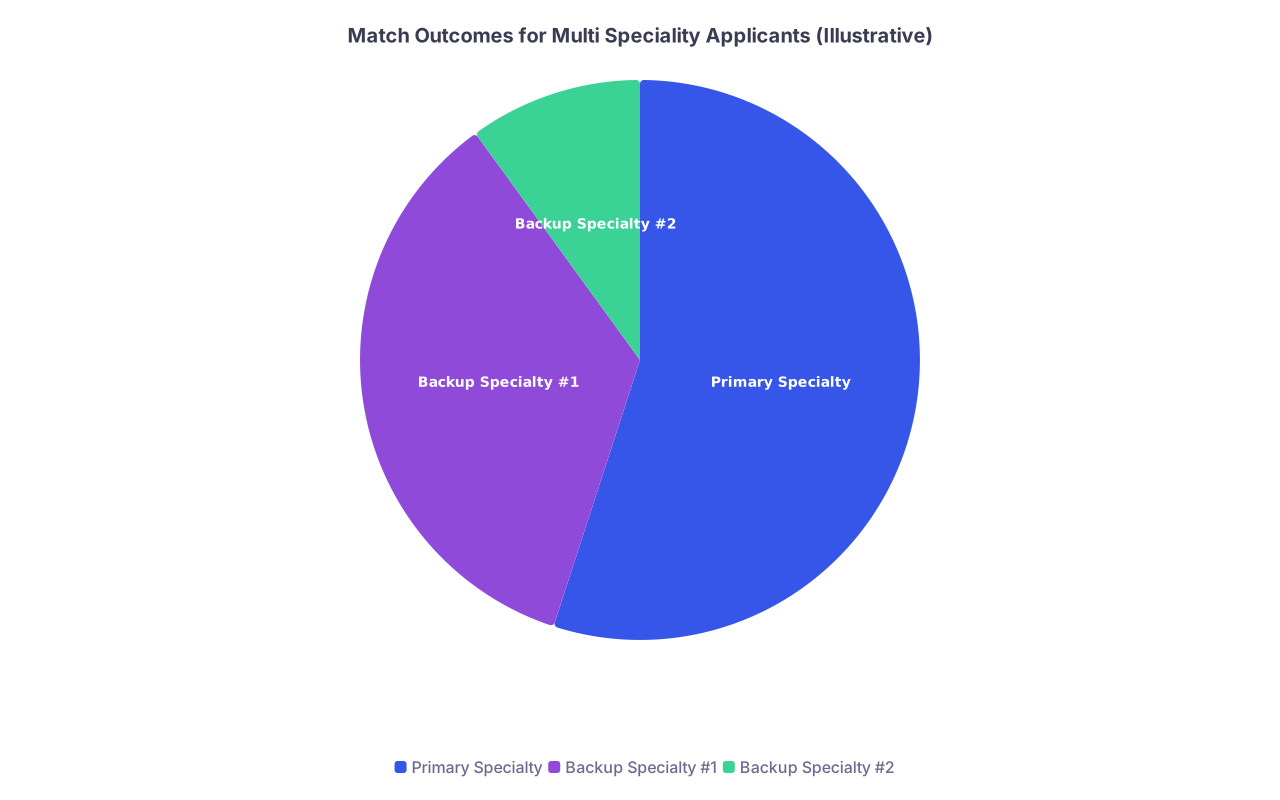
| Category | Value |
|---|---|
| Primary Specialty | 55 |
| Backup Specialty #1 | 35 |
| Backup Specialty #2 | 10 |
Match Week
At this point you should:
- Prepare emotionally for all three main outcomes:
- Match in primary – Great. You threaded the needle.
- Match in backup – Also success. You protected yourself with a field you pre‑approved.
- Do not match – Painful but survivable.
If you don’t match:
- Schedule SOAP planning with your dean’s office immediately.
- Use your multi‑specialty groundwork:
- You may already have a strong story and letters for a less competitive field in SOAP.
If you matched in a backup you’re not excited about:
- Take 2–3 days to feel whatever you feel. Then:
- Reach out to residents in that specialty/program.
- Ask them about fellowships and pathways that might move you closer to your primary interests (e.g., psych to C‑L, FM to sports med, IM to hospitalist or palliative).
Putting It Together: A Condensed Month‑By‑Month Checklist

| Month | Key Focus |
|---|---|
| Jan–Mar | Decide primary vs backup specialties |
| Apr–Jun | Secure letters, plan rotations, draft PS |
| Jul–Aug | Build ERAS, finalize PS and LOR use |
| Sep | Submit apps, signals, early screening |
| Oct–Nov | Manage and prioritize interviews |
| Dec–Jan | Second looks, preference sorting |
| Feb | Final rank list across specialties |
| Mar | Match Week and post‑match planning |
Final Week‑By‑Week Snapshot for Peak Season (Sep–Nov)
To close the loop, here’s how your peak months should look if you’re applying to multiple less competitive specialties.
Week 1 of September
- Submit ERAS (all specialties)
- Double‑check LOR and PS assignment for every program
- Track confirmations
Weeks 2–3 of September
- First wave of interview invites may start
- Build your invite‑tracking sheet
- Accept broadly, especially in your primary field
October (Weeks 1–4)
At this point you should:
- Act on invite conflicts within 24 hours
- Maintain your pre‑set minimums per specialty:
- e.g., “I will not drop below 10 psych and 8 FM interviews”
- Avoid booking >3 interviews per week more than 2 weeks in a row; burnout is real
November (Weeks 1–4)
At this point you should:
- Start canceling lowest‑tier interviews once you’re safely above your target numbers
- Begin rough ranking within each specialty list
- Make notes right after each interview (1–2 bullets about program culture, red/green flags)
Here’s your actionable step for today:
Open a blank document and write three headers: Primary, Backup #1, Backup #2. Under each, list:
- 2–3 reasons you could see yourself happy in that field
- 1–2 attendings who could realistically write for you
- A rough target number of programs you’d apply to
If you can’t fill that in for a “backup,” it’s not ready to be on your calendar. Replace it or commit to fewer specialties before the season steamrolls you.