
The usual “follow your passion” specialty advice will blow up your plan to stay in one city.
If you absolutely need a specific location—because of family, kids, partner’s job, immigration issues, whatever—you cannot pick a specialty like everyone else and just “hope it works out.” That’s how people end up unmatched or moving two time zones away against their will.
This is where the so‑called “easier” or “less competitive” specialties become a strategic tool. Not a compromise. A tool.
I’m going to walk you through how to use less competitive specialties to maximize your odds of staying local, what actually counts as “less competitive” in a realistic way, and how to build a location-anchored strategy that does not depend on miracles.
1. First: Be Honest About Your Constraint
If location is non‑negotiable, say that clearly to yourself:
- “I must be in Chicago because of my spouse’s job.”
- “I cannot leave this state because of custody.”
- “My visa sponsorship options are limited to X region.”
That’s a hard constraint. Hard constraints come before dreams of dermatology or ortho or some ultra-specific fellowship.
I’ve seen two kinds of people in this situation:
- The honest ones: “I need to stay in Houston, so I’m choosing Internal Medicine over EM or Ortho.” These people usually match and stay local.
- The delusional ones: “I have to be in Miami, but I’m applying to Derm with an average Step score and three programs on my list.” These people end up either unmatched, scrambling, or moving anyway.
If staying local is a must, your #1 goal is: maximize number of realistic programs within your geographic box. Everything else is downstream from that.
2. What “Easier” Actually Means (And What It Doesn’t)
“Least competitive specialties” gets thrown around in a lazy way. You need a sharper definition.
We’re talking about relatively less competitive for matching into some program somewhere, not “easy as a job” or “anyone can get in.” There’s a difference.
Right now, in most recent cycles (the exact numbers fluctuate but the pattern holds), the following tend to be on the less competitive side for U.S. MD/DO grads:
- Internal Medicine (categorical, non-elite academic and community)
- Family Medicine
- Pediatrics (non-top-tier programs)
- Psychiatry (this has heated up, but still easier than EM/Ortho/Derm/Plastics)
- Pathology
- Neurology
- PM&R (variable, but overall more accessible than surgical subspecialties)
- Some community OB/GYN and general surgery programs (but these specialties globally are still more competitive than FM/IM)
Ultra-competitive:
- Dermatology
- Plastic Surgery
- Neurosurgery
- Orthopedic Surgery
- ENT
- Integrated Vascular/CT surgery
- Radiology and Anesthesiology are in the middle but bouncing in competitiveness depending on the year.
If you must stay in one location, you want a specialty with:
- Numerous programs in your city/region
- A wide range of program tiers (academic + community)
- A high overall match rate
- Some flexibility for prelim/TY + reapplication if things go wrong
That usually means IM, FM, Peds, Psych, Path, Neuro. Not Derm. Not Ortho. Not ENT.
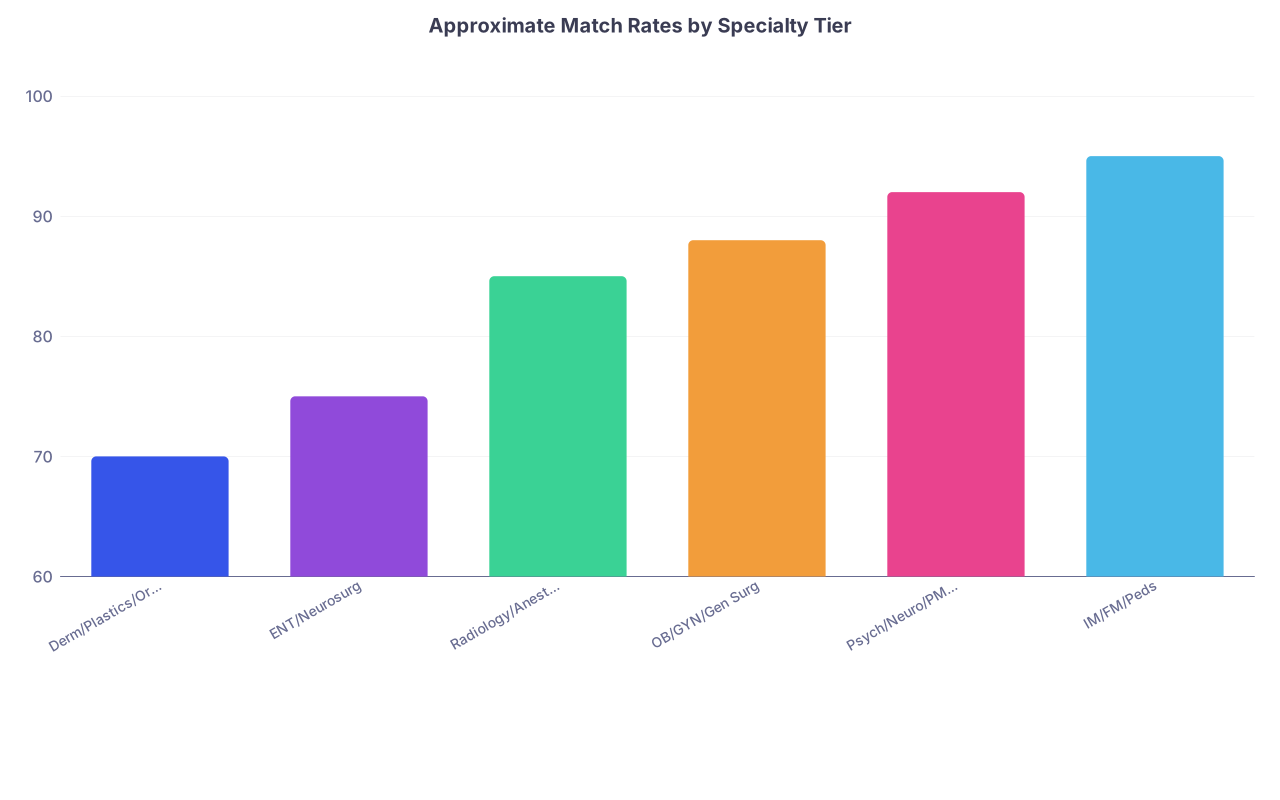
| Category | Value |
|---|---|
| Derm/Plastics/Ortho | 70 |
| ENT/Neurosurg | 75 |
| Radiology/Anesthesia | 85 |
| OB/GYN/Gen Surg | 88 |
| Psych/Neuro/PM&R | 92 |
| IM/FM/Peds | 95 |
Don’t obsess over exact percentages. The pattern is what matters: medicine- and primary-care–leaning specialties give you more breathing room to be picky about geography.
3. Map Your City Before You Pick a Specialty
Most people pick a specialty, then look for places to apply.
If you need one specific location, flip that.
Step 1: Pull up the program map for that city/region. ERAS, FREIDA, VSLO, or even just Google: “Internal Medicine residency [City]” and repeat for each specialty.
Step 2: Count how many programs exist within your acceptable commute radius for each specialty.
Example: Let’s say you must stay in the greater Philadelphia area. When you map:
- Internal Medicine: multiple programs (Penn, Jefferson, Temple, Drexel affiliates, community sites, etc.)
- Family Medicine: several hospital-based and community programs in and around the metro
- Pediatrics: at least CHOP, plus affiliates
- Psychiatry: a few solid academic and community options
- Orthopedic Surgery: maybe 2–3 programs total
- Dermatology: 1–2 programs, insanely competitive
If you only have:
- 1 local program in a specialty → dangerous if you must stay local
- 3–5 programs → manageable but still risky if the specialty is competitive
- 6+ programs in a less competitive specialty → now you’re playing this game correctly
| Specialty | # Local Programs | Relative Safety for Staying Local |
|---|---|---|
| Internal Med | 8 | High |
| Family Med | 6 | High |
| Pediatrics | 3 | Medium |
| Psychiatry | 4 | Medium-High |
| Orthopedics | 2 | Low |
| Dermatology | 1 | Very Low |
If your location has:
- Many IM/FM/Peds/Psych/Neuro/Path programs
- Few or no surgical subspecialty programs
then the rational move, if you cannot leave, is to lean into the fields with density.
4. Decide: “Career First” vs “Location First”
This is the real fork in the road.
You can’t fully optimize both. People pretend you can, but the match data says otherwise.
You need to answer: If I had to choose, would I rather:
- Be in my dream specialty but move far away?
- Be in my decent-but-not-dream specialty and stay where I need to be?
If you are truly location-locked (kid, visa, dependent parent), your answer is probably “location first.” If it isn’t, then be honest that you’re merely location-preferential, not locked.
Once you choose “location first,” your specialty decision should sit inside a simple priority framework:
- Location: non‑negotiable
- Match safety: high
- Specialty interest: within a range you can see yourself doing long-term
- Program prestige: a bonus, not a requirement
That’s how someone ends up saying: “I like psych, neuro, and IM. I must stay in Boston. Psych has 3 programs locally and is getting hotter. IM has 10+ programs. I’m going IM.”
That’s a smart move. Not a sellout move.
5. How to Use Easier Specialties Strategically
Let me walk you through a concrete scenario.
Scenario: You must stay in Dallas–Fort Worth
You tolerate several fields: Internal Medicine, Family Medicine, Pediatrics, Psychiatry. You like Ortho but you’re not married to it. You have average stats (Step 2 CK 233, no red flags).
What you do:
- List the local programs in each of your possible specialties.
- Rank by both number of programs and your genuine interest.
You may discover:
- Internal Medicine: 7+ programs
- Family Medicine: 5+ programs
- Pediatrics: 2–3 programs
- Psychiatry: 3–4 programs
- Orthopedics: 1–2 programs, highly competitive
Given your scores and need to be local, your best bet is IM or FM. Peds and Psych might still be fine, but they give you fewer total shots.
You then:
- Fully commit to one primary specialty (say IM) that has multiple local options.
- If you’re really paranoid, you can also:
- Apply broadly to FM as backup if your school supports dual-application strategy and you can do it without looking sloppy. But you’d better be prepared to explain that coherently.
The point: you’re using specialty choice to multiply the number of realistic, commutable programs.
6. Red Flags and How They Change the Equation
If you’ve got any of these:
- Step failures
- Low Step 2 CK (<220 for MD, <215 for DO/IMG depending on context)
- Multiple remake clerkships or professionalism issues
- Heavy IMG competition in your city
then “least competitive” becomes not just helpful—it becomes almost mandatory if you won’t move.
In that situation, your priority order tightens:
- Location locked + significant red flags + competitive specialty = recipe for SOAP or no match.
- Location locked + red flags + FM/IM in a city with MANY community programs = survivable with effort.
I’ve watched IMGs with one Step failure match Family Medicine in the same city because:
- They hit every local program hard.
- Showed up for observerships.
- Networked with PDs and chiefs.
- Applied widely within the metro and any reachable areas.
Meanwhile, I’ve watched similar candidates go all in on gen surg or EM locally and end up matching nowhere because their city only had 1–2 programs and those programs had their pick of cleaner applications.
If you’ve got baggage, you need:
- High program volume
- Lower specialty-wide competitiveness
- Willingness to be flexible about academic prestige
That means IM/FM/Psych/Path/Neuro in most regions. Not the shiny surgical stuff.
7. Building a Local-First Application Strategy
Once you pick a specialty that gives you enough local options, you have to signal hard that you’re committed to that city and that field.
Get clinical Face Time Locally
Rotate, shadow, or do electives at:
- Your top 3–4 local programs
- Any community sites affiliated with those programs
The attending who says, “This student knows our patient population and would fit right in,” is worth more than a random letter from a big-name away rotation three states away.
Shape Your Story Around Location
Your personal statement and interview answers should make it painfully obvious why you’re staying:
- “My entire support system—partner, young child, and extended family—is here. I am committed long term to serving this community and putting down roots here.”
- “I have been in this city for undergrad and med school. I volunteer at [local clinic]. I see myself practicing here long-term.”
Do not be vague. Programs worry locals will leave for “something better.” Reassure them you are long-term material.

Rank List Strategy
When ROL time comes:
- Put every acceptable local program in your chosen specialty at the very top.
- Only then add any “dream” but distant programs if you’re truly location-first, you might not rank any distant at all.
I’ve seen people sabotage themselves by ranking “fancy” out-of-state programs above solid local community programs—then complain when they matched 1000 miles away.
You can’t say “I must stay here” and then rank a distant name-brand #1. That’s you lying to yourself.
8. Specialty-by-Specialty: How They Work for Staying Local
I’ll hit the big ones quickly with a location-first lens.
Internal Medicine
Best overall tool for staying local in most U.S. cities.
- Widely available: academic + community
- Flexible career: outpatient, hospitalist, fellowship options
- Tolerates a wide range of applicant profiles
If your city has 5+ IM programs, this is usually your safest bet for anchoring yourself geographically.
Family Medicine
FM is the “nuclear option” for staying put.
- Immense need in most regions
- Many community-based programs
- Often friendlier to non-traditional paths, IMGs, and red flags (relative to surgical fields)
If you really need to stay in a more rural state or region with limited academic centers, FM is often the single most realistic anchor.
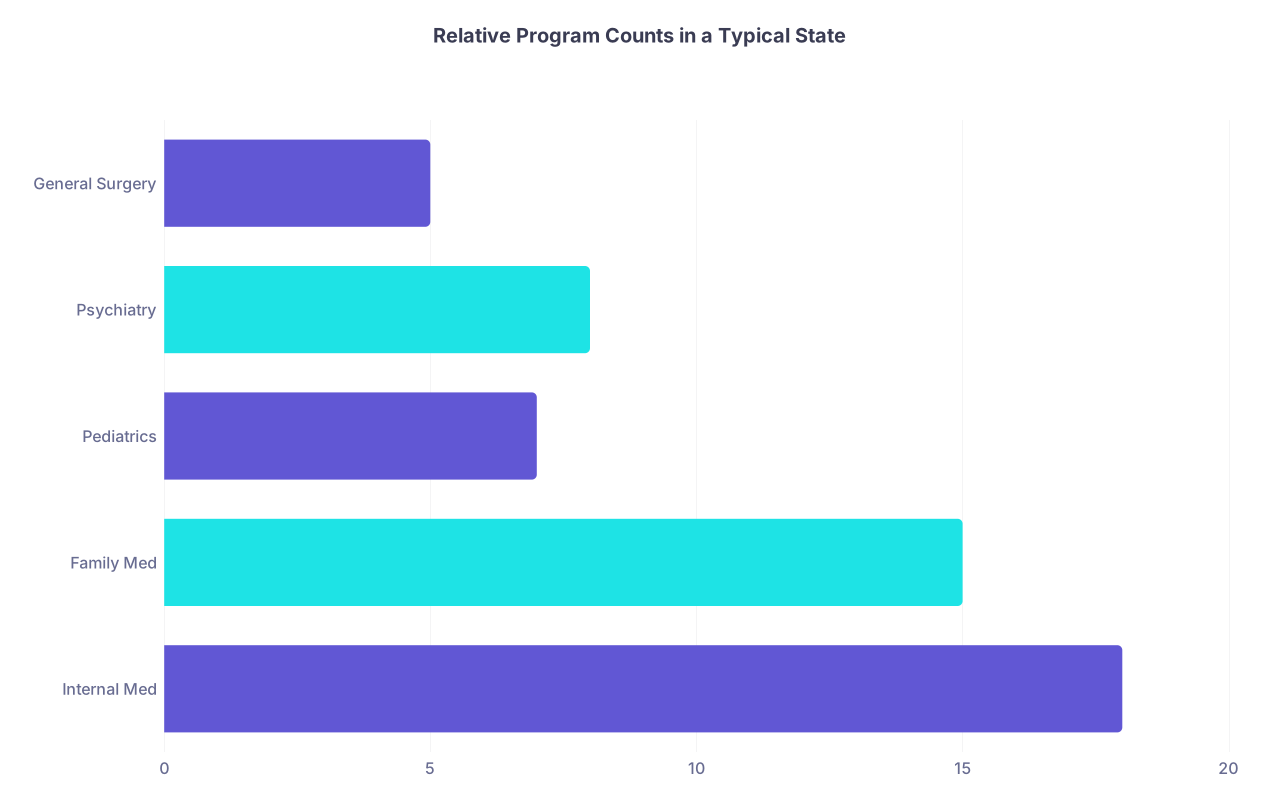
| Category | Value |
|---|---|
| Internal Med | 18 |
| Family Med | 15 |
| Pediatrics | 7 |
| Psychiatry | 8 |
| General Surgery | 5 |
Pediatrics
Usually solid but fewer programs per city than IM/FM.
Good for cities with a large children’s hospital plus a few community-affiliated programs. More fragile if your city has only 1 peds program.
Psychiatry
Getting more competitive, but still workable for a location-focused plan if:
- Your city has multiple psych programs
- You have at least average stats and no huge red flags
Don’t bank on Psych if your city only has 1–2 programs and it’s become a “hot” destination.
Pathology / Neurology / PM&R
These can be smart niche plays when:
- Your city has multiple programs
- You genuinely like the work (don’t fake it; these are very different lives from FM/IM)
They’re not “automatic easy matches,” but they’re typically less suicidal choices than surgical subspecialties if you’re locked geographically.
Surgical Fields, EM, Derm, Rad, Anesthesia
If you must stay local and your local program count is tiny (1–2), these are all high-risk unless:
- You are an extremely strong applicant (high Step 2 CK, strong letters, research, no red flags), and
- You’re willing to accept the possibility of going unmatched.
Not impossible. Just dangerous if you truly cannot move.
9. If You’re Already Late in the Game
Let’s say you’re an M4 or IMG who’s just waking up to this reality.
If You Haven’t Applied Yet
You can still:
- Swap from a more competitive field to a less competitive one before ERAS goes in.
- Aggressively network at every local program in your chosen “easier” specialty.
- Cut back the number of far-away applications and use that money to apply to every single local program in your lane.
If You Already Applied to a Competitive Specialty
If you went all in on something like Ortho or EM and now realize you must stay put, you have three options:
- Ride it out and accept the risk.
- Add a second, easier specialty in the same ERAS season (if deadlines allow and your school approves).
- Plan a reapplication strategy now: prelim year + pivot into IM/FM/Psych next cycle.
None of those are fun. But pretending you don’t have a problem is worse.

| Step | Description |
|---|---|
| Step 1 | Need specific location |
| Step 2 | Consider applying to dream specialty |
| Step 3 | Choose less competitive field with many local programs |
| Step 4 | Accept high risk of no match or moving |
| Step 5 | Strengthen local ties and apply broadly |
| Step 6 | Many local programs in dream specialty |
| Step 7 | Open to other specialties |
10. Hard Truths You Need to Hear
A few blunt realities:
- You cannot have “must stay within 30 minutes of my house” and “must do ENT” without massive risk, unless you’re a top‑tier unicorn.
- Prestige is a luxury, not a necessity, when your location constraint is hard.
- Your future happiness is not determined by whether you matched at an Ivy. It is very heavily influenced by whether your personal life is intact and stable.
- Less competitive does not mean less meaningful. I’ve seen burned-out orthopods jealous of their outpatient FM friends with normal lives.
If you must stay local, your smartest move is to treat specialty choice like probability management, not identity construction.
FAQs
1. I like a competitive specialty but must stay local. Should I still try?
You can, but only if you’re honest about the risk. Look at how many local programs exist in that specialty and how strong your application is. If there are only 1–2 programs and you’re average on paper, that’s not strategy, that’s gambling. If you’re going to try anyway, at least have a concrete backup plan (second specialty, prelim year with pivot, or willingness to move if life changes).
2. Is dual applying (e.g., IM + FM) a good idea to stay local?
Sometimes. It helps when:
- Both specialties exist in decent numbers locally.
- You can credibly explain interest in both without sounding scattered.
- Your letters and personal statements are tailored, not copy-pasted.
If dual applying causes you to look unfocused to both sides, it can backfire. Do it deliberately, not out of panic.
3. I’m an IMG and location-locked. Do I have any realistic paths?
Yes, but you need to be extremely targeted. Prioritize specialties with:
- Multiple community programs in your region (FM/IM/Psych/Path/Neuro)
- A history of taking IMGs (check FREIDA, program websites, current residents)
Then get local exposure—observerships, research, volunteering—at those exact programs. You can’t rely on generic ERAS submissions; you need faces to go with your name.
4. Is it “settling” to pick FM or IM just to stay near family?
Only if you secretly resent the work and are lying to yourself. If you genuinely like broad clinical medicine and outpatient or hospital medicine, then it’s not settling, it’s prioritizing your life realistically. I’ve watched plenty of people in so‑called “prestige” specialties wish they’d made the opposite tradeoff when they’re divorced, burnt out, and living far from any support.
5. How many local programs do I need for it to be “safe” to stay put?
There’s no magic number, but as a rough guide:
- 1 program: very risky unless you’re a standout and specialty is less competitive.
- 2–3 programs: manageable in a less competitive specialty, but you should be nervous.
- 4–6 programs: reasonable buffer if your application is solid.
- 7+ programs: now specialty choice and your own profile become bigger factors than sheer geography.
Key points to leave you with:
- If location is non‑negotiable, choose specialties that multiply your local program options—usually IM/FM/Peds/Psych/Neuro/Path, not Derm/Ortho/ENT.
- Map your city first, then pick your specialty, not the other way around.
- Back up your location-first story with real actions: local rotations, relationships, and a rank list that actually reflects your priorities.