
It’s November 2nd. Your ERAS is out, interview season is in full swing, and your inbox is… quiet. Too quiet.
You’ve got a failed Step attempt, a professionalism write‑up, or a leave of absence on your record. You aimed for a mid‑tier internal medicine or family medicine program, thinking you were being “realistic,” but you’re not getting the traction you hoped for.
You start googling “least competitive specialties,” “IMG‑friendly programs,” “low score programs,” at 1:30 a.m. You’re wondering:
Do I bail to a “backup specialty”?
Are there programs that actually take people like me?
Or am I just screwed?
You’re not screwed. But you cannot afford fantasy thinking. You have to start treating low‑competition specialties and low‑competition programs as tools, not as insults. And you need a strategy, not just a bigger throw‑spaghetti‑at‑ERAS approach.
I’m going to walk you through how to actually use less competitive options to offset a red flag. Not the sugar‑coated version. The “here’s what works when you’re in a hole” version.
Step 1: Be Honest About Your Red Flag and Risk Level
First, you have to classify your situation. Not in vague terms. Precisely.
Common red flags:
- Step 1 or Step 2 fail
- Big score drop (Step 1 pass, Step 2 tank)
- Leave of absence for academic or personal reasons
- Professionalism concern (disciplinary action, remediation)
- Multiple poor clerkship grades in core rotations
- Very low Step 2 (sub‑220 in the US MD world, sub‑230 in competitive IMGs)
Your job is to answer: How radioactive is my application to “normal” programs in “normal” specialties?
Quick rule of thumb:
| Severity Level | Example Red Flags | Competitiveness Impact |
|---|---|---|
| Mild | One low shelf, average Step 2 | Slightly limits mid-top programs |
| Moderate | Step 1 fail, then strong pass | Cuts off many academic and competitive programs |
| Significant | Step 1 fail + Step 2 < 225 | Most standard categorical spots are reluctant |
| Severe | Multiple fails or professionalism | Must rely on lowest competition programs/routes |
If you’re in the moderate to severe zones, you cannot treat the match like your classmates do. You need to:
- Expand your program list dramatically
- Include true low‑competition programs and pathways
- Get over the ego hit of “less prestigious” options
If you pretend your application is “pretty normal except for X,” you’ll be sitting unmatched in March. I see this every year.
Step 2: Understand What “Low-Competition” Actually Means
People throw around “low competition” like it’s one monolithic category. It’s not. There are layers.
A. Less Competitive Specialties (on average)
Historically lower barrier (for US MD at least):
- Family Medicine
- Internal Medicine (categorical, not university hospital heavy-research tracks)
- Pediatrics
- Psychiatry (getting tighter, but still more forgiving than surgical specialties)
- Pathology (varies a lot by program)
- Neurology (also tightening, but still easier than most procedural fields)
- PM&R (used to be low, now middle of the pack; still some accessible programs)
If you have a serious red flag, forget:
- Dermatology, ortho, ENT, plastics, neurosurgery, urology
- EM at most major academic centers
- Integrated IR, integrated vascular, etc.
Yes, there are unicorn stories. No, you’re probably not that unicorn.
B. Low-Competition Programs Within a Specialty
Inside each specialty, there are tiers. The real lifeline for you is not just picking an “easier” specialty, but deliberately targeting less selective programs within it.
Patterns that often signal more accessible programs:
- Community hospitals without a big-name university affiliation
- Programs in less desirable geographic areas (very rural, Rust Belt, Deep South, certain Midwest towns)
- Brand-new or recently expanded programs
- Formerly unfilled programs (SOAP history)
- Programs heavy on service, lighter on research and subspecialty departments
These are where your red flag hurts less, because:
- They’re desperate for bodies to cover service
- They historically take more IMGs / DOs / lower score applicants
- They’re used to training residents who aren’t Step 1 monsters
The combination you’re aiming for:
Less competitive specialty + lower tier program + your realistic stats.
Step 3: Build a Target List That Actually Matches Your Situation
Now we get practical. You need a two‑tier strategy: standard programs plus true safety programs.
Tier 1: Reasonable-but-Not-Delusional Targets
Let’s say:
- US MD, Step 1 fail → Step 2 = 225
- Mostly passes, a couple of High Passes, no honors
- No professionalism hit
In Internal Medicine, your Tier 1 might be:
- Community IM programs in mid‑sized or undesirable cities
- Some lower‑tier university affiliate programs with loads of IMGs
- A few state programs known to be friendly to lower scores
In Family Medicine:
- Most community FM programs outside premium cities
- Some rural tracks
- Some new programs
You still apply broadly here—maybe 60–80 programs in your chosen specialty. But you are not depending on these alone.
Tier 2: True Safety / Low-Competition Anchors
This is where people with red flags either save themselves or blow up. You need programs that would be thrilled to have a warm, reasonably functioning body who shows up.
Examples by specialty:
Family Medicine:
- Newer FM programs in rural Midwest, South, and certain community systems
- Programs with high IMG percentages, >70–80%
- Formerly unfilled programs from last 2–3 match cycles
Internal Medicine:
- Community IM programs with high service load, low research output
- Programs not attached to big-name universities, especially in less desirable cities
Psychiatry/Peds/Path/Neuro:
- Smaller community-based or hybrid programs
- Programs at hospitals that aren’t household names even in medicine
You want a substantial number of these. Not 3–5 sprinkled in. For a serious red flag, I’m talking:
- Total applications: 80–120 minimum
- With at least 30–40 true low‑competition targets
Yes, the cost sucks. Compare that to an unmatched year plus an extra year of rent.
Here’s how distribution might look for a US grad with a Step fail applying IM:
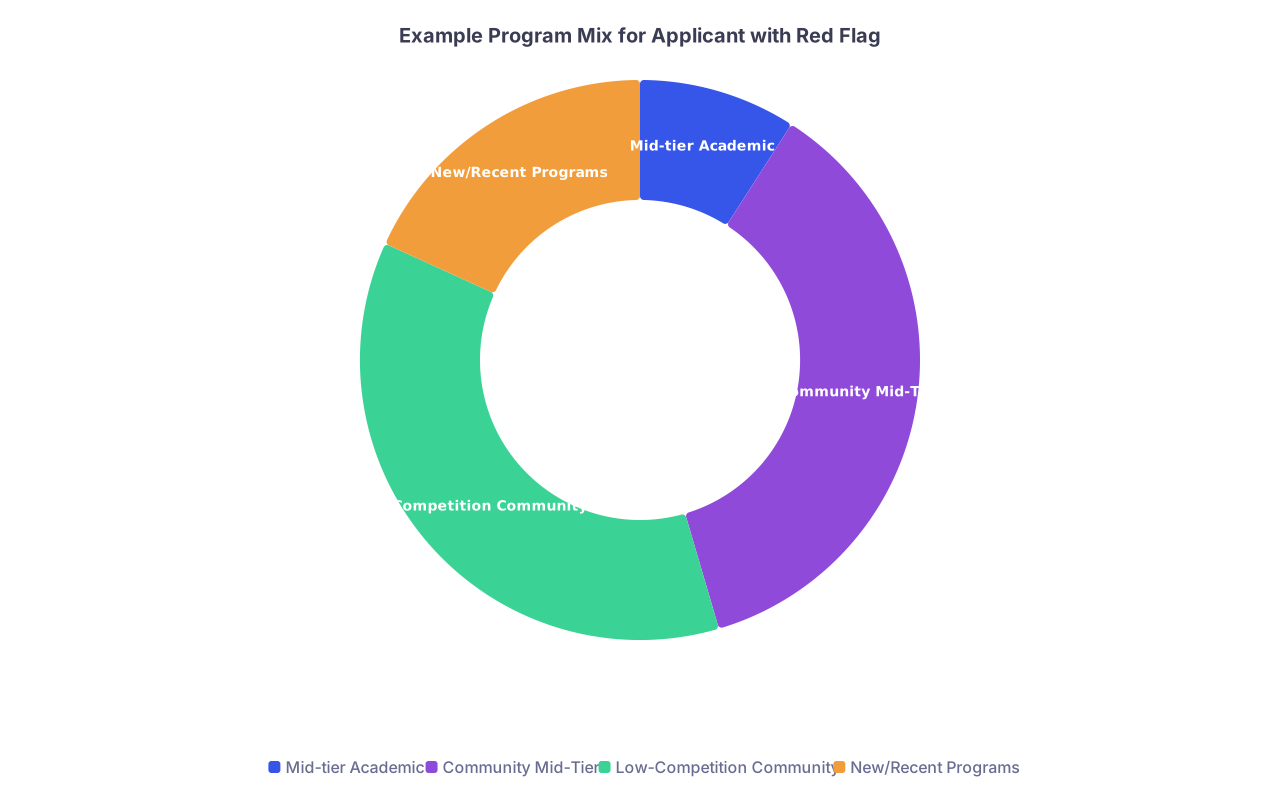
| Category | Value |
|---|---|
| Mid-tier Academic | 10 |
| Community Mid-Tier | 40 |
| Low-Competition Community | 40 |
| New/Recent Programs | 20 |
Interpretation: out of 110 programs, 10 relatively ambitious, 40 solid-but-not-top, 40 low‑competition community, 20 brand new or recently expanded.
Step 4: How to Identify Low-Competition Programs Without Guessing
You shouldn’t be guessing based on vibes and website fonts. Use actual signals.
Concrete methods:
Check historical fill rates and SOAP history
If a program has gone unfilled and used SOAP more than once in the last 3–4 years, that’s a big clue. NRMP and some specialty organizations publish this data. Also ask upperclassmen quietly.Look at resident rosters
Scroll through photos/names on the program website. Red flags that signal accessibility:- Large proportion of IMGs
- Many DOs in specialties that are usually MD heavy
- Multiple Caribbean grads
- Schools you’ve never heard of in multiple countries
These programs are used to working with less conventional backgrounds.
Signals from program website and FREIDA
Watch for:- Higher number of spots (>8–10 per year for IM, >6 for FM)
- Location in non-glamorous city
- Minimal mention of “research excellence,” “top fellowship placement,” etc.
Ask people who matched where you’re aiming
Residents tend to be very honest off the record. A quick:
“Hey, I have a Step 1 fail, Step 2 225, thinking IM/FM. Do you feel your program has taken folks with issues like that?”
will get you real data.Listen to how PDs/residents talk on open houses
Subtle hints:- “We are very holistic” (can be fluff, but at some places it’s code for ‘we know our stats are lower’)
- “We are very IMG friendly”
- “Scores are not the most important thing for us”
None of these alone prove low competition, but stack enough and you know what you’re looking at.
Step 5: Tailor Your Story Specifically for Low-Competition Programs
Programs that are willing to take a chance on an applicant with red flags care about different things than top‑tier academic places.
They care about:
- Reliability
- Work ethic
- Teachability
- Commitment to their location / type of work
- Low drama
So your application needs to scream: “I will show up, work hard, and not be a problem.”
In your personal statement and interviews for these programs:
Own your red flag briefly and cleanly
One to three sentences. Not a page of excuses.
Example:
“I failed Step 1 during a period when I had not yet developed effective study strategies. I took responsibility, overhauled my approach, and passed on my second attempt. Since then I have passed all subsequent exams on the first attempt and performed reliably in my clinical rotations.”Pivot quickly to reliability and growth
Emphasize:- Consistent clerkship attendance
- Positive narrative comments
- Concrete examples of showing up early, staying late, covering extra shifts
Signal you actually want them, not just anyone
Low‑competition programs hate being obviously treated as backups. Mention:- Ties to the region (family, training, grew up nearby)
- Genuine interest in community medicine, underserved care
- Realistic long‑term plan (e.g., community practice, not “I want triple subspecialty fellowship in a hyper‑academic role”)
Letters matter more than you think here
A strong letter saying “This person shows up, works hard, and patients like them” is worth more at these programs than a lukewarm letter from some big‑shot researcher.
Step 6: Decide if You Need a Specialty Pivot
This is the harsh part.
There’s a point where the combination of your record and your chosen specialty is just math‑wise not workable, even with low‑competition programs.
Classic examples I’ve seen:
- US MD with 2x Step fails aiming for EM or anesthesia, then shocked at 1 interview
- Caribbean grad with 205 Step 2 aiming for categorical IM at major city academic centers
At some point, you have to ask: Is there a more forgiving specialty that still lets me have a decent life and career?
Reasonable pivots:
- From EM → FM or IM
- From anesthesia → IM/FM/Neuro
- From gen surg ambition → prelim surgery + plan B, or IM/PM&R
- From radiology → IM/FM + later pain, hospitalist, etc.
Do not make a pivot blindly, though. Talk to:
- Residents who matched from your school with similar stats
- Specialty advisors who have seen multiple cycles
- A PD you trust who will be blunt
You’re looking for an honest assessment like:
“With your combination of Step fails and professionalism flag, you should not be banking on EM. You need to aim IM or FM, and be heavy on low‑competition programs.”
If multiple experienced people are telling you that, listen.
Step 7: Use Process and Timing to Your Advantage
Low‑competition programs often move a bit slower or are more flexible.
Here’s how to play that:
Apply early, but keep doors open
Submit broadly, including your low‑competition list from day one. Do not “wait to see” if big programs invite you first. That’s how you wind up in SOAP.Track your interview yield versus your classmates
Rough guide:- If by mid‑November you have < 3–4 interviews for IM/FM with a red flag, that’s concerning.
- That’s when you consider expanding to even more low‑tier programs or adding another specialty if logistically possible.
SOAP strategy
If you land in SOAP, you must drop the ego fast.
People who still rank “strong academic IM only” in SOAP with a Step fail often go unmatched again.
You want:- Any ACGME‑accredited IM or FM or prelim with a shot at categorical later
- Any program with stable accreditation and non-toxic vibes (talk to current residents if you can)
Here’s roughly how interview numbers correlate with match probability for someone with a red flag, based on NRMP data and what I’ve seen:
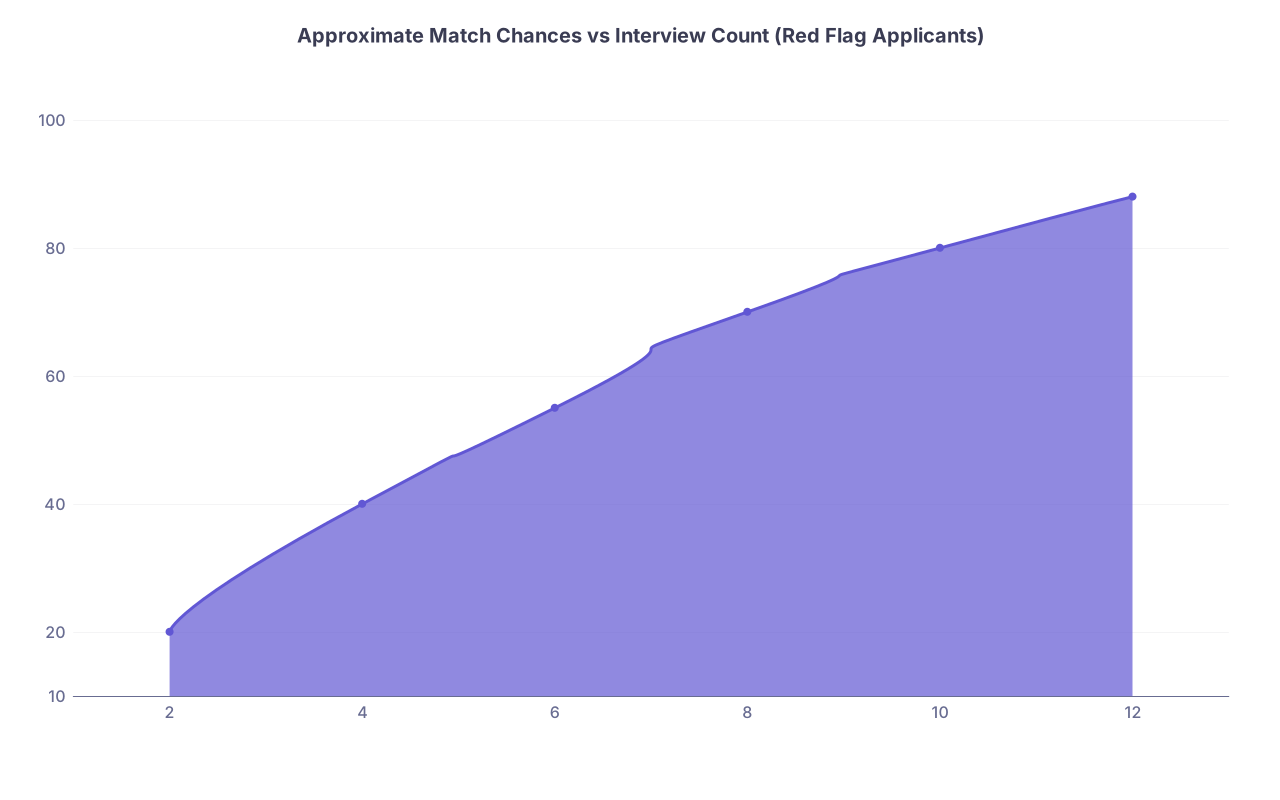
| Category | Value |
|---|---|
| 2 | 20 |
| 4 | 40 |
| 6 | 55 |
| 8 | 70 |
| 10 | 80 |
| 12 | 88 |
These are not hard numbers, but the message is clear: with a red flag, you want as many interviews as you can reasonably get, which argues strongly for a big chunk of low‑competition programs.
Step 8: Avoid Common Self-Sabotage Moves
People with red flags make predictable mistakes. Don’t repeat them.
Applying too aspirational and too narrow
30–40 programs in a moderately competitive specialty, mostly academic? That’s suicide for a Step fail.Not telling the truth about your red flag
Hiding a fail or professionalism issue, letting a PD “find out on their own” during rank meeting—this is how you go from “maybe we take a chance” to “absolutely not.”Trash‑talking low‑competition programs
I have heard PDs repeat lines from applicants who obviously thought they were “too good” for the program. You’re not. Even if you are, you can’t afford to show it.Acting like you still have all the leverage
You don’t get to insist on coastal city, research powerhouse, top‑of‑the‑heap career track. Your priority now is: match into a stable, non‑abusive program that will train you adequately.Ignoring lifestyle and toxicity red flags
Low‑competition doesn’t mean you accept abuse. You still watch for:- Sky‑high attrition
- Residents mysteriously “on leave” and not returning
- No one smiling, residents whispering “run” during tours
You need a job, not a miserable or dangerous one.
Quick Example Scenarios
Just to anchor this, a few composite examples I’ve seen work out:
Case 1: US MD, Step 1 Fail, Wants IM
- Stats: Step 1 fail → pass, Step 2 224, average clinicals
- Strategy:
- Applied to 110 IM programs:
- 10 mid-tier academic, 40 standard community, 40 low‑competition, 20 new programs
- Very honest 2‑sentence Step explanation in personal statement
- Strong letters from community IM attendings emphasizing reliability
- Applied to 110 IM programs:
- Outcome: 9 interviews, matched at a low‑competition community IM in the Midwest. Now a hospitalist making good money and living a completely fine life.
Case 2: Caribbean Grad, 2 Fails, Wants EM → Pivots to FM
- Stats: Step 1 fail, Step 2 fail, eventual 220
- Strategy:
- Dropped EM completely after honest talk with advisor
- Applied to 120+ FM programs, majority in rural areas and smaller towns
- Heavy emphasis on primary care interest, underserved work
- Outcome: 6 FM interviews, matched at a newish rural FM program that was thrilled to fill.
FAQ (Exactly 4 Questions)
1. Should I apply to a “backup” specialty in the same cycle if I have a red flag?
Maybe. If your first-choice specialty is even moderately competitive and you have a serious red flag (multiple fails, professionalism issue), dual applying can be smart. But only if you can do it properly—meaning enough programs in each specialty, and at least some dedicated personal statements and letters. Half‑assing two specialties is worse than doing one solidly. Talk to someone who knows your full situation before you split your efforts.
2. Are new residency programs safe, or are they all dysfunctional?
New programs are mixed. Some are fantastic opportunities with PDs who are excited and supportive. Others are chaotic messes with no structure and chronic understaffing. For new or recently expanded programs, you need to talk to current residents if possible, check accreditation status, and listen carefully during open houses. If leadership seems disorganized or evasive, that’s a bad sign.
3. Can a strong Step 2 completely cancel out a Step 1 fail?
No. It helps a lot, but it doesn’t erase it. A 250 Step 2 after a Step 1 fail will open doors that a 220 won’t, but there are still programs with strict “no fail” policies. Where it really helps is with low‑ and mid‑tier programs who are already flexible but want reassurance you can pass boards. For them, a strong Step 2 can push you into the “worth the risk” category.
4. If I match at a low-competition program, am I stuck there forever career-wise?
Not at all. Your first job and your reputation as an attending will ultimately matter more than your residency program’s name. Will it be harder to land certain hyper‑academic fellowships? Yes. But for community jobs, hospitalist roles, outpatient primary care, and many subspecialties via solid fellowships, you can absolutely build a good career starting from a small or unglamorous program. The key is: match first, train well, build a track record. Prestige can’t save you if you never match.
Key Takeaways
- Stop pretending your application is average if you have a real red flag. Your strategy has to be different.
- Use low‑competition specialties and low‑competition programs deliberately—big list, targeted, and humble.
- Your goal is not to impress your classmates. Your goal is to match into a solid, trainable spot and build your career from there.