
You’re in your apartment, it’s 11:30 p.m., and you’ve got two browsers open: ERAS on one screen and a USCIS visa info page on the other. Your stats aren’t terrible, but every time you filter for “sponsors visas” the list shrinks to something that looks like a bad joke. Then you read that FM, psych, peds, even IM hospitalist tracks are filling with US grads now. And you’re thinking:
“Do I burn my whole cycle on ‘least competitive’ specialties and tiny programs that barely exist on Google… or do I hold out for the big names and probably get nothing?”
This is exactly the situation where “using low-competition programs wisely” either saves your career or wastes two years of your life.
Let me be blunt: visa or citizenship limits do change the rules. You do not have the same playing field as a US citizen with the same scores. But that doesn’t mean you should just apply to every “low competition” program you can find and hope. That’s how people end up unmatched three cycles in a row.
Here’s how to be strategic, not desperate.
1. First Reality Check: What “Low-Competition” Really Means for Visa-Restricted Applicants
“Least competitive specialties” is already a misleading phrase. For you, the correct phrase is:
“Least competitive programs that actually take people like me.”
That’s a different list.
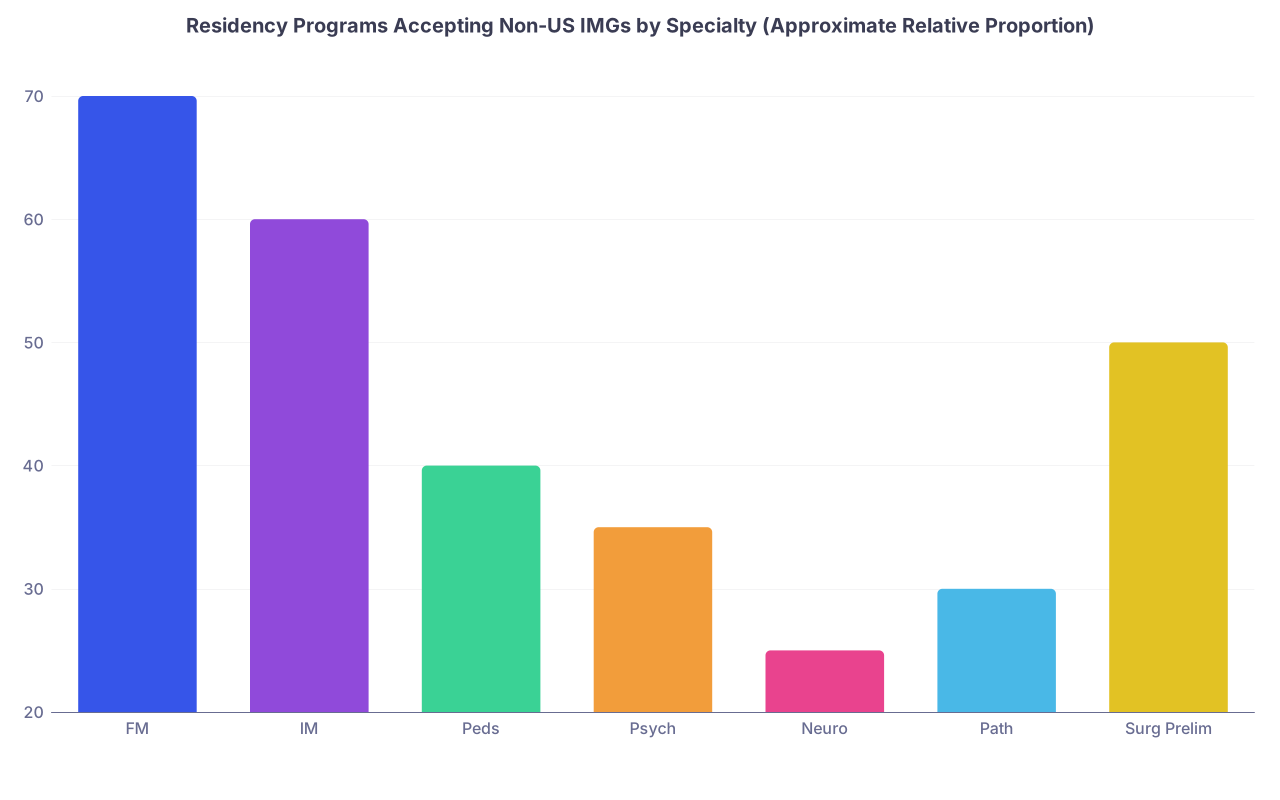
| Category | Value |
|---|---|
| FM | 70 |
| IM | 60 |
| Peds | 40 |
| Psych | 35 |
| Neuro | 25 |
| Path | 30 |
| Surg Prelim | 50 |
Those bars are not real NRMP numbers, but they’re directionally right from what I keep seeing:
- Family Medicine and Internal Medicine still have the largest absolute number of programs and spots that will consider non–US citizen IMGs.
- Pediatrics and Psychiatry look “friendly” from the outside, but a lot of those programs either:
- prefer US grads heavily, or
- quietly avoid H-1Bs and are stingy about J-1s.
- Pathology and Prelim Surgery are classic “backup” havens, but pathology job markets and visa issues post-residency are a whole separate mess you need to think about.
You can’t just think “Oh, FM and Psych are least competitive, I’ll be fine.” You have to think in layers:
- Specialty competitiveness overall
- Program competitiveness within that specialty
- Visa policy and historical behavior of that program
The third one is where most applicants screw up.
2. Build Your Target Zone: Where Your Profile + Visa Reality Overlap
Before you talk “low competition,” you need to see what you’re actually competitive for.
Step 1: Put Hard Numbers on Paper
Do this in brutal honesty mode:
- Step 1 (if taken) and Step 2 CK scores
- Attempts on any USMLE
- YOG (year of graduation)
- US clinical experience (how many weeks, what kind, inpatient vs outpatient)
- Research (if any)
- Visa need: J-1 only okay vs need H-1B vs no visa needed
Write it out. Not in your head. On paper.
Then compare your numbers in context:
| Tier / Specialty Group | Step 2 CK Range |
|---|---|
| Highly competitive (Derm, Ortho, Plastics, ENT) | 250+ |
| Mid competitive (EM, Anesthesia, Rad Onc, better IM/Peds) | 240–250 |
| Less competitive (FM, community IM, Psych, Neuro, Path) | 225–240 |
| Salvage / backup (many prelim spots, some weak FM/IM) | 215–225 |
If you’re sitting at 215 with a 2018 YOG and no USCE and you’re on an F-1 needing H-1B… then “low competition” for you means something very different than for a 240/2023 grad needing just a J-1.
Step 2: Decide Your Realistic Specialty Set
Given visa + stats, you should pick:
- 1–2 “primary” specialties
- 1 “true backup” strategy (can be a prelim or categorical)
For example:
Profile: 228 Step 2, 2021 YOG, 12 weeks USCE, need J-1 OK
- Primary: FM + community IM
- Backup: Prelim medicine or transitional wherever possible
Profile: 240+ Step 2, 2023 YOG, strong USCE, research, need H-1B
- Primary: IM (including some academic)
- Secondary: Neuro or Psych in known IMG-friendly places
- Backup: FM at strong community programs that actually use H-1Bs
Don’t chase five specialties. That reads as unfocused and kills the coherence of your application.
3. Low-Competition Programs: How to Find the Ones That Are “Underrated,” Not Just “Bad”
This is the core move: separating “low competition because hidden gem” from “low competition because red flag.”
A. Start with documented visa history, not just “Sponsors J-1”
ERAS filters and program websites lie by omission all the time.
Look for:
- Official site listing current residents with names and med schools
- Past resident lists with international names and schools
- Explicit wording like “We welcome applications from international graduates”
- PD or coordinator actually answering visa questions in FAQs
Signs a “low competition” program is worth your time:
- Multiple current or recent IMGs
- You see J-1 and H-1B both mentioned clearly (if you need H-1B)
- They explicitly state they’ll support ECFMG-sponsored J-1
Warning signs that it’s low competition for a bad reason:
- Last 5 years of residents all from one or two US med schools
- “We prefer US graduates” on their website
- No mention of visas + all residents have US med schools listed
- Website clearly outdated, no current residents list at all
You are not “using low-competition programs wisely” if you’re applying blindly to places that never actually rank IMGs.
B. Learn the “hidden” low-competition categories
There are specific categories of programs that are easier to match into for visa-restricted applicants if you know where to look:
New or recently expanded programs
- New FM or IM programs in smaller cities (think midwest, south, rural) often struggle for applicants the first 3–5 years.
- These are more likely to be desperate enough to seriously consider IMGs and visa candidates.
Community programs far from major metro areas
- Example: A 6-6-6 FM program in a town you’ve never heard of in Kansas vs a 12-12-12 in suburban New Jersey.
- The Kansas one will often be dramatically more approachable.
Programs in less glamorous states
- North Dakota, West Virginia, Arkansas, Mississippi, Wyoming, etc.
- These states can still give solid training, and many have hospitals that routinely sponsor J-1 and H-1B because they’re used to recruiting internationally.
Unopposed FM programs in small hospitals
- Only FM residents in the hospital → more hands-on, fewer applicants, less competition.
- Some are training-heavy and place grads into good jobs.

Key move: once you identify a program that looks like this and clearly has IMGs + visas, stack it higher on your list even if the name isn’t flashy.
4. When to Use “Very Weak” Programs as Career Stepping Stones (and When Not To)
Let’s be honest. Some programs are labeled “low competition” because they’re badly run, malignant, or under-resourced. Those can still be strategically useful—but only if you know exactly what you’re buying.
Useful as a stepping stone if:
- It gives you:
- A US residency entry point
- Regular US clinical work
- Access to attendings who can write strong letters
- You have a clear plan:
- Do 1–2 years → build CV → reapply to a different specialty or stronger program
- Or complete and leverage it for hospitalist jobs or fellowships that care less about pedigree.
Examples where this can make sense:
- Prelim Medicine / Surgery when your only other option is going unmatched
- Lower-tier FM in a rural area if they actually place grads into solid jobs and you want to work clinically ASAP
Terrible idea if:
- The program has chronic ACGME citations or is at risk of losing accreditation
- There’s a pattern of residents quitting or transferring every year
- No graduates get decent jobs or fellowships and the training is known to be poor
- You need an H-1B and the institution plays games with visas
Ask yourself: “If this were the only residency I ever did, would I be employable and legal in the US after graduation?” If the answer is no, you’re rolling dice with your future.
5. Application Strategy: Using Low-Competition Programs Without Wasting Your Cycle
Now the practical part. How you actually structure your applications.
A. Distribution by tier
For a visa-restricted IMG, a smart ERAS spread might look like:
- 15–20% reach programs
- 50–60% solid, mid-tier, genuinely IMG-friendly programs
- 20–30% clearly low-competition / new / remote programs that you’d still be willing to attend
The mistake I see all the time: 80% reaches “just in case” and 20% random low-tier places with zero research into visa behavior. Then wonder why no interviews.
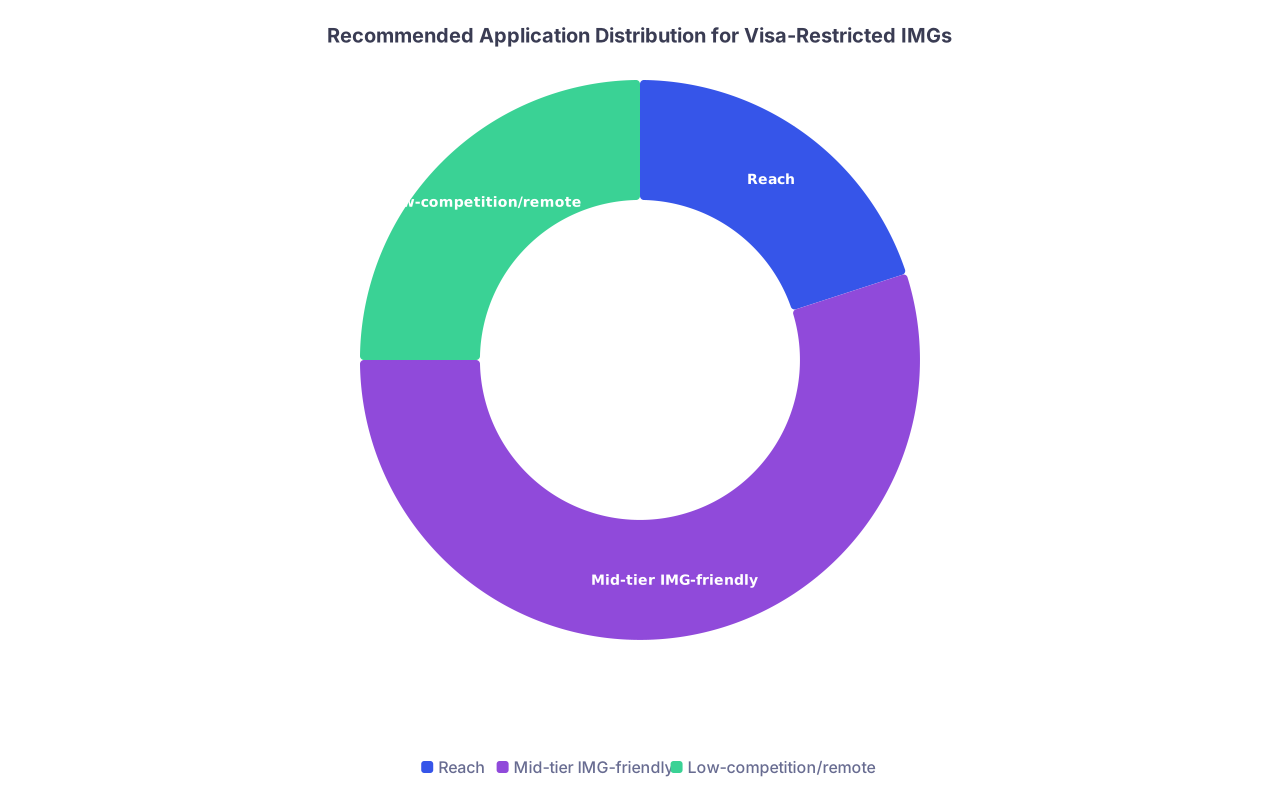
| Category | Value |
|---|---|
| Reach | 20 |
| Mid-tier IMG-friendly | 55 |
| Low-competition/remote | 25 |
B. Customize your signal: why this low-competition program?
Programs smell desperation. If you send a generic FM personal statement to 200 places, including a rural 6-6-6 program in Nebraska, they’re going to assume you don’t actually care about them and you’re just throwing apps.
So for low-competition programs you’d actually attend:
- Mention explicitly:
- Population type (rural, underserved, specific communities)
- State or region (ties, even if weak—extended family, previous observership, etc.)
- Why their training environment suits your goals
One solid paragraph tied directly to that program’s vibe is enough. You don’t need a bespoke PS for every single program, but you do need a few tailored versions.
C. Communication that doesn’t backfire
For IMGs with visa needs, emailing programs is a double-edged sword. But used correctly, it helps.
Smart email content:
- Short introduction (name, YOG, Step 2, visa type you need)
- One sentence on why you’re genuinely interested in that program (location, mission, unopposed training, etc.)
- Polite question about whether they’ll be considering J-1/H-1B candidates this cycle
Do not:
- Attach your entire life story and CV unsolicited
- Beg for interviews
- Spam the same email to 150 programs (coordinators talk; they can tell)
If they respond with a clear no on visas, remove them from future cycles. Do not cling to false hope.
6. Specialty-Specific Nuances: Where “Least Competitive” Actually Works for You
Not all “less competitive” specialties are equal for someone with visa limits.
Family Medicine
Best overall option for many visa-restricted IMGs.
Pros:
- Huge number of programs
- Many in rural/underserved areas already used to J-1 waivers later
- Lower Step 2 thresholds
Watch out for:
- Very small programs with no past IMG or visa history
- Places that train you mostly outpatient with minimal inpatient exposure, making hospitalist jobs harder later
Use FM wisely when:
- You’re okay being a broad generalist
- You’re willing to work in smaller communities early in your career
Community Internal Medicine
Strong option if you want flexibility (hospitalist, some fellowships, academic options).
Pros:
- More fellowships downstream (cards, GI, etc.) if you pick a half-decent program
- Many community IM programs still IMG-friendly
Cons:
- H-1B more variable
- Some “low competition” IM programs are actually toxic environments with awful workloads and poor teaching
Use IM wisely when:
- You care about internal medicine as a field, not just as a backup name
- You’re ready to grind hard but want a pathway to hospitalist or fellowship
Psychiatry and Pediatrics
They look IMG-friendly. Reality is mixed.
Psych:
- Exploding interest from US grads
- Some programs absolutely love IMGs with good communication skills
- Some quietly prefer US grads and almost never rank IMGs
Peds:
- Very child-focused; language/sociocultural issues matter
- Visa support can be inconsistent
Use these wisely:
- If you have excellent English, strong psych/peds exposure and letters
- If you research program-specific IMG and visa history carefully
Prelim Surgery / Medicine
Good last-ditch strategy. Not a primary plan.
Use prelims when:
- You’d rather do something in the US system than sit out unmatched
- You understand you may have to reapply during intern year, which is stressful and exhausting

7. Protecting Your Post-Residency Future: Think Beyond “Just Match Somewhere”
Too many people with visa limits think only about matching. Then 3 years later they’re scrambling for jobs that will sponsor them and discovering their training doesn’t translate well.
When you evaluate low-competition programs, ask:
- Where did their last 3 classes go?
- Hospitalist jobs? Which states?
- Fellowships? Any visa holders?
- Do attendings take teaching seriously, or is this just cheap labor?
- Does the hospital have a pattern of renewing visas and sponsoring waivers when possible?
If they can’t show a clear track record of graduates getting real jobs, you’re gambling with both your training and your immigration status.
8. Simple Decision Flow: Should You Apply to This Low-Competition Program?
Use this mental flowchart every time you add a “maybe” program.

| Step | Description |
|---|---|
| Step 1 | Program seems low competition |
| Step 2 | Skip program |
| Step 3 | Email coordinator to ask |
| Step 4 | Low priority or skip |
| Step 5 | Apply and consider higher priority |
| Step 6 | Has current IMG residents? |
| Step 7 | States visa support clearly? |
| Step 8 | Graduates get jobs or fellowships? |
| Step 9 | Reply supports visas? |
If at any step you’re hitting repeated “no” or “unknown and they won’t answer,” that program is low competition for a reason. And not a good one.
FAQ (Exactly 4 Questions)
1. I need an H-1B, not just a J-1. Does that change how I use low-competition programs?
Yes, dramatically. Many low-competition community programs will do J-1 easily but avoid H-1B because of cost and legal hassle. You must filter first by historical H-1B usage. Use resident lists, alumni info, and program FAQs. A “low competition” program that never sponsors H-1B is effectively closed to you, no matter how weak the applicant pool is.
2. Should I apply to very weak programs in dangerous or extremely remote areas just to get a US residency spot?
Sometimes yes, sometimes absolutely not. If it’s your only realistic way into the US system, and they have a clear track record of graduates getting jobs and visas, it can be a tough but rational move. But if the program has constant turnover, bad ACGME status, and residents warning others away on forums, then matching there might trap you in toxic training and harm your long-term prospects. Survival is not the only metric.
3. How many programs should I apply to as a non-US IMG with visa needs?
If you can afford it: often 120–180 total is reasonable for FM/IM combos, scaled to your competitiveness. The key is not just volume but selection: most of those must be programs that actually consider IMGs and visas. I’ve seen people apply to 250+ programs and get 2 interviews because 70% of their list never truly took IMGs. A well-researched 140 can out-perform a blind 250.
4. Can I match a “better” program in a competitive specialty later if I start in a low-tier FM or prelim spot?
It’s possible but not common. Transfers do happen, but they usually require excellent performance, strong US letters, and a clear need in the target program. More realistic is: do a prelim year, then reapply in a less competitive specialty with improved credibility. Or complete FM/IM at a solid but unflashy place, then aim for hospitalist work or certain fellowships. Banking on a big upgrade later is a risky primary strategy; treat it as a bonus if it happens, not a guarantee.
Tonight, do one specific thing: open your program list and put a checkmark only next to places where you can find at least one current or recent IMG resident and explicit visa language. Then count them. If that number is under 40, you’re not “using low-competition programs wisely” yet—you’re still guessing.