
The moment your dean says “You need a backup,” your primary dream is already on probation.
Not dead. But definitely not safe.
This article is about what to actually do when that happens—specifically how to add a genuinely low-competition specialty as a backup without nuking your main plan or ending up unmatched.
I’m going to assume a few things:
- You’re already mentally committed to a more competitive field (derm, ortho, ENT, plastics, EM at a bad score range, etc).
- Your dean has hinted or flat-out said: “You should consider parallel planning.”
- You’re not trying to reinvent your entire life; you want a realistic safety net.
Let’s get into the mechanics.
1. First, Decode What Your Dean Is Really Saying
They’re not just “being cautious.” A dean (or PD, or specialty advisor) usually pulls the “you need a backup” card when several risk factors line up.
Common triggers:
- Below-average or borderline Step 2 (for your target field)
- Mediocre or missing home department support
- Few or no strong letters in the target specialty
- Weak or inconsistent clinical evals (especially in core rotations)
- Late decision for a competitive specialty with no prior investment
This conversation usually fits one of three patterns:
Soft concern:
“You’re in range, but it’s not a lock. Parallel planning would be smart.”
Translation: You might match into your dream, but the tail risk of an unmatched outcome is non-trivial.Clear warning:
“You are unlikely to match in X if you only apply there.”
Translation: If you ignore this, you’re rolling dice with bad odds.Redirection:
“I actually think you’d be stronger in Y.”
Translation: They’ve quietly already slotted you as non-competitive for your first choice.
Step one: Pin them down. You need numbers, not vibes.
Ask directly:
- “If I only applied to [primary specialty], what do you realistically think my match probability is?”
- “On a scale from 1–10, how concerned are you that I’d go unmatched?”
- “Given my Step, grades, and letters, which specialties do you consider low-risk for me?”
If your dean dances around specifics, press once more:
- “Would you be comfortable with your own kid applying my same list without a backup?”
You’re not being annoying. You’re forcing them to translate bureaucratic language into actionable risk.
2. Understand What “Low-Competition” Actually Means
“Least competitive specialties” is a misleading phrase. Almost nothing is truly non-competitive now. But some are consistently safer bets than others if you build a halfway coherent application.
Common relative backups people consider:
| Primary (More Competitive) | Common Backup Option |
|---|---|
| Dermatology | Internal Medicine, Path |
| Ortho / ENT / Urology | General Surgery, IM |
| EM (with low Step/late) | FM, IM |
| Radiology | IM, Neurology |
| Anesthesiology (borderline) | IM, FM |
Low-competition doesn’t mean:
- You can ignore letters.
- You can send a bare-bones application.
- You can show up with zero narrative about why that field.
Programs in “easier” specialties can still smell a desperation backup from a mile away. The game is: low barrier to entry + believable story + enough volume.
Some specialties that often function as lower-competition backups (varies year-to-year, but this is the general pattern):
- Family Medicine – The classic safety net. Very wide range of programs. Many community programs will interview almost any US MD who looks sane and professional.
- Internal Medicine (community-heavy focus) – University IM can be competitive; community IM is generally more forgiving.
- Pediatrics (non-elite programs) – Still selective at big-name children’s hospitals, but there are many solid community-based or smaller academic programs.
- Psychiatry – Used to be easy; now moderately competitive. Still easier than derm/ortho/ENT by a mile, but no longer a “dumping ground” you can ignore.
- Pathology / PM&R / Neurology – Variable. Some years they’re hidden gems, some years they tighten up. But usually easier than the ultra-competitive surgical subs.
So your first move: pick one realistic low-ish competition field. Not three. Not five. One.
3. Decide: Are You Parallel Planning or Fully Pivoting?
This fork matters. You can’t half-ass both and expect a good outcome.
Two main scenarios:
Scenario A: True Parallel Plan
You’re still shooting seriously for your competitive field, but you want a solid backup.
You:
- Apply broadly in the primary specialty.
- Apply moderately-to-broadly in the backup.
- Build real, but slightly thinner, materials for the backup.
- Rank both specialties on the same list (NRMP lets you do that).
This is reasonable when:
- Your Step and application are in the “borderline but not hopeless” range.
- Your home department supports you, even if they’re cautious.
- You could honestly see yourself doing either specialty without hating your life.
Scenario B: You’re Being Nicely Told to Pivot
Your dean’s “backup” talk is actually: “Stop wasting time chasing a lottery.”
Signs:
- No interview signals from your target field by mid-season.
- Your chair quietly says: “I think you’ll thrive in IM much more.”
- Your school’s historical data shows people with your metrics do not match in your primary field.
Here, the smart move is often:
- Make the backup the real plan.
- Still toss 10–15 “dream” applications in the primary specialty if it calms you.
- But put 80–90% of your actual energy, letters, and strategy into the backup.
Be honest with yourself which situation you’re in. If everyone is telling you “You’re not going to match in ortho,” you’re not doing yourself a favor pretending this is a symmetric parallel plan.
4. How to Choose the Right Low-Competition Backup for You
Here’s where people get lazy and say, “I’ll just throw some Family Med apps in.” That’s how you end up with weak interviews and awkward conversations.
You need alignment on:
- Your transcript
- Your personality and interests
- Your procedural vs cognitive preference
- Your geography needs
Think in constraints:
Do you absolutely need a certain geography?
If you must stay near a partner, kids, or visa constraints, choose a field with many programs in that region (FM/IM/Peds) instead of something niche like PM&R with limited spots.Your transcript already points somewhere. Use it.
Strong evals in medicine, psych, and peds? Backups like IM, Peds, Psych make sense.
Mediocre communication scores but good technical comments in surgery and EM? Think anesthesia, path, maybe neuro.You want a real chance, not theoretical safety.
A “backup” of academic IM at only top-tier coastal centers is not a backup. That’s just a slightly different flavor of competitive.
If you’re stuck, ask your dean bluntly:
- “Given my record, which specialty would see me as a strong applicant instead of a rescue case?”
- “Which lower-competition field gives me the most leverage with my existing letters and rotations?”
5. Back-Engineering the Backup: What You Need To Add Fast
Once you pick a backup, you have three levers:
- Letters
- Experiences/rotations
- Story
A. Letters of Recommendation
Minimum target:
- 2 strong letters in your primary specialty
- 2 strong letters in your backup specialty
- 1 flexible “wild-card” letter (IM, EM, surgery, etc.) you can use for both if it fits
If you’re late in the year, you do not have time for perfection. You just need:
- One home rotation in the backup specialty where someone can see you for 2–4 weeks.
- Overcommunicate: “I am strongly considering [specialty] as a residency path and would really appreciate feedback and possibly a letter if I perform well.”
Do not:
- Reuse a weak, generic “nice student” letter to pad both specialties.
- Assume your primary letters will be enough for the backup. Programs notice when you have zero specialty-specific support.
B. Rotations
If away rotations are already locked, you’re not going to redesign your schedule from scratch. You just need enough exposure to sound credible.
Priorities:
- 1 home sub-I or acting internship in the backup specialty (or at least a solid elective).
- Ask for direct feedback: “What would I need to improve to be a strong candidate in this field?”
If scheduling is tight, swap something:
- Drop a low-yield away in your dream specialty that will not realistically move the needle.
- Add a home rotation in the backup where you can get a letter and evaluations.
Yes, that might sting. But it’s better than reapplying next year as “Unmatched.”
6. ERAS Logistics: How to Actually Run a Two-Specialty Plan
This is where people screw up. They either:
- Send the same generic personal statement to both fields.
- Or obviously telegraph that they don’t care about the backup.
You can’t do that.
Personal Statements
You need:
- One personal statement tailored to your primary field.
- One personal statement tailored to your backup.
No, you cannot just change two sentences and call it a day. The narrative arc is different.
Primary PS:
- Heavily field-specific, with concrete experiences in that specialty.
- Clear “I see myself as X-type physician” statements.
Backup PS:
- Anchored to broader themes that also fit your history (continuity of care, longitudinal relationships, intellectual curiosity).
- Name the specialty clearly, but don’t pretend it was always your only dream if that’s obviously false.
Instead say: “As I progressed through third year, I found myself consistently drawn to…” and then give specific cases.
Program Signaling
Some specialties have signals or preference forms. Your backup usually doesn’t require a sophisticated signaling game—but:
- Do not waste your limited official signals on reach programs that will never interview you in either field.
- In your backup specialty, aim signals at mid-tier, realistic programs where you’d actually be happy and competitive.
ERAS Filters and Program List
Use your dean’s office data (or NRMP/FRIEDA) to build a rational list.
For the backup:
- Heavy on community and mid-tier academic.
- Bias towards regions that historically like grads from your school.
- Enough volume.
How much volume? Rough numbers for someone truly at risk:
- Primary competitive field: 40–80 applications (depends on field).
- Backup: 40–80 applications in less competitive specialties, leaning community.
If you’re very borderline and risk-averse, your backup number should not be smaller than your primary.
7. How to Not Look Like a Desperate Backup Applicant
Programs aren’t stupid. They know people parallel-plan. What they hate is blatant dishonesty and obvious disinterest.
Your job is to be:
- Honest enough.
- Committed enough.
- Specific enough.
On interviews:
If asked, “Are you applying to other specialties?” you have three basic strategies.
Pure parallel honesty (best if backup is strong option)
“Yes, I applied to [primary] and [backup]. I realized I enjoy both for slightly different reasons. I’d be very comfortable and happy matching into either, and here’s what specifically appeals to me about your program and [backup specialty].”Soft emphasis on current interview specialty
“I started the season more focused on [primary], but as I spent more time in [backup], I found myself drawn to the patient population and day-to-day work. At this point, I’m looking hard at both and could genuinely see myself committing to [backup specialty].”If you’ve effectively pivoted
“I did explore [primary] earlier, but my more recent experiences in [backup] have convinced me that this is a better fit long term. I’m no longer actively pursuing [primary] interviews.”
Do not lie and say you’re “only applying here” if that’s not true. People talk. And it’s unnecessary—programs know the market.
8. Managing Risk: How Many Interviews Do You Actually Need?
Forget someone’s cousin who matched ortho with four interviews. That’s survivor bias.
For a genuinely at-risk applicant, with a low-competition backup in the mix, I like a simple mental model:
In your primary field:
- 10+ interviews → you’re in the game, likelihood of matching is decent.
- 5–9 interviews → unstable territory; the backup plan matters a lot.
- <5 interviews → your backup needs to carry the load.
In your backup field:
- Aim for 12–15+ interviews minimum if you’re truly worried about going unmatched. More is fine; people cancel as they go.
Watch your numbers as invites roll in:
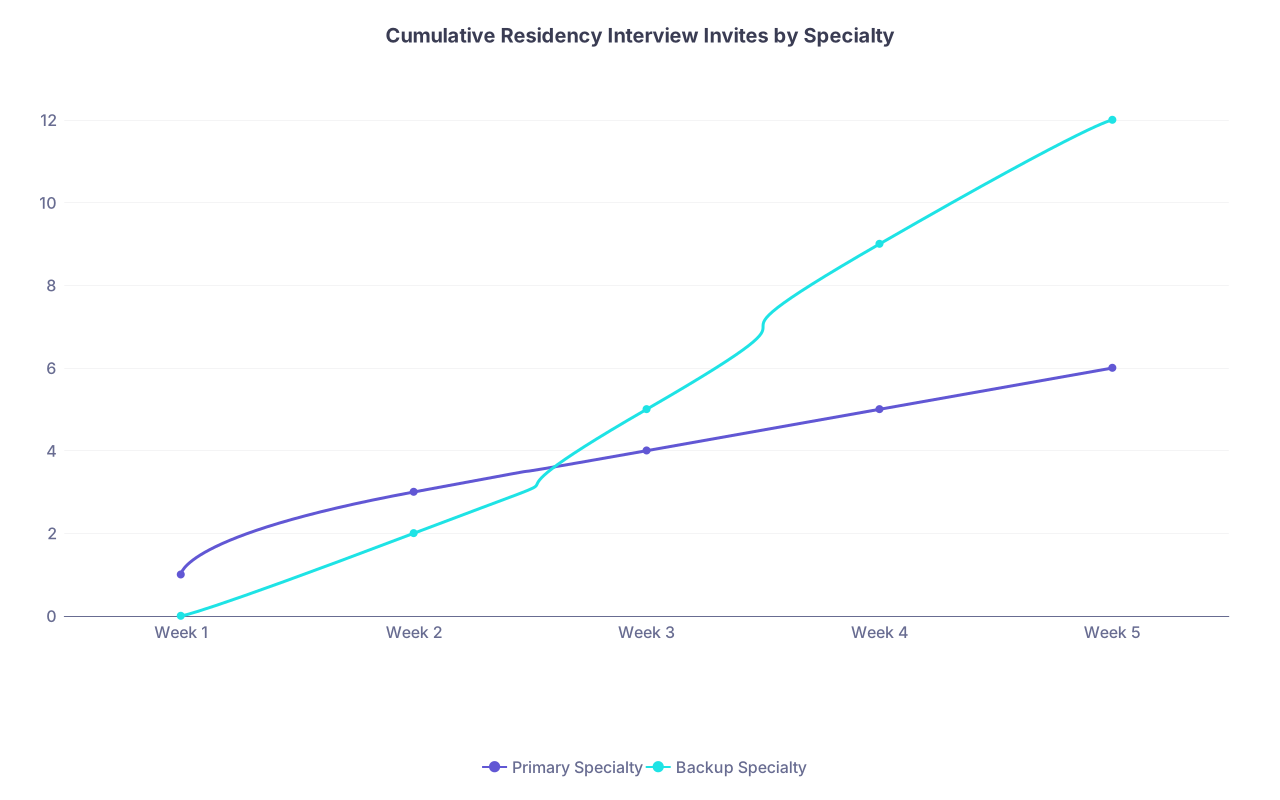
| Category | Primary Specialty | Backup Specialty |
|---|---|---|
| Week 1 | 1 | 0 |
| Week 2 | 3 | 2 |
| Week 3 | 4 | 5 |
| Week 4 | 5 | 9 |
| Week 5 | 6 | 12 |
If by late October/early November:
- You’ve got 2–3 in the primary, and 2–3 in the backup → start doing damage control: email more programs, ask your dean for targeted advocacy, lean hard into the backup.
- You’ve got 2 in the primary and 10 in the backup → emotionally accept the likely outcome: your list will be backup-heavy.
9. Rank List Strategy When You’re Dual-Applying
This part makes people spiral. You don’t need to.
Fundamental rule: Rank programs in true order of where you’d want to train, across both specialties combined.
The algorithm doesn’t care about specialty. It just cares about your rank order and programs’ rank lists.
Example:
If your dream is:
- A mid-tier derm program in your home city
2–6. Several strong IM programs you love
7–10. Random derm reaches that felt prestigious but you didn’t vibe with
You should rank them exactly in that order. One derm, then a bunch of IM, then other derms.
Common mistakes:
- Stacking all primary specialty spots first, even programs you actively disliked, ahead of really good backup options. That’s how you end up miserable.
- Overthinking: “Will programs see I ranked an IM program above their derm program?” No. They never see your list.
10. Realistic Emotional Management Through This
Let me be blunt: adding a low-competition backup feels like admitting defeat. You’re grieving the idea of being “the person who matched into X.”
You’re also doing the adult thing. People outside medicine do this all the time. They apply to dream jobs and safer jobs in parallel. Only in medicine do we moralize it like a character flaw.
There’s a quiet conversation I’ve heard in hallways more times than I can count:
- Student: “I feel like I’m selling out if I don’t go all-in on ortho.”
- Advisor: “You know what feels worse? Explaining to your parents, partner, and yourself why you’re reapplying next cycle with a huge gap and no Plan B.”
You’re not a failure for protecting yourself. You’re someone who understands risk.
11. Concrete 4-Week Action Plan Once the Dean Talk Happens
Here’s what you actually do, step by step.

| Step | Description |
|---|---|
| Step 1 | Dean advises backup |
| Step 2 | Clarify risk and options |
| Step 3 | Choose one realistic backup |
| Step 4 | Schedule or confirm rotation in backup |
| Step 5 | Request at least 2 backup letters |
| Step 6 | Draft backup personal statement |
| Step 7 | Build program list for backup |
| Step 8 | Submit dual applications |
Week 1:
- Have the blunt conversation with your dean and specialty advisors.
- Decide on one backup specialty.
- Scan your schedule: where can you slot a rotation or sub-I in that field ASAP?
Week 2:
- Start that backup rotation if possible.
- Tell attendings early you’re considering the field and would value feedback and maybe a letter.
- Outline and draft a separate personal statement for the backup.
Week 3:
- Lock in at least 2 letter writers for the backup.
- Finalize your program list for the backup, focusing on realistic, not shiny.
- Run both PS drafts and program lists past someone who isn’t afraid to hurt your feelings.
Week 4:
- Upload and assign letters correctly in ERAS (double-check specialty assignments).
- Assign the right personal statement to the right field.
- Hit submit. Then stop tinkering obsessively and focus on being excellent on your current rotation and prepping for interviews.
To keep yourself sane, track progress simply:
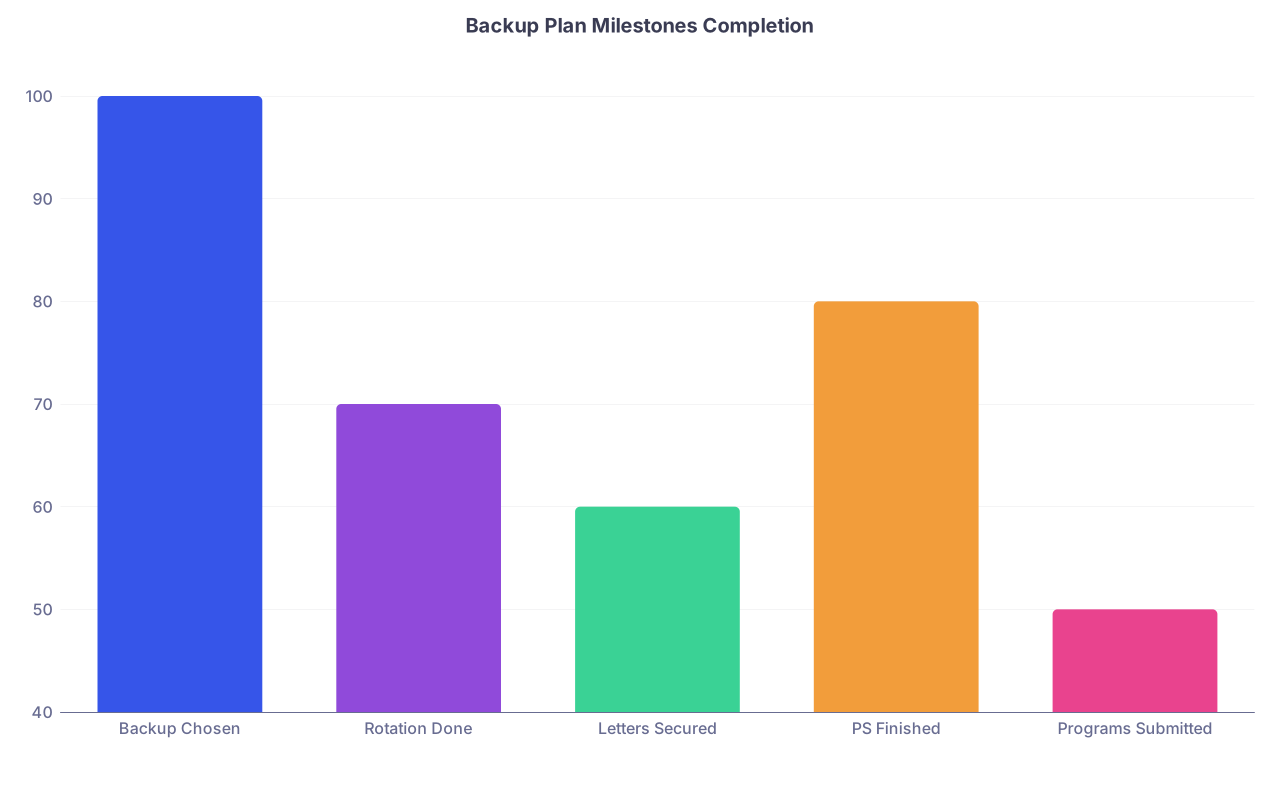
| Category | Value |
|---|---|
| Backup Chosen | 100 |
| Rotation Done | 70 |
| Letters Secured | 60 |
| PS Finished | 80 |
| Programs Submitted | 50 |
You’re not trying to build perfection. You’re trying to get the major dominoes standing.
12. How To Make Peace With Whatever Happens
On Match Day, one of three things occurs:
- You match into your primary dream field. The backup feels like a weird alternate timeline you avoided.
- You match into your backup. You feel relief, a pang of loss, and then—very quickly—you get busy being a resident and your life moves on.
- In the rare bad case, you go unmatched. Even then, having a backup often gives you more SOAP options and a clearer reapplication narrative.
None of these outcomes are improved by ignorance or magical thinking. They’re improved by:
- A clear-eyed look at your actual competitiveness.
- One realistic low-competition specialty added with intention.
- Enough applications and interviews that you’re not trying to game chance with tiny numbers.
You’re not just “adding a backup.” You’re building yourself a second actual future that could work.
And that’s the whole point.
You’ve now got the framework for adding a low-competition option without blowing up your primary plan. The next major challenge in this path is interview season—how you present yourself to two different specialties without sounding scattered or insincere. That’s its own skill set, and it’s the next lever you’ll need to pull once the invites start landing.