
It’s late December of your third year. Your classmates gunning for ortho and derm are frantically trading emails about away rotations and chair letters. You? You’re thinking, “I’m going into family medicine / psych / peds / IM — it’s not that competitive. I’ll be fine.”
You look at your rotation history and realize you kind of… drifted. Shadowed randomly. Took electives mainly because they had good hours. You did your FM rotation early but never went back. You told everyone you were “keeping an open mind.”
Here’s the problem: low-competition does not mean “no standards.” And I’ve watched very average applicants in these “safe” fields get fewer interviews than they expected, land in places they really did not want, or scramble at SOAP — not because of scores, but because of lazy, unfocused choices in shadowing and electives.
Let me walk you through the landmines.
The Big Lie: “It’s Low Competition, So It Doesn’t Matter”
The most dangerous mindset I see in applicants to family medicine, psychiatry, pediatrics, internal medicine, PM&R, pathology, and some community-based programs:
“It’s easy to match. I don’t need to overthink electives and shadowing.”
Wrong. Here are the pieces people conveniently ignore:
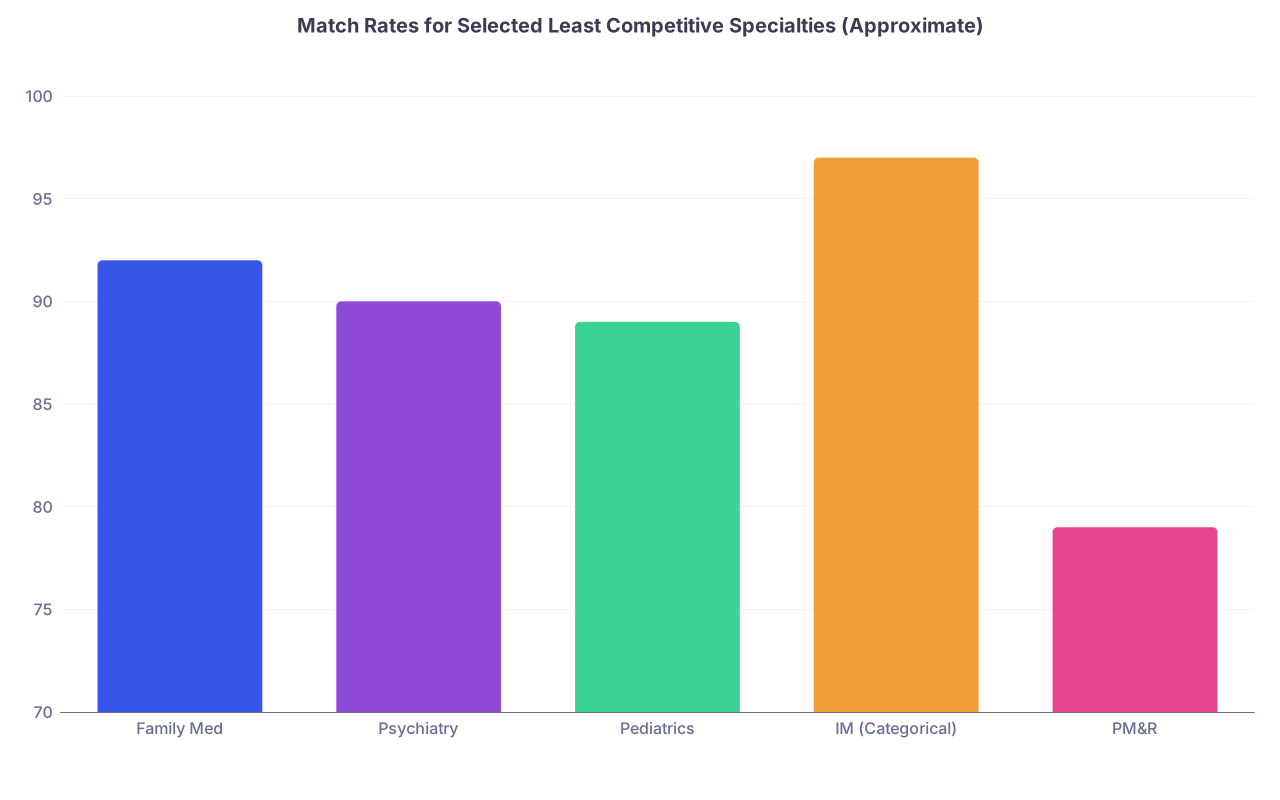
| Category | Value |
|---|---|
| Family Med | 92 |
| Psychiatry | 90 |
| Pediatrics | 89 |
| IM (Categorical) | 97 |
| PM&R | 79 |
Those numbers look reassuring — until you realize:
- A noticeable chunk of people still do not match.
- The “bottom” of who matches often ends up at programs with poor support, chaotic call, and minimal teaching.
- International grads and DOs get squeezed first when they rely on “it’s not that competitive” as a strategy.
You don’t want to be in the group that thought “it’s easy, I’ll be fine” and ends up begging for SOAP spots.
So yes, you can match these fields with mid-range scores. But you can absolutely sabotage yourself with clueless choices in:
- Who you shadow
- Where you do electives
- How (and when) you show genuine interest
Low competition means more wiggle room. It doesn’t mean you can act like your decisions are meaningless.
Mistake #1: Treating Shadowing Like a Box to Check
You’ve probably heard: “Just shadow a bit to show interest.” That’s half true and half trap.
The mistake: logging a few scattered half-days with random physicians, then never converting that into anything useful.
Shadowing That Hurts You
Here’s what bad shadowing patterns look like on paper or in conversation:
- “I shadowed a cardiologist, a neurosurgeon, an ophthalmologist, and an ENT… but I’m applying to family med.”
- “I did 20 hours in an urgent care once in M1 and never went back to primary care.”
- “I shadowed my uncle who’s a psychiatrist in private practice, no EMR, cash-only, sees 3 patients a day.”
Programs aren’t impressed that you stood in a room and watched. They care whether:
- You understand the real day-to-day of that specialty.
- You’ve seen the specialty in different settings (clinic vs hospital, academic vs community).
- Your interest looks consistent, not like a last-minute pivot after other doors closed.
The red flag: completely disorganized shadowing that doesn’t line up with what you say you want to do.
What You Should’ve Done Instead (And Still Can)
Minimalist, effective approach:
- Pick 1–2 core clinicians in your future specialty early (M1/M2) and stick with them.
- Go back periodically instead of doing 10 one-off shadowing experiences. Depth beats scatter.
- Get involved: simple tasks, chart review, patient follow-up. Even small responsibilities signal engagement.
If your application says “I’m passionate about underserved outpatient psychiatry,” but your shadowing is 100% with fancy sub-specialists in plush offices, people notice the mismatch.
Mistake #2: Wasting Electives on “Easy A” Rotations
This is the one that quietly kills otherwise decent applications.
It’s late in third year, you’re exhausted, and you hear:
“Take that elective, it’s super chill. No notes, no call. Everyone gets honors.”
So you do three of those. None actually related to the specialty you say you love. And you assume no one will care because “It’s just family medicine / peds / psych.”
I’ve seen this over and over:
Good Step score, decent core clerkship grades, but a transcript full of random, low-effort electives and zero signal of focused interest. Those applicants get leapfrogged by people with lower scores but intelligent elective choices.
The Red Flag Pattern
Programs look at your schedule and see:
- OB elective, then anesthesia, then ENT, then radiology.
- One week of outpatient psych.
- Zero sub-Is in the field you’re applying to.
- A random research elective in a completely unrelated specialty.
Individually, none of these are catastrophic. Collectively, they scream: “I waited too long to commit and just strung together whatever sounded easy.”
Especially in “low-competition” fields, programs lean heavily on perceived fit and interest because they’re not sorting 1,000 applicants by Step 1 anymore. Your electives are one of the clearest signals of that interest.
Mistake #3: Doing the Wrong Type of Elective for Your Target Field
Another quiet screw-up: you do electives that sound sort of related but don’t actually show what programs want to see.
Let’s be specific.

Family Medicine
Common mistake:
You say you want broad-spectrum FM but choose:
- Cardiology, GI, ortho electives in subspecialty clinics
- No rural / community / continuity clinic experiences
- Nothing with full-scope outpatient + inpatient mix
Programs then reasonably ask: Do you actually like comprehensive, cradle-to-grave care, or do you just like sending consults?
What you should prioritize instead:
- At least one sub-I or heavy acting intern month in FM or IM with strong outpatient exposure
- Rural or community-based family medicine if available
- Electives where you see complexity, chronic disease, and lots of follow-up
Psychiatry
Common mistake:
You only do “interesting” or cushy psych electives:
- One month of child psych in a private clinic
- One consultation-liaison month where you mostly watched
- Zero inpatient adult psych, zero emergency psych
Programs then worry: can you handle the intensity of real-world psych? Acute mania. Suicidal patients. Hospital volume.
You want at least:
- One solid inpatient psych elective (adult)
- Exposure to emergency or crisis psychiatry
- Ideally a continuity clinic type experience if your school offers it
Pediatrics
Common mistake:
- You load up on NICU and PICU because they sound cool and “intense”
- No bread-and-butter general peds clinic
- No experience with adolescents or school-age kids in outpatient care
So your application looks like you’re chasing prestige and acuity, not planning to be a functional, general pediatrician.
Balance is key:
- One general peds sub-I (ward or combined ward/clinic)
- Then sprinkle in NICU/PICU if you want, but not as your only exposure
Internal Medicine (for community IM or primary care–leaning)
Common mistake:
You stack:
- Cardiology inpatient
- GI inpatient
- Heme/Onc inpatient
And nothing in:
- Primary care clinics
- Geriatrics
- Chronic disease management in outpatient
You’re saying “I want to match community IM and be a hospitalist or outpatient doc” but training your application to look like you only care about procedurally-heavy subspecialties.
Mistake #4: Overestimating How Much “Any Sub-I” Helps
Sub-internships (acting internships) matter. The mistake is assuming any sub-I is equally helpful to any specialty.
I see this one constantly:
“I did a surgery sub-I because it’s harder and shows work ethic, then I decided on psych.”
What that really shows is you either:
- Didn’t think ahead, or
- Switched late (which is sometimes unavoidable, but you pay a price)
Let’s be blunt: for low-competition specialties, choosing the wrong sub-Is doesn’t always kill you, but it often means you’re competing against people who chose much better.
| Target Specialty | Strong Sub-I Choices | Weak / Misaligned Choices |
|---|---|---|
| Family Med | FM sub-I, IM wards | ENT, Ortho, Derm |
| Psychiatry | Inpatient Psych, IM wards | Anesthesia, Ophthalmology |
| Pediatrics | Peds wards, Peds ICU (with gen peds) | Neurosurgery, Radiation Oncology |
| Community IM | IM wards, Geriatrics, FM | Pathology, Interventional Radiology |
You’re not “impressive” because you survived a random hard rotation unrelated to your advertised interests. You’re unfocused.
If you’ve already made this mistake, fine — just do what you can to course-correct with additional, aligned electives before ERAS submission.
Mistake #5: Ignoring Where Your Letters Will Come From
You’d be surprised how many students pick electives with zero thought about letters of recommendation. As if the rotation exists in a vacuum.
Here’s the usual pattern:
- You take a “chill” elective with minimal attending interaction.
- Residents run the show, attending barely knows your name.
- You walk away with a generic, weak letter that might as well have been written from a template.
In low-competition fields, programs may be more forgiving on scores, but they still read letters carefully. They’re looking for:
- Consistency over time: “We’ve worked with them in multiple settings.”
- Concrete examples of reliability, patient ownership, and professionalism.
- Signals that you’ve been observed doing the actual work of that specialty.
Elective mistake: choosing rotations that are:
- Super-subspecialized with minimal student role.
- Overcrowded with students so nobody stands out.
- Staffed by per diem or part-time faculty who don’t do many evals.
When you’re planning electives, you should be asking:
- Who on this rotation is known to write strong, detailed letters?
- Will I get direct attending contact or just be buried under a resident team?
- Is there continuity or repeated exposure so they can genuinely say “I trust this person”?
If you’re shy about asking senior students, that’s costing you. They usually know exactly which electives and attendings are letter goldmines — and which are black holes.
Mistake #6: Doing All Your Relevant Electives Too Late
Another quiet killer: the timing of your shadowing and electives.
You might think: “As long as I do them before graduation, it’s fine.”
No. Programs care if you’ve demonstrated interest before your ERAS application goes in and before interview season.
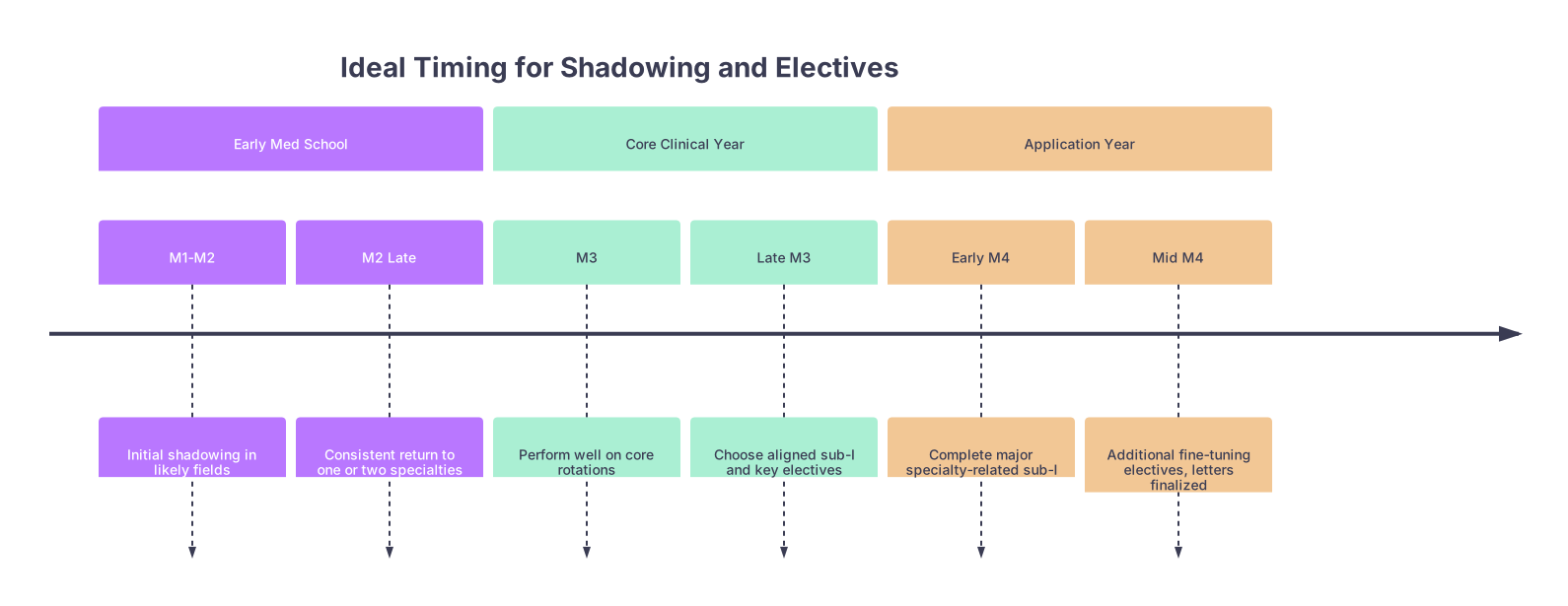
| Period | Event |
|---|---|
| Early Med School - M1-M2 | Initial shadowing in likely fields |
| Early Med School - M2 Late | Consistent return to one or two specialties |
| Core Clinical Year - M3 | Perform well on core rotations |
| Core Clinical Year - Late M3 | Choose aligned sub-I and key electives |
| Application Year - Early M4 | Complete major specialty-related sub-I |
| Application Year - Mid M4 | Additional fine-tuning electives, letters finalized |
The mistake pattern:
- All your psych / FM / peds electives are scheduled for after October of M4.
- Your most relevant sub-I ends in December — long after interview invites go out.
- You discover your target specialty in June and don’t move quickly to rearrange.
Then your application hits programs in September showing:
- One core clerkship in that field.
- Maybe a short elective you crammed in early M4, if you’re lucky.
- No real longitudinal interest.
Programs don’t have time to wait and see how you’ll do in a December rotation. By then, most interview slots are gone.
If you’re in this boat right now, you don’t have the luxury of denial. You need to:
- Push to move at least one key elective / sub-I into early M4 (June–August).
- Get letters as fast as possible from anything you’re doing now that’s relevant.
- Make your personal statement and experiences section absolutely airtight to show genuine interest despite your delayed timing.
Mistake #7: Zero Understanding of the Real Workload and Setting
Another subtle but nasty shadowing mistake: you only see the specialty in its most glamorous or cushioned form.
I’ve seen FM applicants who only shadowed concierge docs with 8 patients a day. Psych applicants who only saw 45-minute therapy sessions and no inpatient chaos. Peds applicants who never once saw a screaming child at 3 AM in the ED.
Programs in less competitive specialties know something you don’t: burnout is real in their fields. They’re screening for whether you actually know what you’re signing up for.
Red flag in interviews:
“What do you think will be challenging about family medicine?”
Answer: “Paperwork, I guess.”“What is difficult about inpatient psych?”
Answer: vague, superficial answer clearly based on TV, not lived observation.
To avoid this, your shadowing and electives should include:
- At least one high-volume clinic experience (for FM, IM, peds)
- Something with real behavioral challenges (for psych, peds, FM)
- Exposure to on-call or after-hours work if possible
If you’ve only seen the specialty in a boutique, slow-paced environment, you’re walking into residency blind. That will show in your interview answers and in how thin your application stories sound.
Mistake #8: Assuming Community Programs Don’t Care
This one irritates me the most.
People think: “It’s just a community FM / IM / psych program. They’ll take whoever.”
No. Many of those programs have small classes and tight teams. A single problem resident can wreak havoc. They’re more sensitive to fit and reliability because they can’t hide you in a giant class.
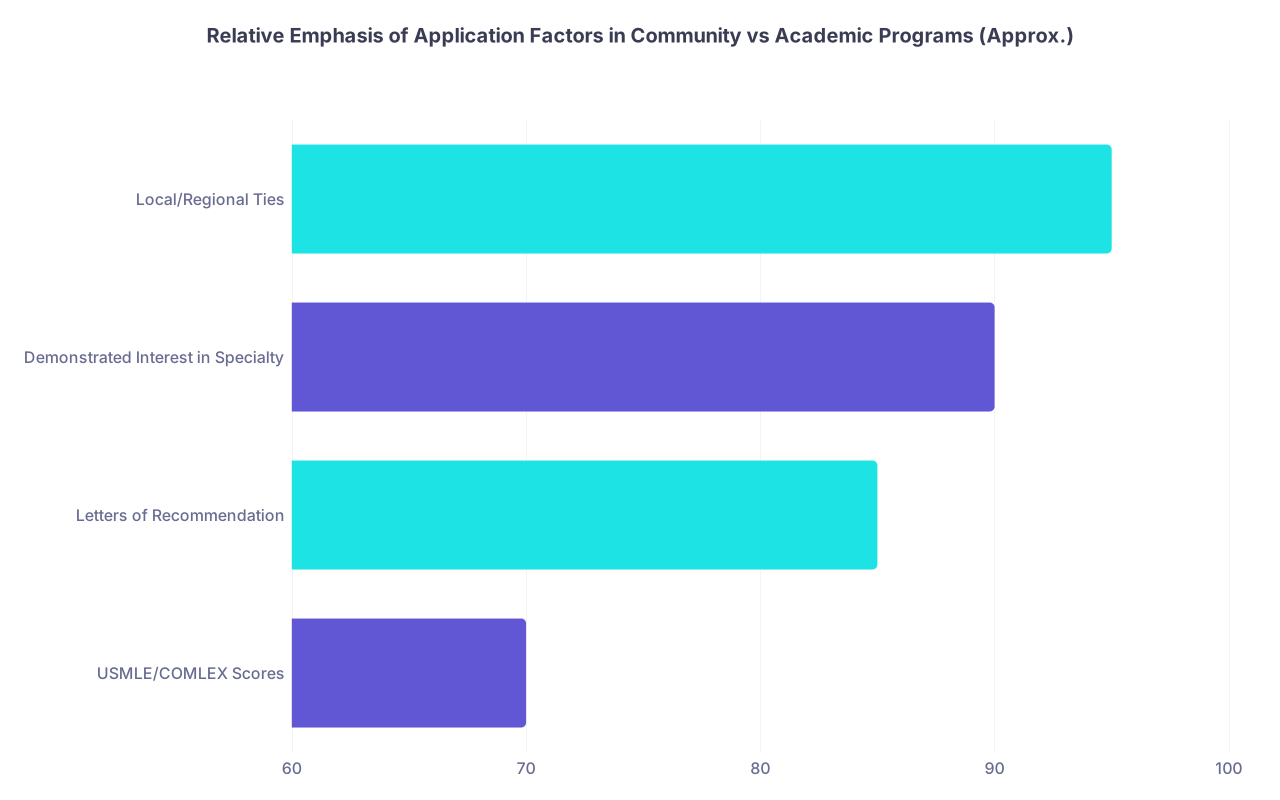
| Category | Value |
|---|---|
| USMLE/COMLEX Scores | 70 |
| Letters of Recommendation | 85 |
| Demonstrated Interest in Specialty | 90 |
| Local/Regional Ties | 95 |
Community-heavy programs often put enormous weight on:
- Strong, specific letters from people they trust
- Evidence you actually like the kind of work they do
- Any tie to the region or patient population
So if your electives and shadowing scream “academic subspecialty” but you’re applying heavily to community primary care or psych, they doubt:
- Will you be happy here, or will you bail for a fellowship the first chance you get?
- Are you going to resent the bread-and-butter work?
- Do you even understand what we do?
Low competition ≠ low standards. It just means the filter is different.
What To Do Now: A Simple Course-Correction Plan
If you’re realizing you’ve already made some of these mistakes, don’t spiral. Fix what you can, now, in a focused way.

Immediate steps you can take this week:
Pull up your rotation history and future schedule.
- Mark anything that clearly supports your target specialty.
- Mark anything that’s neutral or useless for that goal.
Identify 1–2 high-yield changes.
Examples:- Swap a random radiology elective for a sub-I in FM/IM/peds/psych.
- Move a key elective earlier (June–August) if ERAS is still ahead.
Actively plan for letters.
- Decide who you want letters from now.
- Email them early: tell them your goals, ask how best to perform on their service to earn a strong letter.
Patch the shadowing gaps.
- If your experience is lopsided (only fancy private psych, only ICU-level peds), schedule 1–2 short but intense exposures in more typical settings.
- Even a few half-days now is better than pretending.
Rewrite how you talk about your experiences.
- In your personal statement and interviews, don’t lie, but do frame your trajectory coherently.
- “I explored several specialties early, but over the last year my experiences in X, Y, Z have made it clear that ____ is the right field for me.”
- Back that up with specific elective and shadowing examples, not vague feelings.
FAQ (Exactly 3 Questions)
1. I decided on my “low-competition” specialty late. Am I screwed if my electives don’t match perfectly?
No, you’re not automatically sunk. But you cannot pretend your timeline looks ideal. Programs can see when your interest crystallized. Your job is to:
- Load as much aligned experience as possible into the time you have left.
- Get at least one strong letter from someone in the specialty who worked with you recently.
- Use your personal statement and interviews to clearly explain your path without sounding flaky or desperate.
Late is recoverable. Random and unplanned is not.
2. Do I really need a sub-I in the specialty if it’s considered less competitive?
If your school offers it, yes — you should treat that as a near-requirement, not a luxury. For family med, peds, psych, and IM, a strong sub-I that shows you can function like an intern is huge. Programs are wary of residents who fold under basic inpatient responsibility. A relevant sub-I shows you’ve seen the pace and still chose to apply.
3. Is it bad if most of my shadowing was in a different specialty, and I switched to a lower-competition field later?
It’s not fatal, but you need to handle it carefully. The mistake is pretending your earlier interest never existed. Better approach:
- Acknowledge you took your exploration seriously.
- Emphasize what you learned about yourself from those experiences that pushed you toward your new field (e.g., preferring longitudinal care over procedure-heavy work).
- Then show receipts: recent, focused shadowing and electives in your chosen specialty that prove it’s not a panic move after poor scores or rejections.
Open your rotation schedule right now and highlight every block that genuinely supports the specialty you’re aiming for. If there aren’t at least two or three clear, defensible choices there, you’ve got work to do — and today is when you start fixing it.