
The belief that “letters of recommendation don’t matter in less competitive specialties” is flat‑out wrong.
They still judge you by them. The bar is just different. And if your letters are weak, lazy, or mismatched, you will look like the applicant who could not even get strong support in an easier field. That is deadly.
I am going to walk through the specific LOR mistakes that quietly sink applicants to the so‑called “less competitive” specialties—family medicine, internal medicine (community programs), pediatrics, psychiatry at lower‑tier sites, pathology, PM&R in certain regions, prelim/TY years, and some community OB/GYN spots.
These programs do not expect a chair letter from Mass General. But they absolutely notice when your letters scream: unmotivated, marginal, or high risk.
Let’s make sure you are not that person.
1. Assuming “Least Competitive” Means Letters Do Not Matter
This is the first and most expensive mistake: treating LORs as an afterthought because “IM/FM/Peds will take anyone with a pulse.”
No, they will not. Especially not now.
Program directors in these fields are tired. Tired of residents who require constant pushing, can’t handle basic tasks independently, or implode mid‑PGY2. You know what they screen hard for? Reliability, professionalism, and genuine interest in the field.
Letters are one of the few places those qualities show up.
Here is the trap people fall into:
- They delay asking, so faculty write rushed, generic letters.
- They pick random letter writers who barely know them.
- They submit letters that talk about everything except the specialty they are applying to.
Then they wonder why even “backup” programs did not bite.
I have sat in rank meetings where people said, verbatim:
“Her application is fine, but these letters could be about any random student. I do not see a future family doc here.”
That applicant dropped several slots. She did not match in round one.
Just because a specialty is less competitive on paper does not mean you can coast on mediocre LORs. It means you cannot afford obvious red flags.
2. Using Letters That Don’t Match The Specialty
The second huge mistake: letters that do not seem to know what you are applying for.
You are applying to family medicine. Your “strongest” letter? From vascular surgery. Describing how you scrubbed, closed skin, and “may develop into a capable surgical trainee.”
To a family medicine PD, that reads as:
- This student is hedging hard.
- None of the FM docs wanted to vouch for them.
- They might just use us as a backup and leave.
Same story for:
- Psych applicant with letters from neurosurgery and radiology, but no psych.
- Peds applicant with letters from adult cards and MICU, but no pediatrics.
- Pathology applicant with two IM ward letters and a random research PI from basic science.
You do not need 100% specialty‑specific letters, but you absolutely need enough evidence that people in that field have seen you and would actually want you as a colleague.
As a rough rule:
| Target Field | Minimum Specialty Letters | Other Acceptable Letters |
|---|---|---|
| Family Med | 1–2 FM | IM, Peds, OB, Psych |
| Community IM | 1–2 IM | FM, Subspecialty IM, Hospitalist |
| Pediatrics | 1–2 Peds | FM, OB, IM |
| Psychiatry | 1 Psych | Neurology, IM, FM |
| Pathology | 1 Path | IM, Surgery, Research PI |
| PM&R | 1 PM&R | Neuro, Ortho, IM |
If you cannot get even one letter from the specialty you claim to love, every PD will ask why.
And no, “I liked psych but never rotated there” is not a good look.
3. Accepting Vague, Generic, or Template Letters
Weak letters in less competitive specialties do not usually say “this student is terrible.” They kill you in a more subtle way: by saying almost nothing.
Read this slowly:
“I have worked with many students over my career. [Name] is a pleasant, hardworking student who will make a fine resident. I recommend them without hesitation.”
Sounds okay? It is not. It is the LOR equivalent of answering “fine” when someone asks how your date went.
Strong letters contain specific behaviors, clear comparisons, and evidence of trust.
Weak ones rely on:
- Stock adjectives: “hardworking,” “pleasant,” “enthusiastic”
- No concrete examples
- No comparison group (“among the top X% of students I have worked with”)
- No discussion of readiness for residency
And programs in less competitive specialties see tons of these because students assume “anything is fine.” So a single specific, invested letter stands out massively.
Here is how it plays in a rank meeting:
- Applicant A: 230s Step 2, mid‑tier school, but one letter: “Top 10% of students I have supervised in the last 10 years, I would trust them with my own family.” Specific example of a night shift they handled alone.
- Applicant B: 250, higher‑tier school, letters full of “does what is expected.”
Guess who the small community FM or IM program will prefer. Over and over.
If a faculty member says, “I can write you a letter, but I do not know you very well,” that is code for: “You will get a generic, neutral LOR.”
You do not want that.
You want: “I can write you a strong letter.” Anything short of that is a yellow flag.
4. Letting the Wrong People Write Your “Strong” Letters
Another predictable mistake: assuming big titles automatically equal strong letters.
They do not.
A brief list of risky letter writers for less competitive specialties:
- Department chairs who barely know you
- Famous researchers who worked with you peripherally
- The “big name” surgeon for your psych or FM application
- A subspecialist who saw you for two half‑days and mostly talked to fellows
I have seen pathology programs ignore a letter from a Nobel‑adjacent PI because it basically said, “This student helped in my lab and is interested in academic medicine.” No description of work ethic, personality, or clinical ability.
Meanwhile, the applicant’s small‑town community IM attending had written a detailed letter… that the student did not upload because “they are not a big name.”
Bad call.
For least competitive specialties, programs care more about:
- Who actually saw you on the wards
- Who can describe how you interact with patients and staff
- Who can speak to reliability, humility, and teachability
Big names impress more in ultra‑competitive fields trying to separate 260+ Step 2s. Your local FM doc who says, “I wanted to hire her myself” is more valuable than a world‑famous cardiologist who remembers you vaguely.
If your strongest, most detailed advocate is a community physician with zero titles, that is still often your best letter.
5. Submitting Letters That Quietly Undermine You
Not all “bad” letters are obviously negative. The worst ones are subtly damning.
Program directors are very good at reading between the lines. They see word choice patterns that you do not.
Phrases that should make you sweat:
- “With appropriate supervision, they can manage…”
- “Given time, I expect them to develop into…”
- “They completed all assigned tasks.”
- “They are suitable for training in a structured program.”
That last one? I once heard a PD say, “That is what I write when I do not trust them to work independently for years.”
Common hidden red flags:
- Overemphasis on needing direction
- Praise that is purely about knowledge but not people skills
- No mention of teamwork, communication, or professionalism
- Lukewarm comparison: “comparable to most students”
In less competitive specialties, these cautious phrases scream:
“This person is already borderline, even in an ‘easier’ field.”
If you are unsure whether a specific attending is actually on your side, ask directly:
“Do you feel you know me well enough to write a strong, supportive letter for [specialty]?”
If they hesitate, or say anything like “I can write a letter” without the word strong, choose someone else.
6. Reusing Mismatched or Outdated Letters
Another lazy, avoidable problem: recycling letters across cycles or specialties without thinking.
I have seen:
- A psych PD reading a letter that repeatedly praises the student’s “commitment to a career in surgery.”
- A second‑cycle applicant whose best letter was clearly dated 2 years ago, with no recent clinical references.
- A family medicine program reading a letter about “future cardiology fellowship potential” with zero mention of primary care.
These are all preventable.
If you are switching specialties—say, from surgery to PM&R, or from FM to psych—you cannot just carry over last year’s letters and hope no one notices. They will. And they will assume you are applying “by default,” not by choice.
At minimum, you need:
- At least one current letter that explicitly supports your new specialty choice
- No letters that overtly contradict your stated path
- Updated experiences or recent rotations to show you actually tried the new field
And about dates: an older but excellent letter (e.g., from a beloved 3rd‑year FM rotation) can still be valuable, but only if:
- You also have recent clinical letters
- The old letter is clearly strong and specific
- It does not frame you as 100% set on a different field
Do not let your LOR packet advertise your uncertainty.
7. Failing to Guide Your Letter Writers (Without Ghostwriting)
Here is the dirty little secret: even good attendings write bad letters when they have no information.
Classic scenario:
You ask at the end of a rotation, they say yes, you send them your ERAS info and CV, and that is it. They then churn out a generic, timeline‑style letter:
“During the rotation, [Name] saw patients, pre‑rounded, and attended didactics. They were always on time and pleasant.”
Completely forgettable.
The preventable mistake? You never helped them remember your best moments or your specialty interest.
You are not supposed to draft your own letter. That is shady. But you absolutely can, and should, send:
- A short “CV highlight” paragraph with specific clinical examples
- A one‑page summary of why you chose this specialty and what you hope to do
- Reminders of particular patients or situations you handled well
Example email content (condensed):
- “I especially appreciated when you let me manage Mrs. X’s insulin adjustment; I learned a lot from that follow‑up call.”
- “Family medicine appeals to me because I enjoy continuity and broad practice. I am particularly interested in [rural medicine, underserved populations, etc.].”
This is not telling them what to write. It is jogging their memory so they can be specific. Otherwise you get the “nice, hardworking, showed up” template letter that places you dead‑center in the pile.
8. Overloading on Non‑Clinical or Irrelevant Letters
Because these specialties are “less competitive,” students sometimes assume any admiration is good admiration. So they submit weird mixes like:
- 1 clinical letter + 2 research letters + 1 volunteering supervisor
- 1 IM letter + 1 from a humanities professor + 1 random dean’s office person
I have watched PDs flip to the LOR section, see zero consistent clinical voices, and immediately down‑rank the file.
Remember what they are asking:
“Can this person safely and reliably care for patients in my specialty, starting in three months?”
Non‑clinical letters can be useful as extras, but they cannot anchor your packet. You need at least 2 strong clinical voices who watched you on the wards in something vaguely related.
Reasonable balance for low‑competition fields:
- 2–3 clinical attendings, at least 1 from target specialty
- Optional: 1 research or non‑clinical letter that shows long‑term character, leadership, or grit
What you cannot do is substitute “she was a great peer mentor” for “I trusted her with sick patients.”
9. Timing Your Letters Poorly
Even in less competitive specialties, late or missing letters send a message: you are disorganized, or nobody was willing to write for you early.
Two common mistakes:
- Asking right before ERAS opens, so attendings rush something in 48 hours.
- Waiting to see your scores, then scrambling, so letters arrive weeks after programs start reviewing.
Both result in weaker content and weaker optics.
Reality check: Community IM and FM programs in particular start skimming applications early. If your LORs trickle in mid‑October, they may not re‑screen you.
You want:
- Requests made at the end of the rotation when you are fresh in their mind
- ERAS LOR slots populated before or very soon after apps open
- A clear plan B for any attending who drags their feet
If an attending has not uploaded by your soft deadline (which you tell them), you politely nudge. If they still do not, you secure another writer. The risk of a last‑minute, low‑effort letter is higher than the risk of asking someone else who actually will deliver.
10. Ignoring What Low‑Competition Programs Actually Want To See
One more mistake: using the same kind of letters that might work for highly academic programs when you are targeting community or less competitive ones.
These places are not primarily searching for “future national leaders in translational research.” They want:
- People who show up
- Take care of patients without drama
- Do not flame out on nights
- Do not make the nurses’ lives harder
Letters that rave about your “potential as a clinical researcher” but never once mention:
- Work ethic
- Being teachable
- Being kind to staff
- Handling stress well
…are miscalibrated.
Good letters for least competitive specialties sound like this:
- “I have seen them handle a full patient load on busy ward days with minimal supervision.”
- “They were the medical student the nurses chose to ask for help.”
- “They took feedback well. I watched them correct a documentation pattern within 24 hours.”
- “I would be happy to have them as a junior resident on my team.”
That is what sells in these specialties. Not the fact that you presented a poster in another field three years ago.
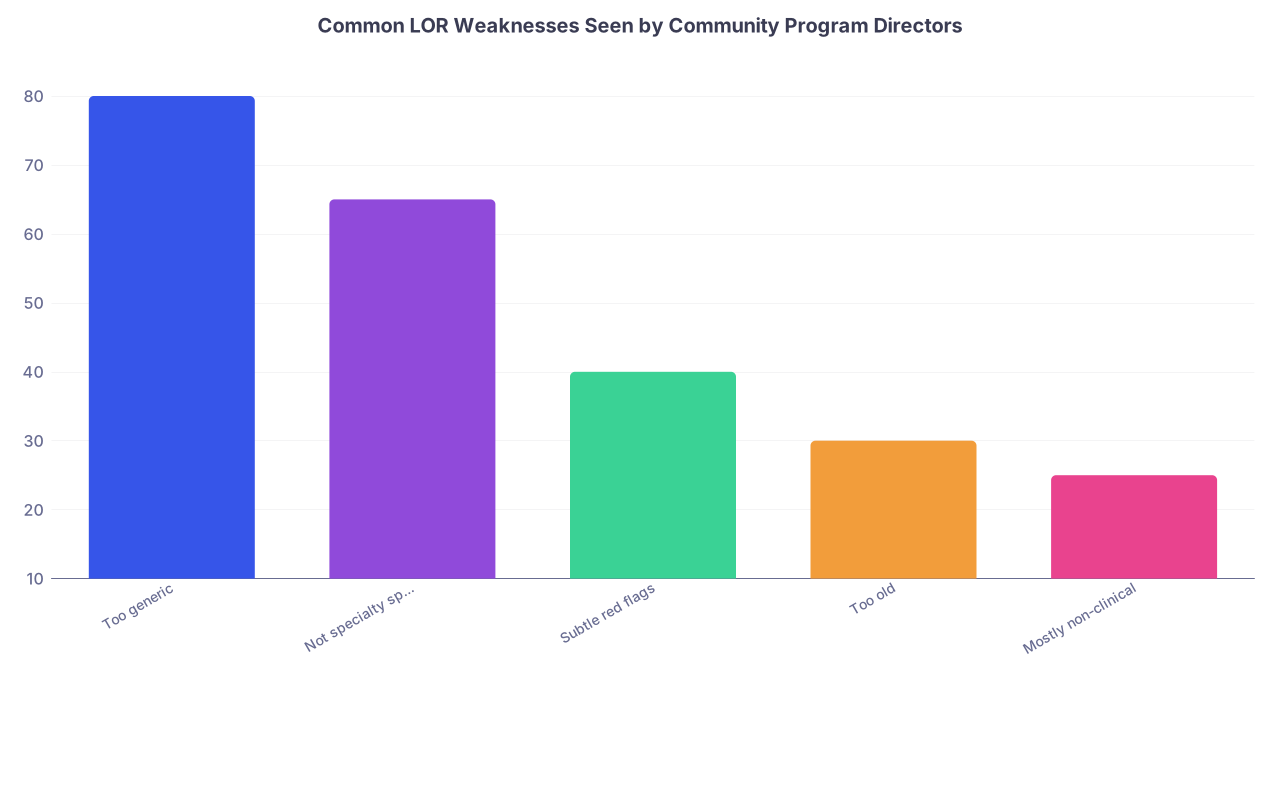
| Category | Value |
|---|---|
| Too generic | 80 |
| Not specialty specific | 65 |
| Subtle red flags | 40 |
| Too old | 30 |
| Mostly non-clinical | 25 |
11. Specialty‑Specific Pitfalls You Probably Are Not Thinking About
A few quick landmines per field that I have seen hurt applicants:
Family Medicine
Mistakes:
- All letters from subspecialists in tertiary centers; none from true primary care.
- Zero mention of continuity, outpatient work, or holistic care.
- Letters that frame you as “clearly fellowship‑bound in cardiology or GI.”
FM PDs worry you will be miserable in broad practice and leave early. Have at least one letter from outpatient FM or a doc who can speak to your comfort with bread‑and‑butter primary care.
Community Internal Medicine
Mistakes:
- Letters from ICU and cards attendings that emphasize how much you love procedures and emergencies but never talk about bread‑and‑butter inpatient ward work.
- Super academic letters pitching you as “perfect for a physician‑scientist track” when you are applying to a small community hospital.
They want to hear that you can manage volume, communicate with families, and be comfortable without sub‑subspecialist backup every second.
Pediatrics
Mistakes:
- Only adult medicine letters.
- No mention of your interaction with children or parents.
- Letters that paint you as blunt or impatient, which reads much worse in a peds context.
If you did a single peds rotation and they would not write for you, that is a signal you need to interrogate.
Psychiatry
Mistakes:
- Zero psych letters. Just neurology and IM.
- Letters that describe you as “brilliant but sometimes aloof,” or “sometimes struggles with time management” (PDs see burnout potential and safety concerns).
- Overly focused on your own mental health interest without mention of your actual clinical performance.
Psych PDs care deeply about boundaries, reliability, and teamwork. They read carefully for hints of drama.
Pathology
Mistakes:
- No path letters at all; only IM and surgery.
- Total lack of commentary on your attention to detail and reliability.
- Letters that subtly imply you are doing path because “patient care is not for you.”
Path programs want meticulous, stable people who can handle solitary, detailed work and still be collegial.

| Step | Description |
|---|---|
| Step 1 | End of Rotation |
| Step 2 | Ask for strong letter |
| Step 3 | Do not ask |
| Step 4 | Send CV and highlight email |
| Step 5 | Confirm specialty and interests |
| Step 6 | Monitor upload status |
| Step 7 | Include in ERAS |
| Step 8 | Gentle reminder |
| Step 9 | Find alternate writer |
| Step 10 | Attending knows you well |
FAQ (Exactly 4 Questions)
1. Do I really need a specialty‑specific letter for a less competitive field like family medicine or community IM?
Yes. At least one. Programs want proof that someone in that field has seen you function and still wants you as a colleague. You can fill the rest with related fields, but a complete absence of letters from the target specialty looks like avoidance or lack of interest.
2. Is it better to have a generic letter from a famous name or a strong letter from a no‑name community doc?
Take the strong community doc every time. A generic LOR from a big name gets skimmed and forgotten. A specific letter that says “I would hire this person myself; they are in my top 10% of students” carries real weight, especially in lower‑competition specialties that care about day‑to‑day reliability.
3. How many non‑clinical or research letters can I safely include?
One at most, and only as a supplement. Your core letters should be clinical—people who saw you handle real patients. A research PI or volunteer supervisor can add character context, but they cannot substitute for ward attendings in IM, FM, peds, psych, path, or PM&R.
4. What if I suspect a letter might be lukewarm or subtly negative?
Do not use it. Ask directly whether the writer can provide a strong, supportive letter for your chosen specialty. If the answer is anything less than clear enthusiasm, thank them and find someone else. A neutral or slightly negative LOR hurts you more than simply having one fewer “fancy” writer in your packet.
Key points, stripped down:
- Even in the least competitive specialties, weak, vague, or mismatched letters make you look like the applicant who could not even impress in an easier field.
- Prioritize specific, clinical, specialty‑aligned letters from people who actually know your work over big titles or recycled, off‑specialty praise.
- Ask early, confirm they can write a strong letter, and give them the right reminders so your best qualities make it onto the page.