
You’re sitting in a Zoom interview for a community internal medicine program. The faculty interviewer leans back and asks, “So… why internal medicine?” You know IM is not dermatology or ortho. You’re worried they’re secretly wondering if you “settled,” if you “couldn’t match something better,” or if you’ll bail for a fellowship the first second you can.
Here’s the answer you’re looking for: you explain your interest in a less competitive specialty by sounding intentional, not defensive. Calm, specific, and grounded in your actual experiences.
Let me walk you through how to do that.
First, understand what they’re actually worried about
If you’re going into a less competitive specialty (think: family medicine, psychiatry at many places, pediatrics, PM&R, pathology in a lot of regions), interviewers are not usually thinking, “Why aren’t you more ambitious?”
They’re thinking three things:
- Are you genuinely committed to this field, or are we someone’s backup plan?
- Do you understand what this specialty really looks like day to day?
- Will you fit what this program actually does (community care, underserved, primarily outpatient, etc.)?
Translate that into your job on interview day:
You must show:
- This is a choice, not a consolation prize.
- Your reasons tie to specific experiences, not vague “I like helping people.”
- Your goals line up with what this specialty and this program can actually give you.
If your answer doesn’t clearly hit those three, it sounds flimsy. Competitive or not.
The core structure of a strong answer
Use this basic skeleton for “Why [specialty]?” and adapt it to your field:
- Origin: Where the interest started
- Reality check: How real experiences confirmed or refined it
- Fit: Why this specialty suits your strengths and values
- Future: What you plan to do with this training
Keep it tight: 60–90 seconds when spoken. If it sounds like a TED talk, you’ve overdone it.
1. Origin – but not childhood fantasy
Skip the “I wanted to be a pediatrician since I was 5” version. It’s cliché and usually not convincing.
Better: anchor your origin to a concrete medical school or pre-med experience.
Examples:
- Family medicine: “During my third-year FM rotation at a FQHC, I saw patients I’d met in the hospital now doing better months later in clinic. That continuity grabbed me in a way I didn’t expect.”
- Psychiatry: “On inpatient psych, I was struck that 30-minute conversations could change someone’s trajectory more than some of the procedures I’d done.”
Notice the pattern: specific setting, specific impact.
2. Reality check – show you know the less glamorous side
This is where you separate yourself from people who just read a blog.
You briefly acknowledge the non-ideal parts and show you still want it.
- “I know outpatient family medicine involves a lot of chronic disease management, short visits, and administrative work. On my continuity clinic, I still found it satisfying to track patients over time and adjust their care.”
- “On inpatient psych, there were days where progress was slow and documentation heavy. I liked the team-based problem solving that happened even on those tougher days.”
If you only talk about the “interesting cases,” you sound naive.
3. Fit – link your actual strengths to the specialty
Programs want residents who will thrive doing the core work of that field.
Do not say:
- “I like work-life balance.”
- “It’s broad.”
- “I want to help people.”
Say things like:
- Specific skills (communication, pattern recognition, longitudinal relationships)
- Ways you like to think (diagnostic puzzles, systems thinking, behavior change)
- Work settings you enjoy (clinic-heavy, team-based rehab, lab/diagnostic work)
Make it concrete:
- PM&R: “I like complex, function-oriented problems and working with a team—PT, OT, speech. On my rehab rotation, I loved being the physician coordinating all those perspectives toward one goal.”
- Pathology: “I enjoy pattern recognition and detailed, focused work. On my pathology elective, I liked that my decisions mattered for downstream patient care even though I wasn’t at the bedside.”
4. Future – show you’re going somewhere with this
Less competitive does not mean low ambition. Programs hate residents who appear directionless.
State a focused but flexible direction:
- “I’m especially interested in outpatient internal medicine in underserved communities, possibly with a focus on diabetes care quality improvement.”
- “I see myself in community psychiatry or C/L, working with medically complex patients. I’m open to subspecializing but I want a strong general psych foundation first.”
You’re telling them: I have a trajectory, and your program is a logical step in it.
Don’t say this stuff (or at least, don’t lead with it)
Some reasons might be true for you but sound terrible in an interview unless they’re framed very carefully.
Here’s a quick run-through.
| Weak Reason (Do NOT lead with) | Stronger Reframe |
|---|---|
| "Better lifestyle" | "I value continuity and long-term relationships, which this outpatient-focused specialty allows." |
| "Easier to match" | "My clinical experiences lined up most with the core work of this field, and it fits how I like to practice." |
| "I didn’t like surgery" | "I prefer longitudinal, cognitive work and frequent patient contact over procedural-heavy roles." |
| "Less intense residency" | "I want to invest deeply in outpatient medicine and behavior change, even if that means less time in procedural settings." |
If something like “lifestyle” or “geography” truly mattered, mention it once you’ve already established a patient-care-centered reason:
- “I’m drawn to family medicine for the continuity and community focus. I also know this specialty offers paths where I can have sustained presence with my own family long-term, which matters to me.”
Value-based, not convenience-based.
Examples by specialty (you can steal the structure)
Here’s how a clean, believable answer can sound for a few “less competitive” specialties.
Family Medicine
“I got interested in family medicine during my third-year rotation at a rural clinic. I followed a patient from hospital discharge back to clinic and watched how adjusting his meds and involving his wife in the plan kept him out of the ED for months. That continuity and big-picture view of his life hooked me.
I know a lot of family medicine is bread-and-butter chronic disease and preventive care, with short visits and real-world constraints. On my continuity clinic, I actually liked tracking blood pressures, A1Cs, and small behavior changes over time. It fits how I think—longitudinal, systems-focused rather than one big intervention.
I enjoy building rapport quickly and explaining plans in plain language. Those are strengths that seem directly useful in full-spectrum primary care. Long term, I see myself in a community-based practice working with underserved patients, ideally with some involvement in resident teaching. Your program’s emphasis on community sites and behavioral health integration aligns really well with that.”
Psychiatry
“My interest in psychiatry started on my internal medicine rotation, actually. I kept noticing how uncontrolled depression or substance use wrecked our carefully constructed medical plans. On my inpatient psych rotation later, I saw how treatment of those conditions changed people’s ability to engage with the rest of their care.
I’ve seen the slow days and the challenges—patients who are not ready for change, a lot of documentation, and sometimes limited resources. What I liked, even on those days, was the team-based approach and the space to really explore why someone is where they are rather than just stabilizing them and moving on.
I’m drawn to work that is conversational and diagnostic, where the main tools are careful listening and formulation. I think my patience, comfort with ambiguity, and ability to build trust quickly fit well with psychiatry. Long term, I’m interested in community psychiatry or C/L, working at the interface of medicine and mental health. That’s why I’m particularly interested in your program’s strong C/L service and community rotations.”
Pediatrics
“I didn’t start med school thinking pediatrics. On my MS3 year, what stood out on peds was watching families learn to manage chronic conditions—new-onset diabetes, asthma—and seeing kids bounce back with the right support.
Pediatrics is not all cute babies. I’ve seen tough conversations with parents, long hospitalizations, and a lot of preventive care that can feel repetitive. But I like the mixture: acute problem solving in the hospital and then helping families build routines that actually work at home.
I communicate well at different levels—explaining to kids, then rediscussing with parents, and collaborating with schools or social workers. That multi-level communication seems central to pediatrics. Long term, I see myself in general pediatrics or possibly heme/onc, but always with a strong base in general peds. The continuity clinic structure here and the exposure to underserved populations are exactly what I’m looking for.”
How to handle the “backup plan” suspicion
Sometimes they’ll ask it directly. Often they won’t, but they’re thinking it.
You deal with it by being explicit without sounding defensive.
If you explored more competitive fields:
“I explored anesthesia and IM subspecialties early on, and I’m glad I did. It gave me a clearer sense that I care more about long-term patient relationships and outpatient management than the OR or procedure-heavy work. That’s what pushed me toward family medicine, and once I spent more time in clinic, that decision felt solid. I ranked and applied only in family medicine because that’s where I see myself long term.”
Key elements:
- Acknowledge exploration. Everyone explores.
- Show a decision point and why.
- Confirm you’re actually committed now.
Do not:
- Trash other specialties. (“Surgeons were miserable.”)
- Overexplain test scores. If asked, answer briefly, but don’t volunteer Step drama in your “why this specialty” speech.
Integrate “less competitive” without sounding apologetic
You do not need to say, “I know this is a less competitive specialty.” That’s awkward and irrelevant.
But you can implicitly address the stereotype by sounding serious and ambitious within the field:
- Talk about specific niche interests (addiction in psych, sports in FM, developmental in peds).
- Mention quality improvement, teaching, or leadership interests.
- Show you’ve talked to attendings who do what you want to do.
For example:
“I’ve spoken with several community internists who precepted me and have combined primary care with teaching and small QI projects. That blend is what I’m aiming for, and your program’s resident QI curriculum makes sense for that path.”
That sounds like someone choosing a path, not settling.
Practice: turn your scattered thoughts into a 60-second answer
Do this today:
Write down:
- 2 rotations or experiences that pulled you toward this specialty
- 2 things about the day-to-day work that you actually enjoy
- 1–2 future career goals that match the specialty
Turn it into 4 sentences:
- Where it started
- How reality experiences confirmed it
- Why it fits your strengths
- Where you want to go with it
Say it out loud. Time it. Cut fluff until it’s under 90 seconds.
Then add program-specific lines when they ask, “Why our program?” but keep the core specialty story consistent.
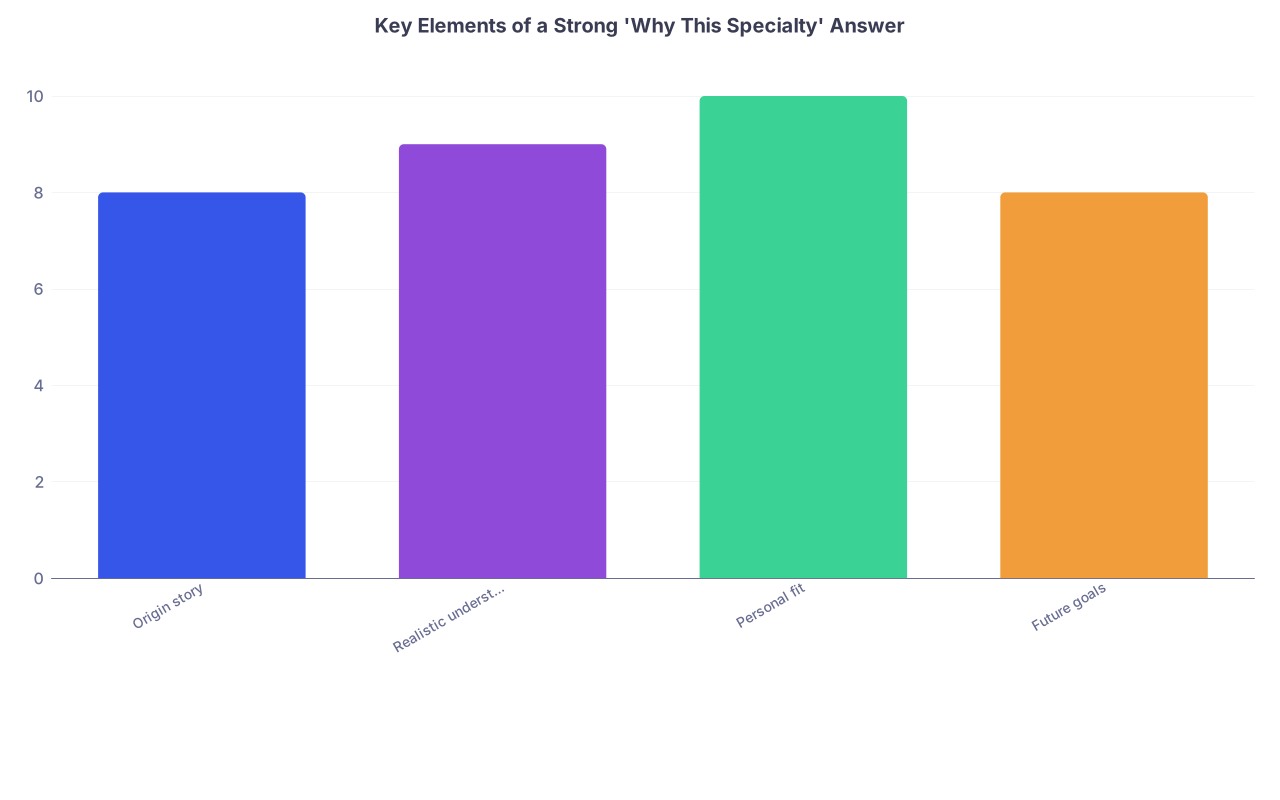
| Category | Value |
|---|---|
| Origin story | 8 |
| Realistic understanding | 9 |
| Personal fit | 10 |
| Future goals | 8 |

| Step | Description |
|---|---|
| Step 1 | List experiences |
| Step 2 | Identify what you enjoyed |
| Step 3 | Match to specialty traits |
| Step 4 | Draft 4 part answer |
| Step 5 | Practice out loud |
| Step 6 | Refine for each program |
FAQ: Explaining Interest in a Less Competitive Specialty
Do I have to admit I considered more competitive specialties?
Not automatically. If they ask directly or your application screams “ortho turned FM,” be honest and concise. Frame it as exploration that clarified your fit. Then pivot back to why your chosen specialty matches your strengths and values now. No long apology tour.Can I mention lifestyle as a reason?
Yes, but never first and never alone. Lead with patient-care and work-style reasons. Then you can say something like, “I also appreciate that this specialty offers viable paths where I can be present for my family long term.” That sounds like values, not laziness.What if my main reason really is geography or couples match?
Geography can explain why this program, not why this specialty. For the specialty answer, you still need a patient-care and work-style rationale. When asked “Why our program?” then bring in location, partner, or family needs—but pair them with program features.How do I answer if my board scores pushed me away from a more competitive field?
Do not lead with scores. If asked, you can say: “I realized that my interests and performance aligned better with [specialty], where I can focus on [X and Y aspects]. Exploring my options actually made this choice feel more authentic, not just score-driven.” Keep it brief and turn the focus back to genuine fit.Is it a red flag to say I’m undecided about fellowship?
No. For many less competitive specialties, it’s normal to say you’re open. Example: “I’m very interested in being a strong general internist. I’m open to a fellowship if I find a niche I love, but I want broad training first.” What they want to hear is that you see value in the core specialty, not that you view residency as a holding pattern.What if I genuinely just like ‘everything’ and chose this because it was broad?
“Broad” is fine, but be specific about how you plan to live within that breadth. For example: “I chose family medicine because I like caring for all ages and conditions in one setting, and I want to serve as a first point of contact in the community.” Then add 1–2 clinical areas you especially enjoy (women’s health, addiction, sports, etc.) so you don’t sound directionless.How honest should I be about not liking certain aspects of the specialty?
You can acknowledge challenges, but always pair them with why you still choose it. For instance: “I know outpatient visits can feel rushed and documentation-heavy, but I’ve found that even short, focused interactions over time can move the needle for patients—and I enjoy tracking that progress.” If you sound like you hate key parts of the job, they’ll assume you’ll burn out or switch paths.
Open a blank document right now and write your four sentences: origin, reality check, fit, future. Say them out loud once. If you can do that cleanly, you’re already ahead of half the interview trail.